English
 Türkçe

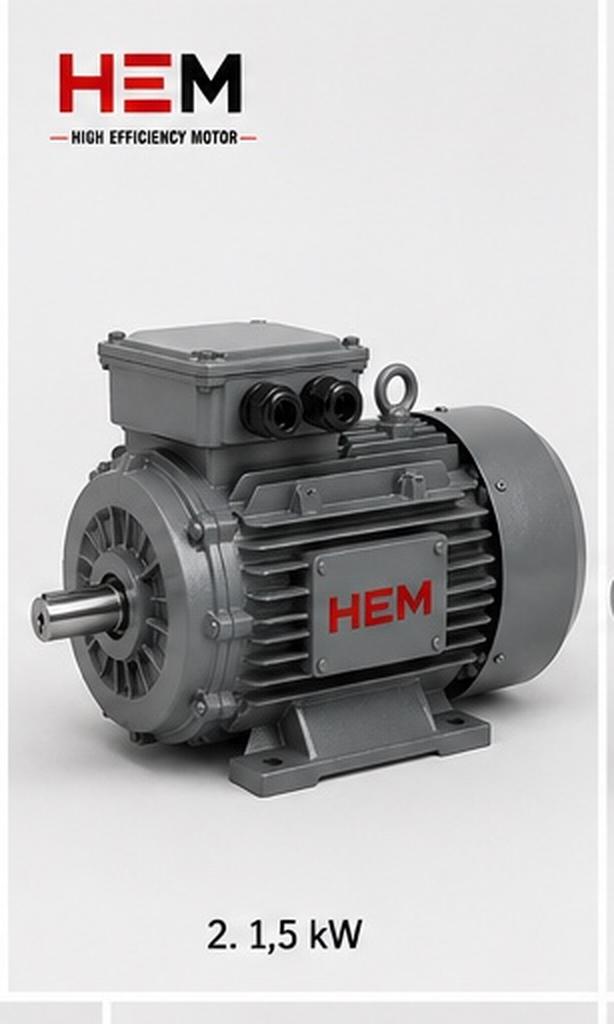

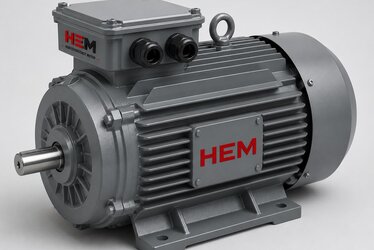
IE5 synchronous reluctance (SynRM) motors are modern motors that offer the highest efficiency class and operate together with a drive. However, these motors do not always run under uninterrupted S1 continuous duty; many applications require S3/S4 frequent start-stop duty. In cranes, elevators, conveyor feeding, packaging indexing, presses and cyclic processes, the motor continually stops, starts, brakes and re-accelerates. This cyclic duty directly affects motor heating, starting frequency and drive selection. In this article we explain what S3/S4 duty type on IE5 SynRM motors means, why starting frequency is limited, how heating is managed and how to supply the correct motor for these applications.
At HEM Motor we offer IE5 synchronous reluctance motors together with drive packages. In frequent start-stop applications the correct motor-drive combination guarantees both energy savings and long life; the wrong choice brings early failure and efficiency loss.
Duty Types: The Difference Between S1, S3 and S4
Motor duty types define the motor's run-stop profile and determine its heating behavior. The three most common types are:
- S1 (Continuous duty): The motor runs at constant load for a long time and reaches thermal equilibrium. This is the typical duty of continuous processes such as pumps, fans and compressors.
- S3 (Intermittent periodic duty): The motor repeats run and stop periods; each run time is not enough to reach thermal equilibrium. The heating effect of the starting current is considered negligible. It is defined by the cyclic duration factor (CDF %).
- S4 (Intermittent periodic duty with starting): Similar to S3, but here the heating effect of the starting current is decisive. In applications with frequent starts such as cranes, elevators and indexing, how many times per hour the motor starts becomes critical.
Our article on electric motor duty type (S1-S6) selection: continuous or intermittent operation, which addresses the role of duty type in the purchasing decision, gives the basic framework; in this article we go deeper into the IE5 SynRM specifics.
Starting Frequency: Why Is It Limited?
On each start the motor draws a starting current several times the rated current. This current produces a short but intense heat in the winding and rotor. In S4 duty the motor starts again and again before reaching thermal equilibrium, so this heat accumulates. If the permitted number of starts per hour is exceeded the motor overheats and the insulation life shortens.
- Moment of inertia (J): If the inertia of the driven load is large, the start takes longer and produces more heat. With high inertia loads the hourly start limit drops.
- Counter load: There is a serious difference between starting unloaded and starting under load; starting under load produces more heat.
- Braking: In frequent start-stop applications stopping also produces heat; especially if electrical braking is done through the drive, the thermal load increases.
The Role of the Drive in SynRM Motors
IE5 synchronous reluctance motors do not run connected directly to the grid; they always operate with a variable frequency drive (VFD). This is actually a major advantage for frequent start-stop applications: the drive provides smooth and repeatable acceleration by controlling the starting current and torque. Because there is no harsh current surge of direct starting, the motor undergoes less thermal stress. We cover in detail why SynRM motors do not run without a drive and the package cost in our article on why IE5 synchronous reluctance motors do not run without a drive, package selection and cost.
Heating Management: The Importance of Cooling in Frequent Start-Stop
Thanks to low rotor loss, SynRM motors heat up much less on the rotor side; this is an important advantage over asynchronous motors. However, in drive operation, especially at low speeds, the cooling capacity of the frame fan can drop. The following points stand out for heating management in frequent start-stop applications:
- Cooling at low speed: The frame mounted fan turns with motor speed; at low speed cooling weakens. If high torque at low speed over a wide speed range is required, external (forced) cooling is considered.
- Thermal protection: A thermistor (PTC) embedded in the winding or thermal protection detects overheating early on frequent starts and protects the motor.
- Correct sizing: In S4 duty the motor must be selected not only by rated power but by the number of starts per hour and the inertia. We detail the thermal behavior of IE5 motors and correct sizing in our article on thermal behavior and cooling in IE5 synchronous reluctance motors: correct sizing in drive operation.
Which Applications Require an S3/S4 IE5 Motor?
- Conveyor and indexing lines: Packaging and assembly lines that continually start and stop.
- Lifting and handling: Applications such as cranes, hoists and elevators that require frequent starting and braking.
- Presses and forming: Repeated starting on cyclically operating presses.
- Machines requiring a wide speed range: Process machines whose speed constantly changes and that stop and start.
In these applications the efficiency advantage of IE5 lowers the high total energy consumption caused by frequent start-stop. We address whether the efficiency difference between IE5 and IE4 justifies the investment in our article on IE5 or IE4? Does the efficiency difference justify the investment.
Correct Supply: What to Specify in the Order
kW alone is not enough when supplying the correct motor for S3/S4 duty. The following must be stated clearly in the order:
- Duty type and CDF %: Is it S3 or S4, and what is the cyclic duration factor?
- Number of starts per hour: How many times per hour the motor will start.
- Load inertia and counter torque: The parameters that determine starting difficulty.
- Speed range: The minimum-maximum speed for drive operation; torque demand at low speed.
- Cooling requirement: Whether external cooling is needed.
At HEM Motor we supply IE5 synchronous reluctance motors together with drive packages suited to your application's duty profile. For the correct motor-drive combination, current electric motor prices and delivery time you can contact us.
Advantages of the SynRM Motor over Asynchronous in Frequent Start-Stop
Traditional asynchronous motors also operate in frequent start-stop applications; however, the IE5 synchronous reluctance motor offers several concrete advantages in this demanding duty:
- Low rotor loss: In an asynchronous motor the current induced in the rotor produces heat; in the SynRM rotor this loss is almost absent. On frequent starts the total heat load stays lower.
- Drive controlled starting: An asynchronous motor connected directly to the grid experiences a harsh current surge on each start; because SynRM always runs with a drive, the starting current is limited and smooth.
- Repeatable positioning: In applications requiring indexing and positioning, the drive stops and starts the motor precisely and repeatably.
- Efficiency across a wide speed range: SynRM maintains high efficiency over a wide speed range; this suits variable speed start-stop applications.
If you are curious about the starting and starting torque behavior of asynchronous motors, our content addressing torque classes and starting methods clearly sets out the difference between the two technologies.
Braking and Energy Recovery
In frequent start-stop applications not only starting but also stopping matters. Especially in applications such as cranes and lifting, the load must be lowered in a controlled manner. In a drive controlled SynRM system, braking is managed in several ways:
- Dynamic braking: The braking energy is converted to heat over a resistor; this is a simple and common method.
- Regenerative braking: The energy released during braking is returned to the grid; it provides energy savings in applications that brake frequently.
- Thermal effect: The braking method affects the thermal load of the motor and the drive; in an application that brakes frequently this load is factored into sizing.
Because the braking strategy affects both energy cost and motor life, it should be evaluated together when defining the duty profile.
Maintenance and Long Life
Frequent start-stop also creates fatigue on mechanical parts. Each start and stop imposes a dynamic load on bearings, couplings and fasteners. For long life on an IE5 SynRM motor the following points are important:
- Bearing selection: Bearing load increases in applications with frequent starts; quality bearings and correct greasing extend life.
- Drive-motor compatibility: Setting the drive with parameters suited to the motor prevents unnecessary thermal and mechanical stress.
- Thermal monitoring: Monitoring the winding temperature catches overheating from frequent starts early.
Our content addressing the maintenance and fault management of SynRM motors shows in detail how to secure long life in drive operation. With correct maintenance these motors run reliably for years, even in the most demanding start-stop duties.
Frequent start-stop is one of the most demanding duties for a motor; but with the right duty type definition, correct sizing and drive control, an IE5 SynRM motor runs both efficiently and durably in these applications. Defining the duty profile clearly in the order is the most solid way to supply the correct motor the first time and to avoid surprises in the field.
Order Checklist for S3/S4 Duty
When selecting an IE5 synchronous reluctance motor for a frequent start-stop application, ordering by kW value alone creates disappointment in the field. To get the correct motor the first time you must clearly determine the following information and reflect it in the order:
- Duty type: Is your application S3 or S4? If the heating effect of the starting current is decisive, you are within S4.
- Cyclic duration factor (CDF %): Determine what percentage of a cycle the motor runs; this is the basis of the heating calculation.
- Number of starts per hour: How many times per hour the motor starts is the most critical parameter in S4 duty.
- Load inertia (J): The inertia of the driven mass determines the starting time and heat load; high inertia lowers the limits.
- Counter torque: Whether the motor starts under load or unloaded directly affects the heat load.
- Speed range: The minimum and maximum speed for drive operation; if high torque at low speed is needed, cooling must be planned.
- Braking requirement: Whether dynamic or regenerative braking will be used affects both the thermal load and the drive selection.
- Cooling: If high torque at low speed over a wide speed range is needed, external (forced) cooling should be evaluated.
Clarifying this information upfront allows the motor neither to overheat nor to be oversized unnecessarily. A well defined duty profile maximizes the efficiency advantage of the IE5 motor in a frequent start-stop application and secures long life.
Frequently Asked Questions
What is the difference between S3 and S4 duty?
S3 is intermittent periodic duty and the heating effect of the starting current is neglected. S4 is intermittent duty with starting; here the heating effect of the starting current is decisive. Applications with frequent starts such as cranes, elevators and indexing fall under S4, and the number of starts per hour becomes critical in selection.
Is an IE5 SynRM motor suitable for frequent start-stop?
Yes, in fact it is advantageous. Because it operates with a drive, the starting current and torque are controlled and smooth, eliminating the harsh current surge. Thanks to low rotor loss it heats less on the rotor side. Even so, in S4 duty correct sizing according to the number of starts per hour and the inertia is essential.
Why does frequent starting heat the motor?
On each start the motor draws several times the rated current and this current produces intense heat in a short time. In frequent start-stop the motor starts again before reaching thermal equilibrium, so heat accumulates. High inertia loads and starting under load increase this heat; therefore the hourly start limit must be respected.