English
 Türkçe

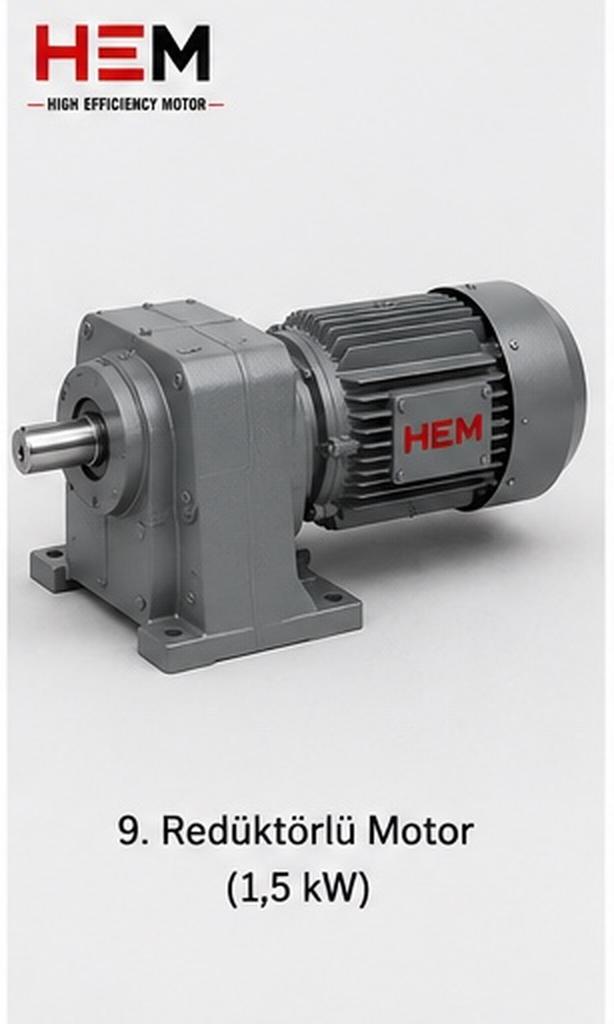

IE5, the Ultra Premium efficiency class, represents the highest point that energy efficiency can reach in electric motors. One of the most common and economical ways to achieve this class is synchronous reluctance technology, a magnet-free design. An IE5 synchronous reluctance motor contains no rare-earth magnets in its rotor; instead, it produces reluctance torque through specially shaped magnetic barriers. This architecture makes it mandatory for the motor to run permanently with a frequency drive (VFD). And it is precisely here that a subject often overlooked by induction-motor users becomes critical: every rotating machine has its own natural frequencies and speed zones that coincide with them.
When a motor's running speed overlaps with the system's natural oscillation frequency, resonance occurs. In this state, vibration amplitudes grow exponentially, bearing life shortens, noise increases, and in the worst case mechanical damage results. While this possibility is limited to a single point in a fixed-speed induction motor, the situation is different for a SynRM motor running across a wide speed range with a drive: throughout its operating life, the motor may pass through more than one critical speed zone. In a correctly configured system, the motor never runs continuously in these zones; it only passes quickly through them during acceleration.
In this article we examine, within a technical and practical framework, the concepts of critical speed and the resonance band in IE5 synchronous reluctance motor applications, the skip-band function defined through the drive, and the correct motor and mechanical selection for low vibration. Our aim is to ensure that your investment is long-lasting in terms of both efficiency and mechanical durability.
What Is Critical Speed and Why Does It Matter?
Every mechanical system has one or more natural frequencies at which it tends to oscillate spontaneously when not forced from outside. The rotating assembly made up of the motor rotor, shaft, coupling and driven load also has such natural frequencies. Critical speed is the speed at which the motor's rotational rate coincides with one of these natural frequencies. At this speed the system enters resonance; that is, even a small excitation produces large-amplitude oscillations.
In a classic fixed-speed motor, the engineer designs for a single operating point and places the critical speed far enough away from it. However, an IE5 synchronous reluctance motor fed by a frequency drive (VFD) can run across a wide speed band, for example from half load to full load. This flexibility is a great advantage, but it also creates the possibility that one or several critical speeds fall within the operating range. For this reason, in SynRM systems, critical-speed management is an inseparable part of installation quality.
Resonance Band and Amplitude Growth
The resonance band is the narrow speed range around the critical speed where vibration amplitude rises markedly. If system damping is low, this band is narrow and sharp; if damping is high, it is wider and softer. Running continuously inside the resonance band leads to early bearing fatigue, coupling wear, frame noise and loosening of foundation bolts. The goal is not to eliminate this band entirely, because physically a natural frequency always exists. The goal is to operate the motor outside this band and to pass through it as quickly as possible.
How Does the Skip-Band Function Work?
A modern frequency drive (VFD) offers a feature called skip-band. This function gives the drive the instruction "do not run continuously in this frequency range". When a skip band is defined and the user or process requests a speed reference corresponding to this forbidden zone, the drive shifts its output either below or above the band. Thus the motor is never locked into the resonance zone.
During acceleration or deceleration, the motor inevitably passes through the resonance zone. However, thanks to the skip band, the drive speeds up this transit; within the ramp time the motor quickly slips out of the band and gives no time for amplitudes to grow. The essence of the skip-band approach is this: pass through the resonance zone but do not dwell inside it.
Points to Watch When Defining a Skip Band
- The center frequency and width of the forbidden band should be determined by on-site vibration measurements, not by guesswork.
- The driven load's own critical speed (pump, fan, compressor) must also be taken into account and evaluated together with the motor's.
- If the system has more than one resonance point, several skip bands can be defined in the drive.
- Long-term operation right at the edge of the band should be avoided; a safe buffer distance must be left.
- During commissioning, the acceleration ramp should be set so that the motor passes through the band quickly enough.
Sources of Vibration: Not Just Speed
The goal of low vibration cannot be reached with the skip band alone. Resonance is only one dimension of the problem. When the other factors that determine vibration amplitude are ignored, even a correctly defined skip band is not enough. In practice, the main sources of vibration are:
- Rotor balancing: The rotor's balancing quality grade determines to what extent the centrifugal forces of the rotating mass are balanced. A high balancing grade limits amplitude even at critical speed.
- Coupling alignment: Shaft misalignment between motor and load (parallel and angular) produces forcing that repeats every revolution and triggers resonance.
- Bearing condition: Worn or insufficiently lubricated bearings both produce vibration and amplify existing vibration.
- Frame and foundation stiffness: A flexible foundation or weak frame can directly create the problem by pulling the natural frequency into the operating band.
- Magnetic forces: The reluctance-torque ripple in the SynRM rotor can contribute to vibration depending on the switching quality of the drive.
For a holistic treatment of these subjects, our article on noise and vibration in electric motors offers a complementary resource.
Correct Mechanical Installation: Rigid Foundation and Alignment
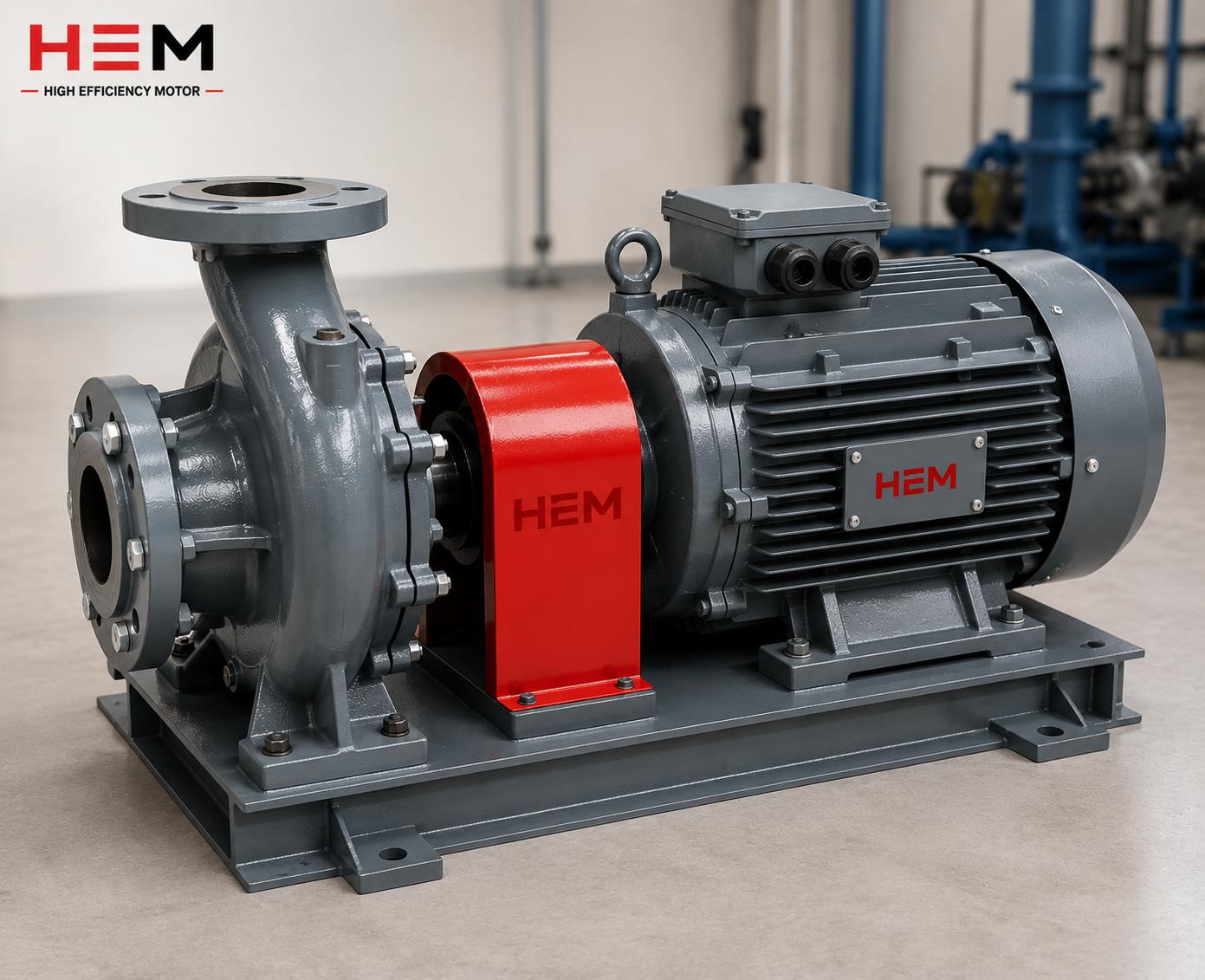
No matter how well an IE5 synchronous reluctance motor is manufactured, a poor mechanical installation can erase all its advantages. The greater part of the resonance problem stems not from the motor itself but from the mounting conditions. A rigid foundation is the most effective way to push the system's natural frequency outside the operating band. The concrete base must have the mass and stiffness to absorb the vibration energy produced by the motor.
Coupling alignment, meanwhile, is the most frequently neglected source of vibration. Precise adjustment with a laser alignment device reduces parallel and angular misalignment to the manufacturer's tolerance values. If alignment is poor, even a perfectly balanced motor is forced on every turn, and this forcing grows exponentially at speeds near the resonance band. Tightening the foundation bolts to the specified torque and checking for "soft foot" are also inseparable parts of this stage.
The Driven Load's Own Critical Speed
A common mistake in systems engineering is to focus only on the motor. Yet driven machines such as pumps, fans, blowers or compressors also have their own critical speed values. Vertical pumps with long shafts or large-diameter fan impellers can have natural frequencies completely different from the motor's. The real resonance map of the system is formed by the combination of the natural frequencies of the motor and the load.
For this reason, when defining skip-band settings, the vibration behavior of the entire drive train must be measured, not just the motor's. Especially in variable-flow pump and fan applications, it is common to encounter more than one resonance point while sweeping across a wide speed range with the drive. For drive-motor compatibility and commissioning steps, our article on IE5 motor drive and installation compatibility offers a practical checklist.
Drive Settings and Their Relation to Vibration
The frequency drive (VFD) in a SynRM motor determines not only speed but also the quality of torque. The switching frequency, current control band and correct matching of the drive to the motor parameters affect the smoothness of the torque produced. Smooth torque means less excitation, and therefore lower vibration. A poorly parameterized drive can produce electrically induced vibration even in a mechanically flawless system.
Therefore, performing the drive's auto-tune procedure correctly during commissioning is as important as the skip-band settings. For basic information on the general use of VFDs with induction motors, our article on VFD frequency drive with motor is a useful starting point.
HEM Motor IE5 SynRM Range and Correct Selection
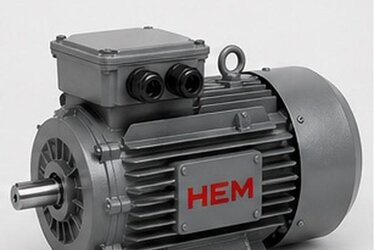
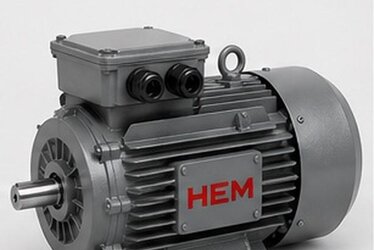
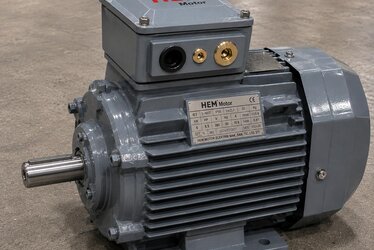
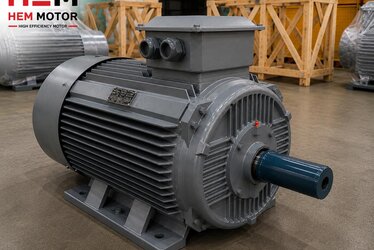
The foundation of a low-vibration, long-lasting IE5 installation begins with a solidly built motor. The HEM Motor IE5 synchronous reluctance range is produced with a design philosophy that considers mechanical durability and electrical efficiency together. The prominent features of our range are:
- Low loss and high thermal stability thanks to 100% copper winding,
- High stiffness and vibration damping due to the cast-iron frame,
- Low initial vibration with a factory precision-balanced rotor,
- Endurance in harsh environments with IP55 protection class and Class F insulation,
- Stable torque over a wide speed range, compatible with the drive.
Correct selection requires looking not only at the efficiency class, but at the application's speed profile, the character of the driven load and the mechanical installation conditions. HEM Motor supplies IE5 and IE4 motors and drive packages from stock with manufacturer assurance; together we determine the frame, speed and drive combination suited to your application. On drive-package selection and total cost, our article on IE5 synchronous reluctance motor drive package and cost makes your decision process easier. For current electric motor prices and technical support, you can contact us.
Frequently Asked Questions
Can I completely eliminate the resonance band in an IE5 synchronous reluctance motor?
No. Every rotating system physically has at least one natural frequency, and therefore a resonance zone; it is not possible to eliminate this. The correct approach is to push the resonance band outside the operating range when designing the system, and where it is unavoidable, to define a skip-band through the frequency drive (VFD) so the motor never runs continuously in that zone. A rigid foundation and correct alignment also help move the band away from the operating point.
How should I determine the skip-band frequency?
Skip-band values should be determined by on-site vibration measurements, not by guessing. While the motor is slowly accelerated from low speed to nominal speed, the vibration amplitude is monitored; the speed zone where amplitude peaks is the resonance point. The forbidden band is defined to leave a safe buffer around this point. If the driven load has its own critical speed, the relevant band must be defined separately as well.
What is the most critical mechanical factor for low vibration?
It is not a single factor but the combination of several that is decisive; however, in practice the most frequently neglected and highest-impact ones are a rigid foundation and correct coupling alignment. When a factory precision-balanced rotor, sound bearings and a rigid frame with 100% copper winding are added to these, the system can run with low vibration even at critical speed.