English
 Türkçe

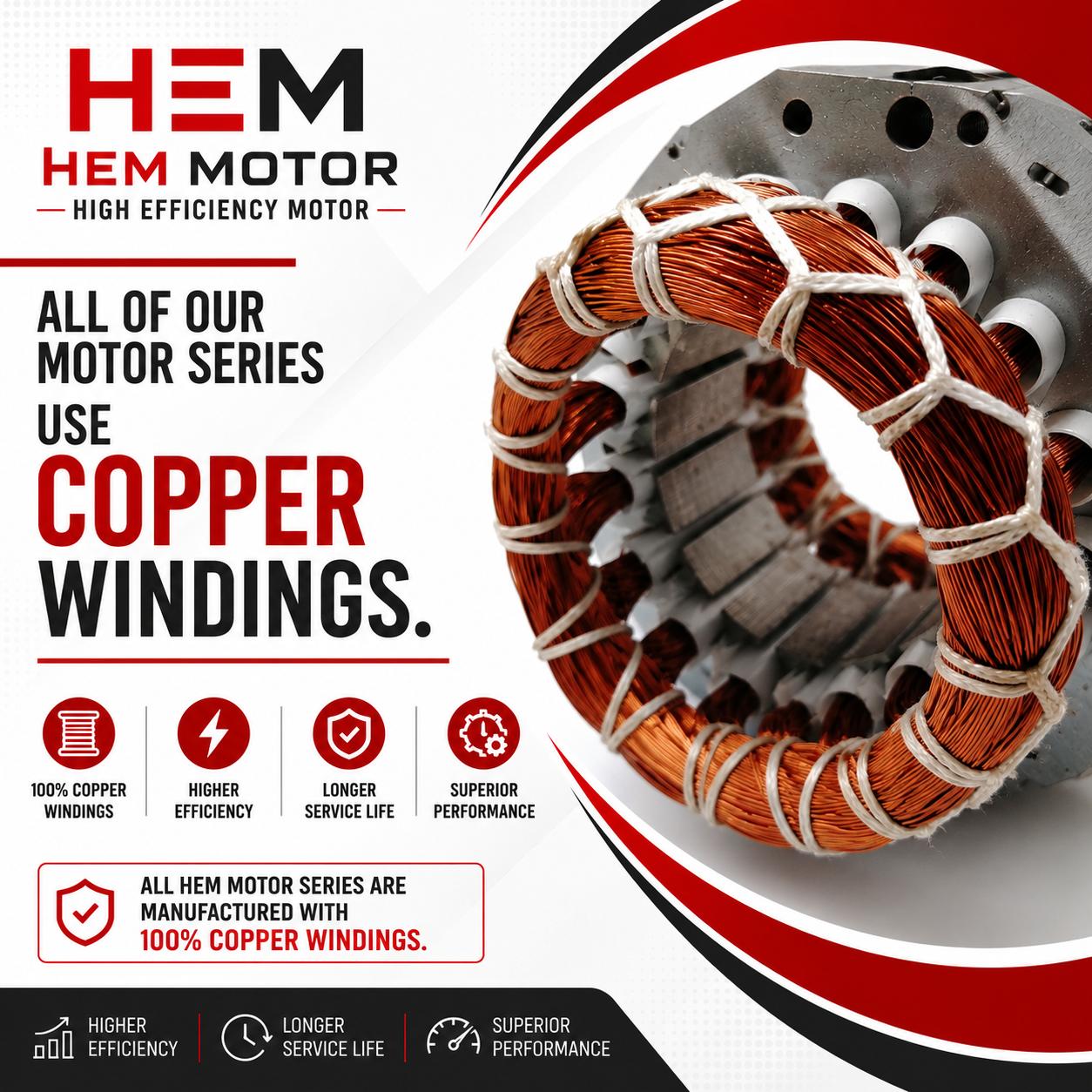

Demand for continuous, stable torque at low speed is one of the most challenging engineering problems in modern industrial drive systems. Extruder lines, mixers, crane hoisting mechanisms, winding machines and process equipment requiring precise positioning all expect the motor to deliver torque without any weakening across a very wide speed range. This is exactly where synchronous reluctance technology in the IE5 motor class offers a solution that surpasses the limits of classic induction motors. As HEM Motor, the IE5 SynRM motor and drive packages we offer with manufacturer assurance stand out in applications that require continuous torque at low speed, delivering both energy efficiency and process stability.
In this article, we will examine in technical depth why the synchronous reluctance motor can offer a wide 1:100 speed range, why its own fan becomes insufficient at low speed and how the need for an external forced cooling fan arises, as well as the decisive role of correct VFD/drive selection in system performance. Our goal is to ensure that the engineer making the purchasing decision sees every variable involved and is helped to source the correct motor-drive package from HEM Motor stock.
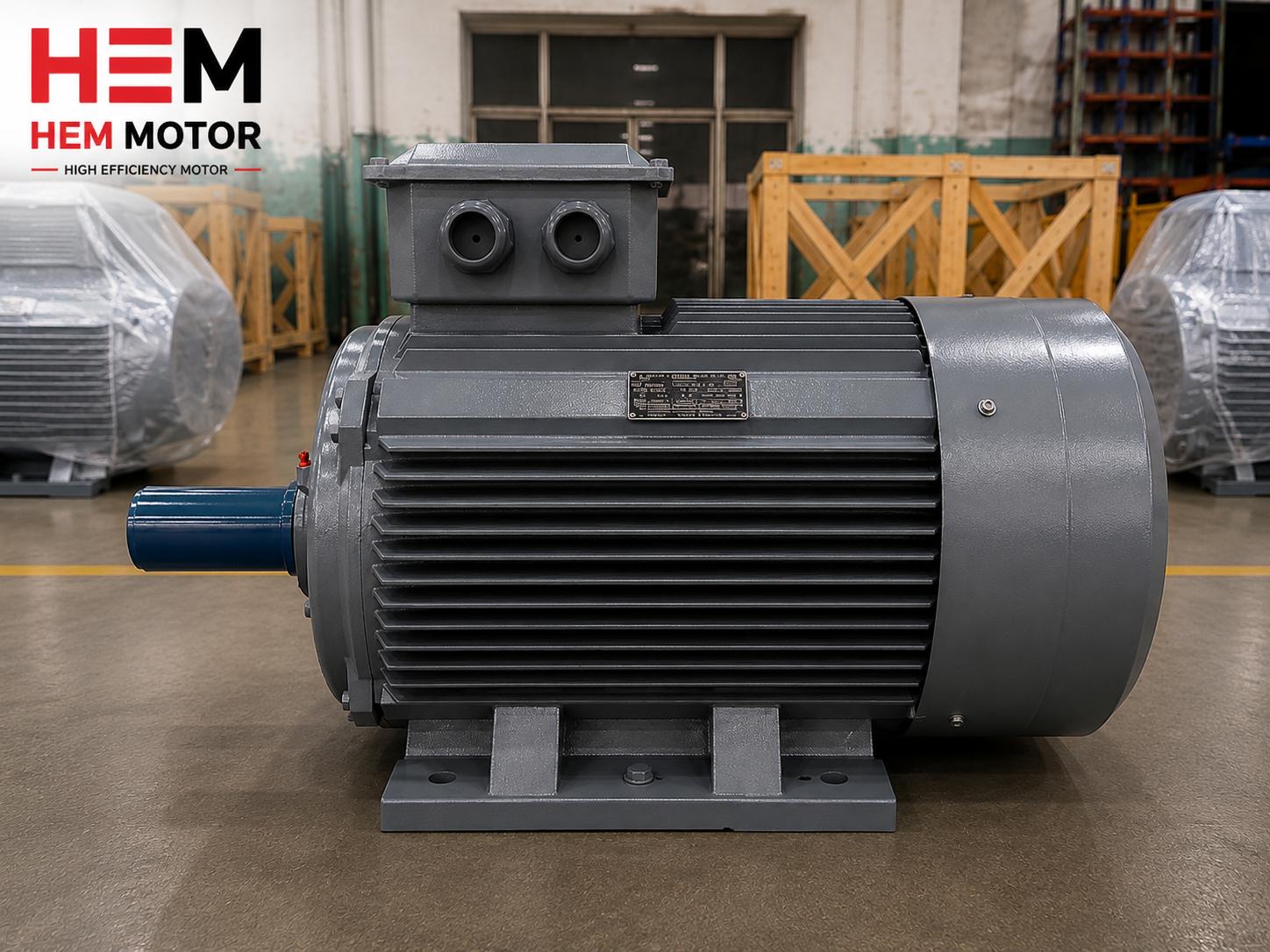
What Is a Synchronous Reluctance Motor and Why Does It Stand Out in the IE5 Efficiency Class?
A synchronous reluctance motor produces torque purely from the magnetic reluctance difference in the rotor iron geometry (the reluctance difference between the d and q axes), without any magnets or windings on the rotor. Because there are no copper losses on the rotor, losses originating from the rotor are largely eliminated compared with an induction motor. This makes it possible for the motor to reach the IE5 motor ultra-premium efficiency class. IE5 is the highest level of the current IEC efficiency tiers and reduces losses by roughly 20 percent compared with IE4.
The magnet-free rotor structure is the strongest strategic advantage of the synchronous reluctance motor. Since no rare-earth permanent magnets are used, supply chain risk, price volatility and demagnetization (loss of magnet strength) problems disappear. The irreversible magnet loss that permanent magnet motors experience at high temperatures simply does not occur in a SynRM motor. This allows the motor to behave far more tolerantly thermally and offers long life under demanding industrial conditions.
Fundamental Differences From the Induction Motor
An induction motor requires current induced in the rotor to produce torque; this current generates heat in the rotor bars and creates slip. The synchronous reluctance motor, however, rotates at synchronous speed with no slip, and no loss arises from current induction in the rotor. The practical consequences are:
- Lower rotor temperature and therefore longer bearing and insulation life.
- Higher torque density in the same frame size and a more compact solution.
- Precise speed and position control thanks to slip-free operation, a clear advantage especially at low speeds.
- A high and wide efficiency plateau due to minimal rotor-related losses.
Continuous Torque at Low Speed: The Meaning of the 1:100 Speed Range
The ability of a motor to maintain its rated torque well below rated speed, in what we call the constant-torque region, is critical for many processes. The expression 1:100 speed range means the motor can continuously produce its full torque even at speeds as low as one percent of its rated speed. For example, a motor rated at 1500 rpm can deliver continuous torque even at a very low speed such as 15 rpm. This wide range can reduce, or completely eliminate, the need for a separate gear reduction stage.
Producing continuous torque at low speed is directly related to the motor's thermal design as much as its magnetic design. Torque is proportional to stator current; therefore producing full torque at low speed means drawing full current at low speed. Current generates heat. The problem is this: when the motor turns slowly or stops, its own shaft-mounted cooling fan (self-fan) cannot provide adequate air flow, because the fan's flow rate falls in proportion to speed. If speed halves, air flow roughly halves; at very low speeds there is almost no cooling at all.
Constant-Torque Region and Constant-Power Region
The motor's characteristic is divided into two main regions. The region up to rated speed is the constant-torque region; here the motor maintains constant torque and power increases in direct proportion to speed. Above rated speed, field weakening engages and the motor operates in the constant-power region, where torque falls in inverse proportion to speed. Our focus in this article is the low-speed constant-torque region where the 1:100 ratio occurs, because the real thermal challenge appears here.
Why Does Its Own Fan Become Insufficient? The Necessity of External Forced Cooling
A standard motor has a radial fan attached to the shaft at its rear cover. As the motor turns, this fan blows air over the fins on the housing and rejects heat to the atmosphere. The design assumes the motor operates near rated speed. However, in low-speed applications requiring continuous full torque this assumption collapses. This is precisely why the external forced cooling fan (forced cooling, separate cooling fan) comes into play.
The external forced cooling fan is an accessory driven by a separate small electric motor, independent of the main motor's shaft speed. It is usually mounted on the rear cover of the motor and runs at a constant air flow rate. Thus, even if the main motor stops at zero speed or turns very slowly, cooling air continues to flow without interruption. This allows the motor to continuously produce its full torque at low speed without exceeding its thermal limits.
- The external fan provides air at a constant flow rate independent of the main motor's speed.
- Continuous cooling is maintained even at low speed or at standstill.
- The motor's continuous torque curve extends toward low speeds; the need for derating is reduced.
- Winding temperature is kept under control, increasing insulation life and reliability.
- It usually requires a separate supply line and a small protection circuit; rotation direction is checked during commissioning.
If you want to examine in more detail how external forced cooling is sized and integrated with the VFD in projects requiring continuous torque at low speed, our content on external forced cooling fans and low-speed VFD integration in IE4 motors is a complementary resource.
It Will Not Run Without a Drive: SynRM Dedicated Drive and Correct VFD Selection
Perhaps the most critical feature of the synchronous reluctance motor is this: it will not run without a VFD/drive. While induction motors can be connected directly to the grid and start on their own, the SynRM rotor has neither a cage nor magnets needed for starting. Therefore the motor must always be driven by a frequency inverter that supports the synchronous reluctance algorithm. The drive estimates rotor position with or without a sensor (encoderless) and manages stator current vectorially according to the d-q axes.
Correct drive selection directly determines whether the motor can reach its catalog values. A randomly chosen inverter performing only scalar (V/f) control will either fail to run the synchronous reluctance motor at all or run it with very poor performance. The correct drive for SynRM must be a device performing field-oriented (FOC) control, matched by the manufacturer with the SynRM motor parameter set. This is the fundamental reason why, as HEM Motor, we offer the motor and drive together as a package with pre-matched parameters.
Technical Criteria to Consider in Drive Selection
- The drive must support the SynRM/reluctance motor control algorithm; devices supporting only induction motors are insufficient.
- For full torque at low speed, the low-speed behavior of sensorless vector control or an encoder feedback option should be evaluated.
- The drive's continuous current capacity must meet the motor's continuous current at low speed.
- The overload capacity must safely meet starting and transient torque demands.
- In systems using an external cooling fan, the drive's motor thermal model and derating settings must be entered correctly.
If you are curious about how drive parameters are set in the field and the commissioning steps, our guide on IE5 synchronous reluctance motor drive parametering and commissioning guides you step by step. To learn how field weakening works in the constant-power region above rated speed, you can review our article on field weakening and the constant-power region in IE5 synchronous reluctance motors.
Thermal Behavior and Interpreting the Continuous Torque Curve
A SynRM motor data sheet usually contains two separate continuous torque curves: one with the motor's own fan (self-cooled) and the other with an external forced cooling fan (forced-cooled). The self-cooled curve bends down rapidly toward low speeds, because air flow falls and the motor allows less torque to avoid overheating. The forced-cooled curve, however, stays almost horizontal toward low speeds, making continuous full torque possible across the wide 1:100 speed range.
Reading these curves correctly is the basis of the purchasing decision. You need to determine the lowest operating speed of your application and the torque demand at that speed, then mark the point on the relevant curve. If the operating point lies above the self-cooled curve, an external forced cooling fan is mandatory. Otherwise the motor will trip on thermal protection, its life will shorten, or it will fail to produce the required torque. The HEM Motor technical team determines the correct curve and required cooling configuration together with you, based on your application data.
Winding Insulation Class and Temperature Monitoring
To increase thermal safety, PTC thermistors or PT100 sensors are placed inside the winding. These sensors are connected to the drive or a separate thermal relay, providing real-time temperature monitoring. In continuous-torque-at-low-speed applications, this monitoring is critical to verify the effectiveness of external cooling and to protect the motor in case of an unexpected fan failure. Evaluated together with the insulation class (for example F or H), the motor's safe continuous operating window becomes clear.
Selecting the Correct IE5 SynRM Motor and Drive Package
When selecting the correct package, three main parameters must be handled together: rated power and torque, the lowest speed at which it will operate and the continuous torque demand at that speed, and the cooling strategy. These three variables determine the motor frame size, the drive's current capacity, and whether an external cooling fan is required. Deciding based on the motor rated power alone can be misleading in low-speed applications, because the real determinant is the thermal limit at low speed.
As HEM Motor, we match the motor and drive to each other appropriately and, when necessary, offer a complete package that also includes the external forced cooling fan. This way the field team does not struggle with incompatibility between different brands, parameters are prepared in advance, and commissioning time is significantly shortened. Sourcing from stock with manufacturer assurance, spare part continuity and technical support reduce the total cost of ownership of your project. You can review our product range for current electric motor prices and package options.
For those who want to evaluate the combined cost of the motor and drive and the return of the total package, our content on IE5 synchronous reluctance motor drive package cost offers a useful comparison. To see the whole efficient motor family you can visit our efficient electric motors product family, and for more technical content the IE5 electric motors blog category.
Application Examples and Sectoral Use
The need for a wide speed range and continuous torque at low speed appears in many sectors. On plastic and rubber extrusion lines, the screw must turn slowly and powerfully; high torque at low speed is required at start. On winding and unwinding machines, the linear speed is kept constant as the material diameter changes, which means a very wide speed range. In crane and hoisting systems, full torque is needed near zero speed during lifting. In agitator and mixer applications, viscous materials require high torque at low speed.
The common denominator of these applications is that the motor operates at full load for long periods at low speed and therefore needs external forced cooling. The magnet-free, slip-free structure of the synchronous reluctance motor provides both energy efficiency and reliability under these demanding conditions. Matched with the correct drive, the system offers both precise control and low operating cost. Contacting our technical team for a solution specific to your application is the fastest way to determine the most accurate motor-drive-cooling combination.
Frequently Asked Questions
Can a synchronous reluctance motor run without a drive?
No. Because the synchronous reluctance motor rotor has neither a cage nor magnets for starting, it cannot run directly from the grid. It must always be driven by a VFD/drive that supports the SynRM control algorithm. For this reason, sourcing the motor and drive together as a package with pre-matched parameters is the safest approach.
Is an external fan always needed for continuous torque at low speed?
If your operating point stays below the motor's self-cooled continuous torque curve, an external fan may not be mandatory. However, if the motor will produce full torque at very low speed for long periods, its own fan flow becomes insufficient and an external forced cooling fan is required. In that case, the forced-cooled curve on the data sheet makes full torque possible across the wide 1:100 speed range.
Why does an IE5 SynRM motor contain no magnets, and is this an advantage?
The synchronous reluctance motor produces torque from the reluctance difference in the rotor geometry, so permanent magnets are not required. The magnet-free rotor structure eliminates rare-earth supply risk and demagnetization problems at high temperature. In the IE5 motor class, this means both high efficiency and thermal durability with long life.