English
 Türkçe



Most of a plant's energy bill goes to electric motors; yet most operations do not know whether this consumption is "good or bad" because they have no reference to compare against. This is where the concepts of sector benchmarking and specific energy come in. Specific energy is the energy you spend per unit of product you make; sector benchmarking is comparing this value against the average of similar plants. These two tools show, with concrete numbers, which motor is truly inefficient, where investment will pay back, and whether switching to an efficient motor is worth it. In this article we examine how specific energy is calculated, how sector benchmarking is done, and how this analysis turns into the right motor investment.

What Is Specific Energy and Why Does It Matter?
Specific energy is the amount of energy consumed per unit of product made; for example, the electricity spent per tonne of product. Total energy consumption alone is misleading because it naturally rises as production grows. Specific energy, however, is an efficiency indicator independent of production volume: it shows how much energy you spend for each unit you make. This lets you fairly compare two different periods, two different lines, or two different plants.
The power of specific energy is that it reveals hidden inefficiency. Even if the total bill has not risen, if specific energy rises while production falls, it means the motors are running inefficiently at idle or partial load. This metric shows which line is weak in energy terms and sets improvement priorities. Our article on the energy efficiency audit and motor inventory clarifies data collection, the first step of specific energy analysis, by building a plant-wide motor inventory and identifying efficiency class.
Components of the Specific Energy Calculation
- Energy consumed: The total electricity drawn by the motors in a period.
- Quantity produced: The product made in the same period (tonnes, units, metres, etc.).
- Specific energy = energy / production: Energy per unit of product; the true measure of efficiency.
- Time series: Tracking the value across periods reveals the trend and deviation.
How Is Sector Benchmarking Done?
Calculating specific energy alone is not enough; to understand whether this value is good or bad you need a reference. Sector benchmarking is comparing your own specific energy against the typical values of plants with similar production. There are two kinds of comparison: external benchmarking (against the sector average) and internal benchmarking (against your own lines or past periods). Internal benchmarking is usually more reliable because the same product and the same conditions are compared.
The aim of benchmarking is not to blame but to see the opportunity. If one line's specific energy is clearly higher than similar lines, there are either old low-efficiency motors, wrong sizing, or poor load management. This is a compass showing where to direct investment. Our article on replacing an old motor with IE4 and payback makes the investment decision concrete for motors highlighted in benchmarking.
Benchmarking Steps
- Collect data: Measure each line's energy consumption and production quantity.
- Calculate specific energy: Find the energy per unit of product for each line.
- Compare: Compare lines with each other, with past periods and with sector typical values.
- Investigate deviation: Examine motor efficiency class and load profile on the high line.
- Prioritise: Direct investment to the line with the highest savings potential.
Turning Benchmarking Results into Motor Investment
Benchmarking analysis shows with a number which motor to replace; but to make the right decision you must look at total cost of ownership. The real cost of a motor is not the purchase price; it is purchase + lifetime energy + maintenance combined. In most industrial motors, energy makes up the overwhelming majority of the lifetime cost; so a slightly more expensive but efficient motor is often cheaper overall. Our article comparing efficiency classes by total cost, the IE5, IE4 and IE3 total cost of ownership comparison, shows which efficiency class is actually cheaper.
When replacing inefficient motors highlighted in benchmarking, correct power and speed selection is critical. An oversized motor means permanent partial-load loss, while an undersized one means overload and early failure. The right choice is made according to the real load profile; this is exactly where the data obtained from specific energy analysis becomes fully useful.

What to Look at in the Investment Decision
- Total cost of ownership: Purchase + energy + maintenance; not just the label price.
- Real load profile: Whether the motor runs at full load or continuously at partial load.
- Efficiency class transition: The savings from moving from IE3 to IE4 or IE5.
- Correct sizing: Power to real demand; neither too large nor too small.
Correct Motor Selection and Supply
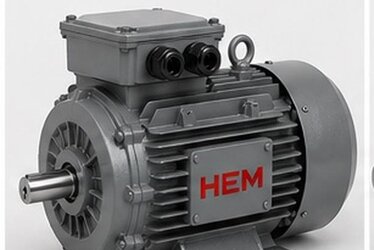
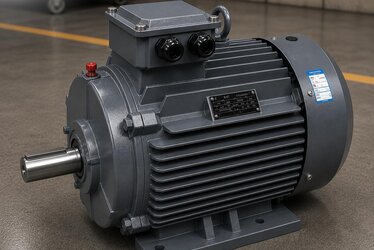
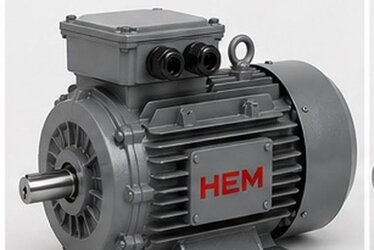
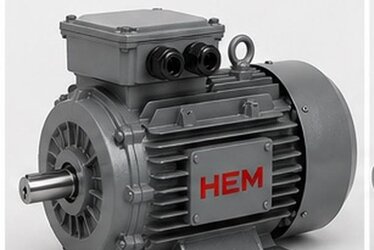
Sector benchmarking and specific energy analysis clarify which motors to replace and which efficiency class to move to; what remains is supplying the right motor with the right specifications. The HEM Motor range offers IE3, IE4 and IE5 class motors in a wide power range from 0.25 kW to 355 kW, with cast iron bodies and IP55 protection. For the lines highlighted by benchmarking, selecting motors of the right power, speed and efficiency class is the most direct way to bring your specific energy below the sector average. To request a quote with current electric motor prices and stock status, providing your line-based analysis results speeds up the right investment.
Our article on IE3 vs IE4 electric motor investment addresses the investment logic of switching to an efficient motor in terms of payback and helps you turn benchmarking data into a concrete payback plan. There is no improvement without measurement; specific energy and benchmarking move motor investment from guesswork to data.
Information to State in the Quote
- Current motor efficiency class: The present class and nameplate of the motor to be replaced.
- Target efficiency class: The target class for an IE4 or IE5 transition.
- Real load profile: The distribution of full-load, partial-load and idle time.
- Power and speed: Real demand power and speed for correct sizing.
Which Motors Make Up Most of the Consumption?
A plant may have hundreds of motors, but the bulk of energy consumption is usually formed by a small number of large, continuously running motors. This rule is the basis of prioritisation in benchmarking analysis: instead of improving small, intermittently running motors one by one, focusing on the large motors that draw the most energy gives the fastest result. To identify these motors it is enough to multiply each motor's power by its annual running hours; the motors with the highest product are also the motors with the highest savings potential.
This approach makes the most efficient use of a limited investment budget. Replacing all motors at once is not possible for most operations; whereas replacing a few large motors that make up most of the consumption with high-efficiency equivalents brings the bulk of the total saving. Benchmarking analysis reveals exactly these few motors and directs the investment there.
Once prioritisation is done, the right power and efficiency class are determined for the selected motors. The point to watch here is that the new motor is also sized to the real load profile; if the old motor was oversized, buying the new one at exactly the same power perpetuates the inefficiency. Correct analysis determines both the efficiency class and the right power together.
Common Interpretation Mistakes in Benchmarking
Specific energy and benchmarking are powerful tools; but interpreted wrongly they lead to the wrong investment. The most common mistake is comparing two plants or two lines when their conditions differ. A different product mix, different raw material, different ambient temperature or different capacity utilisation changes specific energy for reasons unrelated to the motor. So saying "my specific energy is higher than the neighbouring plant" is not a conclusion on its own; first you must question whether the comparison is fair.
The second common mistake is making a hasty decision by looking at short-term fluctuations. In a month run at low capacity, specific energy naturally rises because fixed losses are divided by less production. This does not mean the motors are inefficient. Correct benchmarking rests on a sufficiently long time series and stable production periods. Avoiding these mistakes ensures benchmarking data is truly directed to the right motor.
Rules for Sound Benchmarking
- Fair comparison: Same product, same conditions, same capacity utilisation.
- Sufficient time series: Not a single month but the average of stable production periods.
- Fixed loss effect: Account for the natural rise of specific energy at low capacity.
- Internal benchmarking priority: Comparison among your own lines is more precise than the external average.
The Continuous Improvement Cycle
Benchmarking is not a one-off analysis but a continuous cycle. After an inefficient motor is replaced on a line, specific energy is measured again; the improvement is verified and you move to the next highest-consuming line. This cycle brings the plant's energy performance below the sector average step by step. Instead of settling for a single motor change, making benchmarking a regular management tool delivers permanent and measurable savings.
The power of this cycle is that it moves decisions from guesswork to data. Which motor to replace, which efficiency class to move to and when the investment will pay back are now clear in numbers. When correct measurement, correct comparison and correct motor selection come together, energy efficiency becomes not a one-time project but a permanent competitive advantage for the operation.
Frequently Asked Questions
What is the difference between specific energy and total consumption?
Total consumption is all electricity drawn in a period and naturally rises as production grows; so it alone does not indicate efficiency. Specific energy is energy per unit of product and is independent of production volume. If specific energy rises while production falls, the motors are running inefficiently; this is the real metric that reveals hidden inefficiency.
Where do I find sector average data?
The most reliable comparison is usually internal benchmarking: comparing your own lines with each other and with past periods. The difference between your own lines making the same product gives a more precise result than the external sector average because conditions are identical. For external benchmarking, sector associations and energy efficiency studies can serve as references.
Should I immediately replace the motor on a line with a high benchmarking result?
First investigate the cause. High specific energy is not always due to the motor; it can also be wrong sizing, poor load management or a process issue. If there is an old low-efficiency motor, replacement often pays back quickly on a total cost of ownership basis. The decision should be made according to the real load profile and payback period.