English
 Türkçe

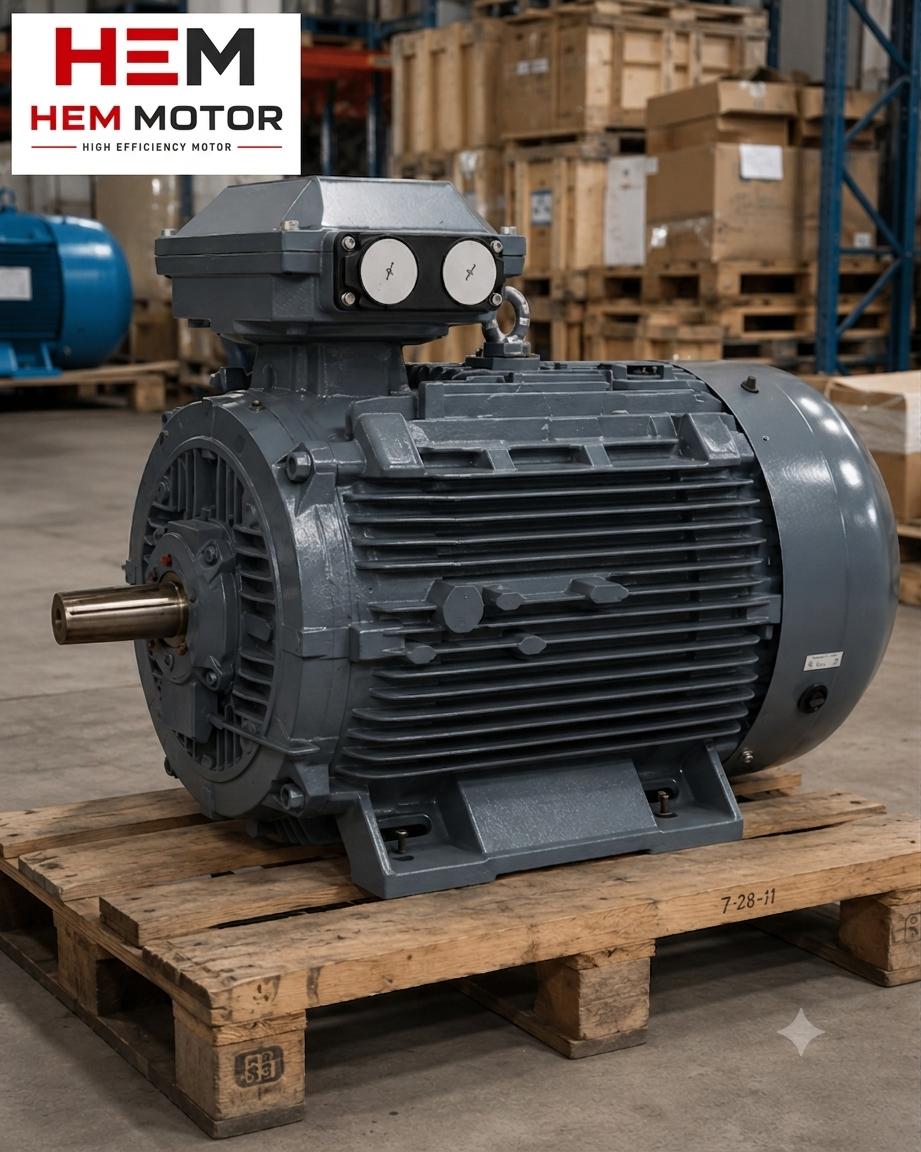

A motor body stamped IP55 or IP66 does not mean that every point on that motor enjoys the same protection. The component most often overlooked in the field — yet responsible for a significant share of failures — is usually the terminal box cover gasket. The place where dust and moisture seep into a motor is generally not the windings, but a terminal box whose cover does not seat fully or whose gasket has been crushed. In this article we examine, in technical detail, why the terminal box cover gasket determines a protection level independent of the body IP class on cast iron motors, the choice between NBR and silicone gaskets, why an IP65/IP66 upgrade cannot be done with a single gasket, and the key points of ordering correctly for dusty and damp environments.
How Does the Terminal Box Cover Gasket Determine Protection?
A motor's IP (Ingress Protection) class expresses protection against solid-object and water ingress with a two-digit code; the first digit indicates protection against dust, the second against water. But this class is only as valid as the motor's weakest link as a whole. However robust the body casting may be, if the terminal box cover leaks, the dust and water in the surroundings reach straight into the volume that holds the electrical connections — that is, the terminals. For this reason the cover gasket is the critical component that determines the box's actual protection level independently of the body IP class.
The terminal box is the motor's most sensitive electrical junction. Phase ends, grounding and link bridges all come together here. Moisture entering this volume causes leakage current between terminals, corrosion and, over time, insulation breakdown. Dust, when combined with moisture, forms a conductive film and increases the short-circuit risk. The job of the cover gasket is therefore not merely to "keep the cover sealed" but to directly protect the motor's electrical safety and service life.
What Does a Crushed or Wrong Gasket Do?
The gasket seals by being compressed between the cover and the box body; but this compression must be controlled. An over-tightened bolt crushes the gasket, the gasket permanently loses its shape and can never again provide its original seal. A gasket of the wrong cross-section or wrong material prevents the cover from seating fully, or fails to withstand the ambient conditions and hardens and cracks within a short time. In both cases the result is the same: dust and water are carried straight to the terminals. That is why, every time the cover is opened during maintenance, the gasket's condition should be checked, and a crushed or hardened gasket must always be renewed.
- Crushed gasket: Permanently deformed by over-tightening; the seal is lost.
- Wrong material: A gasket unsuited to the environment hardens and cracks early under heat or chemical attack.
- Wrong size: A gasket that does not seat fully in the cover groove leaves a gap from the start.
- Reused gasket: Once crushed, a refitted gasket cannot restore its original seal.
NBR or Silicone? Choosing the Gasket Type
The two materials most often encountered in terminal box cover gaskets are NBR (nitrile rubber) and silicone. Although both are elastomers, each excels in a different environment; the correct choice is made according to the environment in which the motor will run. When the wrong material is chosen, the gasket either degrades very quickly or never provides the expected seal at all.
NBR gaskets offer high resistance to oil and many hydrocarbons. For this reason they are preferred in oily environments and in general-industry applications where machine oil and grease splash occurs. Their mechanical strength is good and they offer an economical solution across a broad range of applications. However, NBR's temperature resistance is limited; when continuously exposed to high temperature it hardens and loses its flexibility.
Silicone gaskets, on the other hand, retain their flexibility across a wide temperature range. Because they remain stable at both high and low temperatures, they stand out in hot environments and in maintenance-heavy applications where the cover is opened and closed frequently. Silicone retains its elastic recovery for a long time even when compressed repeatedly, which keeps the seal intact on motors whose covers are opened and closed often. In return, silicone's resistance to oil and some chemicals is not as high as NBR's, so it must be selected carefully in oily environments.
Which Gasket for Which Environment?
- Oily and general industry: NBR gaskets suit environments with machine oil, grease and hydrocarbon splash.
- High temperature: Silicone gaskets are preferred near hot processes or at high ambient temperature.
- Frequent cover opening: In applications with intensive periodic maintenance where the cover is removed often, silicone's elastic recovery is an advantage.
- Low temperature and outdoors: A material that keeps its flexibility in the cold should be chosen, taking care that the gasket does not become brittle.
It is worth remembering that on cast iron motors a high ambient temperature affects not only the gasket but also the motor's power-delivery capacity. For temperature-related derating and selection details, our article on high ambient temperature and derating on cast iron motors is a good guide.
An IP65/IP66 Upgrade Cannot Be Done with a Single Gasket
A common field misconception is the "let's improve the cover gasket so the motor becomes IP66" approach. In reality the IP class is the joint result of the terminal box's entire sealing chain. The cover gasket is only one link in that chain; upgraded alone, the box cannot reach the targeted protection class as long as the other links remain weak. If a high protection such as IP65/IP66 is wanted, then together with the gasket the cable entry glands, body sealing and condensation drainage must all match.
The most neglected point is the cable entry glands. The power and control cables entering the terminal box must pass through in a sealed manner with glands of the correct IP class and correct size. Unused gland holes must always be closed with suitable blanking plugs; a single hole left open renders even the best cover gasket meaningless. In addition, the sealing of the surface where the box body mates to the motor, and the drainage of any condensing water without it pooling, are also part of the whole.
The Links of the Sealing Chain
- Cover gasket: Of the correct material and size, uncrushed and intact.
- Cable glands: Of the target IP class, matched to the cable diameter, at the correct tightening torque.
- Blanking plugs: All unused gland holes closed with sealed plugs.
- Body sealing: The surface where the box seats on the motor and the transitions are sealed.
- Condensation drainage: Water from condensation is expelled without pooling; a drain plug where required.
If any of these links is weak, the box's actual protection is only as good as the weakest link. In environments with heavy dust and moisture the motor's body protection class must also be adequate; on this our article on upgrading IP65/IP66 protection on IE3 motors offers a holistic view.
Why You Should Not Underestimate the Condensation Problem
In dusty and damp environments the most insidious problem is not water entering from outside, but the condensation that forms inside the box. The motor heats up while running and cools when it stops; this heating-cooling cycle causes the moisture in the air inside the terminal box to condense as water droplets on the inner surfaces. However well sealed the box may be, this moisture building up inside can over time cause corrosion and leakage current at the terminals. For this reason, in high-humidity environments not only external sealing but also drainage of the water condensing inside must be considered.
The solution is a condensation drain plug or breather element placed at the lowest point of the box. This element ensures that the accumulated water is expelled in a controlled way; it also equalises pressure difference, reducing the load on the gasket. However, the drainage element too must match the box's target IP class; a drain hole opened haphazardly destroys the seal from the start. Condensation drainage must therefore be planned from the outset as an inseparable part of the sealing chain.
- Heating-cooling cycle: The motor running and stopping creates condensation inside the box.
- Internal corrosion risk: Condensed water can cause corrosion and leakage current at the terminals.
- Drain plug: Placed at the lowest point of the box; expels water in a controlled way.
- IP compatibility: The drainage element too must suit the target protection class.
How to Order Correctly for Dusty and Damp Environments
Getting the right product starts with giving the right information upfront. When ordering a motor or terminal box for a dusty, damp or oily environment, specifying the target IP class and the characteristics of the operating environment from the very start is the most critical step. When the IP class is later "patched up" as an upgrade, costs rise and the result often fails to deliver the desired reliability. By contrast, an order defined correctly from the start brings a holistic solution with the right gasket type, the right gland and a suitable body.
When ordering, you should clearly share whether the environment is oily, hot, dusty or outdoors; how often the cover will be opened; and the target IP class. This information ensures the entire chain — from gasket material to gland selection — is configured correctly. An order defined correctly from the start prevents many problems in the field. For example, if a dusty cement or mining environment is involved, an IP class whose first digit indicates the highest dust protection (6) is required; in food or chemical plants exposed to wash-down water, the second digit is expected to withstand water jets. An order placed without making this distinction upfront leads to the motor needing extra modification after it arrives on site and to commissioning being delayed. Correct definition prevents both time and cost loss. Moreover, seemingly small details such as the temperature range the gasket will operate in and the annual frequency of cover opening directly influence material selection and determine long-term reliability.
Pre-Order Checklist
- Specify the target IP class (for example IP55, IP65, IP66) from the start.
- Define the environment: oily, hot, dusty, damp or outdoors.
- State how often the cover will be opened in maintenance; if frequently, silicone is considered.
- Share the number of cables and their diameters; the gland and blanking plug needs are set accordingly.
- If condensation is expected, note the drainage requirement.
Gasket Maintenance and the Importance of Periodic Inspection
The right gasket with the right order is only half the job; the other half is regular maintenance. Inspecting the gasket by eye and by hand every time the terminal box cover is opened is the simplest way to prevent failures in the field. If the gasket is hardened, cracked, crushed or has slipped out of its groove, it must be replaced with a new one before the cover is closed again. A once-compressed gasket cannot restore its original seal when refitted; reusing the old gasket after maintenance is therefore a common but risky shortcut.
It is also important to tighten the bolts to the correct and balanced torque when closing the cover. Tightening in a cross pattern, gradually, ensures the gasket seats evenly; over-tightening a single bolt crushes the gasket at one point and leaves a gap at another. Periodic maintenance should also check the tightness of cable glands, whether blanking plugs are in place, and whether there is any trace of moisture inside the box. These simple checks are the most economical protection method that lets the motor run trouble-free for many years in a harsh environment.
- Visual check: At every cover opening the gasket is checked for hardening, cracking and crushing.
- Gasket renewal: A degraded or once-crushed gasket is not reused.
- Balanced tightening: Bolts are tightened in a cross pattern at gradual torque.
- Chain check: Glands, blanking plugs and moisture traces are reviewed regularly.
The Advantage of the Cast Iron Body and Correct Supply
Cast iron motors are preferred in heavy industry and harsh environments because of their high mechanical strength and vibration damping. But the robustness of the body alone is not enough when the terminal box sealing is weak. For this reason, when selecting a motor, the terminal box's protection solution should be evaluated as much as the body material. The right gasket type, the right gland and defining the target IP class from the start ensure the motor runs long and safely in a harsh environment.
At the quotation stage, attention should be paid not only to the motor's power and speed, but also to the terminal box's protection class, gasket material and environmental match. The right supplier is one that questions these details from the start and proposes a holistic solution suited to your environment. To obtain comprehensive electric motor solutions and technical support for a motor and terminal box suited to your dusty and damp environment, you can contact us.
Frequently Asked Questions
If the motor body is IP66, is the terminal box automatically IP66 too?
No. The terminal box's actual protection depends on its own sealing chain, independently of the body IP class. If the cover gasket is crushed, the cable glands are unsuitable, or unused holes are left open, then whatever class the body is, dust and water reach straight to the terminals. The box's protection must therefore be evaluated separately.
In an oily environment should I use an NBR or a silicone gasket?
In environments with oil and hydrocarbon splash, an NBR gasket is generally preferred because of its high oil resistance. Silicone stands out in high temperature and in applications where the cover is opened and closed frequently. If your environment has both oil and high temperature, the choice should be made according to which factor is dominant.
Can I upgrade an existing motor to IP66 later?
IP66 is not achieved by changing the cover gasket alone. The whole chain — gasket, cable glands, blanking plugs, body sealing and condensation drainage — must match. For this reason, if high protection is required, ordering a holistic solution by specifying the IP class upfront is both more reliable and more economical than upgrading piece by piece afterwards.