English
 Türkçe



No matter how well balanced and low-vibration a cast iron electric motor is built, the vibration problem does not disappear completely if the unit is mounted incorrectly in the field. The vibration produced by the motor is either absorbed by the baseplate it is bolted to, the floor that the baseplate is anchored to, and the damping elements in between, or it is transmitted into the building structure where it disturbs neighbouring machines, measuring instruments and the comfort of workers. In this article we cover steel baseplate design, anti-vibration mount selection and the correct installation approach that cuts floor-borne vibration, both from a technical and a procurement point of view. Our aim is to help you choose the right product and to make visible the mechanical details that are often overlooked at the purchasing stage.
Why Vibration Matters: The Cost of Energy Transmitted to the Floor
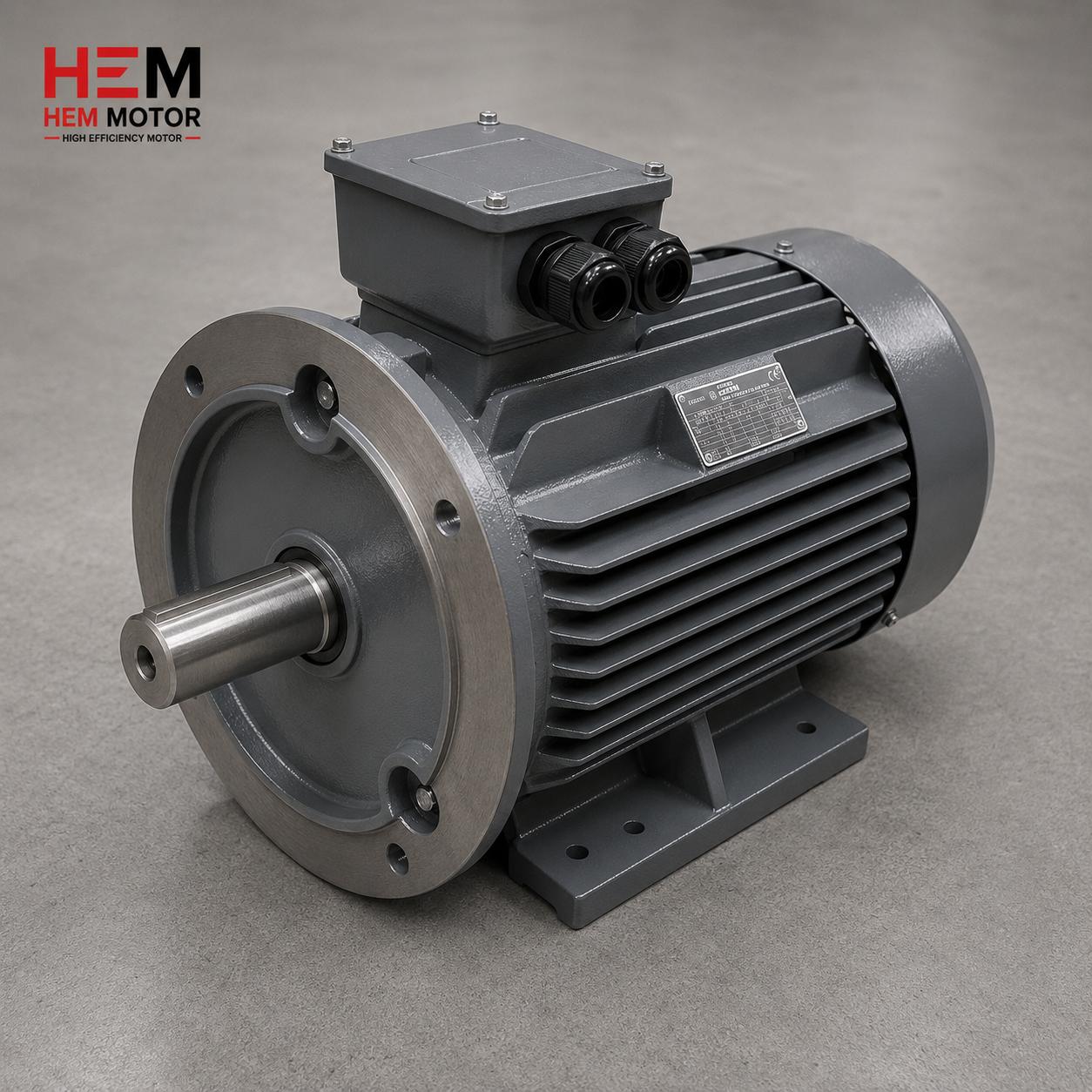
Every rotating machine element produces a certain amount of vibration, even within its design tolerances. In an asynchronous motor, vibration usually originates from rotor balance, magnetic forces, bearing condition and the dynamic balance of the load coupled to the shaft (fan, pump, compressor, gearbox). To limit this vibration, the manufacturer applies rotor balancing, quality bearings and clean frame machining; but the way the motor is connected to the floor determines the field result of this effort. A rigid, direct connection transmits almost all of the vibration energy into the structure.
Floor-borne vibration is not merely a comfort issue. It leads to bolt loosening, weld cracks, loss of calibration in nearby sensitive equipment and, over the long term, shortened bearing life. For this reason, when selecting a cast iron framed motor, you should look not only at the motor's own vibration class but at the entire mounting chain. You can find the motor-side fundamentals in our guide on electric motor noise and vibration, and the quiet-running advantage of IE4 motors in our article on low-vibration IE4 motors.
Rigid Mounting or Flexible (Isolated) Mounting?
The mounting approach splits into two main strategies. In rigid mounting, the motor is bolted directly onto a massive steel baseplate or a concrete foundation; vibration is damped by a large mass. In flexible mounting, an anti-vibration mount (rubber-metal isolator or spring-type isolator) is placed between the motor and the baseplate; these elements absorb vibration and largely block its passage to the floor. Which approach is correct depends on the motor's power, speed, the type of load coupled to the shaft and the structural characteristics of the floor.
Fundamentals of Steel Baseplate Design
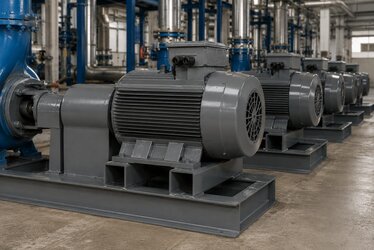
The steel baseplate is the load-carrying platform on which the motor and the driven machine (pump, fan, gearbox) are fixed in the same plane, with shaft misalignment kept to a minimum. A correct baseplate has three core duties: keeping the components in alignment, providing the mass and rigidity needed to damp vibration, and offering easy access during installation and dismantling.
- Rigidity: The baseplate must not flex during the motor's starting torque or under load changes. A thin, unreinforced sheet can amplify the motor's own vibration. A profile-reinforced, box-section or channel steel construction is preferred.
- Flatness: The surface on which the motor feet rest must be in one plane. A non-flat baseplate strains the motor frame as the feet are bolted down and creates a "soft foot" condition; this is one of the most frequently missed causes of vibration.
- Adjustment allowance: Space for placing shims for shaft alignment and jacking bolts for horizontal adjustment raises the quality of the installation.
- Drainage and access: In wet environments water must not pool on the baseplate, and access to the terminal box and bearing greasing must not be blocked.
Because cast iron framed motors are heavy, the connecting bolts between baseplate and motor and the floor anchoring of the baseplate must be correctly calculated. You can review weight and handling details by frame size in our article on cast iron motor frame sizes and weight, and consult our guide on frame size and power matching for the right frame-to-power match.
Soft Foot: The Invisible Vibration Source
Soft foot is the condition where one of the motor's four feet does not make full contact with the baseplate. When the bolt is tightened, the motor frame is slightly distorted, which disturbs shaft alignment and increases vibration. The solution is to measure the gap under each foot with a dial gauge and to insert a shim of the required thickness. When buying a new cast iron motor, machined foot surfaces and clean frame tolerances reduce the soft-foot risk from the outset.
Anti-Vibration Mount Selection
An anti-vibration mount is the elastic element placed between the motor (or motor-baseplate group) and the floor that absorbs vibration energy. Two types are common: rubber-metal isolators and spring-type isolators. Correct mount selection is based on bringing the system's natural frequency sufficiently below the operating frequency to achieve "isolation".
- Static load capacity: The mount must carry the combined motor and baseplate weight in balance across four (or more) points. If the weight distribution between load points is uneven, the mounts compress by different amounts and the system tilts.
- Natural frequency: For isolation to work, the system's natural frequency must be clearly below the motor's forcing frequency (related to speed). A very stiff mount provides no isolation, while an over-soft mount creates oscillation at start-up.
- Material durability: In oily, hot or chemical environments, the rubber mount must be chosen according to material compatibility. As on the motor side, durability in open-field and hot environments is also critical on the mount side.
- Displacement limit: The motor group oscillates during start and stop; a mount design that limits horizontal displacement protects belt-pulley or coupling alignment.
In systems connected by coupling or belt-pulley, the flexibility of the mount can conflict with the precision of shaft alignment. For this reason we recommend evaluating the shaft-side mechanical match together with our article on shaft diameter, key and coupling matching.
Rubber-Metal Isolator or Spring Isolator?
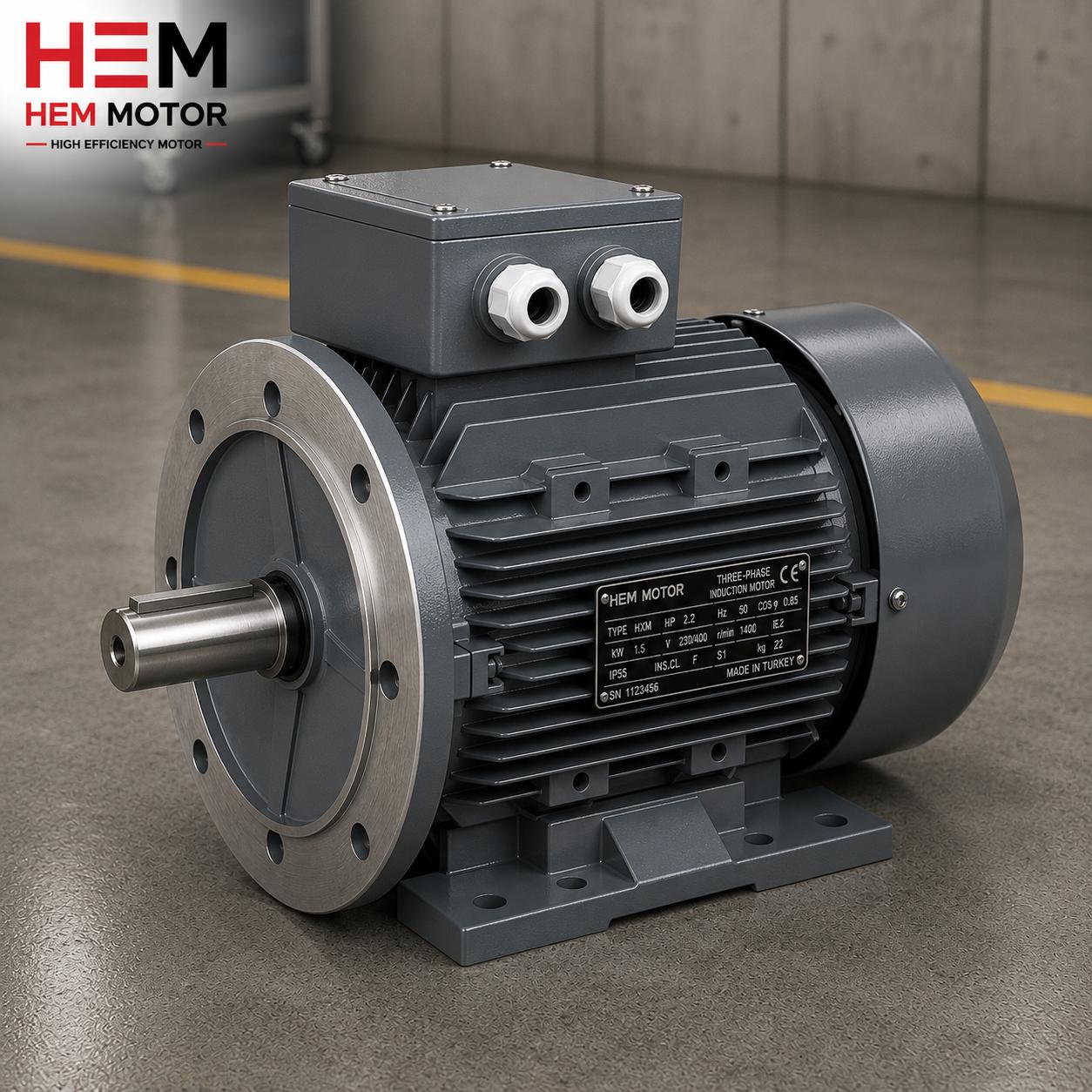
Rubber-metal isolators are compact, economical and sufficient for moderate vibration; they damp in both the vertical and horizontal directions and are simple to install. Spring-type isolators come to the fore in low-speed, heavy applications that require high isolation; a very low natural frequency can be achieved, but additional measures are needed for horizontal stability. The choice is made according to the motor's speed and the required isolation ratio. While isolation is relatively easy on high-speed (2-pole) motors, correct mount selection is more critical on low-speed (6/8-pole) motors; we covered the effect of pole count in our article on 2, 4, 6 pole motor selection.
Installation Sequence: Correct Setup Steps
Good vibration isolation depends less on product selection than on installation discipline. The recommended sequence is as follows:
- Floor flatness is checked; if necessary, levelling is done with epoxy grout. An uneven floor renders even the best mount ineffective.
- The steel baseplate is placed on the floor and anchor points are marked. In isolated mounting the mounts go under the baseplate; in rigid mounting the baseplate is anchored directly.
- The motor is seated on the baseplate with loose bolts; soft-foot measurement is taken and shims are placed.
- Shaft alignment with the driven machine (coupling or pulley) is performed; concentricity and parallelism are measured with a dial gauge.
- Bolts are tightened to the torque value in a crosswise sequence; alignment is rechecked after tightening.
- The direction of rotation is verified before commissioning. A wrong phase sequence strains both the process and the mechanics; we explained this in our article on rotation direction and phase sequence.
Taking a vibration measurement during the first run after installation is valuable for establishing a baseline. An increase in this value over time is an early indicator of problems such as bearing wear or loosening.
Correct Procurement: Planning the Motor and the Mounting Solution Together
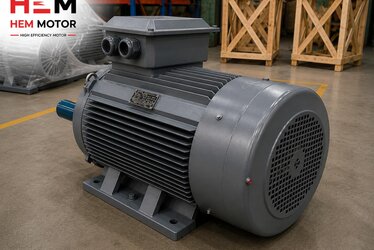
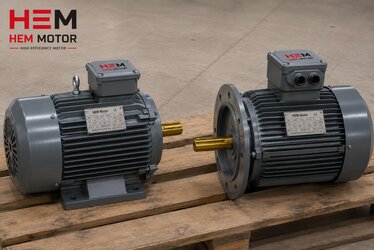
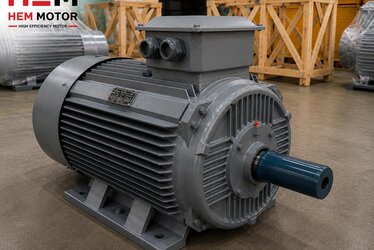
As a HEM Motor manufacturer and seller, we see that a large share of vibration problems can be solved at the purchasing stage. The right frame size, the right mounting type (B3 foot, B5/B35 flange), machined foot surfaces and a balanced rotor all make baseplate and mount selection easier. The high mass of a cast iron framed motor in itself provides a vibration-damping advantage. Our article on frame, foot and shaft mechanical compatibility is a good starting point for the effect of mounting type on vibration.
In project-based applications, once the motor's power and speed are determined, baseplate and mount selection becomes clear. Planning spare motor stock, lead time and replacement options in advance prevents production loss in the event of a failure. You can consult our team for current electric motor prices and the right model for your application, and together we can determine the most suitable solution for your baseplate with B3 and B5/B35 mounting options. A low-vibration, correctly sized motor ensures that your investment in the baseplate and mounts also pays back in the most efficient way.
Frequently Asked Questions
Is an anti-vibration mount always required on a cast iron motor?
No. On a motor seated on a massive concrete foundation or a sufficiently heavy and rigid steel baseplate, and drawing a balanced load, rigid mounting can be enough. An anti-vibration mount is needed in particular on intermediate floors, near sensitive equipment, on steel platforms, or where vibration transfer to the floor causes a problem. The decision is made according to the motor's speed, the type of load and the structure of the floor.
Does soft foot really affect vibration that much?
Yes. A foot that does not seat fully on the baseplate distorts the motor frame when the bolt is tightened, disturbs shaft alignment and noticeably increases vibration. Most "unexplained" vibration complaints originate from soft foot. Measuring the gap under each foot with a dial gauge during installation and placing a shim of suitable thickness largely eliminates this problem.
What information should I provide for correct baseplate and mount selection?
The motor's power, speed (pole count), mounting type (B3/B5/B35), frame size, the type of driven load (pump, fan, gearbox) and floor conditions are the most critical pieces of information. With this data we plan both the right motor and a suitable mounting solution together. Information about the environment (hot, oily, open field) is also useful to share, as it affects the choice of mount material.