English
 Türkçe


Behind the quiet, vibration-free and long-lived operation of a cast iron electric motor lies a measurement that is often invisible to the eye: the air gap between the stator and the rotor. This clearance, only a fraction of a millimetre, governs the motor's magnetic balance, its bearing loads, its noise level and ultimately its bearing life. When the air gap is even and concentric, the motor produces a balanced magnetic field. When the rotor is eccentric (off-centre), the gap narrows on one side and widens on the other, creating a one-directional magnetic pull force. This force continuously pushes the bearing, amplifies vibration and gradually fatigues the bearing, the shaft and even the frame. In this article we explain how to measure the air gap and rotor eccentricity in cast iron motors, how magnetic pull turns into vibration, and why correct procurement guarantees this precision from the very start.
What Is the Air Gap and Why Is It So Critical?
The air gap is the radial clearance between the outer surface of the rotating rotor and the inner surface of the stationary stator. In an induction motor the magnetic flux crosses this clearance to reach the rotor; therefore the smaller and more uniform the gap, the lower the magnetising current and the higher the efficiency. The manufacturer keeps this gap within a tight tolerance that depends on the motor frame size. When the gap is equal at every point, the magnetic pull forces around the rotor cancel one another and the net force stays close to zero.
The trouble begins when the gap narrows on one side and widens on the other. The magnetic pull force varies inversely and quite sharply (roughly with the square) with the gap; if the gap narrows by ten percent on one side, the pull force on that side rises far more than proportionally. As a result the rotor is continuously drawn toward the side where the gap is narrow. This one-directional force is known in engineering as unbalanced magnetic pull (UMP) and is the fundamental cost of eccentricity. The high rigidity of the cast iron frame allows it to resist these forces, which is why it is preferred in heavy and shock-loaded applications; yet no matter how strong the frame, if the geometry is wrong the result does not change.
Static Versus Dynamic Eccentricity
- Static eccentricity: The rotor's axis of rotation is in the correct place but is offset from the stator centre. The narrow point of the gap is fixed and does not rotate. It usually stems from machining error in the bearing housings, frame distortion or incorrect assembly.
- Dynamic eccentricity: The geometric centre of the rotor does not coincide with its axis of rotation; the narrow point of the gap rotates with the rotor. A bent shaft, bearing clearance, rotor core misalignment or shaft bow are the main causes.
- Mixed eccentricity: In practice the two conditions usually coexist; purely static or purely dynamic eccentricity is rare.
How Is the Air Gap Measured?
Direct measurement is the most reliable method and can be done without fully dismantling the motor, simply by opening the end covers or accessing from the terminal side. In field practice the following methods are used:
- Feeler gauge measurement: Thin blade gauges are inserted between the rotor and stator at four or more points around the circumference (top, bottom, left, right). If opposite points read close to each other, the gap is centred. A marked difference between top and bottom indicates vertical eccentricity; a difference between left and right indicates horizontal eccentricity.
- Re-measuring after turning the rotor by hand: If the reading at the same point changes when the rotor is rotated and re-measured, the dynamic component dominates; if it stays the same, the static component dominates.
- Dial gauge shaft runout: A dial indicator is set against the shaft end and, where possible, the rotor core; the rotor is turned slowly. The total runout read shows how off-centre the rotor turns.
The acceptance criterion is expressed as a percentage of the average gap. In general engineering practice the difference between points should not exceed roughly ten percent of the average gap. Once this threshold is crossed, magnetic pull and vibration rise rapidly.
Common Mistakes During Measurement
- Inserting the feeler at a single point and believing the gap has been "measured"; at least four points are essential.
- Measuring cold and ignoring the thermal expansion that occurs in hot running.
- Confusing bearing clearance with air-gap offset; bearing clearance must be checked separately.
- Reading at a random rotor position rather than first seating the rotor at its heaviest point.
How Does Magnetic Pull Turn into Vibration?
In an eccentric rotor the magnetic pull force does not stay constant; as the rotor turns, a force component arises whose direction and magnitude change. This force produces vibration around twice the supply frequency (100 Hz on a 50 Hz supply) and around the pole-passing frequencies. In an induction motor, sidebands modulated by the slip frequency also appear; the classic fingerprint of dynamic eccentricity is sidebands around the rotational frequency in the vibration or current spectrum.
This vibration causes damage in three ways. First it periodically stresses the bearing and shortens bearing life. Second it raises the noise level; a magnetic-origin hum becomes particularly noticeable at light load. Third it transmits vibration through the coupling or pulley to the driven machine, alignment degrades and neighbouring equipment also wears. While the damping capacity of the cast iron frame suppresses these vibrations to some extent, it does not eliminate their source.
Distinguishing Eccentricity with Vibration Measurement
- If 1x rotational frequency dominates: Usually indicates mechanical unbalance or dynamic eccentricity.
- If 2x supply frequency dominates: A magnetic-origin force, i.e. air-gap irregularity, comes to the fore; if this component disappears instantly when the motor is disconnected from the supply, the electrical origin is confirmed.
- Sidebands around the rotational frequency: Sidebands appearing at intervals related to slip and pole count indicate rotor eccentricity.
For plants that wish to use vibration amplitudes as a quality filter, the acceptance values in ISO standards are a useful guide; our content on motor vibration and balance ISO 10816 acceptance values offers a detailed framework.
Why Does the Cast Iron Frame Provide an Advantage Here?
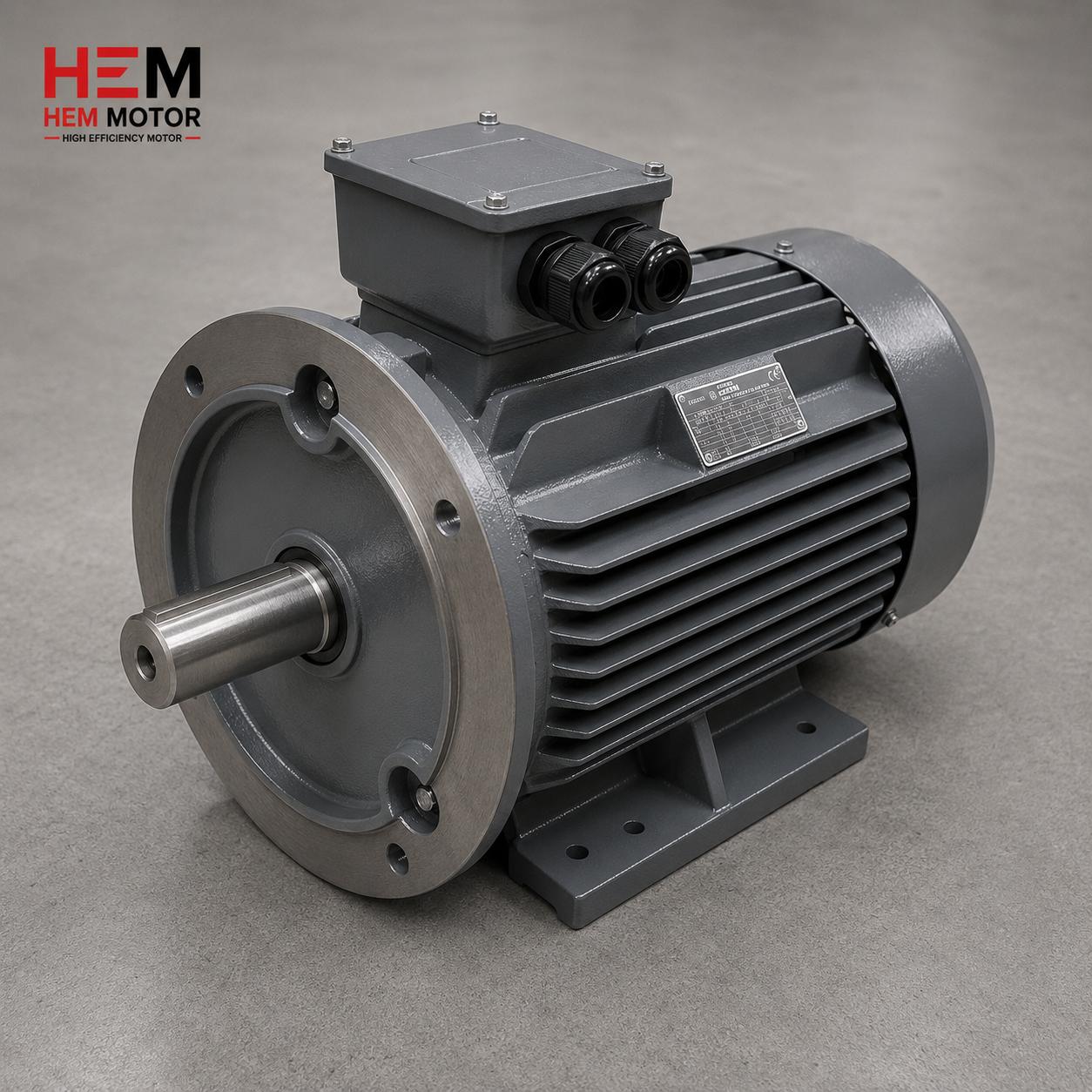
The real factor that preserves the air gap is the geometric stability of the frame and the bearing housings. A cast iron frame is markedly more rigid and a better vibration damper than aluminium. When the bearing housings are precision-machined directly into the cast frame, concentricity is maintained even at operating temperature. Under shock loads — crusher, mill and breaker drives — the frame's refusal to flex prevents dynamic distortion of the air gap. For this reason the cast iron frame is preferred in heavy-duty applications.
- High rigidity keeps frame deformation under magnetic pull forces to a minimum.
- Superior vibration damping suppresses magnetic-origin hum to a degree.
- Together with IP55 protection and Class F insulation, dimensional stability is maintained in dusty, humid and hot environments.
- A reinforced bearing structure carries bearing loads with a wider safety margin.
To explore the role of frame rigidity under shock loads in more depth, see our article on impact resistance and frame rigidity in cast iron motors, and for the quality marks on the bearing side, our content on bearing and bearing life in cast iron motors.
Correct Procurement: Guarantee Precision at the Purchasing Stage
Air-gap tolerance, rotor balance and bearing machining quality are features that are hard to correct in the field but can be guaranteed from the start with the right supplier. When buying a motor, not only power and speed but also this invisible side of manufacturing quality must be assessed. At HEM Motor we deliver our cast iron motors with precision-machined bearing housings, balanced rotors and controlled air-gap tolerance. Contact us for current electric motor prices and stock availability.
- Before ordering, convey the nameplate data and frame size of the existing motor accurately; an exact mechanical match reduces the risk of post-installation eccentricity.
- Check the match between frame size and power; our guide on frame size and power matching in cast iron motors is a helpful reference.
- Even for stock-delivered motors, do not skip the air-gap and rotation-direction check before commissioning.
- Perform shaft alignment carefully when mounting couplings and pulleys; a good motor can behave like an eccentric one with poor alignment.
The Hidden Costs Caused by Eccentricity
Eccentricity is often not seen as a fault on its own; its consequences accumulate slowly and appear under different line items. For a plant manager, seeing these hidden costs explains why it is more economical to procure a quality, correctly dimensioned motor from the start.
- Increased energy consumption: An irregular air gap raises the magnetising current; the motor does the same job by drawing more current. This difference forms a visible item on the annual bill for continuously running motors.
- Shortened bearing life: One-directional magnetic pull stresses the bearing above its design load. The bearing fatigues far earlier than expected and leads to unplanned downtime.
- Wear of adjacent equipment: Vibration is carried to the coupling, pulley and driven machine; alignment degrades and seals and gaskets wear early.
- Production downtime: An unexpected motor failure can turn into a production loss far more expensive than the motor itself; for this reason quality motors and spare planning are essential on critical drives.
How to Assess Dimensional Quality When Buying a New Motor
Air-gap tolerance, balance quality and bearing-machining precision are often invisible; yet you can assess this quality at the purchasing stage by asking the right questions. The points below are concrete marks that distinguish a quality cast iron motor from an ordinary product.
- Balance grade: The balance quality to which the rotor was balanced at the factory matters; a well-balanced rotor reduces dynamic-eccentricity vibration from the start.
- Bearing housing machining: Bearing housings machined concentric to and precisely into the cast frame prevent static eccentricity. In quality manufacturing the housings are machined in a single setup.
- Bearing selection: A reinforced bearing with correct preload keeps the bearing clearance under control and limits dynamic offset.
- Vibration and noise figures: The manufacturer's declaration of vibration and noise grade is an indicator of the motor's magnetic and mechanical balance.
- Frame rigidity: The wall thickness and rib structure of the cast iron frame limit deformation under operating load and preserve the air gap.
Carrying these quality marks into the ordering process eliminates problems that are hard to fix in the field. For an exact mechanical match, shaft diameter, key dimensions and coupling fit must also be checked; otherwise even a perfect motor can behave like an eccentric one with a wrong connection.
Frequently Asked Questions
Do I have to fully dismantle the motor to measure the air gap?
No. In most cases you can take a feeler-gauge measurement around the circumference simply by opening the bearing covers or inspection plugs. Full disassembly is needed only for extensive overhauls that require removing the rotor. On a newly bought stock motor, since the manufacturer performs balance and gap control at the factory, a rotation-direction and vibration check in the field is often sufficient.
How do I tell whether my vibration is electrical or mechanical?
The most practical method is to disconnect the motor from the supply and watch the vibration during free coast-down. If the component at twice the supply frequency vanishes the instant power is cut, the vibration is magnetic in origin, suggesting air-gap irregularity. If vibration continues at the rotational frequency after power is removed, the source is mechanical: unbalance, misalignment or a bearing.
Should an eccentric motor be repaired or replaced?
The decision depends on the motor's frame size, the cause of the eccentricity and its efficiency class. Structural problems such as a machining error in the bearing housing or a bent shaft may not be permanently solved by repair; in that case moving to a new IE4 motor made with a balanced rotor and controlled air gap brings gains in both efficiency and reliability. For small frames and older motors with high efficiency losses, replacement is usually the more sensible choice.