English
 Türkçe

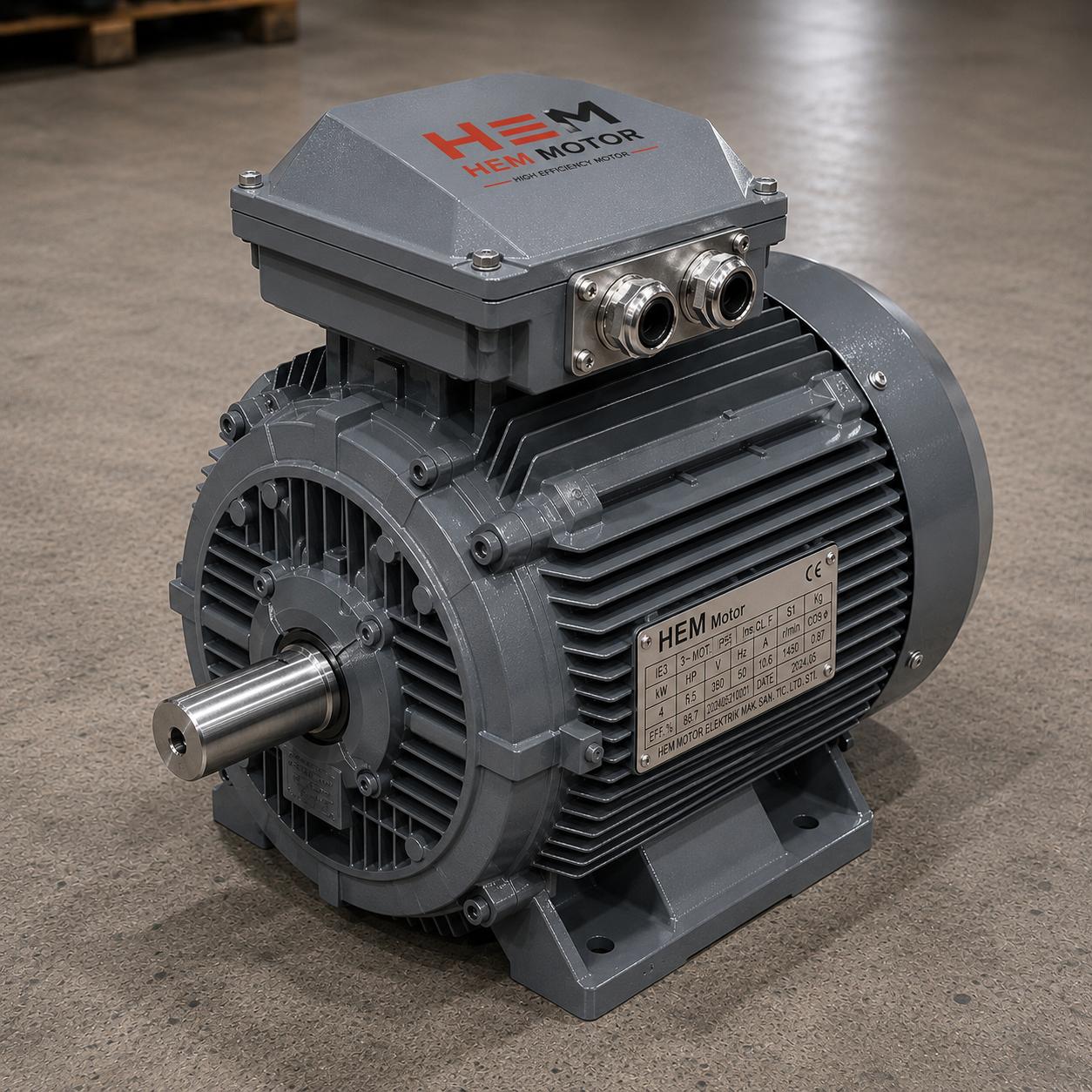

When you purchase a squirrel-cage asynchronous motor, the rated torque and efficiency class printed in the catalogue matter, but so does how the motor behaves during start-up. Some motors lock at a far lower speed than expected during acceleration, fail to reach rated speed and effectively "crawl" along. This phenomenon is called crawling, and its root cause lies in parasitic torques and harmonic torques. At HEM Motor, we carefully optimise the slot combination, rotor bar skew and winding design of our IE3 and IE4 motors precisely to eliminate these problems. In this article we examine, in engineering language and from a buyer's perspective, the physical origin of parasitic torques, the types of crawling, the dips (saddle) in the torque-speed curve, and how correct motor selection avoids these issues.
What Are Parasitic Torques? The Origin of Harmonic Torques
In an ideal asynchronous motor the stator winding produces a perfectly sinusoidal magnetomotive force (MMF) distribution in the air gap, and this fundamental wave interacts with the rotor to generate a smooth rotating torque. In real motors, however, the winding sits in a finite number of slots; this discrete placement adds a series of space harmonics to the air-gap MMF on top of the fundamental wave. The most prominent are the 5th and 7th harmonics. The 5th harmonic rotates opposite to the fundamental field, while the 7th rotates in the same direction. These harmonic fields produce additional torques with their own synchronous speeds, as though they were independent small motors. These unwanted torques added to the fundamental torque are called parasitic torques.
The synchronous speed of the field produced by the n-th harmonic is 1/n of the fundamental synchronous speed. For example, in a 4-pole motor with a synchronous speed of 1500 rpm, the 7th harmonic forms its own synchronous point at roughly 1500/7 ≈ 214 rpm. If the parasitic torque at that point exceeds the actual load torque at that speed, the motor settles at this sub-synchronous point before reaching its fundamental synchronous speed and sticks. This corresponds to a distinct dip in the torque-speed curve, that is, a "saddle" region.
Asynchronous Crawling
Asynchronous crawling is mainly produced by the space harmonics of the stator MMF. The 7th harmonic is the most frequent culprit; the motor settles at a stable operating point at roughly 1/7 of the fundamental synchronous speed. Unless the load torque exceeds the harmonic torque at that point, the motor cannot continue accelerating and crawls. In practice this appears as a motor that draws high current, heats up and cannot reach its rated speed.
Synchronous Crawling (Cogging / Locking)
Synchronous crawling or start sticking (cogging) is caused by an unsuitable choice of stator and rotor slot numbers. At standstill or very low speed the stator and rotor slots magnetically "lock" together and create a holding torque that keeps the rotor in its initial position. This force can prevent a lightly loaded motor from moving at all or cause it to stick at a very low speed. The basic cause of synchronous crawling is that, in certain stator-rotor slot combinations, the harmonic fields coincide at the same pole number.
Slot Harmonics and the Stator-Rotor Slot Combination
Besides space harmonics there are also slot harmonics. These arise from the periodic variation in magnetic permeance caused by the discrete slot structure of the stator and rotor. The relationship between the number of stator slots and the number of rotor bars directly determines which harmonic torques will be amplified. A poorly chosen slot combination magnifies parasitic torques and opens a deep dip in the torque-speed curve; a correctly chosen combination minimises these torques.
- Synchronous parasitic torque appears when the rotor and stator slot numbers satisfy a certain difference or multiple relationship; avoiding these combinations is the first design rule.
- Asynchronous parasitic torque comes mainly from stator MMF harmonics and is suppressed with winding distribution and chording (pitch shortening).
- Rotor bar skew tilts the bars by about one slot pitch so the harmonic fields average out along the rotor and their effect dies down.
- Slot opening and magnetic wedge use reduce the amplitude of slot harmonics, lowering noise and additional torques.
Why Is Rotor Bar Skew Critical?
Slightly skewing the rotor bars in the axial direction is one of the most effective design measures against crawling. Thanks to the skew, each harmonic field interacts with the rotor at different phases along the rotor length, and the net parasitic torque averages out and is largely damped. Typically the bars are skewed by one stator slot pitch. This significantly reduces both the synchronous holding torque and the asynchronous crawling dip, and lowers magnetic noise and vibration. Achieving the correct skew requires advanced manufacturing precision; at HEM Motor the rotor moulds and casting/machining processes are controlled to deliver this skew consistently.
Effect on High-Inertia and High-Friction Loads
The crawling problem is far more dangerous in applications where the torque required by the load during start-up is high. In high-inertia systems (flywheels, large fans, centrifuges, mills) and high-friction systems (conveyors, extruders) the motor needs a long acceleration time to reach the fundamental synchronous speed. If the dip in the torque-speed curve lies right on this acceleration path, the load torque exceeds the motor torque at the dip and the motor locks at that sub-synchronous speed. As a result:
- Because the motor cannot reach rated speed, it runs continuously at high slip and high current, and the winding temperature rises quickly.
- Thermal protection trips or the winding insulation is damaged; even Class F insulation loses its life under continuous overload.
- Vibration, noise and inefficient operation occur in the mechanical system.
For this reason, keeping the torque-speed curve above the load curve across the entire speed range is a critical design requirement for high-inertia or high-friction loads. A properly designed motor solves this at the root by having no dip region, or by keeping the dip well above the load curve.
Avoiding Crawling with Correct Design and Torque Class
Crawling is almost entirely a matter of design and manufacturing quality. In a well-made motor the parasitic torques are already suppressed through the correct slot combination, suitable winding pitch and rotor skew. The motor's torque class (Design N/H) is also decisive here. Design N offers standard starting torque and normal starting current, while Design H provides higher starting torque; in loads requiring high starting torque, choosing Design H makes it easier to keep any dip in the acceleration path above the load curve. To study the torque classes of asynchronous motors in detail, see our content on asynchronous motor torque classes Design N and H.
Starting behaviour is also affected by the starting method. With direct-on-line starting the entire torque-speed curve is tested by the load, whereas stepped starting can soften this behaviour. Knowing the star-delta and softstarter starting methods helps in assessing crawling risk. To understand how slip and actual speed form, our article on the slip and actual speed relationship is a good starting point.
The Role of Soft Starter and VFD
A soft starter limits current by gradually raising the starting voltage, but it does not by itself eliminate the dip caused by parasitic torques; on a poorly designed motor the crawling risk may even increase at reduced voltage. A variable frequency drive (VFD), on the other hand, starts the motor from a very low frequency and accelerates it gradually, allowing the motor to pass quickly through the harmonic dip regions and providing sufficient torque at every speed through V/f control. Therefore, in high-inertia starts, a VFD is the safest way to practically eliminate the crawling risk. For details of driving asynchronous motors with a VFD, see our content on VFD frequency drive with asynchronous motor. Still, remember: a drive does not make a poorly designed motor good; the fundamental solution is a properly manufactured motor.
Selection Checklist
- Torque-speed curve: Check whether the curve supplied by the vendor has a dip (saddle) and how far above the load curve the dip stays.
- Slot combination and rotor skew: A quality manufacturer chooses the slot combination to prevent crawling and skews the rotor.
- Torque class: Choose Design N or H according to the load; prefer H where high starting torque is required.
- Load inertia: For high-inertia loads, evaluate acceleration time and dip risk together.
- Starting method: Plan a VFD or a suitable soft starter for critical high-inertia starts.
- Efficiency class: IE3/IE4 motors, with modern design and quality windings, are both efficient and resistant to crawling.
At HEM Motor we manufacture our IE3 and IE4 motors from 0.55 to 355 kW, in IP55 protection class, with Class F insulation and 100% copper windings, using the correct slot combination and rotor skew; in this way we solve parasitic-torque and crawling-related start-up problems at the design stage. To select the right motor for your application, review our IE3 efficient asynchronous electric motors product group and our IE4 high-efficiency electric motors range, and contact us for current electric motor prices.
Frequently Asked Questions
What is crawling and how is it recognised?
Crawling is the failure of an asynchronous motor to reach its fundamental synchronous speed during start-up, sticking instead at a much lower sub-synchronous speed. Typical symptoms are high current draw, heating, noise and the motor's inability to reach its rated speed. Locking is usually seen at roughly 1/7 of the fundamental synchronous speed.
What is the most effective way to prevent crawling?
The most effective way is to buy a motor from a quality manufacturer that selects the correct stator-rotor slot combination and skews the rotor bars by one slot pitch. Parasitic torques suppressed at the design stage do not cause crawling in the field. In addition, gradual starting with a VFD allows the dip regions to be passed quickly.
Does a soft starter solve the crawling problem?
A soft starter limits current but does not eliminate the parasitic-torque dip; the crawling risk may even increase at reduced voltage. For high-inertia starts a V/f-controlled VFD is safer. Nonetheless, the definitive solution is a properly designed and quality-manufactured motor.