English
 Türkçe


Summary (TL;DR)
- The asynchronous motor equivalent circuit (R1, X1, Xm, R2'/s, X2') mathematically explains motor behavior; torque is directly tied to rotor copper losses and slip.
- Starting torque is largely set by rotor resistance R2' and rotor leakage reactance X2': higher rotor resistance raises starting torque but increases slip and losses at the running point.
- The speed-torque curve has starting, pull-up, breakdown (pull-out) and full-load regions; correct motor selection means fitting the load torque curve onto this curve.
- Deep-bar and double-cage rotors (NEMA design analogy) give high torque at start and low slip at rated load; they are ideal for hard-starting loads.
- HEM Motor offers IE3/IE4 asynchronous electric motors with 100% copper windings and cast-iron frames, with fast supply from stock and manufacturer assurance.
Running a conveyor, crusher, fan or pump smoothly requires more than picking a motor of the right power rating. The motor must break the load free, deliver enough torque throughout acceleration, and run efficiently at the rated point. All of these behaviors originate in the asynchronous motor equivalent circuit and the speed-torque relationship derived from it. This article covers the equivalent circuit of the asynchronous (induction) motor, the concept of slip, and the effect of rotor resistance and reactance on starting torque at an engineering depth. It then shows how to translate this theory into correct motor selection for a real load. The goal is for you to understand, when you look at a catalog, which motor fits your load, and to confidently buy the right product from stock.
Working Principle and Slip of the Asynchronous Motor
An asynchronous motor works on the principle that the rotating magnetic field created in the stator induces voltage in the rotor bars. Three-phase current in the stator windings produces a magnetic field rotating at synchronous speed. The rotor turns slightly slower than this field; if the rotor reached exact synchronous speed, relative motion would vanish and induced voltage, hence torque, would disappear. The fraction by which the rotor lags the rotating field is called slip.
Synchronous Speed and Slip Definition
Synchronous speed is set by line frequency and pole count. On a 50 Hz supply, ns = 120·f / (number of poles):
- 2-pole motor: ns = 3000 rpm (high-speed applications)
- 4-pole motor: ns = 1500 rpm (most common industrial choice)
- 6-pole motor: ns = 1000 rpm (low speed, high torque)
- 8-pole motor: ns = 750 rpm (very low speed loads)
Slip is expressed as s = (ns − n) / ns, where n is the actual rotor speed. Typical full-load slip is between 2% and 5%. At the instant of starting the rotor is not yet turning, so n = 0 and slip s = 1. This concept is the key to understanding why the equivalent circuit depends on slip and how torque arises.
The Asynchronous Motor Equivalent Circuit
An asynchronous motor can be modeled like a transformer: the stator behaves like the primary, the rotor like the secondary. From this analogy, the per-phase equivalent circuit consists of:
- R1 — stator winding resistance (represents stator copper loss).
- X1 — stator leakage reactance (represents the leakage flux not linking the stator).
- Xm — magnetizing reactance (the branch that establishes the main air-gap flux).
- Rc — core-loss resistance (hysteresis and eddy-current losses; usually placed in parallel with Xm).
- R2'/s — rotor resistance referred to the stator, divided by slip.
- X2' — rotor leakage reactance referred to the stator.
Meaning of the R2'/s Term
The heart of the equivalent circuit is the R2'/s term. It combines two physical phenomena. Decomposed as R2'/s = R2' + R2'·(1 − s)/s, the first part (R2') represents the rotor copper loss actually converted to heat in the rotor, while the second part R2'·(1 − s)/s represents the mechanical power delivered to the shaft. When slip is small (rated operation), this term is large and most of the air-gap power becomes mechanical power. When slip approaches 1 (starting) the term shrinks and most power is dissipated as heat in the rotor resistance; this is why starting current is high and starting efficiency is low.
Deriving the Speed-Torque Relationship
The air-gap power Pag transferred to the rotor relates to rotor copper loss as Pcu = s·Pag. Since the developed mechanical power is Pmech = (1 − s)·Pag, the shaft torque can be written as T = Pag / ωs, where ωs is the synchronous angular speed. This confirms a crucial result: torque is proportional to the air-gap power and indirectly to the ratio of rotor copper losses to slip.
Solving the equivalent circuit using a Thévenin simplification, the torque expression becomes T = (3·VTH²·R2'/s) / [ωs·((RTH + R2'/s)² + (XTH + X2')²)]. This gives torque as a function of slip and explains the entire character of the speed-torque curve. The most critical observation is that both the starting torque (s = 1) and the breakdown torque depend directly on R2' and X2'.
Regions of the Speed-Torque Curve
A typical asynchronous motor speed-torque curve has four distinct regions along the axis where slip varies from 1 to 0. Understanding these regions is the basis for predicting whether a motor can drive a load.
- Starting (locked-rotor) region: the point s = 1. The torque here is the starting torque and answers whether the load can be broken free. It is critical for hard-starting loads.
- Pull-up region: the lowest torque point between start and breakdown. If the motor cannot produce enough torque to clear this valley, acceleration stalls.
- Breakdown (pull-out) region: the maximum torque the motor can produce. A load torque exceeding this point stalls the motor. It is typically 2-3 times rated torque.
- Full-load region: the rated point; the curve here is nearly linear, and small slip changes correspond to large torque changes. The motor runs stably in this region.
Effect of Rotor Resistance R2' on Starting Torque
Setting s = 1 in the torque expression gives starting torque Tst = (3·VTH²·R2') / [ωs·((RTH + R2')² + (XTH + X2')²)]. This shows mathematically how rotor resistance R2' affects starting torque. The numerator grows proportionally with R2', while the denominator grows with R2' squared. As a result, there is an optimum rotor resistance: starting torque is maximized when R2' is roughly equal to the square root of (RTH² + (XTH + X2')²).
The Benefit and Cost of High Rotor Resistance
When rotor resistance is increased, the breakdown torque stays the same but this maximum torque shifts to higher slip values. In practice this means motors with high rotor resistance produce far greater torque at start. This property is ideal for applications that start under load, such as crushers, mills and conveyors.
But there is a cost: high rotor resistance increases slip at the rated point. Higher slip means more rotor copper loss, lower efficiency and more heating. The engineering solution is therefore rotor geometries that provide high resistance at start and low resistance during running.
Rotor Reactance X2' and Deep-Bar / Double-Cage Rotors
Rotor leakage reactance X2' appears in the denominator of the torque expression and limits breakdown torque. Lower X2' gives higher breakdown torque. However, X2' is closely related to the frequency-dependent behavior of the rotor bars, and this is where engineering solutions come in.
Self-Adjusting Resistance via Skin Effect
At start, rotor frequency equals line frequency (s = 1). At high frequency, the skin effect pushes current into the upper part of the deep rotor bar; this raises the effective rotor resistance and increases starting torque. As the motor speeds up, rotor frequency drops (for example only 1-2.5 Hz at full load), the skin effect weakens, current spreads across the full bar cross-section, and effective resistance falls. This yields low slip and high efficiency at the rated point.
- Deep-bar rotor: long, narrow bars strengthen the skin effect; high torque at start, low slip during running.
- Double-cage rotor: the outer cage is high-resistance (for starting), the inner cage low-resistance (for running); offers the widest torque range.
These designs are analogous to the international NEMA design classes (Design B, C, D). Motors engineered for heavy loads requiring high starting torque, such as high starting-torque motors, take full advantage of these rotor architectures. For the most demanding start conditions, such as mining, high-torque mining motors are preferred.
Turning Theory into Correct Motor Selection
The practical meaning of all this theory is to fit the motor torque curve onto the load torque curve. For a correct choice the two curves are evaluated together: the torque the motor produces at every speed must exceed the torque the load demands at that speed. The difference forms the accelerating torque.
Load Torque Characteristics
- Quadratic loads: fans and centrifugal pumps; torque rises with the square of speed. Starting torque is low, so standard starting-torque motors suffice. Energy efficiency is the priority here.
- Constant torque loads: conveyors, compressors, hoists; torque is nearly constant across speed. High torque is essential to break the load free at start.
- Constant power loads: winders, some machine tools; demand high torque at low speed and low torque at high speed.
- High-inertia, high-friction loads: crushers, mills, mixers; require very high breakaway torque. Double-cage rotors are decisive here.
Selection Checklist
- Determine the load breakaway torque; motor starting torque should be at least 125-150% of it.
- Ensure breakdown torque stays safely above the load peak torque (typically ≥ 200% rated torque).
- Calculate the moment of inertia (J); acceleration time must not exceed the motor's thermal limits.
- Choose pole count by load speed; 4-pole solutions are balanced for most applications.
- Define the efficiency class (IE3/IE4) and duty type (S1, S4, etc.).
When selecting products that meet these criteria, we recommend reviewing the broad power and pole range of asynchronous electric motors. For three-phase industrial applications, the three-phase electric motors category includes both standard and special starting-torque options. For current electric motor prices and stock availability, you can request a direct quote.
Efficiency Legislation and HEM Motor Assurance
Under EU Ecodesign regulations, direct-on-line (DOL) motors between 0.75 kW and 1000 kW must be at least IE3 efficiency class since July 2021. This is not merely a compliance matter; it means lower slip, lower losses and cooler operation. From an equivalent-circuit viewpoint, IE3/IE4 motors are optimized for lower R1 and R2' values, which means less copper loss and higher efficiency.
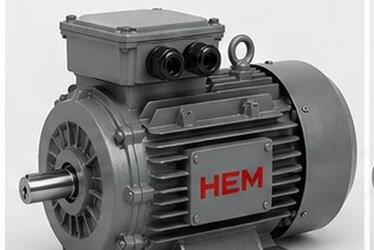
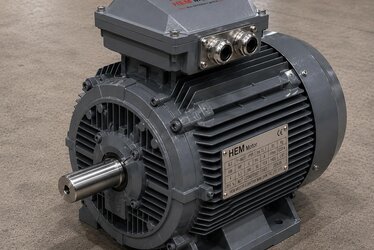
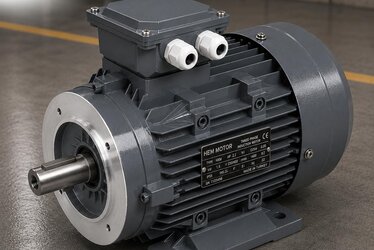
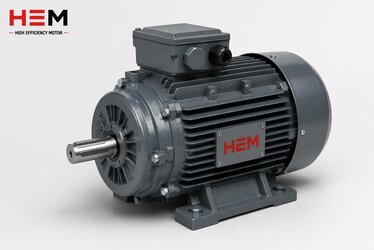
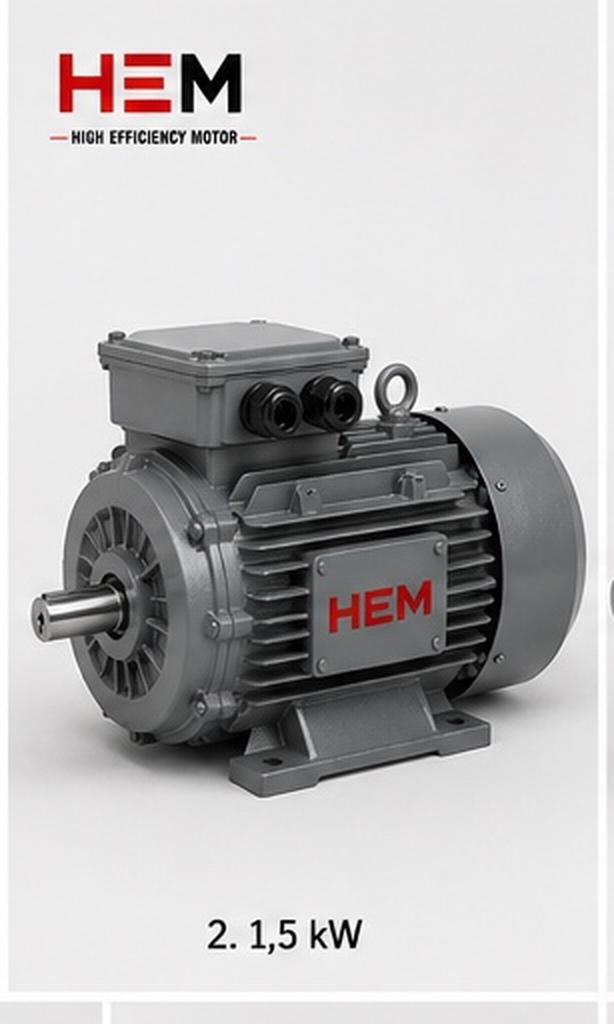
HEM Motor offers IE3 and IE4 asynchronous motors built with 100% copper windings, cast-iron frames and precision balancing. High starting-torque rotor options for hard-starting loads and high-efficiency versions for standard applications are supplied quickly from stock. Manufacturer assurance combines single-source supply of the motor with the correct torque-speed curve and the advantage of project-specific quotations. Share your load torque curve and our engineering team will match the right motor and provide its quote.
Frequently Asked Questions
Why does raising rotor resistance increase starting torque but reduce efficiency?
In the equivalent circuit, starting torque is proportional to R2'; so increasing rotor resistance raises the torque at s = 1 and shifts breakdown torque to higher slip. But the same high resistance increases slip at the rated point. Higher slip means more rotor copper loss (Pcu = s·Pag), which lowers efficiency and increases heating. The solution is deep-bar or double-cage rotors that provide high resistance at start and low resistance at the rated point.
Should I prioritize breakdown torque or starting torque for my load?
Both matter, but the load sets the priority. For constant-torque loads that start under load, such as crushers and conveyors, sufficient starting (breakaway) torque comes first. For quadratic loads like fans and pumps, where starting torque is low, the decisive factor is a sufficient breakdown torque margin against peak loads during running. In all cases breakdown torque is recommended to be at least twice the load peak torque.
How do I decide between two motors of the same power rating?
Two motors of the same kW rating can have very different torque curves. Compare the starting-torque/rated-torque ratio, breakdown-torque ratio and starting-current ratio from the datasheet against your load profile. Choose a high starting-torque-ratio model for hard starts, or a high IE-class model when energy efficiency is the priority. When you share your load torque curve, the HEM Motor engineering team performs the matching and provides a quote for the suitable model from stock.