English
 Türkçe

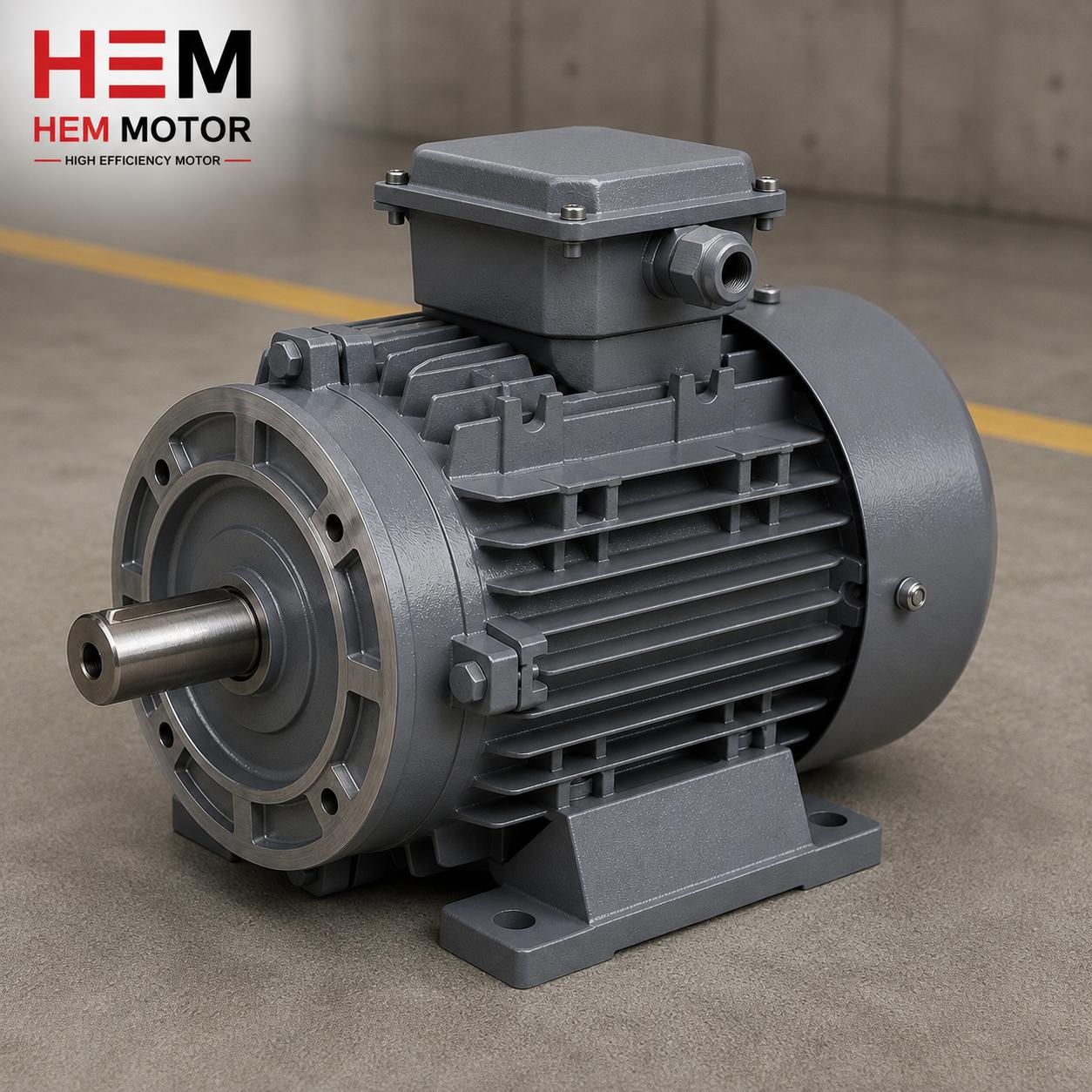

An engineer working in a press shop or a sheet-metal line knows very well how a motor behaves at the moment of impact. The instant a guillotine shear blade cuts the sheet, or an eccentric press die descends onto the material, the load shoots to its peak value within milliseconds; then it drops back to almost zero. In this shock-type, intermittent load profile, a standard asynchronous motor raises its current dangerously with every stroke, heats up, and fatigues its winding over time. This is exactly where the choice of a NEMA Design D high-slip motor is the right engineering decision. High slip allows the motor to drop its speed slightly at the moment of impact, bringing the kinetic energy stored in the flywheel into play; thus the peak load is shared by the motor and the flywheel together, and the peak current drawn from the grid is significantly reduced.
As an electric motor manufacturer and supplier, we see that selecting the correct torque class in presses, shears, guillotines, hoists and flywheel-driven shock machines directly affects not only motor life but also machine performance and energy cost. In this guide we explain step by step what a NEMA Design D high-slip motor does, how slip works with the flywheel, in which load profiles it should be preferred, the thermal load brought by high slip, and the correct supply and equivalent-replacement strategy. Our goal is to clarify what the production manager or maintenance engineer making the purchasing decision should describe when requesting a quotation.
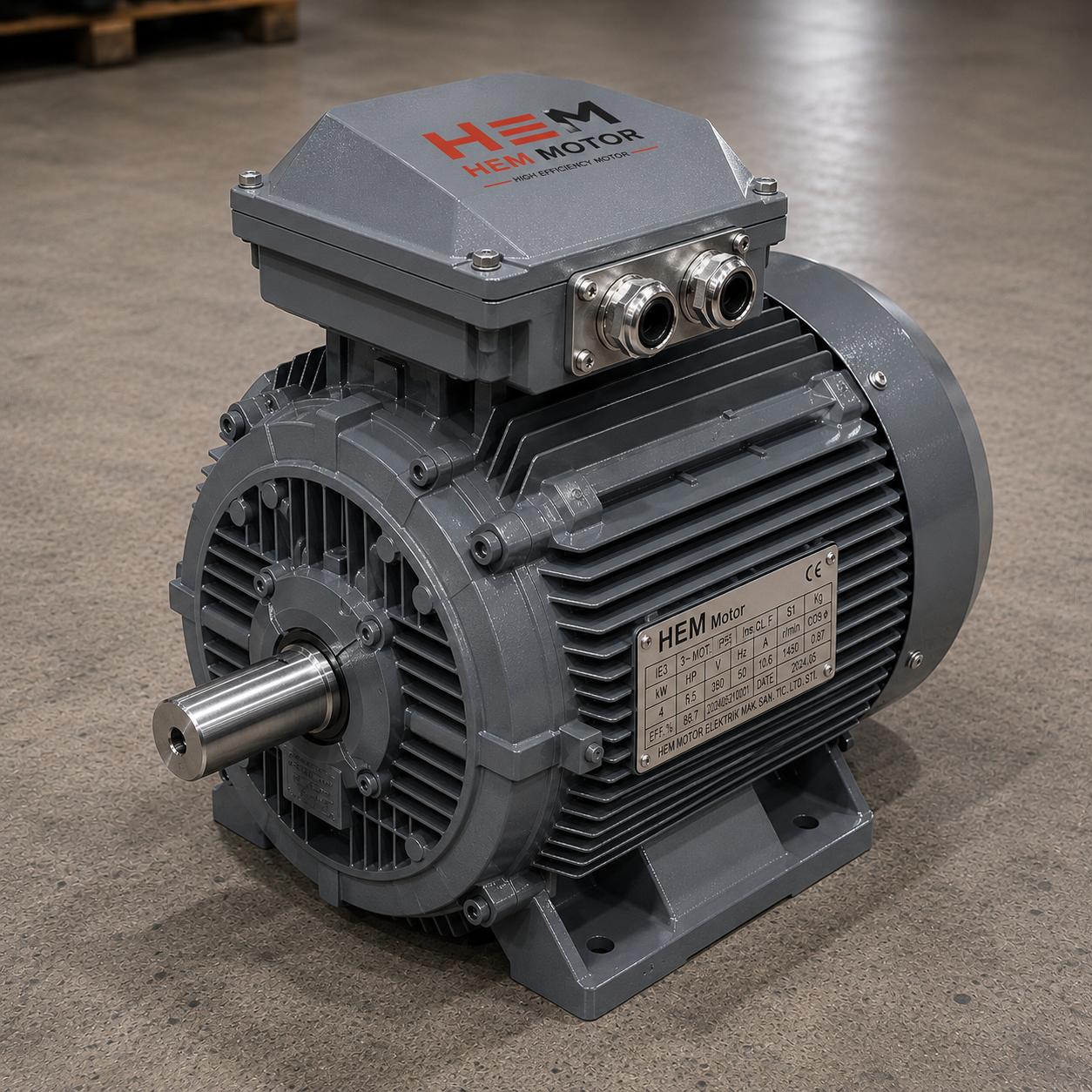
What Is NEMA Design D? The Logic of Torque Classes
NEMA classifies asynchronous motors into design classes according to their starting torque, starting current and slip characteristics. These classes determine the shape of the motor's torque-speed curve and indicate which load type it suits. The three classes most frequently encountered in practice are:
- Design N (normal): Normal starting torque, normal starting current and low slip. The standard choice for steady, predictable loads such as pumps, fans and conveyors.
- Design H (high torque): High starting torque, normal starting current and low slip. Preferred for loaded-start conveyors, crushers and hard-to-start machines.
- Design D (high slip): Very high starting (locked-rotor) torque and high slip (typically 5–13%). Ideal for flywheel-driven, high-inertia, shock-type and intermittent loads.
The main feature distinguishing Design D from the others is high slip. While a standard Design N motor runs very close to its rated speed (for example 2–3% slip), a Design D motor drops its speed more as the load increases. This "flexibility" is vital under shock load. Our article on asynchronous motor torque classes and starting torque, which examines torque-class selection by load in more detail, is a good starting point to clarify the comparison with Design N and Design H.
Slip, Flywheel and Sharing the Impact Energy
The working logic of a flywheel-driven press or shear is to spread energy over time. The instant the press die descends onto the material, the required work is done in a very short time; but the motor does not have to supply this work alone and instantaneously. The flywheel stores kinetic energy by being accelerated by the motor in the gap between strokes. At the moment of impact, this stored energy comes into play and the flywheel meets most of the peak load.
This is where high slip plays a critical role. The Design D motor drops its speed slightly at the moment of impact (slip increases), and this speed drop allows the flywheel to release its stored energy by braking. A low-slip motor, on the other hand, hardly drops its speed at all, so it cannot benefit enough from the flywheel; it tries to meet the peak load directly itself and draws very high current from the grid. As a result, a high-slip motor:
- Reduces the current drawn from the grid at the moment of peak load; it lowers the sudden load on the transformer and panel.
- Enables the flywheel's energy sharing, easing the severity of mechanical shock to which the motor is exposed.
- Provides a smoother torque transfer to the machine, extending the life of transmission elements such as gears, couplings and belt-pulleys.
Our impact-load motor, flywheel and inertia selection content, which concretely explains the effect of flywheel inertia and shock load on motor selection, reinforces this principle with a crusher example as well.
How Slip Reflects in Actual Speed
In an asynchronous motor, the actual speed is always slightly below the synchronous speed, and this difference is slip. Since slip is low in a Design N motor, the motor runs close to its rated speed; in a Design D motor, since slip is high, the speed drops noticeably under load. This is not a defect but a deliberate design choice for shock loads. Our article on slip and actual speed in asynchronous motors, in which we explain how slip reflects in actual speed and why for example 1440 rpm is seen instead of 1500, helps you understand the basis of this behaviour. In press and shear applications, it is normal for the speed drop to vary per stroke; what matters is that the motor handles this fluctuation within safe thermal limits.
In Which Applications Is Design D Preferred?
Design D high-slip motors stand out in machines where the load reaches sudden and repetitive peak values and drops in between. Typical areas of use are:
- Eccentric and mechanical presses: In presses that work through a flywheel and produce high peak load per stroke.
- Guillotine shears and sheet cutting: In lines with short-term high torque demand the instant the blade cuts the sheet.
- Cranes and lifting systems: In lifting applications requiring high starting torque and a shock load profile.
- Flywheel-driven cutting/forming machines: In all shock-type processes where kinetic energy is stored in the flywheel.
The common feature of these machines is the intermittent duty profile. The motor does not run continuously at full load but works with short bursts and pauses; this corresponds to intermittent duty definitions such as S6. Similarly, our article on plastic injection and crushing motor selection by load profile, in which we discuss motor selection for plastic crushing and injection machines with variable and shock load profiles, shows the intermittent-load logic in a different sector too.
The Cost of High Slip: Thermal Load and Cooling
High slip brings a cost alongside its advantages: rotor losses increase and the motor heats up more. The higher the slip, the greater the power dissipated in the rotor and therefore the heat generated. For this reason, thermal design is critical in Design D motors. For the motor to dissipate this extra heat safely under shock and intermittent load, the following points should be taken into account:
- Insulation class: F (or H if needed) class insulation leaves a safe margin against the additional temperature brought by high slip.
- Cooling: Adequate fan and ventilation; cooling must be correctly sized so that heat does not accumulate in frequent shock operation.
- Cast iron body: A robust body resistant to mechanical impact, vibration and continuous load variation is indispensable for Design D applications.
- Duty type compatibility: Selecting the motor with the correct power margin for intermittent duty (S6) balances the average and peak load.
Our article on insulation class and cast iron body selection in hot environments, in which we discuss insulation class and cast iron body selection in hot, harsh environments in detail, guides you when planning the thermal endurance of high-slip motors.
Correct Power Margin and Sizing
When determining motor power under shock load, you must look not only at the peak load but also at the stroke frequency, flywheel inertia and duty period. An oversized motor selected according to the peak load usually runs idle, lowering efficiency and meaning unnecessary investment. Conversely, a motor sized at the limit according to the average load is thermally fatigued in frequent shocks. The correct approach is to size the motor in a balanced way between average power and peak power, taking the flywheel's energy sharing into account.
When establishing this balance, the energy required per stroke, the flywheel size and the number of strokes per minute should be evaluated together. When the correct torque class (Design D) and the correct power margin come together, both machine performance and motor life are maximised.
Starting and Supply: Points to Consider When Purchasing
Since the starting torque is already high in high-slip motors, the starting method is chosen according to the machine's need. Sufficient starting torque is required to accelerate the flywheel; therefore, while direct-on-line starting is preferred in some applications, soft starting methods are used on sites where the current must be limited. Our article on star-delta vs soft starter starting, in which we compare starting options in detail, clarifies the starting strategy.
On the supply side, the most critical issue is equivalent replacement. A motor to be fitted in place of a failed high-slip motor on an existing press must match exactly not only in power but also in torque class, slip characteristic, frame size, shaft diameter and mounting type. Fitting a standard Design N motor in place of a high-slip press motor leads to current rise and early failure. Therefore, the old motor's nameplate information and the machine's load profile must be shared at the quotation stage.
- The power, speed, frame size, shaft diameter and mounting code on the existing motor's nameplate should be conveyed in full.
- The machine type (press, guillotine, crane), the presence of a flywheel and the number of strokes per minute should be specified.
- The operating environment (dust, temperature) and duty type (intermittent/continuous) should be written into the quotation request.
When you contact us for the right torque class, the correct slip characteristic and quickly available stock for your needs, we match a motor that fully suits your machine's load profile. For current electric motor prices and suitable options, it is enough to share your load profile.
Practical Differences Between Design D, Design N and Design H
When choosing the correct torque class for a machine, you must clearly see the practical behavioural differences of the three classes. A Design N motor offers a balanced and predictable character on the torque-speed curve; it is the most economical and most common choice for steady-load pumps, fans and conveyors. A Design H motor raises the starting torque but keeps slip low; this makes it ideal for machines that start under load but do not produce shock during operation. Design D differs from the other two by offering both very high starting torque and high slip.
In practice, these differences appear as follows: a Design N motor of the same power hardly drops its speed at the moment of impact and tries to meet all the peak load from the grid; this causes a current spike. A Design D motor, on the other hand, flexes its speed, engages the flywheel and smooths the peak current. Therefore, although fitting a Design N motor to a flywheel press is technically possible, it is not the right choice in terms of energy efficiency, current surge and transmission-element life. The correct torque-class selection affects the energy and maintenance cost throughout the machine's life.
- Design N: Steady, predictable load → pump, fan, conveyor.
- Design H: Hard-starting but shock-free load → loaded conveyor, some crushers.
- Design D: High inertia + shock intermittent load → press, guillotine, crane, flywheel machines.
Common Mistakes in Design D Motor Selection
- Ignoring the torque class: Fitting a standard Design N motor to a shock load is the most common cause of current rise and early failure.
- Not accounting for the flywheel: Power selection made without considering the flywheel's energy sharing leaves the motor unnecessarily large or insufficient.
- Underestimating the thermal load: If the additional heat from high slip is not taken into account, the motor overheats in frequent shocks.
- Non-equivalent replacement: Replacement made without knowing the old motor's torque class and slip characteristic impairs machine performance.
- Wrong duty type: Selection with continuous-duty (S1) logic prevents correct sizing under intermittent shock load.
Frequently Asked Questions
Which applications is a NEMA Design D motor suitable for?
Design D high-slip motors are suitable for eccentric presses, guillotine shears, cranes and flywheel-driven shock/intermittent load machines. In these applications, the load reaches sudden peak values and drops in between. High slip allows the motor to drop its speed slightly at the moment of impact, engaging the energy stored by the flywheel; thus the peak load is shared by the motor and the flywheel together, and the peak current drawn from the grid is reduced.
Why does high slip heat the motor more?
As slip increases, the power dissipated in the rotor and therefore the heat generated also increase. A Design D motor deliberately drops its speed at the moment of impact, running at high slip; this raises rotor losses and heat. For this reason, F (or H if needed) insulation class, adequate cooling and a robust cast iron body are important in Design D motors. If the duty type (usually intermittent S6) and the correct power margin are selected, the motor dissipates this extra heat safely.
Can I replace a standard motor with a Design D high-slip motor?
In equivalent replacement, not only power but also torque class, slip characteristic, frame size, shaft diameter and mounting type must match exactly. Fitting a standard Design N motor in place of a high-slip press motor leads to current rise and early failure. If you share the existing motor's nameplate information and the machine's load profile (press/guillotine type, flywheel, stroke count), we can match a motor in the correct torque class that fully suits your machine.