English
 Türkçe

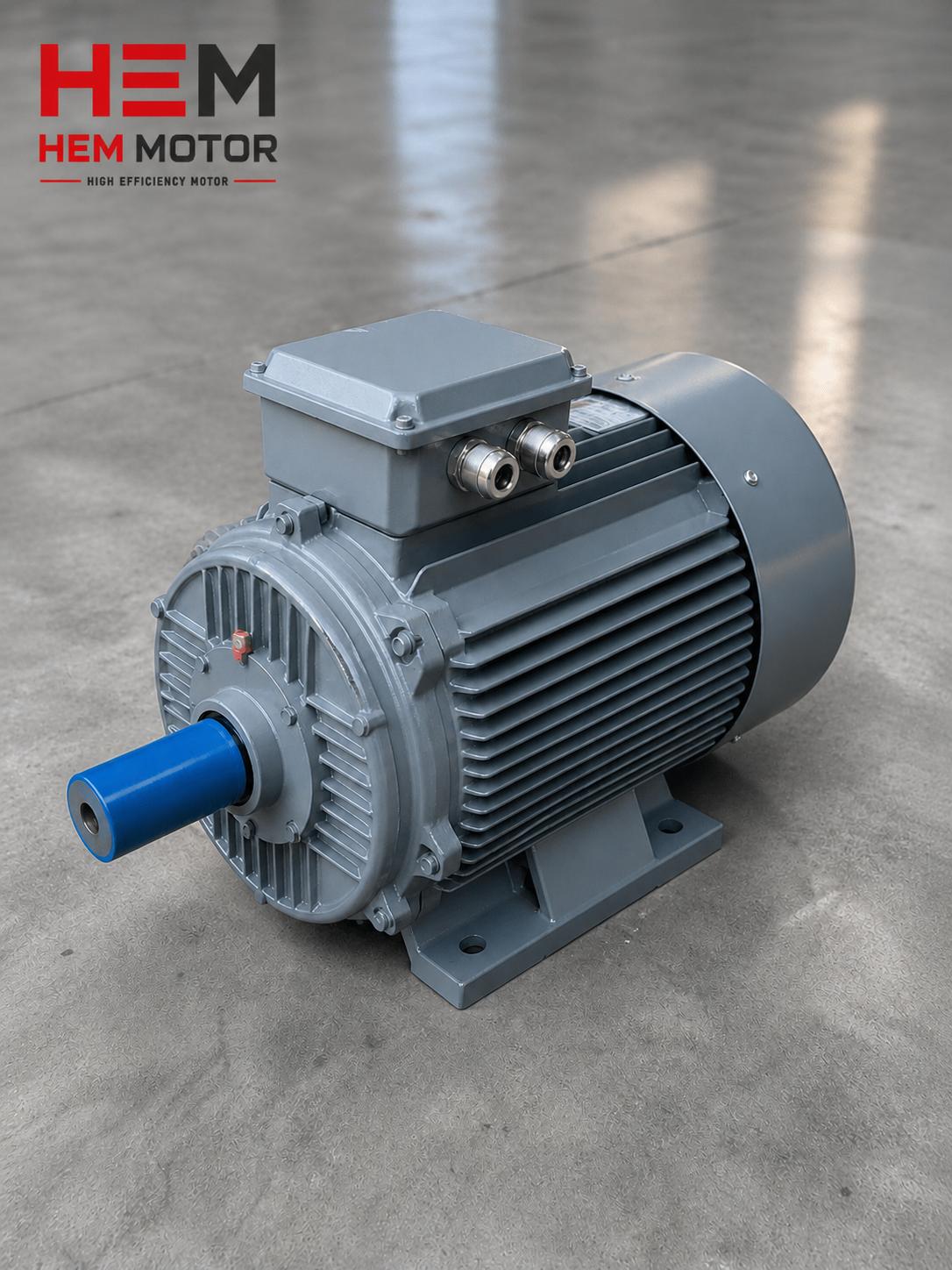

The most critical factor in whether an asynchronous motor can move a hard load is often an overlooked detail: rotor slot geometry. In machines that demand high starting torque such as crushers, conveyors, piston compressors and mills, a standard rotor design can fall short. This is where deep-bar and double-cage rotor designs come into play, because these rotors provide both high torque and relatively low current at start, enabling the motor to move a hard load.
The physical mechanism behind this behaviour is the skin effect. At the moment of start the motor is stationary and the rotor frequency equals the line frequency; this high frequency pushes the current in the rotor bar toward the outer part of the bar. Because the effective cross-section of the current narrows, the rotor's effective resistance rises, and this rise directly increases starting torque. As the motor accelerates, the rotor frequency falls, the current spreads across the whole bar cross-section, the effective resistance decreases and efficiency returns to its normal level. This way the motor delivers both a strong start and efficient continuous operation.
Choosing the right rotor design is the key to success in hard load profiles. HEM Motor manufactures asynchronous motors suited to different load characteristics and, given the load torque curve, recommends the correct design. For more about our product range and technical approach you can visit our homepage.
How Rotor Slot Geometry Determines the Starting Characteristic
The starting behaviour of an asynchronous motor is largely determined by the cross-sectional shape and placement of the rotor bars. In a standard squirrel-cage rotor the bars are relatively shallow and wide; this structure provides efficient continuous operation but limited starting torque. Hard loads require a different approach. The deep-bar rotor and the double-cage rotor are two basic solutions designed to increase starting performance.
Deep-Bar Rotor
In a deep-bar rotor the bars are placed in a narrow, deep slot. At start, due to the skin effect, the current concentrates in the upper part of the bar; this means current passing through a small cross-section, which raises the effective resistance. High rotor resistance means high starting torque. As the motor accelerates, the frequency falls, the current spreads through the full depth of the bar and the resistance drops to its normal value. The deep-bar rotor thus offers both a strong start and efficient operation with a single structure.
Double-Cage Rotor
A double-cage rotor has two separate bar layers: an outer high-resistance cage and an inner low-resistance cage. At start the current concentrates in the outer cage due to the skin effect, and this high-resistance cage produces strong starting torque. As the motor approaches rated speed, the current shifts to the inner cage; the low-resistance inner cage provides efficient continuous operation. This division of labour between the two cages makes the double-cage rotor ideal especially in applications requiring very high starting torque.
NEMA Design A/B/C/D Curves and Their Meanings
The starting behaviour of the rotor design is classified by the torque-speed curves defined by NEMA. This classification allows quick understanding of which load type a motor suits. In asynchronous motor selection, reading the NEMA Design code correctly eliminates the risk of buying a wrongly designed motor that cannot move the load.
- Design A: High starting current, normal starting torque and low slip. Generally used for special applications.
- Design B: General-purpose standard design. Normal starting torque, normal starting current and low slip. Ideal for soft-starting loads such as pumps and fans.
- Design C: High starting torque, normal starting current. Achieved with a double-cage rotor; suited to load-starting applications such as conveyors, crushers and piston compressors.
- Design D: Very high starting torque and high slip. Preferred in presses, cranes and impact loads, where short-duration high torque is needed.
When interpreting these curves, the torque demanded by the load and the torque produced by the motor must be evaluated together. The load's resistance torque at start must always be lower than the torque the motor can produce at the same speed; otherwise the motor cannot start, or starts very slowly and overheats. To address the correct power and speed selection together, you can use our power and speed selection guide.
Correct Design Selection in Hard and Impact Loads
Each load type has its own starting and operating characteristic. Choosing the right rotor design determines whether the motor can meet this characteristic. A wrong choice leads either to the line stopping due to insufficient torque at start, or to the motor burning out due to constant overcurrent.
Crushers and Breakers
Stone crushers are hard applications that must restart when they stop under load. Jaw or impact crushers produce very high resistance torque at start. Motors with Design C or D characteristics and double-cage or deep-bar rotors should therefore be preferred.
Conveyors
A loaded belt conveyor may have to start with material on it. In this case high starting torque is needed to overcome the high static friction. Design C motors offer a balanced solution in conveyor applications.
Piston Compressors and Mills
Piston compressors produce a pulsating load torque and demand high torque at start. Mills require strong starting torque to move a loaded inertial mass. In both applications, the right rotor design ensures the motor runs without strain.
The Relationship Between Slip, Efficiency and Heating
Designs that produce high starting torque generally have slightly higher slip at rated speed. Slip shows how far behind synchronous speed the motor rotates and is directly related to efficiency. In very high starting torque designs like Design D the slip is high; this means more heating and lower efficiency in continuous operation. Design D should therefore be preferred only in impact applications requiring short-duration high torque.
In contrast, deep-bar and double-cage rotors (Design C) provide high torque at start while largely preserving efficiency at rated speed. This balance makes them ideal for continuously running hard-load applications. The motor's pole count also plays a role in this balance; we addressed correct pole selection for slow loads in our asynchronous motor pole selection article.
Data Needed for Correct Motor Selection
Selecting the right asynchronous motor for a hard load requires clearly defining several basic data points. A selection made without this data relies on guesswork and carries a high risk of error. The following information matters in determining the correct design.
- Load torque curve: the torque the load demands from start to rated speed.
- Inertia (GD² or J): the inertia of the mass to be moved, which determines start time.
- Starting frequency: how many starts per hour, which affects the motor's heating limit.
- Duty cycle: whether operation is continuous (S1) or intermittent.
- Ambient conditions: ambient temperature, dust and moisture, which determine the protection class.
With this data the motor's torque reserve is calculated and the appropriate NEMA Design class is determined. A correctly calculated torque reserve ensures the motor moves the load safely and runs for a long life.
Starting Current and Grid Effect
An important advantage of deep-bar and double-cage rotors is that they provide high starting torque with a relatively low starting current. While a standard motor needs high current for high torque, these designs use the skin effect to keep the current limited. Even so, in large motors the starting current can cause voltage drop in the grid.
In such cases, solutions such as star-delta starting or a soft starter are evaluated. But since these methods also reduce the starting torque, they must be applied carefully on hard loads, because the reduced torque may not be enough to move the load. The rotor design and starting method must therefore be planned together.
Torque Reserve and Start Time Calculation
At the heart of motor selection for a hard load lies the concept of torque reserve. Torque reserve expresses how much above the torque the load demands at each speed the motor can produce. Without sufficient torque reserve the motor either cannot move the load at all, or accelerates very slowly, drawing high current over a long start time and overheating. Across the whole region from start to rated speed, the motor's torque curve must therefore stay above the load's resistance curve.
Start time depends on the ratio of the inertia to be moved to the net accelerating torque. The greater the inertia and the smaller the net torque, the longer the start. Since a long start time heats the rotor bars and the winding, the high starting torque provided by deep-bar and double-cage rotors becomes decisive here. These designs increase the net accelerating torque, shortening start time and reducing the duration of thermal stress.
The Effect of Frequent Starting on the Motor
In some applications the motor starts many times per hour. Each start means high current and heat generation. In frequently starting applications the maximum permitted number of starts per hour must not be exceeded; otherwise winding heat accumulates and insulation life shortens. In such applications both rotor design and thermal protection must be carefully planned, and a larger-frame motor selected if necessary.
Thermal Protection and Winding Safety
Asynchronous motors working on hard loads are exposed to heat stress due to overload and long starts. Correct thermal protection is therefore critical for motor life. A thermal overload relay is set to the motor's rated current and disconnects the motor in case of overcurrent. In addition, PTC thermistors or PT100 sensors placed in the motor winding provide more precise protection by directly monitoring winding temperature.
The correct insulation class is also fundamental to winding safety. F class insulation offers a safe operating margin at high ambient temperature and under hard loads. In dusty and humid environments, at least IP55 protection keeps the winding protected from external factors. In asynchronous motor selection, not overlooking these protection elements alongside the rotor design is the guarantee of long, trouble-free operation.
The Risks of Driving a Hard Load with a Standard Motor
Using a standard Design B motor on a hard load out of cost concern may look cheap in the short term but becomes expensive in the long term. When a standard motor cannot produce enough torque at start, the load accelerates very slowly; over this extended start time the motor draws several times its rated current. The result is overheating of the winding and rapid ageing of the insulation. This repeated strain causes the motor to burn out far earlier than expected.
In addition, insufficient starting torque in some cases prevents the load from moving at all. The motor then remains in a locked-rotor state and reaches critical temperature very quickly. A correctly designed double-cage rotor or deep-bar rotor eliminates these risks from the outset. The initial investment in the right rotor design for hard-load applications is therefore a smart choice that prevents future failure, production loss and replacement costs.
Frequently Asked Questions
What is the difference between a deep-bar rotor and a double-cage rotor?
In a deep-bar rotor, a single narrow, deep bar provides high resistance at start through the skin effect. A double-cage rotor has two separate cages, a high-resistance outer one and a low-resistance inner one. The double-cage design can generally produce higher starting torque; the deep-bar design is simpler and more economical. One or the other is preferred depending on the load profile.
Which NEMA Design class should I choose?
For soft-starting loads such as pumps and fans, Design B is sufficient. For load-starting applications such as conveyors, crushers and piston compressors, Design C is preferred. For impact loads requiring short-duration very high torque, such as presses and cranes, Design D is suitable. The correct choice is made according to the load's torque curve.
Is a high-starting-torque motor efficient in continuous operation?
Deep-bar and double-cage rotors with Design C characteristics provide high torque at start while largely preserving efficiency at rated speed. In contrast, very high starting torque designs like Design D show lower efficiency and more heating in continuous operation due to high slip, so they are recommended only for short-duration impact loads.