English
 Türkçe

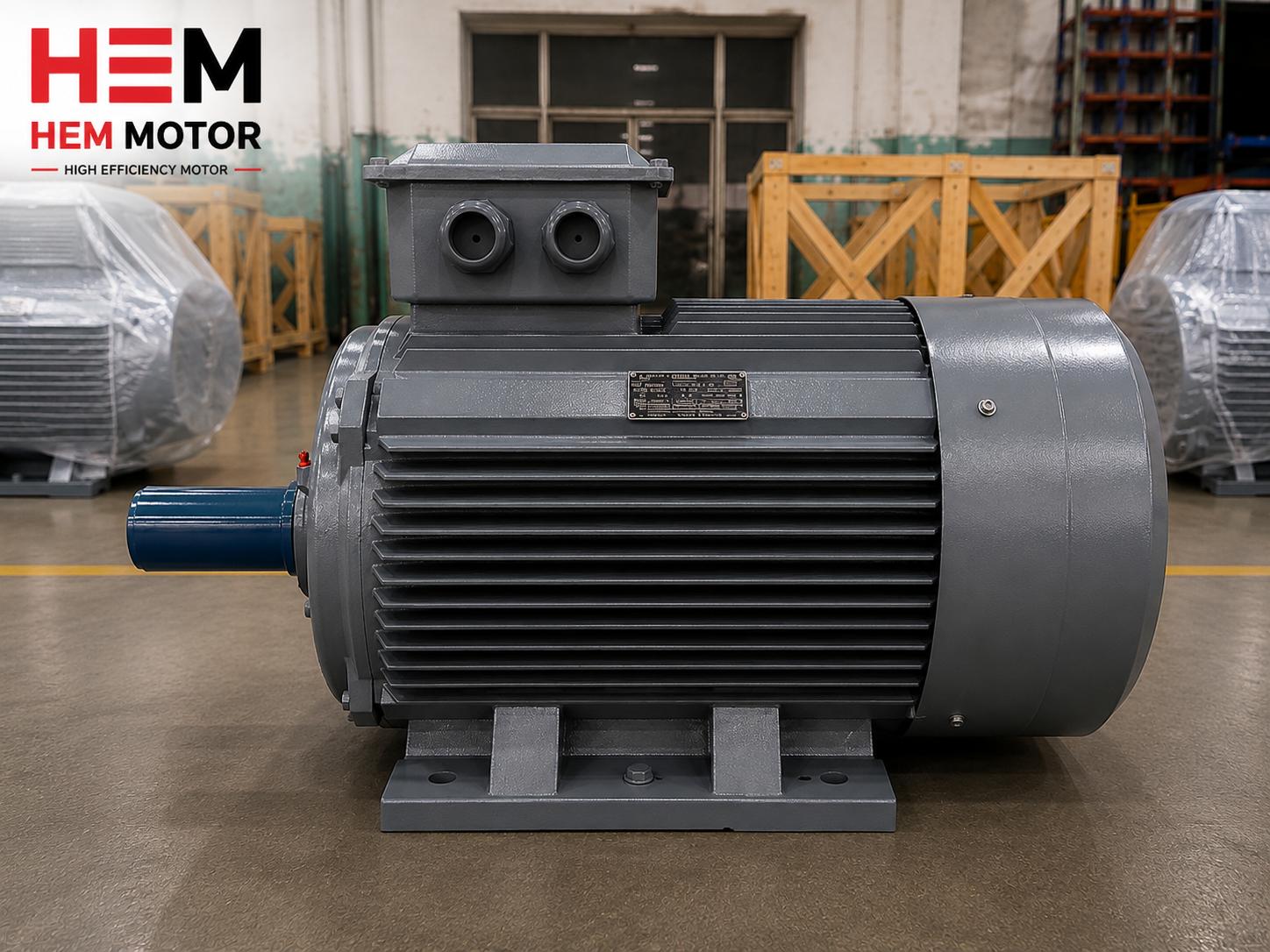

Direct online starting of large asynchronous motors draws an inrush current of 6-8 times the rated current from the grid. This high current causes voltage dips on the grid, fuse trips and mechanical shocks. While star-delta starting partly solves this problem, it is not sufficient for every application. This is where autotransformer stepped starting comes in as a powerful alternative, especially for large, high-inertia loads.
As a manufacturer and supplier shipping high-power motors from stock, we frequently remind customers that the starting method must be considered together with motor selection. In this article we examine autotransformer stepped starting in asynchronous motors from a technical standpoint: how it serves as an alternative to star-delta, how it reduces inrush current, and the correct motor selection suited to it.
Why Is Inrush Current a Problem?
As an asynchronous motor goes from standstill to full speed, it draws a very high current, because at the first instant the rotor is not yet turning, slip equals one, and the motor behaves almost like a short-circuited transformer. This inrush current is acceptable on small motors but stresses the grid on large ones. Its consequences include:
- Sudden voltage drop on the grid affecting other devices on the same line.
- Nuisance tripping of protection elements (fuses, breakers).
- Mechanical shock on couplings, gears and belts from high starting torque.
- Thermal fatigue of windings under frequent starting.
For this reason, a starting method that limits inrush current is essential on motors above a certain power. Star-delta, soft starter, variable frequency drive and autotransformer starting are the main methods used for this purpose.
How Does Autotransformer Starting Work?
In autotransformer starting, a reduced voltage is applied to the motor during starting instead of full grid voltage. This voltage is provided through an autotransformer with stepped outputs. Typically there are steps such as 50, 65 and 80 percent. The motor starts at the lowest step, and as speed rises the contactors switch in sequence to higher steps; in the final stage the motor is brought to full voltage and the autotransformer is taken out of circuit.
Thanks to this stepped transition, the inrush current is limited in a controlled way. An important advantage is this: when the autotransformer reduces the voltage by a factor k, the current drawn from the grid decreases by k². So reducing the voltage to 65 percent brings the grid current down to about 42 percent. This offers a more flexible current-torque balance than star-delta.
Advantages of Autotransformer Starting
- Smooth, controlled starting thanks to stepped voltage.
- Effective limiting of grid current through the k² relationship.
- Achieving higher starting torque at lower current than star-delta.
- Suitability for high-inertia loads (large fans, crushers, mills).
The Difference From Star-Delta
In star-delta starting, the motor is connected in star at start; this reduces the phase voltage to about 58 percent and brings both current and torque to roughly one-third of the rated value. It is simple and economical but has two drawbacks: the starting torque is fixed (one-third) and a current/torque surge occurs during the star-to-delta transition. On high-inertia loads, this surge and low starting torque can be insufficient.
Autotransformer starting, on the other hand, gives the flexibility to adjust starting torque per application through step selection. Because the transitions are stepped, the torque surge is smoother, and the transition can be carried out without disconnecting the motor from the grid (closed transition / Korndörfer connection). On very high-speed and heavy loads, autotransformer starting is a reliable solution where star-delta falls short. We also see similar heavy-start needs in our coal crusher and mill motor applications.
Correct Motor Selection
Whatever the starting method, the real determinant is the motor itself. The starting torque characteristic of the motor chosen for autotransformer starting must match the torque-speed curve of the load to be driven. Because enough starting torque is needed to move the load even at reduced voltage, high starting torque motors (such as design N or design H class) are preferred.
- The load's moment of inertia (J) and the required starting time.
- The starting torque at reduced voltage exceeding the load torque.
- Thermal endurance of the windings during the start (important under frequent starting).
- Motor power and speed; the right pole count for the application.
The rotor's end ring and bar design directly affects inrush current and torque; we covered this in detail in asynchronous motor rotor end ring design. As a manufacturer, the high starting torque asynchronous motors we ship from stock are offered with characteristics suited to autotransformer starting. Share your load's moment of inertia, required starting torque and speed need with us and we will identify the right motor and provide a quote. To see all models, visit our homepage.
Application and Commissioning Recommendations
- Select the step voltages (e.g. 65%/80%) based on the load's starting torque need.
- Prefer a closed-transition (Korndörfer) connection to reduce torque/current surge.
- Ensure the autotransformer has thermal capacity suited to the starting duration.
- If starts are frequent, evaluate the heating limits of both motor and transformer together.
- Set protection relays according to the reduced-voltage starting current.
Closed Transition and the Korndörfer Connection
In autotransformer starting, the choice of transition method is decisive for mechanical and electrical health. In open transition, the motor is briefly disconnected from the grid and reconnected as the autotransformer is removed from the step; this short interruption causes a current and torque surge at the motor terminals. In closed transition, the Korndörfer connection is used: the autotransformer winding behaves for a moment like a series reactor, carrying the motor to full voltage without any interruption.
In the Korndörfer connection, three contactors operate in a specific sequence. First the neutral contactor and the step contactor close, and the motor starts at reduced voltage. As speed rises, the neutral contactor opens and part of the autotransformer acts as a series reactor; during this intermediate stage the motor is not disconnected from the grid. Finally the main contactor closes, bringing the motor to full voltage and taking the autotransformer out of circuit. This stepped transition minimizes torque surge and mechanical shock.
The Importance of Contactor Sequence
- The wrong sequence can cause overcurrent in the autotransformer and contactor arcing.
- Timing relays must trigger step transitions at the correct moments.
- The transition moment must come after the motor reaches sufficient speed.
- Closed transition is preferred for sensitive loads and long-cable systems.
Thermal Design and Limits of the Autotransformer
The most overlooked aspect of an autotransformer starter is that the autotransformer is designed for short-time (intermittent) operation. The autotransformer is in circuit only during starting and is sized to withstand a few seconds of high current; it is not suited to continuous operation. For this reason, the permitted number of starts per hour and the waiting time between consecutive starts are determined by the autotransformer's heating limits.
In an application requiring frequent starts, if the autotransformer is not given enough time to cool, its windings overheat and its life shortens. At this point the thermal limits of both the motor and the autotransformer must be evaluated together. If very frequent and high-inertia starts are involved, a soft starter or variable frequency drive may be more suitable than autotransformer starting. The right method depends on the application's starting frequency and load character.
The Motor's Starting Characteristic and Torque Curve
However well the starting method is designed, the start fails if the motor's torque-speed curve does not match the load. The starting torque, pull-out (breakdown) torque and nominal torque of an asynchronous motor vary with rotor design. Because starting torque decreases with the square of the voltage at reduced voltage, it is critical that the motor chosen for autotransformer starting provides sufficient torque from the start.
- The load's counter-torque curve (rising with the square for pumps and fans, nearly constant for conveyors).
- Starting torque at reduced voltage exceeding load torque at every speed.
- Pull-out torque comfortably above the load point at the transition moment.
- Thermal capacity to withstand the long start time under high inertia.
For this reason, motor selection for autotransformer starting is based not only on power but on torque characteristic. Rotor bar and end-ring geometry are the fundamental factors determining this characteristic; rotor end-ring design directly affects the balance between inrush current and breakdown torque. As a manufacturer, we identify a motor with the starting torque suited to your application's load curve from stock and provide a quote.
Comparative Evaluation of Starting Methods
To make the right decision, autotransformer starting must be weighed against the other methods. Direct online starting is the simplest and cheapest but, due to high inrush current, suits only small powers or strong grids. Star-delta is economical and common at medium powers, but it fixes the starting torque and creates a surge at transition. A soft starter provides smooth starting through thyristor control and is a compact solution; however, it generates harmonics and its starting torque is limited by voltage. The variable frequency drive is the most flexible solution, controlling both the start and the running speed, but it is the highest-cost option.
Autotransformer starting holds a special place in this spectrum: with stepped voltage adjustment it can lift high-inertia loads with low grid current, generates no harmonics, and is rugged thanks to its electromechanical construction. At very high powers and under demanding starting conditions, it remains a preferred method when a simple and robust solution is sought. Which method is suitable is determined by power, starting frequency, load character and budget.
- Direct online: Simplest, but highest inrush current.
- Star-delta: Economical, fixed starting torque, transition surge.
- Soft starter: Smooth and compact, generates harmonics.
- Autotransformer: Ideal for high inertia, harmonic-free, rugged.
- VFD: Most flexible, speed control, highest cost.
Protection, Maintenance and Operational Safety
An autotransformer starter system runs safely for many years with correct protection and regular maintenance. The contact surfaces of the contactors wear over time under the effect of inrush current; they should therefore be inspected periodically and replaced when needed. Correctly set timing relays are critical for performing step transitions at the right moments; wrong timing strains both the autotransformer and the motor.
On the motor side, there should be thermal protection, phase protection and, where needed, thermistor protection monitoring the winding temperature. On high-inertia loads, the long start time heats the windings; monitoring this heat is the most effective way to prevent winding burnout. As a manufacturer, we ship asynchronous motors with adequate thermal capacity and the right starting torque suited to autotransformer starting from stock, and we recommend the right solution by evaluating the whole system.
Frequently Asked Questions
When is autotransformer starting preferred over star-delta?
It is preferred on high-inertia loads that require significant starting torque even at reduced voltage. Star-delta fixes the starting torque at about one-third of the rated value and causes a surge during transition; the autotransformer offers a more flexible current-torque balance through step selection. Large fans, crushers and mills are typical use cases.
How much does autotransformer starting reduce inrush current?
When the autotransformer reduces the voltage by a factor k, the current drawn from the grid decreases by approximately k². For example, reducing the voltage to 65 percent brings the grid current down to about 42 percent. This k² relationship makes the autotransformer method quite effective from the grid's perspective; at the same time, since starting torque also decreases with k², the step must be selected to match the load.
Why use an autotransformer when soft starters or VFDs exist?
Soft starters and variable frequency drives are modern, flexible solutions; however, at very high powers, when a simple and rugged electromechanical solution is wanted, or when a method that generates no harmonics is preferred, autotransformer starting is still valuable. Share your application's power, inertia and duty-regime requirements and we will determine the most suitable method and motor together.