English
 Türkçe

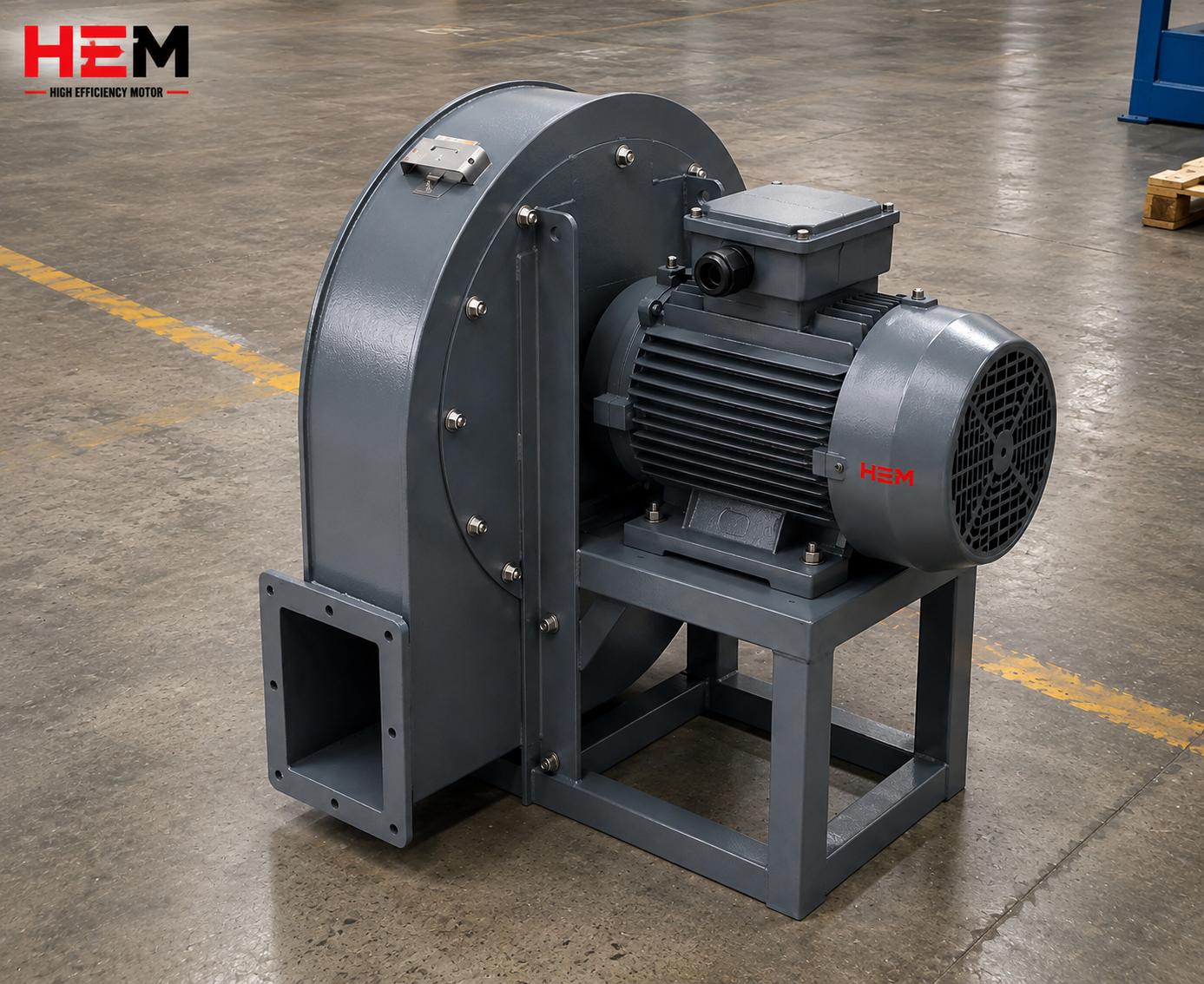

Summary (TL;DR)
- A wall-mounted propeller (axial) fan motor is designed for ventilation that demands high airflow at low pressure; correct selection depends on airflow, blade diameter, speed and outdoor conditions.
- Axial fans present a quadratic (square-law) torque load, so 4- or 6-pole motors at 1500 or 1000 rpm give the most efficient and quiet drive for low-pressure wall fans.
- For outdoor mounting, IP55 protection and Class F insulation are the minimum against dust and moisture; a rain canopy and upgrades are advised in rain-exposed positions.
- Cast iron and aluminium bodies with B3 foot or B5/B14 flange mounting fit most propeller fan hubs; supply from stock prevents project delays.
- HEM Motor manufactures and stocks fan and ventilation motors from 0.25 kW to 355 kW, matching the correct airflow-pressure point with fast quotes and delivery.
A plant's ventilation performance is often decided by a plain-looking propeller (axial) fan bolted to a wall. These fans expel hot air from workshops, supply fresh air to warehouses, and balance the climate in poultry houses and greenhouses by moving large volumes of air against a small pressure difference. Yet the component that truly determines how efficiently, quietly and durably the fan moves air is the electric motor behind it. The wrong speed, an insufficient protection class or an incorrect power rating leads to both wasted energy and premature failure. This article explains how to select a wall-mounted axial fan motor correctly, which parameters are critical, and how to source the right power from stock.
What Is an Axial Fan and Why Is It for Low Pressure?
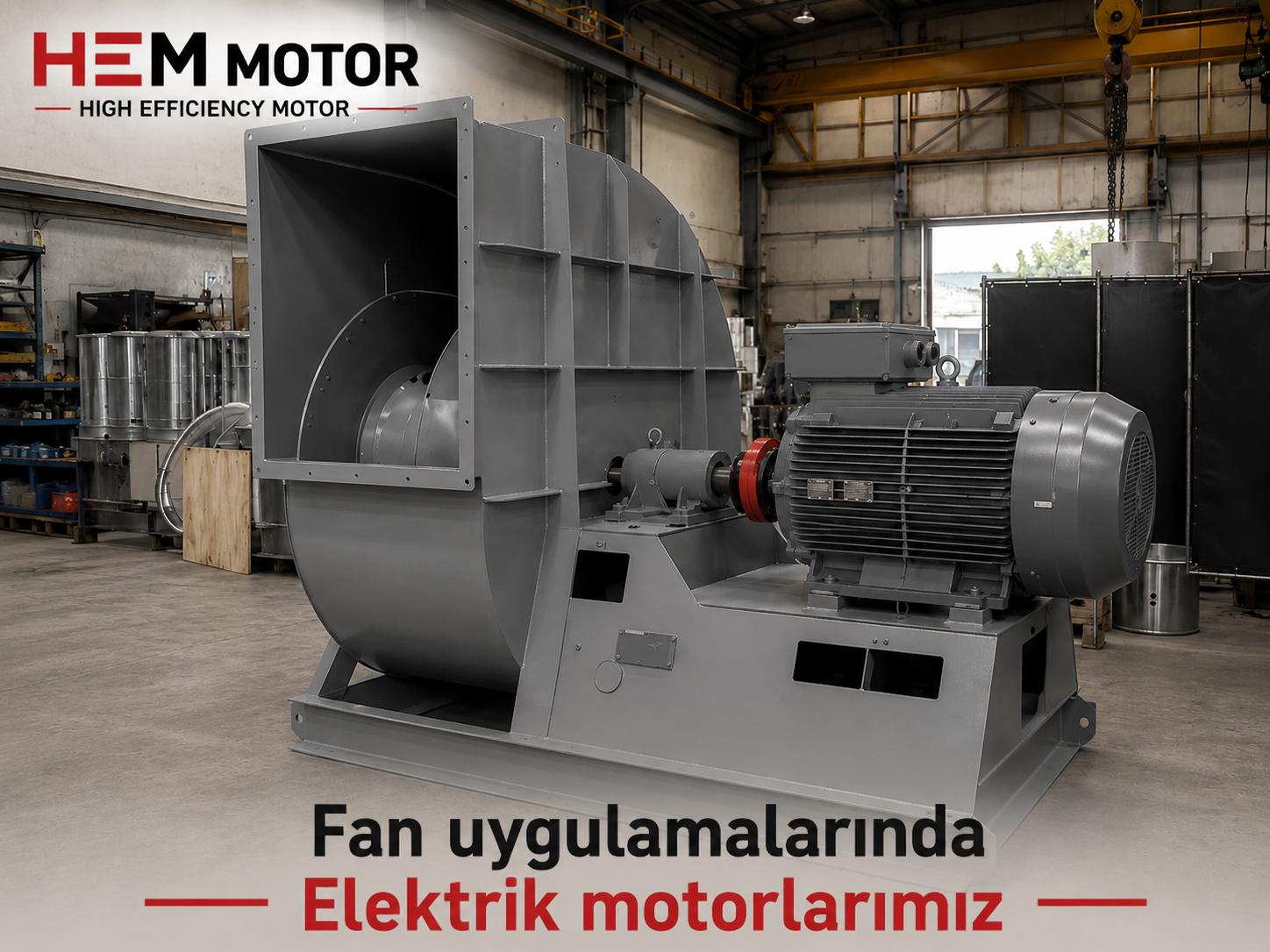
Axial fans move air along the propeller (blade) axis, meaning inlet and outlet share the same direction. This geometry suits moving very high airflow (m³/h) against a relatively low pressure difference (Pa). Wall-type propeller fans typically operate in the 50–300 Pa range to push large air volumes over short distances. Centrifugal fans, by contrast, are preferred where high pressure and ducting are involved.
This physical difference maps directly onto motor selection. A low-pressure wall fan asks for relatively low power but can be noisy at high speed. That is why most wall fans use 4-pole (1500 rpm) motors, or 6-pole (1000 rpm) motors in quieter applications. A 2-pole 3000 rpm motor only makes sense in small-diameter, high-speed compact fans.
Quadratic Torque: How Fan Load Affects the Motor
Fan and propeller loads follow a quadratic torque curve: required torque rises with the square of speed and power with the cube. This has two important consequences. First, running the fan slightly below rated speed cuts power draw substantially, which is why speed control via a variable frequency drive is so efficient. Second, fan torque is low at start, so axial fan motors usually start easily with direct-on-line (DOL). Still, large-diameter, high-inertia propellers can stretch the start, heating the winding, so correct power and duty-type selection matter.
Determining Motor Power by Airflow and Pressure
To size a wall fan motor, clarify three values: the required airflow (m³/h or m³/s), the total pressure the fan must overcome (Pa), and the fan efficiency. The approximate shaft power is the product of airflow and pressure divided by fan efficiency, with a safety margin added for coupling or belt-drive losses.
- Small workshop/warehouse wall fans: 0.25–1.5 kW 4-pole motors are usually sufficient.
- Mid-size industrial exhaust fans: handled by 1.5–7.5 kW, 4- or 6-pole motors.
- Large greenhouse/barn and tunnel ventilation fans: high airflow calls for 5.5 kW and above, mostly 6-pole low-speed motors.
Oversizing runs the motor at low load, hurting power factor and efficiency; undersizing brings constant overload and overheating. Matching the fan curve to the operating point is essential to find the right point.
Speed and Pole Count Selection
In wall-type axial fans, speed selection drives both airflow and noise. With a fixed blade diameter, airflow and noise climb quickly as speed rises. So low speed suits large-diameter fans and high speed suits small-diameter fans.
4 Pole (1500 rpm)
The most common wall fan motor. Its balance of airflow, noise and power fits most industrial ventilation. It pairs with standard propeller diameters and enjoys wide stock availability.
6 Pole (1000 rpm)
Preferred for large-diameter, high-airflow and quiet greenhouse, barn and cold-store fans. Lower speed reduces blade-tip speed and therefore aerodynamic noise.
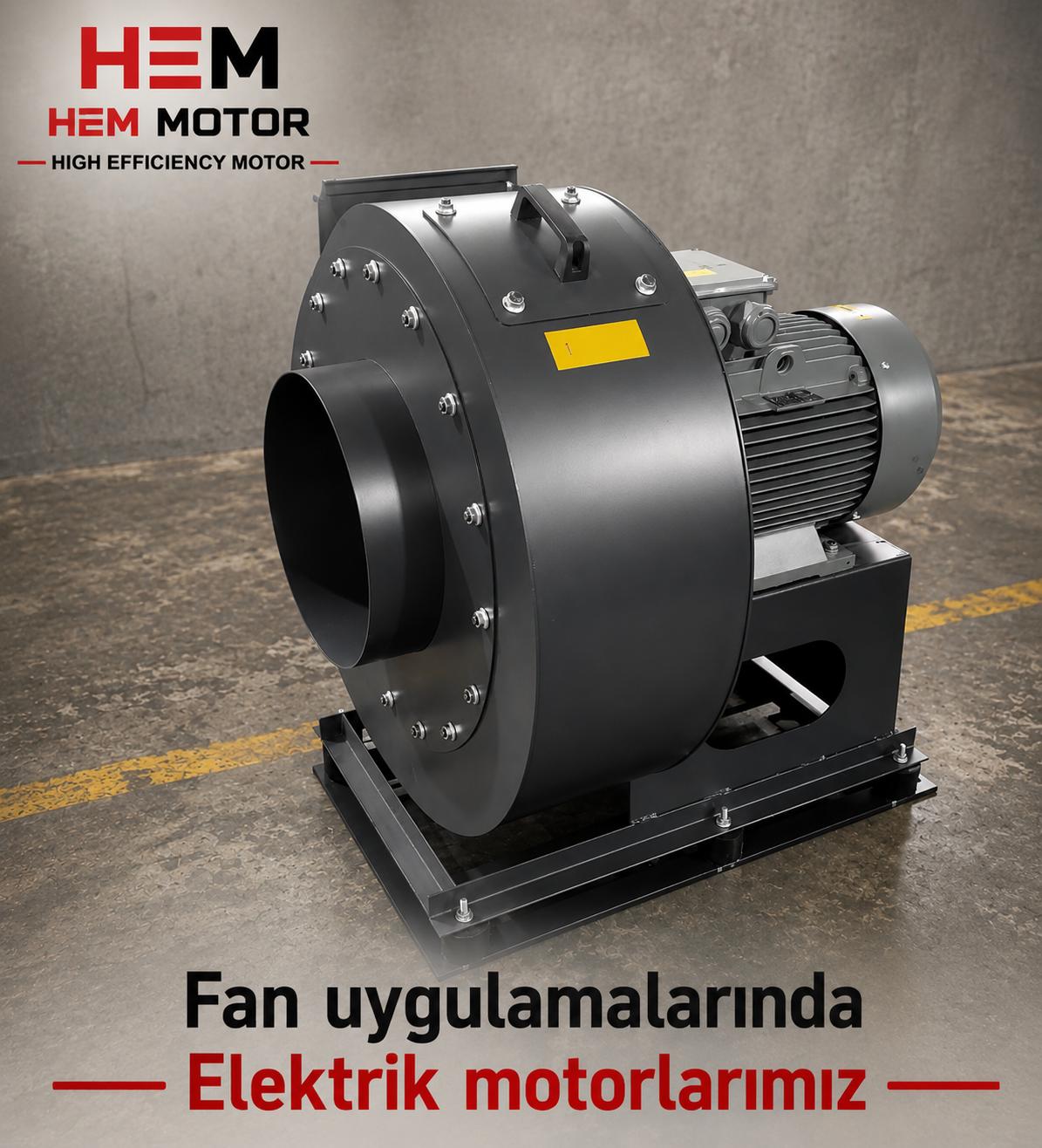
Outdoor Conditions: IP Protection, Insulation and Rain Canopy
Wall fans are usually mounted on building façades, eaves or walls facing open areas, exposing the motor to dust, moisture, rain and temperature swings. Our standard industrial motors are built to IP55 protection and Class F insulation, ensuring safe operation against dust ingress and water jets from any direction.
- Direct rain exposure: a rain canopy (protective roof) is advised for rain landing on the fan cowl.
- Dusty/agricultural environments: an IP65/IP66 upgrade and dust-tight seals may be preferred.
- Cold climate/condensation risk: an anti-condensation heater (space heater) option is valuable to prevent moisture in an idle motor.
Mounting Type and Mechanical Compatibility
In propeller fans the motor is usually direct-coupled to the propeller (direct drive) or, in some large fans, belt-driven. With direct drive, the motor shaft diameter, key size and hub connection must match the propeller exactly.
- B3 (foot): for structures fixed to the fan frame via feet.
- B5/B14 (flange): for compact applications bolted directly to the propeller hub or fan plate.
- B35 (foot+flange): ideal for robust mountings needing both base support and a flange.
Aluminium bodies are practical in small-to-mid power wall fans for their light weight and corrosion resistance; cast iron bodies provide durability under heavy duty, high vibration and impact.
Efficiency and Energy Cost
Ventilation fans often run long hours or continuously, so motor efficiency feeds straight into the electricity bill. IE3 and IE4 efficiency-class motors consume less energy for the same airflow, delivering significant savings over the years. On large continuously running fans, switching to an IE4 super-premium motor can pay for itself quickly. Because the energy consumed over a fan motor's service life vastly exceeds its purchase cost, the efficiency class should be treated as a core selection criterion rather than an optional upgrade. When you compare two motors that move the same air, the small price difference of a higher efficiency class is recovered through lower running cost, while the fan keeps delivering the same airflow and pressure.
Noise, Vibration and Bearing Life
Wall fans frequently sit close to occupied spaces, so acoustic comfort matters. Three sources dominate fan motor noise: aerodynamic noise from the blade tips, magnetic noise from the motor itself, and mechanical noise from bearings and imbalance. Choosing a lower-speed, higher-pole motor for a large blade directly cuts aerodynamic noise, since blade-tip speed falls. A well-balanced rotor and quality bearings keep mechanical noise low and extend service life. In direct-drive propeller fans, the propeller adds radial and axial load onto the motor shaft, so the bearing arrangement must tolerate the fan's weight and thrust. For outdoor fans that start and stop with the seasons, an idle motor can collect condensation in its bearings; periodic operation or an anti-condensation heater protects bearing grease and prevents corrosion. Specifying the right bearing clearance and grease for the ambient temperature is part of a durable fan motor selection.
Replacement and Equivalent Selection
When an existing wall fan motor fails, the fastest path back to operation is an equivalent replacement that matches the original frame size, shaft diameter, mounting type and electrical ratings. Reading the old motor's nameplate — power in kW, speed in rpm, voltage, frequency, frame and mounting code — lets us match a current IE3 or IE4 motor that bolts straight onto the existing fan without mechanical rework. Keeping the same frame and mounting means the propeller hub, guard and wall bracket all stay in place, minimising downtime. If the original motor was an older, lower-efficiency unit, the replacement is also an opportunity to step up to a higher efficiency class and reduce the long-term running cost of a fan that operates many hours a year.
Supply from Stock and the Right Quote
The most common problem in ventilation projects is the inability to source the right motor on time. As a manufacturer and seller, HEM Motor keeps the most-requested fan motor power-speed combinations in stock, so you avoid lead-time risk in wall fan replacement or new installations. To pin down the motor matched to your airflow-pressure point, align the equivalent frame and mounting type, and get a fast quote, simply share your requirements. Contact us for current electric motor prices and stock status.
Frequently Asked Questions
How many poles should the motor have for a wall-type axial fan?
For most industrial wall fans, a 4-pole (1500 rpm) motor is the most balanced choice. For large-diameter, high-airflow fans that must run quietly — greenhouse, barn and cold-store fans — a 6-pole (1000 rpm) motor gives lower noise and suitable airflow. 2-pole motors only make sense in small, compact fans.
What protection class should a façade-mounted fan motor have?
Wall fan motors facing open areas should be at least IP55. In positions of direct rain a rain canopy is advised, in heavily dusty environments an IP65/IP66 upgrade, and in cold climates an anti-condensation heater. Class F insulation is standard for high-temperature endurance.
Is it sensible to slow the motor to reduce fan airflow?
Yes. Because the fan load is quadratic, lowering speed cuts power draw with the cube of speed. Reducing airflow with a variable frequency drive is far more efficient than throttling the blade pitch or a damper, yielding major energy savings on large continuously running ventilation fans.