English
 Türkçe

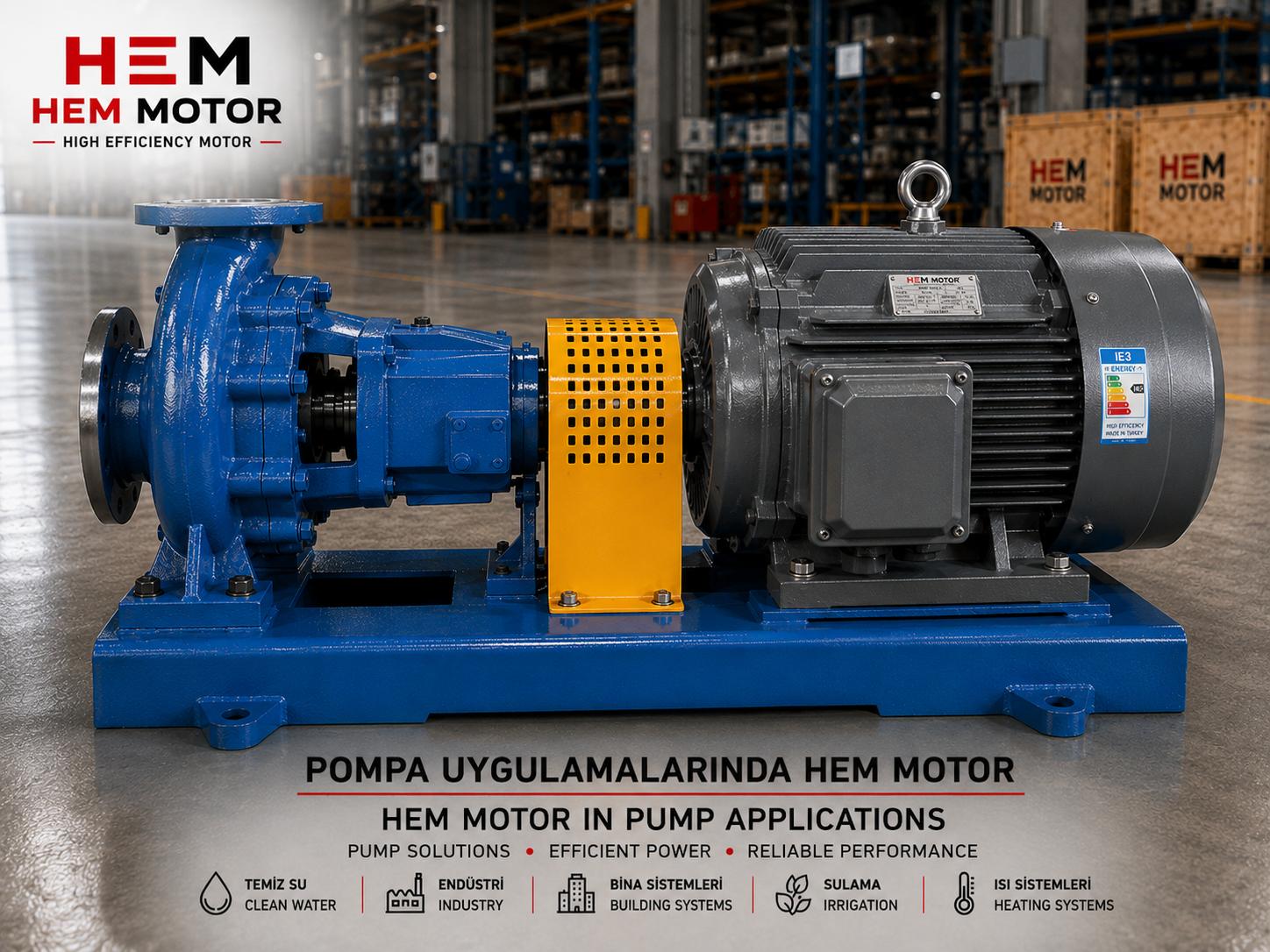

A closed-loop HVAC circulation pump is the very heart of a building, continuously moving heated or chilled water between boilers and chillers and the fan-coil, air-handling and radiator circuits. In this loop the water never opens to the atmosphere; the same water is pumped over and over. The pump's job is therefore not to lift water to a height but to overcome pipe friction loss and maintain the required flow rate continuously. This is exactly where in-line circulation pump motor selection becomes critical: choose the wrong power, speed or frame type and the system either under-heats/under-cools or wastes energy and inflates running cost. In this guide we explain step by step how to size the motor from flow and head, what continuous operation (S1 duty) demands from the motor, and how to source the right product from HEM Motor stock.
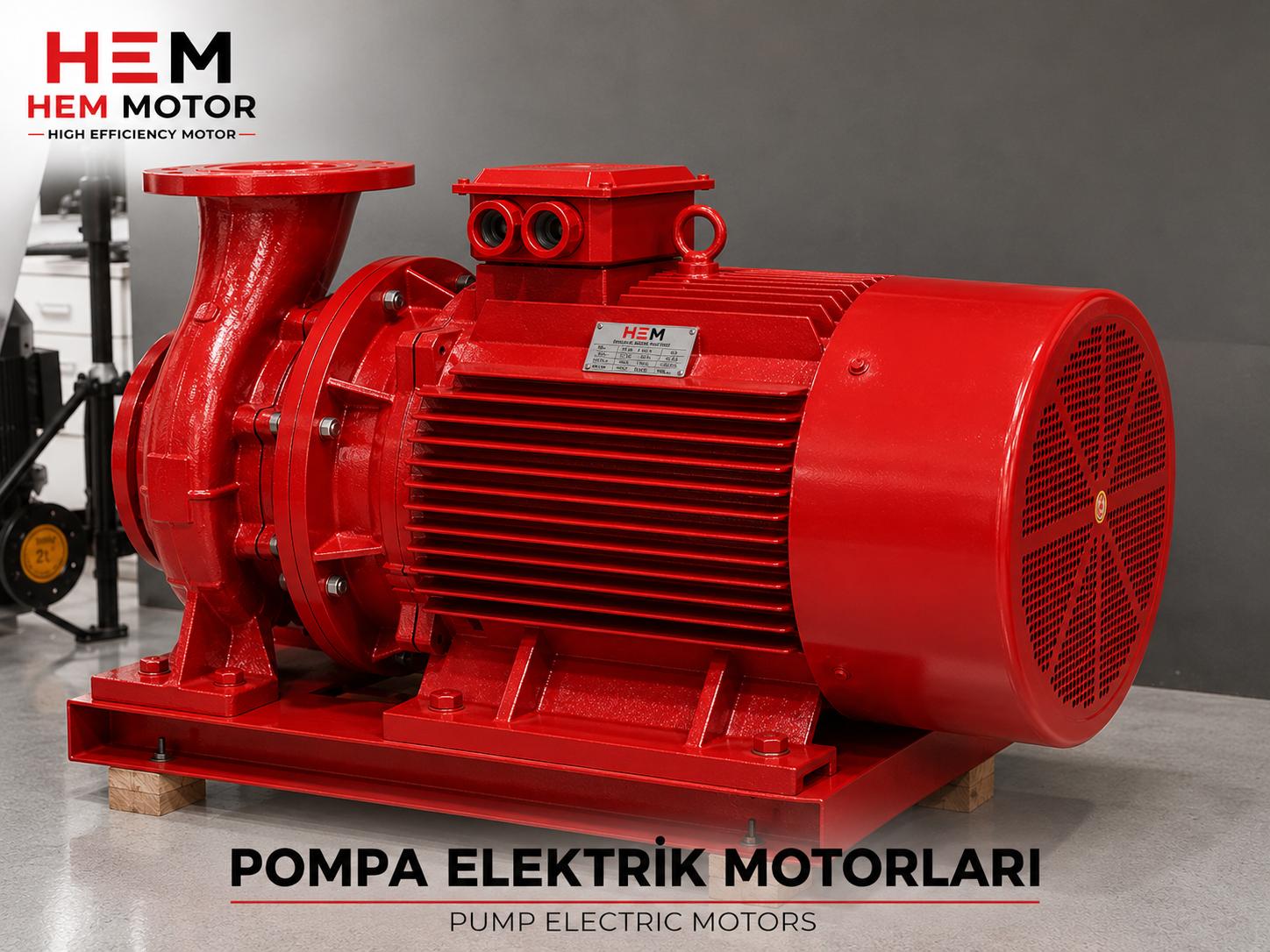
Why Correct Motor Selection Matters So Much
In an HVAC installation the pump motor is the invisible yet most decisive component of the system. Chosen correctly, it runs quietly, steadily and cheaply for years; chosen poorly, it reminds you of itself through constant complaints, high bills and unexpected stops. Because circulation lines directly determine the building's thermal comfort, motor selection is not only a technical but also an operational decision. An undersized motor causes cooling to fall short on hot days and heating to fall short on cold ones; an oversized motor needlessly raises both the initial investment and the running cost. The way to strike this balance is to clarify the system's real need through flow and head, then select the motor accordingly with a reasonable safety margin. Throughout this article we cover the steps that will help you base this decision on solid technical and supply-side foundations.
Closed-Loop vs Open-Loop From the Motor's Perspective
In an open loop (filling a well or tank, for instance) the pump moves water to a defined geodetic height; static head dominates. In a closed HVAC loop the water is already circulating inside the pipework and gains no net height. The only thing the pump must overcome is the dynamic friction loss created by pipes, valves, heat exchangers and fan-coil batteries. This difference directly affects motor selection:
- Closed loops usually have lower head but higher flow, which often makes 4-pole (1500 rpm) motors more suitable than 2-pole motors.
- Because the loop keeps moving the same water, the pump almost never stops; this mandates S1 continuous duty and the matching thermal endurance.
- Cavitation risk is lower than in open loops, but if the system lacks proper pressurisation (expansion tank), the suction side can cause trouble and influence speed and power selection.
So on an HVAC circulation line you size the motor for the high-flow/medium-pressure point, not for high lift like a vertical deep-well pump.
From Flow and Head to Motor Power
The shaft power the pump draws is determined by flow (Q), head (H), water density and pump efficiency. In practice shaft power is found by multiplying flow and head and dividing by pump efficiency; the motor is then selected with a safety margin on top. Key points for HVAC circulation pumps:
Read the Duty Point Correctly
What matters is not a single point on the catalogue curve but the intersection where the system actually sits. If system resistance is underestimated, the pump shifts right on the curve, flow rises and the motor becomes overloaded. It is therefore safest to size the motor for the worst (highest power-drawing) point the pump can reach on its curve.
Safety Margin and Service Factor
Rather than leaving a continuously running circulation motor at its full-load limit, round the calculated shaft power up to the next standard size. This way the motor runs comfortably through summer-winter load swings, scale-induced pipe resistance and filter clogging. IE3 and IE4 efficient motors provide lower heating at the same power, preserving this margin without raising running cost.
- High flow-low pressure: usually a 4-pole 1500 rpm motor gives quieter, more balanced circulation.
- Compact booster-like lines: a 2-pole 3000 rpm motor may be chosen, but noise and cavitation must be assessed carefully.
- In very large buildings, low-speed high-flow pumps may call for 6-pole options.
You can find the detail of matching power to flow and head in our centrifugal pump motor selection guide.
In-Line Pump Body and Motor Mounting Type
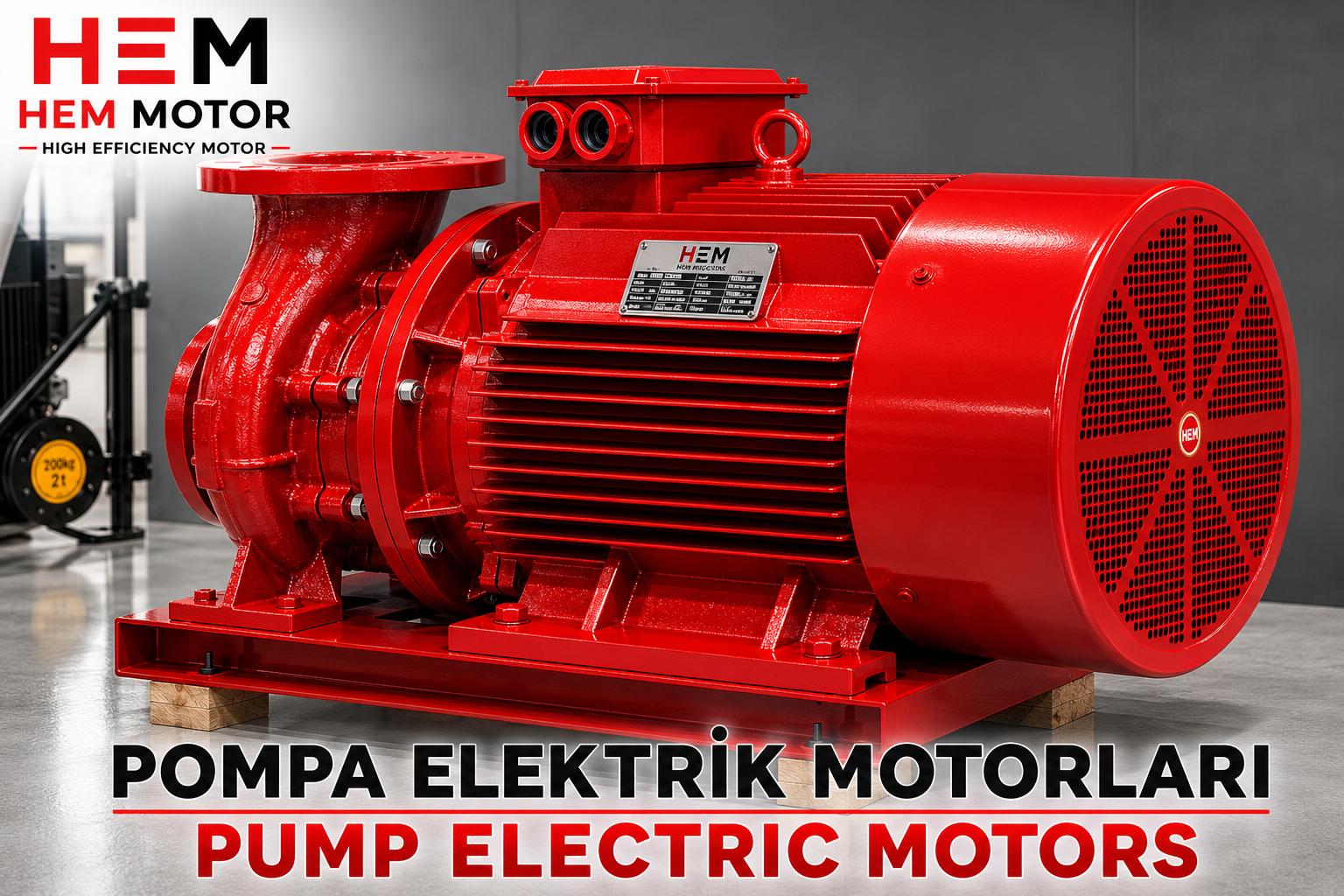
The defining feature of in-line pumps is that suction and discharge ports lie on the same axis and the pump mounts directly onto the pipe line. This favours flanged mounting types for the motor:
- B5 flanged motor: bolted directly to the pump body via the large flange, forming a compact, vibration-free unit.
- B35 (foot + flange) motor: bolted to the pump by flange and fixed to the base by feet; adds mechanical support at higher powers.
- For vertically mounted in-line pumps, the motor must suit vertical operation and resist water dripping with IP55 protection.
Correct coding of mounting type (B3/B5/B35) is the most commonly confused item at ordering. For correct supply, review our in-line and circulation pump motor supply article together with our boiler room circulation pump motors content.
Calculating System Resistance Correctly: Pipe, Valve and Heat-Exchanger Losses
Correct sizing of the circulation pump motor depends, above all, on correct calculation of system resistance. In a closed loop the total resistance is the sum of three main components: straight-pipe friction loss, local losses (elbows, tees, valves, reducers) and equipment losses (boiler, chiller, heat exchanger, fan-coil battery). If these are underestimated, the pump either delivers insufficient flow or becomes overloaded. Points the engineer must watch:
- Straight-pipe loss depends on pipe diameter and flow velocity; the smaller the diameter, the faster the loss rises. In old narrow-pipe installations, resistance is therefore higher than expected.
- Local losses form a significant part of total resistance in complex loops with many elbows and valves, and are frequently overlooked.
- Heat exchangers and fan-coil batteries must be included with the pressure drop values from the manufacturer catalogue; these rise over time with scaling.
- As filters and strainers clog, resistance increases; the safety margin in motor selection must cover this rise too.
Summing all these losses gives the true duty point, and the motor is selected at the next standard size above it. This disciplined calculation eliminates both under-circulation complaints and overheating from continuous overload. In tall buildings requiring high pressure, a multistage pump and matching motor may be needed instead of a single stage; we cover this in detail in our multistage vertical pump motor selection article.
Heating, Duty Type and Efficiency Class in Continuous Operation
An HVAC circulation pump runs 24 hours a day through the heating season and for long hours through cooling. This requires the motor to be selected for S1 continuous duty with F-class insulation and IP55 protection. Continuous operation brings two fundamental costs:
1. Energy Cost
In a continuously running motor, small percentage differences in efficiency class turn into large sums over a year. Choosing IE3 and where possible IE4 high-efficiency motors on HVAC lines is therefore a fast-payback investment.
2. Heating and Service Life
An overheating winding shortens insulation life. A correctly sized motor designed for continuous duty runs cooler; bearing and winding life increase. Our cast-iron body motors at HEM Motor deliver high mechanical strength and good heat dissipation, providing a long-life solution on continuously running circulation lines. Explore our dedicated range on the HVAC sector electric motors page.
Effect of Speed Selection on System Noise and Life
On a circulation line, speed selection determines not only flow but also the noise the system produces and the life of components. A pump running at 3000 rpm may use a smaller frame than one doing the same job at 1500 rpm; but because flow velocity rises, in-pipe noise, valve vibration and cavitation tendency also increase. In buildings where comfort matters (hotels, hospitals, offices), a low-speed motor brings both acoustic comfort and lower wear. A practical approach:
- For comfort-critical, long-running lines, make a 4-pole 1500 rpm motor your default choice.
- If space and cost dominate and sound insulation can be solved, consider the 2-pole option.
- In large building automation where variable flow is required, driving the motor with a variable-frequency drive (VFD) provides both energy savings and soft operation; the motor is then expected to have drive-compatible winding insulation.
Because winding and insulation endurance are critical when selecting a VFD-driven motor on variable-flow HVAC lines, you can see the same logic on the in-line fan side in our duct-type axial fan motor selection content.
Spare Motor Stock and Loop Continuity
In a closed-loop HVAC system, when the pump motor fails, heating or cooling stops entirely. In critical facilities such as hospitals, data centres and hotels this is an unacceptable risk. Field engineers therefore often want to keep a spare motor of the same power-speed-frame combination on site. For proper spare planning:
- Record the power, speed, frame, mounting type and shaft diameter from the existing motor's nameplate; determine the exact equivalent motor in advance.
- At the most-used powers, keep the spare motor ready from stock for critical facilities.
- Plan supply early for motors to be commissioned at season start; do not leave it to the last moment.
HEM Motor meets this spare requirement with both stock delivery at standard powers and planned project-based shipment, so your building mechanical system never suffers an unexpected stop.
HEM Motor Stock and Supply Advantage
In HVAC projects the motor is usually requested together with the pump and under a deadline. If the commissioning date is fixed, getting the motor to site on time decides the project. HEM Motor removes this risk by offering the most-used power-speed-frame combinations from stock:
- Fast delivery from stock on common 1500 and 3000 rpm, B5/B35 flanged motors.
- Equivalent motor matching and a clear quotation for project-based bulk purchasing.
- Selecting the right motor from nameplate data of an existing pump, supplied with manufacturer assurance.
For current elektrik motoru fiyatları and stock status, contact us and we will determine together the circulation pump motor best suited to your project's flow and head values.
Frequently Asked Questions
Should I choose a 2-pole or 4-pole motor for an HVAC circulation pump?
Closed-loop HVAC lines usually need high flow and medium pressure, so a 4-pole (1500 rpm) motor is quieter, more balanced and more energy-efficient in most applications. Only compact lines requiring high pressure favour 2-pole (3000 rpm). Share your duty point and we will set the right speed together.
What happens if I oversize the head?
A pump chosen for excessive head shifts right on its curve when system resistance is low, increasing flow and therefore the power it draws. This overloads the motor and wastes energy. The correct approach is to calculate the duty point from the real system resistance and select the motor accordingly.
Is an IE4 investment worthwhile on a continuously running circulation motor?
Yes. On a motor that runs non-stop for most of the year, the efficiency-class difference returns quickly as energy savings. IE3 and IE4 motors run cooler and lower running cost. HEM Motor supplies both classes from stock.