English
 Türkçe

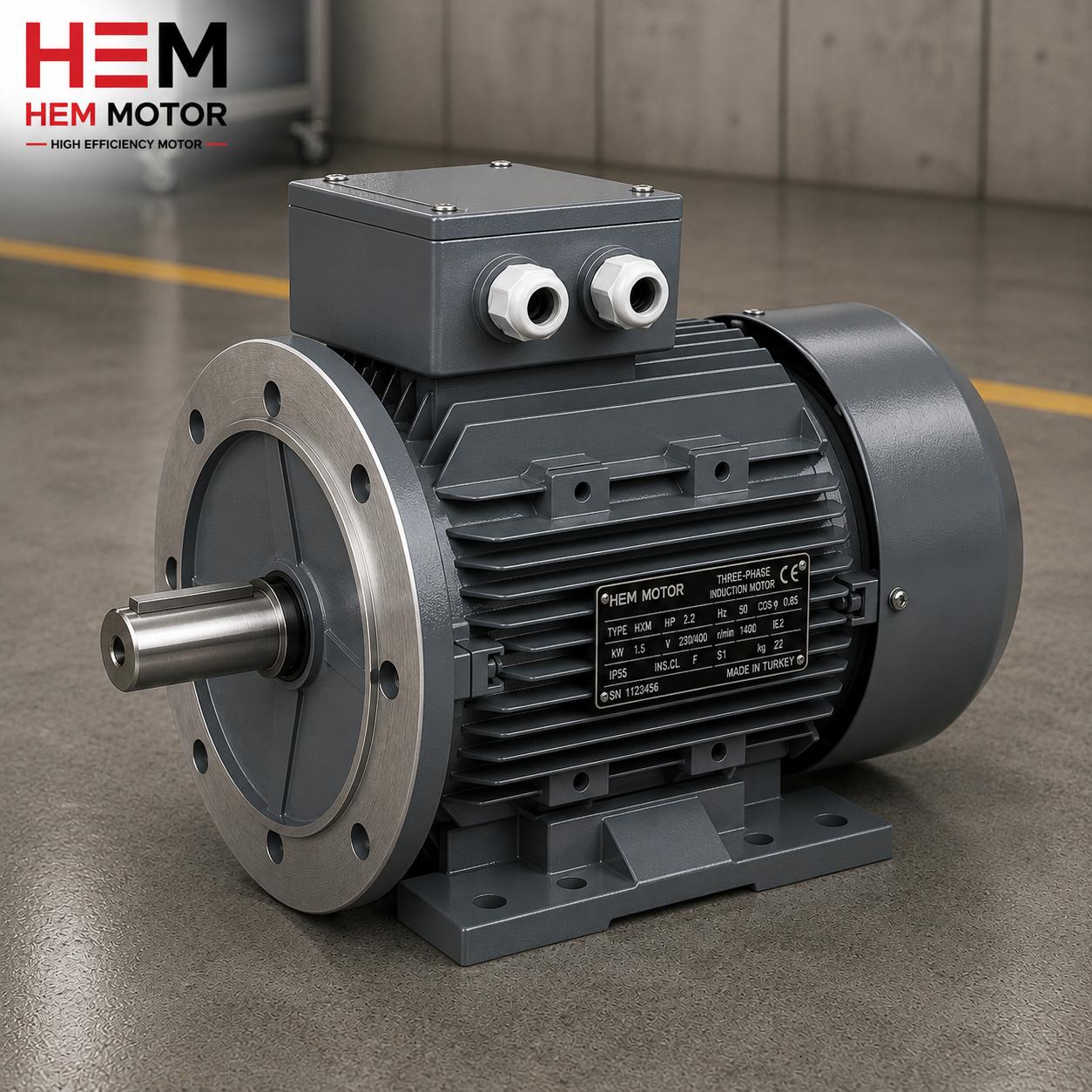

The 7.5 kW and 11 kW power classes form the most frequently supplied mid-range band of industrial electric motors in production facilities. From pumping stations to fan and blower groups, from conveyor drives to compressor units, a remarkable number of applications cluster precisely within this range. For this reason, making a sound 7.5 and 11 kW electric motor selection based on rated power alone almost always leads to a wrong or inefficient purchase. To identify the correct motor, speed, pole configuration, frame size, mounting type and — most importantly — current stock availability must all be evaluated together.
We manufacture these power classes on our own production line and deliver them from stock. In this article we explain in technical detail how to select 7.5 and 11 kW motors according to pole choice, speed range, frame type and load character. Once you have defined the configuration that suits your project, we recommend that you quickly request a quotation.
Why Is the 7.5 and 11 kW Range So Critical?
These two power values represent a transition zone in industrial motors. Motors up to 7.5 kW typically run in lighter frames with lower current draw, whereas at 11 kW the frame size grows, the starting current increases, and the mechanical coupling elements must be sized more carefully. Therefore, although the choice between 7.5 and 11 kW looks like a single step, it directly affects the facility's electrical infrastructure, panel equipment and mechanical couplings.
Correctly calculating the true demand of your application load eliminates both the unnecessary cost of buying too much power and the overheating and early-failure risk caused by insufficient power. In many facilities motors are unwittingly oversized; this condition is known as motor oversizing and it causes efficiency losses.
Pole Count and Speed Relationship: 2/4/6 Pole
In electric motors, the pole count determines the synchronous speed and therefore the speed of the driven machine. On a 50 Hz grid, a 2-pole motor runs at roughly 3000 rpm synchronous speed, a 4-pole motor at 1500 rpm, and a 6-pole motor at around 1000 rpm. Under real load these values drop by the slip ratio.
2 Pole (~2900 rpm)
2-pole 7.5 and 11 kW motors are preferred in high-speed applications. Centrifugal pumps, high-pressure blowers and some compressor drives belong to this group. Higher speed means lower torque at the same power; hence shaft and bearing selection is critical for vibration and balance at high speed.
4 Pole (~1450 rpm)
The most widely used pole configuration is 4-pole. It offers an ideal speed-torque balance for conveyors, general-purpose pumps, fans and mixers. In the 7.5 and 11 kW class, 4-pole motors form the broadest variety in our stock. Most standard gearboxes and couplings are also designed for this speed.
6 Pole (~960 rpm)
6-pole motors come into play in applications requiring low speed and high torque. Heavily loaded conveyors, mills and low-speed mixers favor this configuration. Because you produce the same 11 kW power at a lower speed with 6 poles, the reduction requirement in the transmission elements decreases.
Frame Size Selection
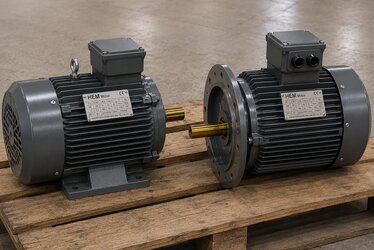
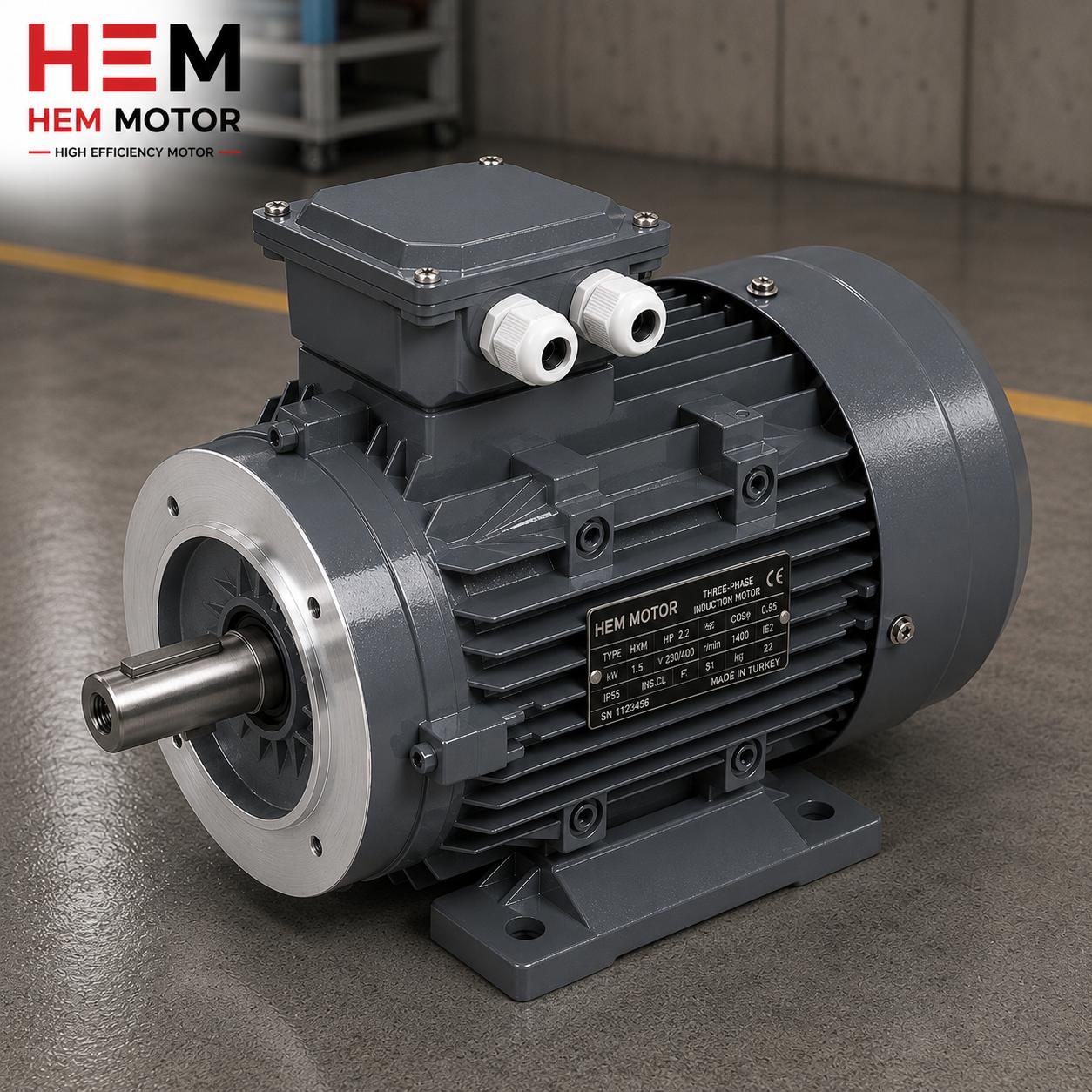
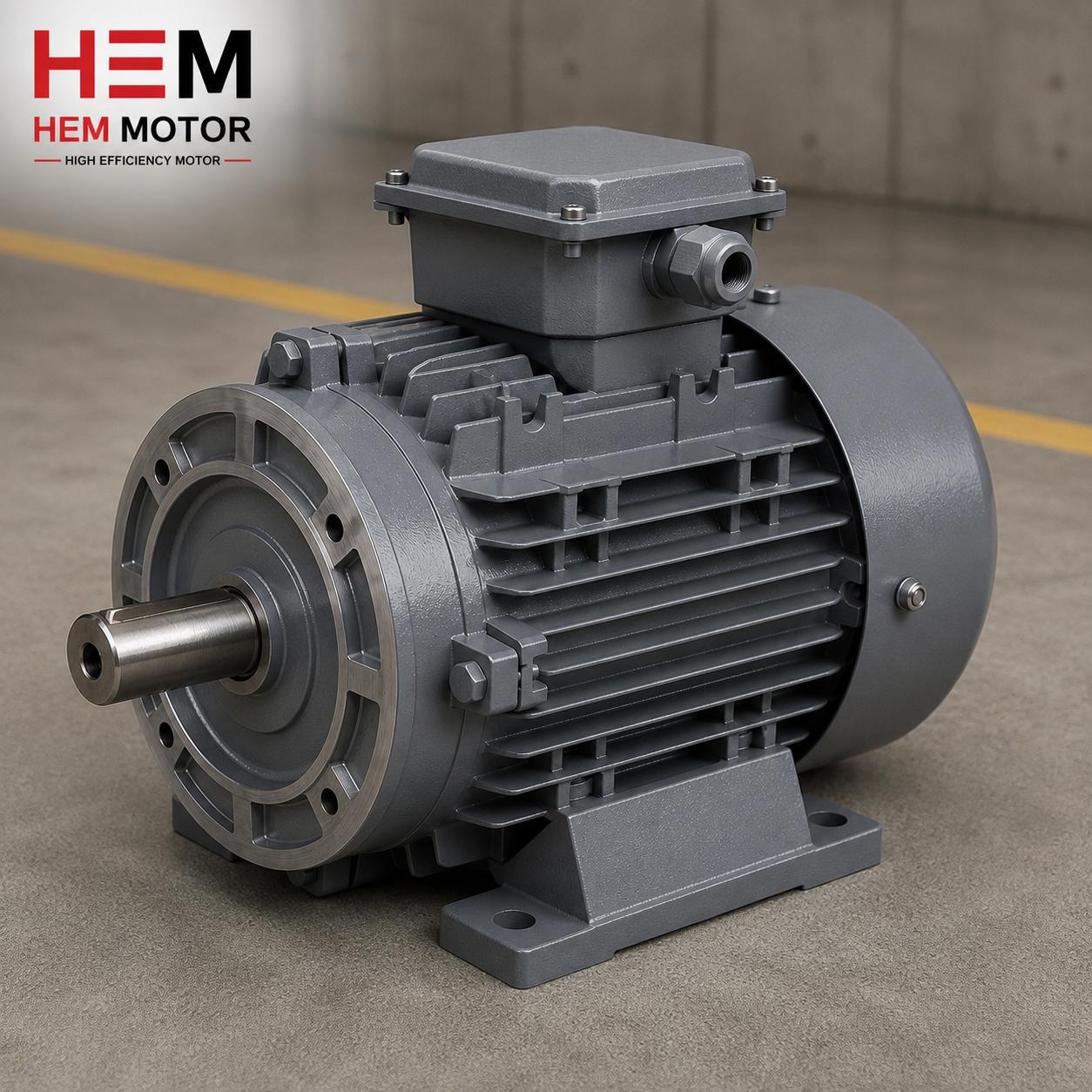
7.5 kW motors are typically built in the 132 frame class, while 11 kW motors are produced between 132 and 160 frame. The frame size determines shaft diameter, foot-hole spacing, shaft height and flange connection type. If you are replacing an existing motor, sending us the old motor's frame code, shaft height (e.g. 132M, 160M) and mounting type (B3 foot, B5 flange, B35 foot+flange) allows us to supply a fully compatible motor.
- B3 (foot mounting): For classic bolted mounting on a base.
- B5 (flange mounting): For applications connected directly to a pump or gearbox by flange.
- B35 (foot + flange): Combined mounting supported by both foot and flange.
Efficiency Class and the Importance of IE3
The 7.5 and 11 kW range falls directly within the scope of efficiency regulations. At these powers, IE3 premium-efficiency motors visibly reduce energy cost in facilities with high annual running hours. The purchase price of a motor is small compared with the electricity it consumes over its lifetime; therefore choosing a high-efficiency motor is the most economical decision in the long run. For detailed information and stock speed availability on our IE3 motors, you may contact us.
Selection According to Load Character
The load type of the driven machine is one of the most decisive factors. Variable-torque loads such as pumps and fans increase torque demand with speed and exhibit a smooth start-up profile. Constant-torque and shock loads such as conveyors, crushers and mills demand high breakaway torque at start-up.
For shock or high-inertia loads, star-delta or autotransformer starting methods or soft starters are used to limit the inrush current. While direct-on-line starting is acceptable for most panels in the 11 kW class, staged starting is recommended in facilities with grid restrictions.
The Effect of Stock Availability on the Purchase Decision
Selecting the right motor is as critical as obtaining it on time. We continuously hold the standard 4-pole configurations of high-demand powers such as 7.5 and 11 kW in stock. This lets us deliver quickly from stock without waiting for production. For cases requiring special speed, special frame or special winding, we provide a short lead time according to our production plan. When you send us your project's power, pole and mounting type, we present the most suitable stock option and delivery time.
Checklist for Correct Motor Selection
- Have the power and torque demands of the driven machine been clarified?
- Has 2, 4 or 6 pole been determined according to the required speed range?
- Has the existing motor's frame code and mounting type (B3/B5/B35) been read correctly?
- Has the IE3 efficiency class been evaluated against annual running hours?
- Is the starting method (DOL, star-delta, autotransformer) suitable for the panel infrastructure?
- Has the stock availability and delivery time of the chosen configuration been asked?
After completing this checklist, whether it is a single motor or a serial supply for an entire facility, you may also review our 2.2 and 3 kW power-speed comparison and, if a need arises at lower powers, visit our IE3 1.5 and 2.2 kW stock speed page. Our guide on efficient motors and correct sizing is also a useful reference to avoid buying excess power.
Frequently Asked Questions
Is it safer to buy an 11 kW motor instead of 7.5 kW?
No. If your real load is 7.5 kW, buying an 11 kW motor makes it run in an inefficient low-load region, lowers the power factor and causes unnecessary energy cost. The correct approach is to calculate the true load demand and select the matching power. If a safety margin is needed, a measured margin is enough.
Is there a price difference between 2, 4 and 6 pole at the same power?
As the pole count increases, the motor for the same power generally grows and requires more material, which can affect supply conditions. However, the correct choice must always be made according to the speed-torque balance the application requires. When you share the speed data, we recommend the most suitable configuration.
How fast is delivery from stock possible?
Because we continuously keep standard 4-pole 7.5 and 11 kW motors in stock, we can deliver quickly in these configurations. For requests requiring special speed, frame or winding, we share a clear lead time based on the production plan. Just tell us your need; we will determine the suitable stock option and delivery time together. For details you may visit our homepage.