English
 Türkçe

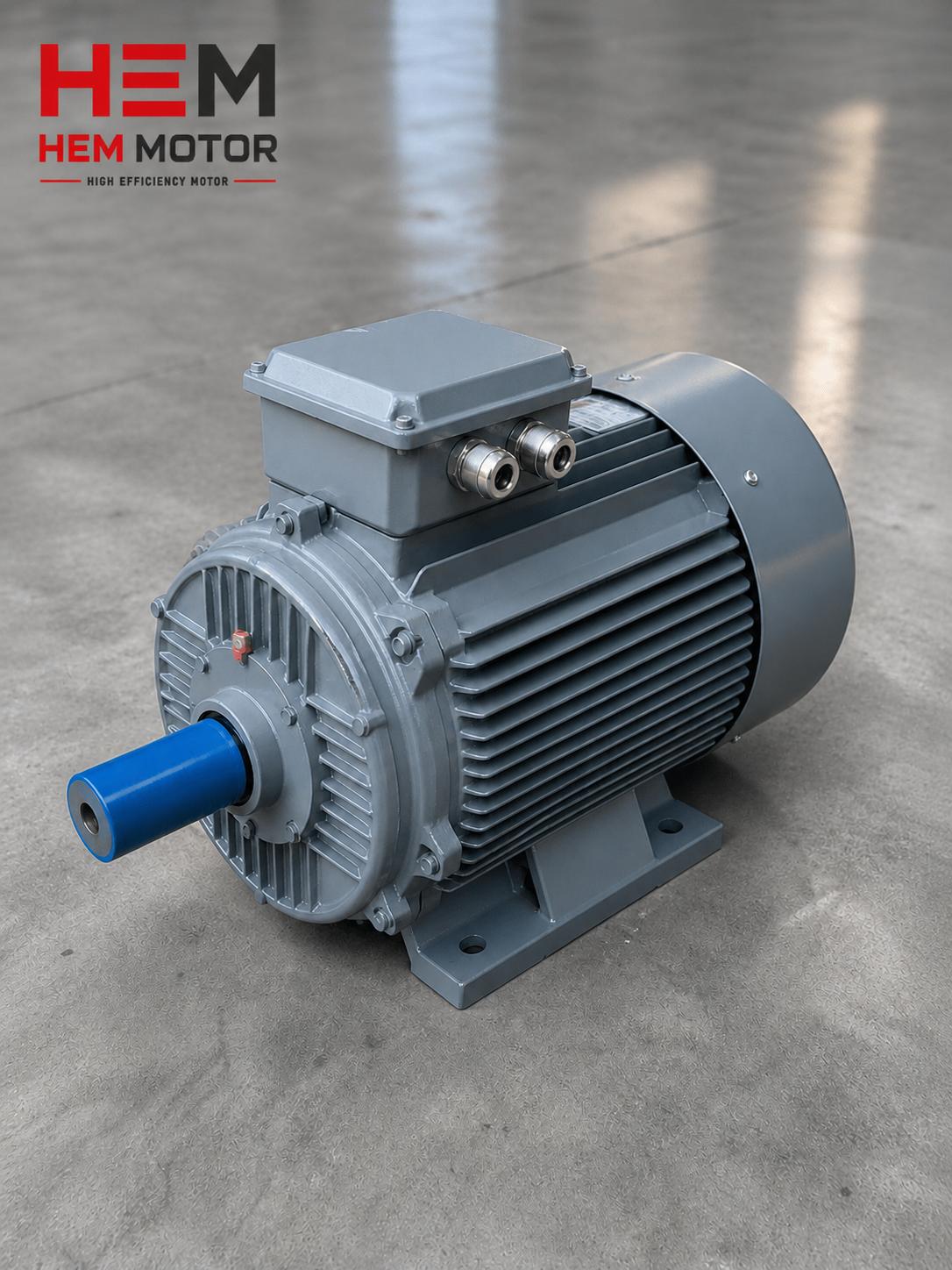

A single power rating, the 5.5 kW electric motor, is one of the most sought-after and most heavily stocked powers in Turkish industry. It appears across a very wide range of applications, from pumps to fans, conveyors to compressors, crushing-screening plants to general-purpose industrial machines. Yet two motors carrying the same 5.5 kW label can suit completely different jobs once their pole count, speed, frame size and mounting type differ. Saying 'I need a 5.5 kW motor' is therefore only the start of a correct purchase. In this guide we cover, step by step, how to select the right motor at a single power: the differences between 2-pole, 4-pole and 6-pole, the speed-frame relationship, mounting types, efficiency class and the stock-supply advantage. Our aim is to prevent the wrong motor reaching the field and to help you place your order correctly the first time.
Why Is 5.5 kW Such a Popular Power?
5.5 kW sits right in the middle of small and medium-sized industrial machinery. On one hand it answers applications where lower powers like 4 kW fall short; on the other, it offers lower investment and running cost than higher powers such as 7.5 kW. It has therefore become a kind of standard power for pump manufacturers, fan producers, machine integrators and maintenance teams. It is also critical from a stock-management point of view: because it is one of the most demanded powers, being able to source it quickly from the right supplier directly affects machine delivery times.
The first question you face when looking for a motor at this power is how many revolutions it will run at. Because even when 5.5 kW stays constant, the torque and speed combination the motor produces changes completely with the application. If you want to evaluate the stock and selection logic of 5.5 and 7.5 kW IE3 motors together, our 5.5 and 7.5 kW IE3 motor stock content is a good starting point.
2, 4 and 6 Pole: Same Power, Different Speed and Torque
The speed of an asynchronous motor is set by its pole count. On a 50 Hz grid a 2-pole motor turns at roughly 3000 rpm, a 4-pole at roughly 1500 rpm, and a 6-pole at roughly 1000 rpm. When power stays constant, torque rises as speed falls; the same 5.5 kW produces much higher torque at 6 poles but turns more slowly. Correct pole selection depends on what the application demands.
2-Pole 5.5 kW (3000 rpm)
High speed, low torque. This combination is ideal especially for applications whose efficiency rises with speed, such as centrifugal pumps, fans and compressors. In booster and pressurisation systems requiring high water pressure, and in high-speed fans, a 2-pole 5.5 kW motor is frequently chosen. Its frame size is usually smaller, offering a more compact and lighter structure than a 4-pole motor of the same power.
4-Pole 5.5 kW (1500 rpm)
The most preferred and most balanced option. A 4-pole 5.5 kW motor is the default choice for conveyor belts, reducer inputs, general-purpose industrial machines, mixers and many HVAC applications. Thanks to medium speed and medium-high torque, it suits a very wide range of machines. At this power the 4-pole motor is usually produced in the 132 frame and is the most heavily stocked combination on the market.
6-Pole 5.5 kW (1000 rpm)
Low speed, high torque. A 6-pole 5.5 kW motor is used in applications requiring direct drive that should turn slowly but powerfully. Mixers with heavy starting, some conveyor and elevator systems, and low-speed fans fall into this group. Because the speed drops, the frame size grows compared with a 4-pole motor of the same power, which affects both cost and size. To see in detail how pole selection is made according to the application, you can review our 2, 4, 6 pole asynchronous motor selection article.
Relationship Between Speed, Frame Size and Shaft Diameter
Even at a single power, frame size and shaft diameter change as the pole count changes. This is one of the most commonly confused issues in the field and a frequent cause of wrong orders. The typical situation for 5.5 kW is:
- 2-pole 5.5 kW: usually a smaller frame (for example 112) and a thinner shaft; suitable for compact pump and fan connections.
- 4-pole 5.5 kW: mostly the 132 frame; a thicker shaft diameter, better suited to reducer and coupling connections.
- 6-pole 5.5 kW: because the speed drops, the frame can grow further; a strong shaft is needed for high torque transmission.
So when changing the motor on an existing machine, saying '5.5 kW' alone is not enough; the frame size, shaft diameter, key dimensions and mounting flange must also match. Without a correct match the pump or reducer connection will not hold, the coupling will not align, and vibration problems will begin.
Mounting Type: Choosing Between B3, B5 and B35
How the 5.5 kW motor will be connected determines its mounting type. A wrong mounting code means the motor will not fit the machine in the field at all.
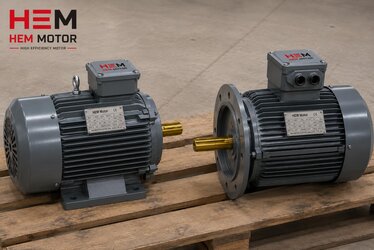
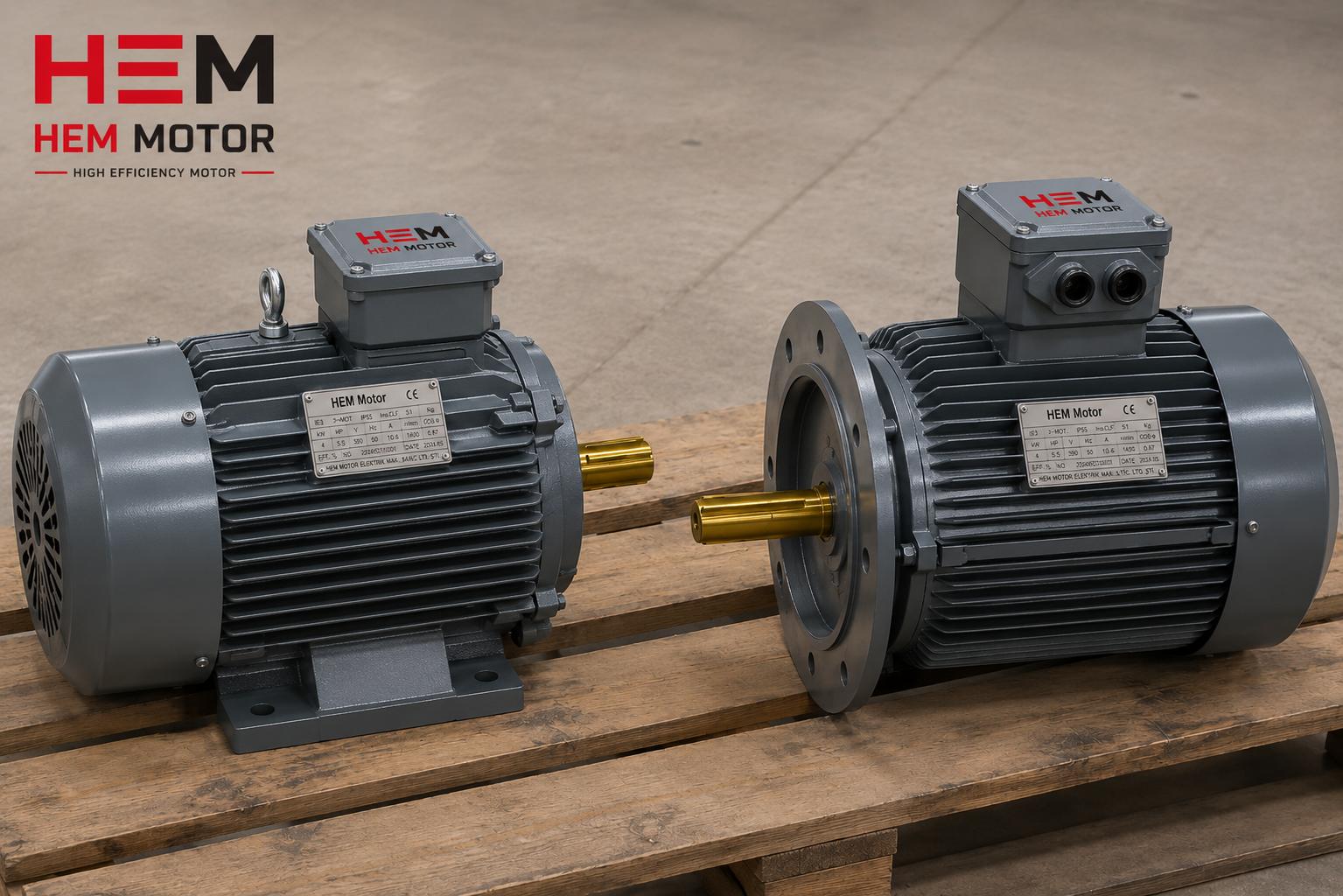
- B3 foot-mounted motor: fixed to the base or foundation via feet under the body; common for belt-pulley and coupled connections.
- B5 flanged motor: connected directly to a pump, reducer or machine body through the large flange on the front cover.
- B35 (foot + flange) motor: bolted both to the base by feet and to the machine by flange; adds mechanical support at higher powers.
At a common power like 5.5 kW all three mounting types can be found from stock; however, clearly stating the mounting code on the order shortens delivery time and prevents wrong shipment.
Efficiency Class: IE3 Requirement on a 5.5 kW Motor
5.5 kW is a power directly covered by efficiency regulation. Under the current Ecodesign rules, three-phase motors running direct-on-line (DOL) within a certain range must meet at least IE3 efficiency class; 5.5 kW falls squarely within this scope. A 5.5 kW three-phase motor you buy today is therefore expected to be IE3 or the higher IE4 class. The importance of the efficiency class is not only regulatory compliance:
- A high efficiency class does the same job with less energy, lowering running cost.
- IE3 and IE4 motors heat up less, which extends winding and bearing life.
- In continuously running (S1 duty) applications the efficiency difference turns into noticeable savings over the year.
To see how the efficiency and load curve at 5.5 kW are evaluated, we recommend our IE4 5.5 kW efficiency load curve content. You can review all our three-phase options on the 3 fazlı elektrik motorları page.
Cast Iron or Aluminium Body?
At 5.5 kW both cast-iron and aluminium-body options can be found. The choice depends on the severity and environment of the application.
Cast-Iron Body
Provides high mechanical strength and resistance to impact and vibration. It is preferred for crushing-screening, conveyor, heavy-duty and harsh environments. A cast-iron body, together with IP55 protection and F-class insulation, offers a long-life, reliable solution.
Aluminium Body
Lighter and more compact; advantageous in small machines, frequently moved equipment and places needing easy mounting. However, in very heavy impact environments cast iron should be preferred. In 5.5 kW general-purpose applications both bodies can be supplied from stock.
Continuous Operation, Duty Type and Cooling
In most industrial applications a 5.5 kW motor runs for long hours. It is therefore standard to select the motor in S1 continuous duty with IP55 protection and F-class insulation. Correct power selection is critical on a continuously running motor: an undersized motor is constantly strained and overheats; an oversized motor means unnecessary investment and poor part-load efficiency. The correct approach is to calculate the machine's real shaft power and confirm whether 5.5 kW meets that need. If the calculation comes out around 4.5–5.2 kW, then 5.5 kW is the correct standard power; if it goes higher, 7.5 kW should be considered.
Pole count is also decisive for cooling. Because the fan at the rear of the motor turns with the shaft, it runs faster on a 2-pole motor and slower on a 6-pole motor. A low-speed 6-pole 5.5 kW motor therefore receives less cooling from its own fan while running continuously at full load. Motors driven at very low speeds through a variable-frequency drive (VFD) may need an external forced-cooling fan. These details must be set up correctly from the outset so the motor reaches its expected service life in the field. Wrong cooling, though unnoticed in the first years, wears the winding insulation and leads to early failure.
Typical Application Areas of the 5.5 kW Motor
Although it is a single power value, 5.5 kW is used across very different sectors depending on speed and frame selection. The most common application areas are:
- Pump applications: centrifugal pumps, booster and pressurisation systems, circulation lines; mostly 2 or 4 pole.
- Fans and ventilation: radial and axial fans, blowers, air-handling units; 2, 4 or 6 pole according to speed need.
- Conveying and transport: belt conveyors, screws, elevators; usually 4 pole, often with a reducer.
- Compressors: piston and screw compressors; 2 pole when high speed is required.
- General-purpose industrial machines: mixers, crushing-screening auxiliary equipment, wood and metal working machines.
This diversity also explains why the 5.5 kW motor is stocked in such high volumes. Because the same power appears in many different machines, having the right pole and frame combination in stock directly shortens delivery time.
Nameplate Reading and Information Needed for a Correct Order
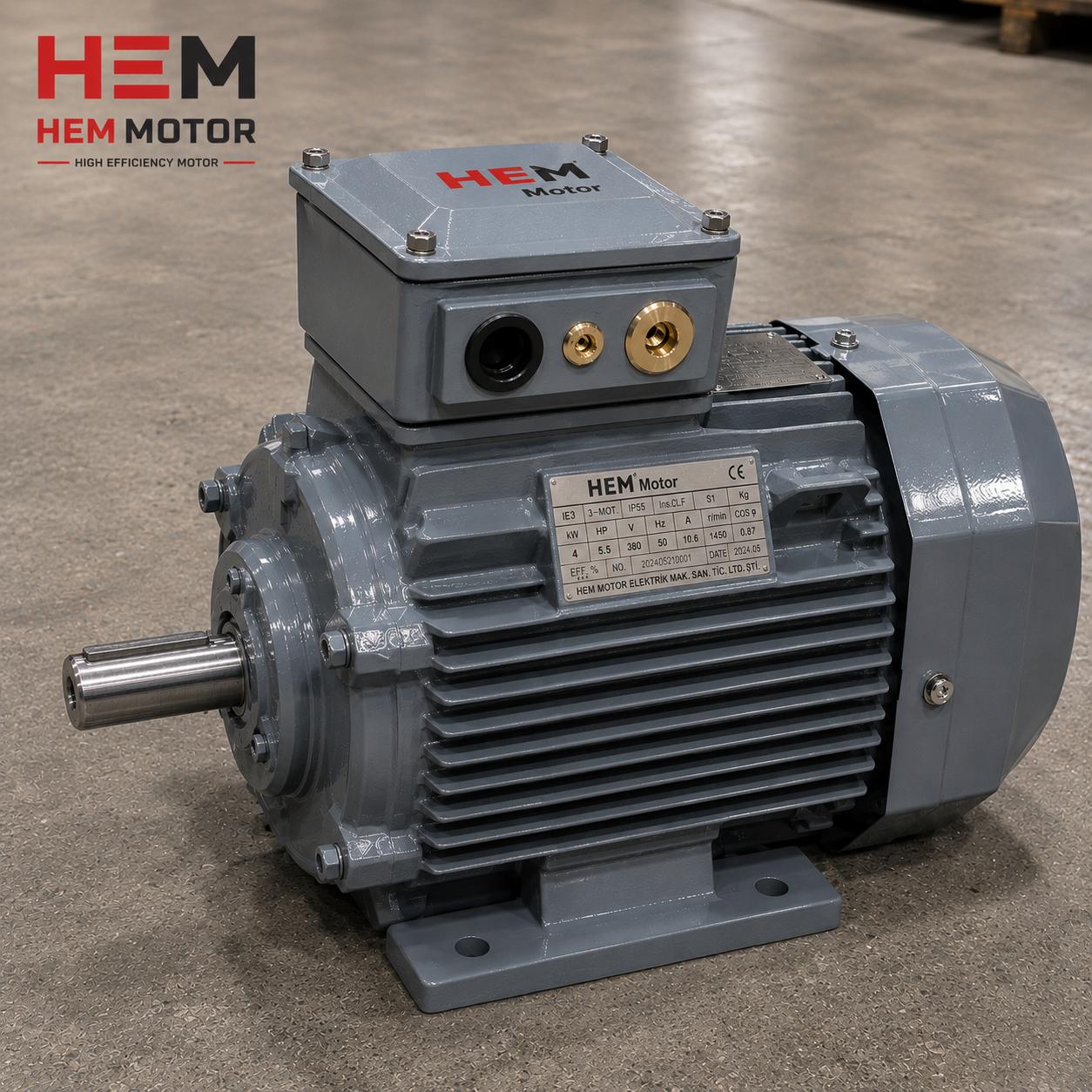
When sourcing a 5.5 kW motor for an existing machine, the information on the motor nameplate must be conveyed in full to get the right product the first time. The key items to check before ordering are:
- Power (kW) and speed (rpm): such as 5.5 kW and, for example, 1500 rpm; this determines the pole count.
- Frame size: such as 132; defines the shaft height and overall dimensions.
- Mounting type: B3, B5 or B35; shows how it connects to the machine.
- Shaft diameter and key dimensions: critical for coupling, pulley or reducer connection.
- Voltage and frequency: such as 380-400 V / 50 Hz; affects the connection type (star/delta).
- Efficiency class and protection: IE3/IE4, IP55, F-class insulation.
When this information is conveyed in full, the motor fits the existing machine exactly; an order placed with missing data causes mismatch and lost time in the field. The HEM Motor technical team evaluates your nameplate data, determines the correct equivalent motor and supplies it quickly from stock.
HEM Motor Stock and Supply Advantage
Because 5.5 kW is one of the most sought-after powers, stock management matters greatly. If the machine delivery date is fixed, getting the motor to site on time decides the project. At HEM Motor we offer the most-used combinations at this power from stock:
- Fast delivery from stock on 2, 4 and 6-pole 5.5 kW motors.
- Wide choice across B3, B5 and B35 mounting types and clear quotation support.
- Manufacturer assurance in IE3 and IE4 classes with cast-iron and aluminium body alternatives.
- Correct supply by exactly matching the motor on the existing machine from its nameplate.
For current elektrik motoru fiyatları and stock status, contact us and we will clarify the 5.5 kW motor best suited to your application together with its pole count, speed, frame and mounting type.
Frequently Asked Questions
How many poles should I choose for a 5.5 kW motor?
It depends on your application. For jobs requiring high speed such as pumps, fans and compressors, a 2-pole (3000 rpm); for conveyors, reducer inputs and general industrial machines, a 4-pole (1500 rpm); for applications that must turn slowly but with high torque, a 6-pole (1000 rpm) is preferred. Share your machine's speed and torque needs and we will set the right pole count together.
What frame size does a 5.5 kW 4-pole motor have?
This combination is mostly produced in the 132 frame and is the most heavily stocked option on the market. However, for mounting on an existing machine, the frame size, shaft diameter and mounting flange must also match; the power rating alone is not enough.
Is IE3 mandatory on a 5.5 kW motor?
Yes, 5.5 kW is within the power range covered by current efficiency regulation; three-phase motors running direct-on-line must meet at least IE3 class. For higher efficiency and lower running cost, the IE4 option can also be considered. We supply both classes from stock.