English
 Türkçe

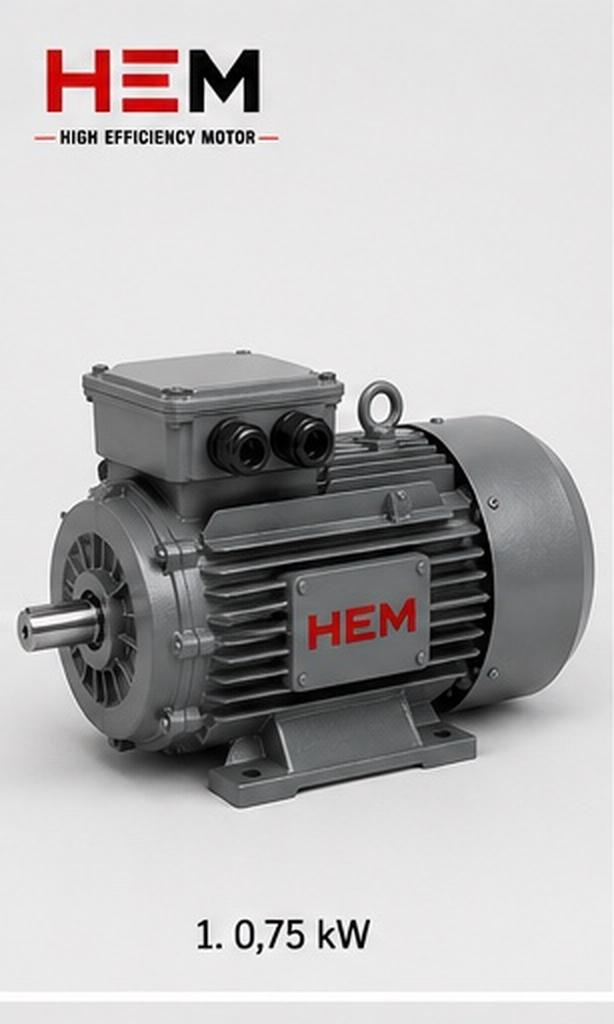

Small-power electric motors are indispensable components that are often overlooked in industry yet perform critical roles at key points of the production line. At low power values such as 0.25 kW and 0.37 kW, making the correct selection is, contrary to common belief, not possible by looking at the power value alone. In this power class, speed, frame size, shaft diameter and mounting type are at least as decisive as power. A wrongly selected mounting flange or an incompatible shaft diameter can make it impossible to connect the motor to the machine at all. In this article, HEM Motor examines all the technical requirements of correct buying for 0.25 and 0.37 kW motor selection, from the pole-speed relationship to IEC frame standards, from distinguishing mounting types to the advantage of stock supply.
The Key Point in Small Power: Power Alone Is Not Enough
When selecting a 0.25 or 0.37 kW motor, focusing only on the power value such as "quarter kilowatt" is a common mistake. In reality, four basic parameters determine whether this motor will fit the machine: speed, frame size, shaft diameter and mounting type. If even one of these four parameters is incompatible, even a motor of the correct power becomes useless in the application.
Small-power motors are generally used in applications such as pumps, small fans, dosing pumps, mixers, conveyors, valve actuators and laboratory equipment. Each of these applications carries different speed and mounting requirements; therefore, selection must be made by considering the application as a whole.
- Power: The shaft power required by the mechanical load (0.25 or 0.37 kW).
- Speed: The rotational speed required by the driven machine.
- Frame: The IEC frame code that standardizes the mechanical connection dimensions.
- Mounting: The structure that determines how the motor is fixed to the machine (B3, B5, B14, B35).
Pole Count and Speed Relationship
In asynchronous motors the speed is determined directly by the pole count. On a 50 Hz grid, the synchronous speed by pole count is as follows:
- 2-pole: About 3000 rpm — for high-speed small pumps and blower applications.
- 4-pole: About 1500 rpm — the most common and balanced choice; for general drives, fans and pumps.
- 6-pole: About 1000 rpm — for slow drives requiring low speed and high torque.

The speed under real load is slightly below the synchronous speed due to slip; for example, the rated speed of a 4-pole motor is typically in the 1380-1450 rpm range. Speed selection affects not only speed but also torque: at the same power, a lower-speed motor produces higher torque. Therefore, in applications requiring high starting torque, the pole count must be chosen deliberately. To examine the effect of pole and speed selection across a wider power range, our 3 kW electric motor selection 2/4/6 pole article offers a good comparison.
IEC Frame Standards: 56, 63 and 71 Frame
In small-power motors, mechanical connection compatibility is determined by the IEC frame standard. Powers of 0.25 and 0.37 kW are typically produced in IEC 56, 63 and 71 frame sizes. The number in the frame code expresses the height of the shaft axis from the foot base (in mm); for example, frame 63 means the shaft axis is 63 mm above the base.
Frame size varies with both power and pole count. At the same power, a motor with more poles can usually fit in a one-size-larger frame because it produces more torque. Once the frame code is determined, the shaft diameter, foot hole spacing and flange dimensions are also fixed as standard.
Shaft Diameter and Connection Compatibility
Each frame size has a standard shaft diameter. At small powers, typical shaft diameters are 9, 11 and 14 mm:
- Frame 56: Usually 9 mm shaft diameter.
- Frame 63: Usually 11 mm shaft diameter.
- Frame 71: Usually 14 mm shaft diameter.
The shaft diameter must directly match the coupling, pulley or gear connecting the motor to the driven machine. An incompatible shaft diameter requires an intermediate adapter, which can cause mechanical looseness and vibration. In belt-pulley driven applications, correctly calculating the radial load on the shaft is also critical; for this we recommend our radial load selection in belt-pulley drive article.
Mounting Types: B3, B5, B14 and B35 Must Not Be Confused
One of the most common mistakes in small-power motors is confusion over mounting type. The mounting types defined by the IEC standard determine how the motor is fixed to the machine and are not interchangeable:
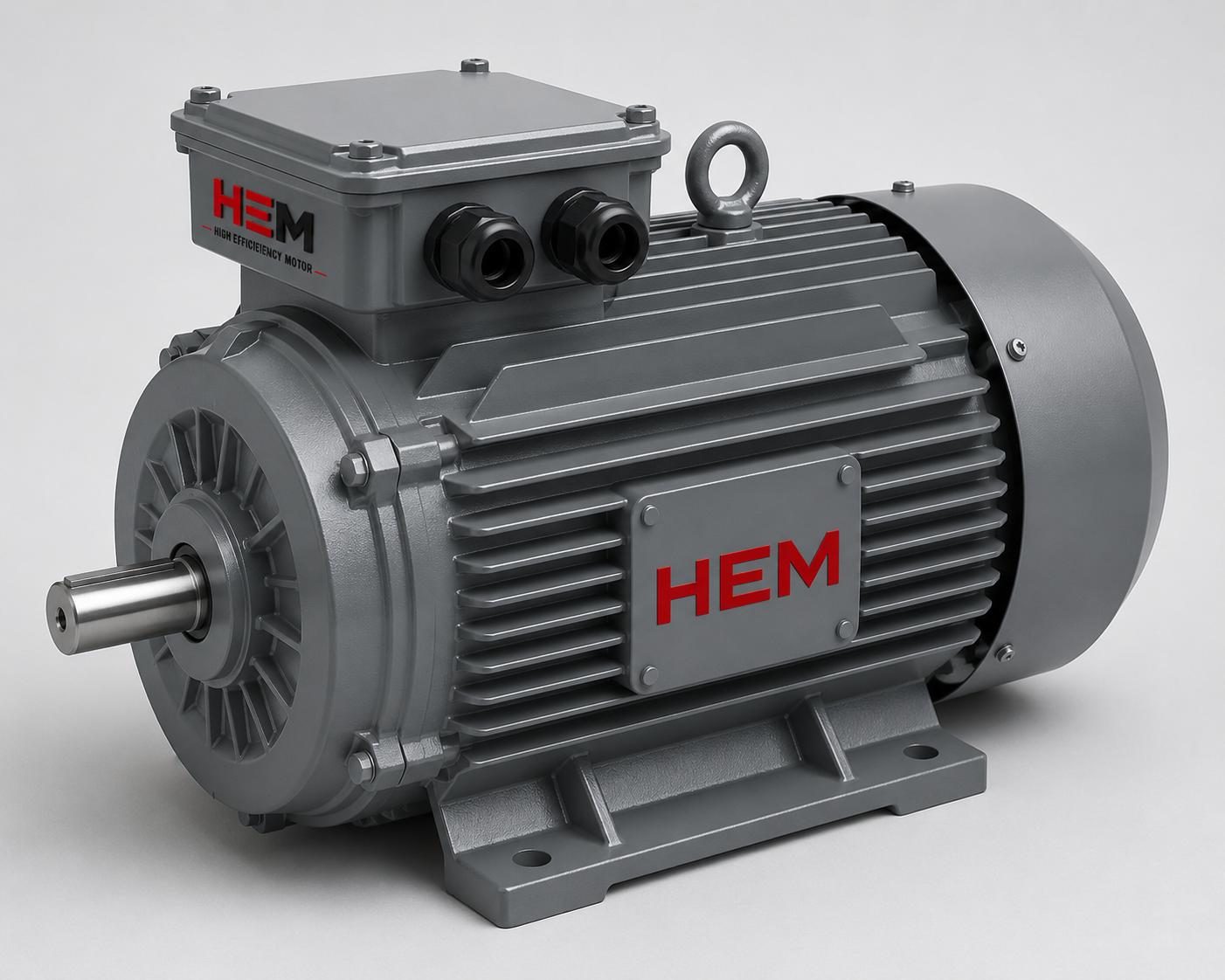
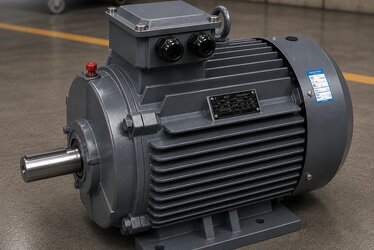
- B3 (foot-mounted): The motor is bolted to the floor or bracket via its feet. The most common and general-purpose mounting type.
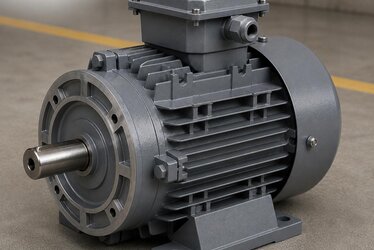
- B5 (large flange): The motor is connected to the machine via the large-diameter, drilled flange at the front. Common in pump and gearbox applications.
- B14 (small flange): A smaller-diameter, tapped-hole flange. Used for compact machines and mixer applications.
- B35 (foot + flange): Combined foot and B5 flange mounting. It is both fixed to the floor and coupled via the flange.
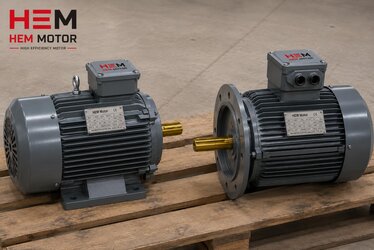
The most critical point here is this: B5 and B14 are not interchangeable. B5 is a large-diameter connection flange, while B14 is a small flange with tapped holes; the flange diameter and hole pattern are completely different. The machine's flange type must be clarified before ordering. For facilities that need multiple mounting types, we covered the advantage of B35 and universal frame options in our IE3 multimount B3/B5/B35 universal frame article.
Stock Advantage: 4-Pole Small Powers Are Delivered Fast
In the small-power class, the most frequently requested configuration is 4-pole (1500 rpm) motors. Standard 0.25 and 0.37 kW, 4-pole, B3 or B14 mounted motors can usually be supplied fast from stock. This provides an important advantage in emergency failure replacements and short-lead-time projects.
Less requested 2- and 6-pole variants, and non-standard requests such as special voltage, special shaft or high IP protection, may require a lead time tied to the production schedule. Therefore, clarifying the stock status and delivery time of the configuration before ordering is a correct approach. With our broad small-power motor stock, HEM Motor responds quickly to your facility's emergency and planned needs. You can reach our full product range from our homepage.
Checklist for Correct Selection
- Verify the power required by the mechanical load (0.25 or 0.37).
- Determine the pole count according to the driven machine's speed need.
- Check the compatibility of frame size and shaft diameter with the machine.
- Select the mounting type (B3/B5/B14/B35) according to the machine's connection.
- Confirm stock status and delivery time before ordering.
Voltage, Frequency and Connection Type
Another important selection criterion in small-power motors is voltage and connection type. 0.25 and 0.37 kW motors are generally available in both three-phase and single-phase variants. Three-phase models can be connected in star (Y) or delta (Δ) according to the grid voltage; at small powers the typical connection is 230/400 V. This means the motor can be connected in star on a 400 V grid and in delta on a 230 V grid.
In single-phase applications, the motor runs with an auxiliary winding and a start capacitor. Single-phase motors are preferred in small workshops, domestic pumps and light applications where a three-phase grid is not available; however, they are somewhat disadvantaged in starting torque and efficiency compared with a three-phase model of the same power. Three-phase supply should be preferred wherever possible.
- Three-phase (Y/Δ): Higher efficiency and starting torque; standard for industrial applications.
- Single-phase (capacitor): A practical solution where three phases are unavailable; limited starting torque.
- Frequency: 50 Hz standard; on export machines 60 Hz affects speed and power.
On export-oriented machines, 60 Hz supply changes the motor's speed and power; therefore the frequency suited to the target market must be clarified from the start.
Efficiency, Heating and Insulation Class
Although absolute energy savings are limited at small powers compared with large powers, the efficiency class still makes a difference in continuously running applications. In low-power motors, efficiency is lower than at large powers due to the small size of the motor; this is a physical fact. Nonetheless, motors with optimized designs both heat up less and last longer by reducing losses.
The insulation class directly determines service life in small motors too. Standard F-class insulation with B-class temperature rise provides the motor with thermal reserve and enables safe operation even in hot environments. Small-frame motors may struggle to dissipate heat because of their small surface area; therefore a well-ventilated location and proper mounting are important.
- Insulation class F: Common standard; provides good thermal reserve.
- Temperature rise B: A safe margin that extends winding life.
- Ventilation: Clean air flow is critical for heat dissipation in a small frame.
In a continuously running small pump or fan motor, high efficiency and good insulation lower both the energy cost and the failure risk.
Protection Class and Application Environment
Small-power motors often operate in demanding environments: humid pump rooms, dusty workshops or outdoor applications. Therefore, the protection class (IP) selection must be evaluated alongside power. Standard industrial motors are usually IP55 protection class; this means dust-protected and resistant to water jets from all directions.
In cleaner indoor applications a lower protection class may suffice, while in outdoor, dusty or washdown environments higher protection classes should be preferred. The application environment affects not only the protection class but also the frame material selection; a corrosion-resistant structure is important in humid environments. For the power limit and the criteria for switching to three-phase in single-phase-supplied small-power motors, see our single-phase 220V motor power limit three-phase transition article.
Frequently Asked Questions
Is there any harm in buying 0.37 kW instead of 0.25 kW?
Slight oversizing usually causes no harm but is not ideal. A 0.37 kW motor runs at part load under a 0.25 kW load; in this case efficiency and power factor drop somewhat. At small powers the difference is limited, but the correct approach is still to measure the load and select the power closest to the need. An unnecessarily large motor raises both initial cost and energy consumption.
I ordered a B5 flange motor but my machine is B14 flange, what should I do?
B5 and B14 flanges are incompatible in diameter and hole pattern and cannot be fitted directly. In this case you must either obtain a B14 motor suitable for the machine or use an appropriate adapter flange. The soundest solution is to correctly determine the machine's flange type before ordering and select a motor of the matching mounting type.
Does the IE efficiency class matter in small-power motors?
The efficiency class matters at every power, but at very small powers the absolute energy savings are limited compared with large powers. Still, even in continuously running small motors, a high-efficiency model provides long-term benefit. If your application runs continuously, choosing a high efficiency class lowers lifetime cost.