English
 Türkçe


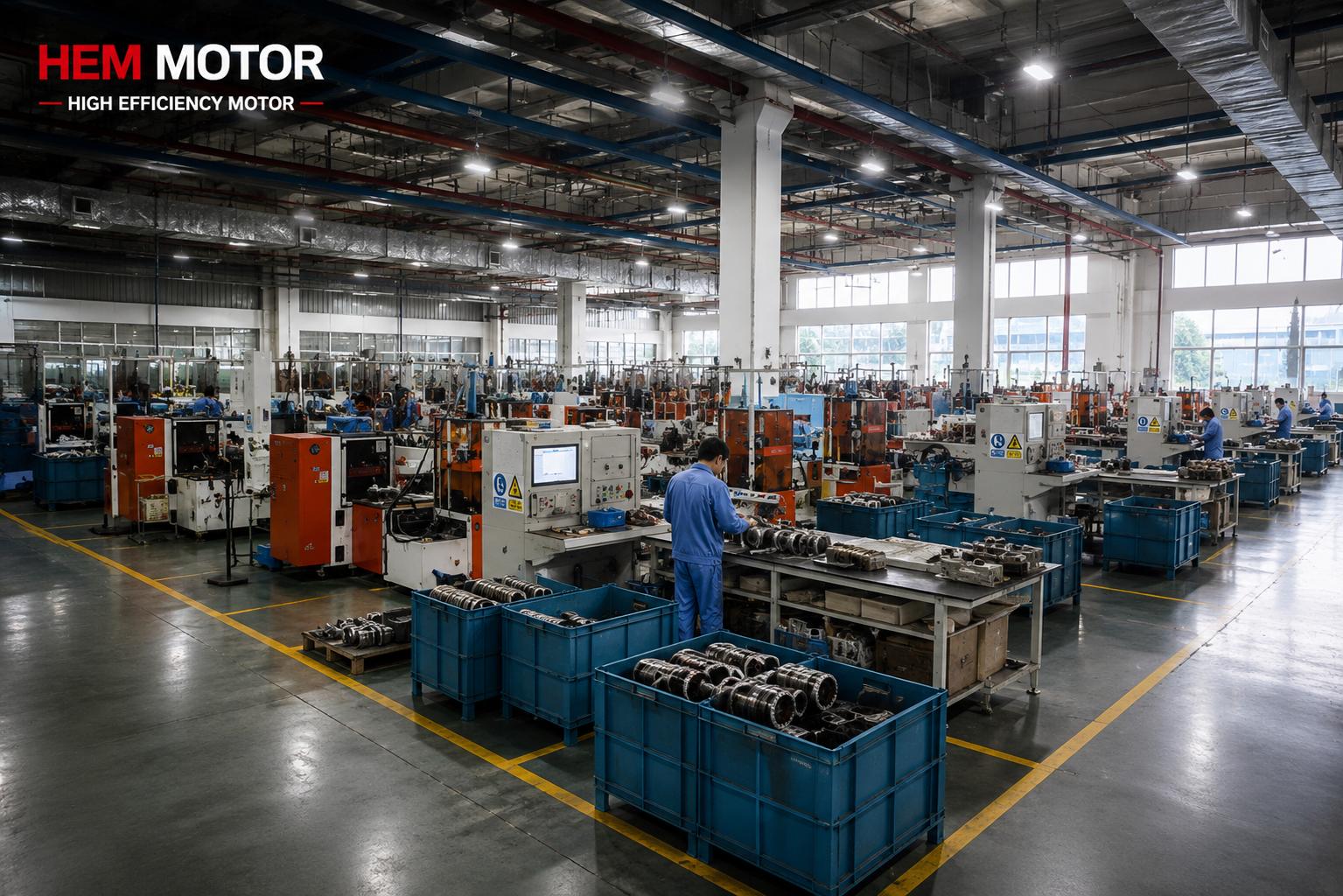
Denizli stands almost on its own on Turkey's textile map: a significant share of the world's towel and bathrobe exports leaves from here, and knitted and woven fabric mills spread across the Denizli Organized Industrial Zone and the surrounding districts. Behind every machine that keeps these production lines turning sits an electric motor — from the yarn twisting frame to the weaving loom, from the dyehouse pump to the stenter fan. And when one of those motors stops, the problem is not technical, it is commercial: deadlines slip and shipments are delayed. Manufacturing since 1979, electric motor manufacturer and supplier HEM Motor delivers IE3 and IE4 motors from 0.25 kW up to 355 kW to the Denizli and Aegean textile industry with fast dispatch, backed by Turkey-based stock.
This guide speaks directly to textile businesses in Denizli and the wider Aegean region. We look at which motors are most in demand on which drives, the stock and delivery logic a plant searching for a "Denizli electric motor" needs to understand, and how to select the right motor for very different environments such as a dyehouse and a weaving hall. We covered the Aegean-wide same-day delivery process in our Izmir and Aegean supply guide; here we narrow the subject down to Denizli itself and the unique drive requirements of textiles.
Why Are the Motor Needs of the Denizli Textile Industry Different?
Denizli's industrial profile is distinctive: towel and bathrobe weaving, home textiles, knitted fabric, yarn production, and the dyehouse and finishing plants that feed them. Every link in this chain demands a different drive character. Unlike general machinery manufacturing, textile drives usually run continuously (S1 duty), speed stability translates directly into product quality, and in sections such as the dyehouse the motor faces moisture, steam and a chemical atmosphere. For this reason, selecting a motor for Denizli is not a matter of "checking a catalogue and matching the power"; environment, duty type and speed sensitivity must all be weighed together.
Speed Stability in Weaving and Spinning Drives
In yarn twisting and on the weaving loom, even small fluctuations in speed show up in yarn tension and fabric weight. An old motor with worn bearings and an unbalanced rotor delivers an unsteady, fluctuating speed to the shaft instead of a constant one, and that comes back as thread breaks and weaving defects. That is why copper-wound, balanced and low-vibration motors are preferred on spinning and weaving lines. Positioned specifically for textile machinery, our textile machinery electric motors are stocked to suit continuous operation and applications that demand precise speed. We covered the effect of speed stability on thread breakage and the method of renewing an aging motor fleet without stopping production in detail in our article on motor renewal in textile plants.
Protection Class for Dyehouse, Finishing and Damp Sections
The dyehouse, bleaching and finishing sections are the most demanding environments in a textile plant: high humidity, steam, splashing chemicals and constant wetness. In these sections an IP55 protection class and Class F insulation are the minimum expectation; under harsher conditions the sealing of the terminal box and the choice of suitable cable glands must be planned separately. A cast iron body is more durable than aluminium in damp and corrosive environments. For pumps, cabinets and circulation lines, our general purpose industrial motors meet these needs across a wide power range.
Stenter, Extraction and Fan Drives
The stenter, the drying oven and the extraction systems are high energy-consuming fan drives in textiles. Because efficiency in these applications feeds straight into the electricity bill, IE4 class motors pay for themselves over the long run. To weigh the annual payback of the efficiency difference on continuously running fan and extraction motors, you can look at our article on the IE4 threshold for pumps, fans and compressors. Another critical point in fan drives is how the motor connects to the machine: belt and pulley, direct coupling or flanged? This connection method determines the motor's mounting type and shaft diameter, so it must always be clarified at the ordering stage.
Garment, Sewing and Auxiliary Lines
Alongside the main weaving and knitting lines in Denizli, garment making, ironing and pressing, packaging and auxiliary conveying lines also use motors. These applications usually call for small and medium-power, compact motors; flanged connections and geared drives are common. When speed has to be reduced on conveyor and conveying lines, the motor does not work directly but together with a gearbox; in that case the motor's IEC frame and flange dimensions must match the gearbox. These auxiliary lines are often overlooked, yet their downtime can affect production just as much as the main line, so they should be included in spare motor planning.
The Logic of Delivering from Stock to Denizli OIZ and Surrounding Districts
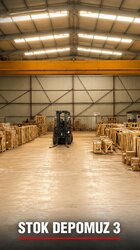
In Turkey, a large part of motor supply runs through Istanbul-based warehouses or import lead times. In that model, the urgent motor need of a weaving plant in Denizli is, at best, pushed to the next day, and if importing is required, to weeks later. Working with a Turkey-stocked electric motor manufacturer reverses this equation: the motor is already on the shelf, and dispatch begins the same day.
- Denizli OIZ and city centre: The region where towel-bathrobe, home textile and knitting plants are concentrated; the most frequently sought powers leave stock quickly.
- Surrounding districts (Babadag, Buldan, Saraykoy, Honaz): Weaving and knitting workshops and dyehouses; fast reach via freight depot and cargo options.
- The wider Aegean (Aydin, Usak, Manisa): Textile and garment basins; delivery within short lead times through the regional shipping network.
We explained in detail how the right channel is chosen, along with the freight depot and cargo options, in our Anatolia shipping guide.
Which Powers and Speeds Wait Ready in Stock for Textiles?
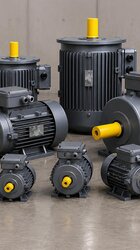
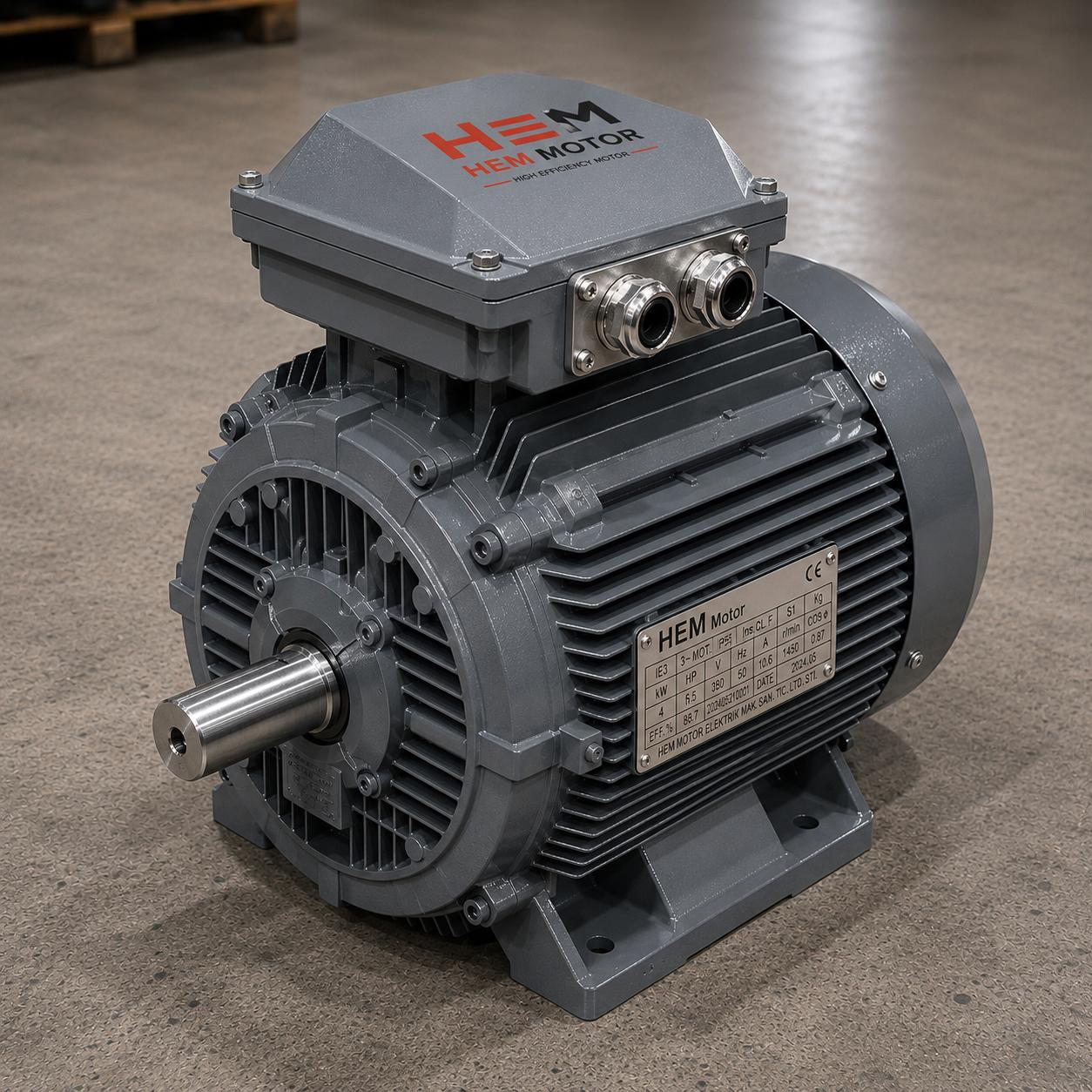
The combinations most in demand on textile drives are well known. On spinning and weaving frames, medium-power 4-pole (1500 rpm) and 2-pole (3000 rpm) three-phase motors; on dyehouse pumps, 1500 rpm motors; and on stenter and extraction fans, 1000, 1500 or 3000 rpm options depending on the application. HEM Motor holds these combinations in stock with B3 foot-mounted, B5 and B14 flanged mounting types. For standard production lines, our standard electric motors are delivered fast in common power ratings.
In an urgent breakdown, the most critical point is that the incoming motor is a one-to-one match for the existing machine: the same frame size, the same shaft diameter, the same flange type and the same connection. That is why the nameplate information of the old motor is decisive at the quotation stage. To see all power and speed options you can review our electric motors product family, and for our regional supply articles you can browse our electric motors blog category.
Planning Motor Renewal in a Textile Plant Without Stopping Production
Most textile plants in Denizli run in shifts, often three shifts; this means motor renewal cannot be done by the "stop the line and replace everything at once" method. The right approach is gradual renewal: first the motors on the most critical and most heavily used drives, then the secondary lines. Three questions are decisive in this planning. First, which motors, when they fail, bring production to a complete halt? Second, which motors run the longest hours at the highest load, so that the efficiency gain pays back fastest? Third, how many critical spares of which power ratings should be kept in stock so that a breakdown does not hit production?
The most practical way to answer these three questions is to draw up the plant's motor inventory: for each machine, the power, speed, mounting type, shaft diameter and running hours are collected in one list. This list both sets the renewal order and lets you find the right motor for an emergency replacement within seconds. We explained in detail how to plan the critical spare motor stock and which powers should be kept on the shelf in our article on the critical spare motor list. Once a plant has drawn up this inventory, the supply process for every subsequent breakdown drops to minutes.
Another advantage of gradual renewal is budget management. Instead of renewing the whole motor fleet at once, starting with the IE4 candidates that have the shortest payback period turns the investment into a self-financing cycle: the energy savings of the first renewed motors begin to cover the cost of the next renewals. On continuously running textile drives, this cycle usually closes faster than expected.
The Energy and Quality Return of an IE4 Motor in Textiles
Textiles is an energy-intensive sector, and electricity cost is a significant item in production cost. On a continuously running motor, the efficiency difference between IE3 and IE4 may look small on paper, but on a drive that runs thousands of hours a year it corresponds to a serious amount. IE4 Super Premium motors do the same work with fewer losses; this is an advantage both for the bill and for the motor's heating. A motor that heats up less means a longer-lived winding and more stable operation.
Alongside the efficiency class, another return from IE4 motors is low vibration and quiet operation. In textiles, vibration affects both product quality and the working environment; a balanced rotor and quality bearing structure reduce vibration. Businesses that want to measure the effect of a high-efficiency motor investment on total cost of ownership should consider not only the purchase price but also the energy and maintenance cost. To see the technical advantages of the IE4 class and where it should take priority, you can review our IE4 high-efficiency electric motors page. You can find all efficient motor options in our efficient electric motors category.
In an export-oriented basin like Denizli, energy efficiency is increasingly important not only for cost but also for sustainability and the carbon footprint. When overseas buyers begin to question efficiency and environmental criteria in the supply chain, an IE4 motor fleet becomes concrete evidence that strengthens the business's position.
What the Plant Side Should Do to Speed Up the Quotation Process
Fast delivery depends not only on the supplier's stock but also on how clearly the request is stated. If a textile business in Denizli passes on a few pieces of information up front when asking for a quote, the process concludes in hours rather than days. These are: the motor's power (kW), speed (rpm or pole count), mounting type (B3 foot-mounted, B5 or B14 flanged), shaft diameter and, where needed, a special protection class. If possible, a photo of the old motor's nameplate should be shared; the nameplate moves matching from guesswork to certainty.
Stating what the application is also speeds up the right recommendation: will the motor drive a weaving loom, a dyehouse pump or a stenter fan? Because a motor of the same power may require a different speed and protection in different applications. You can find the ways to prevent the wrong motor arriving at the plant and pre-order nameplate matching in detail in our nameplate matching article. A request opened with the right information both speeds up the quote and reduces the risk of the wrong product arriving to almost zero.
Frequently Asked Questions
How long does it take to deliver a motor to Denizli?
Because the most frequently sought powers and speeds are ready in Turkey-based stock, motors in stock are generally dispatched the same or next day. The transit time to Denizli OIZ and the surrounding districts is set by the chosen channel (freight depot, cargo, project delivery) and the weight of the motor. For an emergency replacement, sharing the old motor's nameplate information at the order stage speeds up delivery.
Which motor is suitable for damp sections such as a dyehouse?
Because the dyehouse, bleaching and finishing sections contain high humidity and chemicals, at least IP55 protection class and Class F insulation are recommended. A cast iron body provides durability in these environments; terminal box sealing and the correct cable gland choice should also be planned separately. If you state your need at the quotation stage, we assess the protection class suitable for the environment together.
Can you find a motor exactly the same as my old one?
Yes. With the power (kW), speed (rpm), frame size, mounting type (B3/B5/B14) and shaft diameter from the old motor's nameplate, we select an exactly equivalent motor from stock. This way you can fit the motor with the same connection, without making mechanical changes to the machine. Sharing a photo of the nameplate speeds up the matching.
Should I prefer IE3 or IE4 for textile motors?
The running hours of the motor determine this decision. On weaving, spinning and fan drives that run thousands of hours a year continuously, the energy savings of an IE4 motor pay back the purchase difference in a short time; IE4 makes sense in these applications. On drives that run less or sit as spares, IE3 may be sufficient. From a regulatory standpoint, minimum efficiency class requirements apply according to power and pole count; if you tell us your application at the quotation stage, we determine the right class together, for both efficiency and compliance.
Can a motor reach Denizli the same day in an emergency breakdown?
If the power and speed you need are in Turkey-based stock and the order is confirmed within the day, the motor can be dispatched the same day. The most important factor that speeds this up is sharing the old motor's nameplate information up front; that way the exactly matching motor is selected and set off without losing time. The transit time to Denizli OIZ, the surrounding districts and the wider Aegean varies by the chosen shipping channel.
Get a Quote for the Denizli and Aegean Textile Industry
Denizli OIZ, the surrounding districts or the wider Aegean; whether the drive is weaving, spinning, knitting or dyehouse, we supply the motor you need from stock with fast delivery. For a motor that is an exact match in the right power, speed and mounting type, get in touch with us. If you share your old motor's nameplate information, we prepare the quote the same day.
To get a quote right away you can call us on +90 (532) 345 49 86 or reach us through our contact us page. In the motor supply of the Denizli and Aegean textile industry, we are by your side with the assurance of HEM Motor.