English
 Türkçe

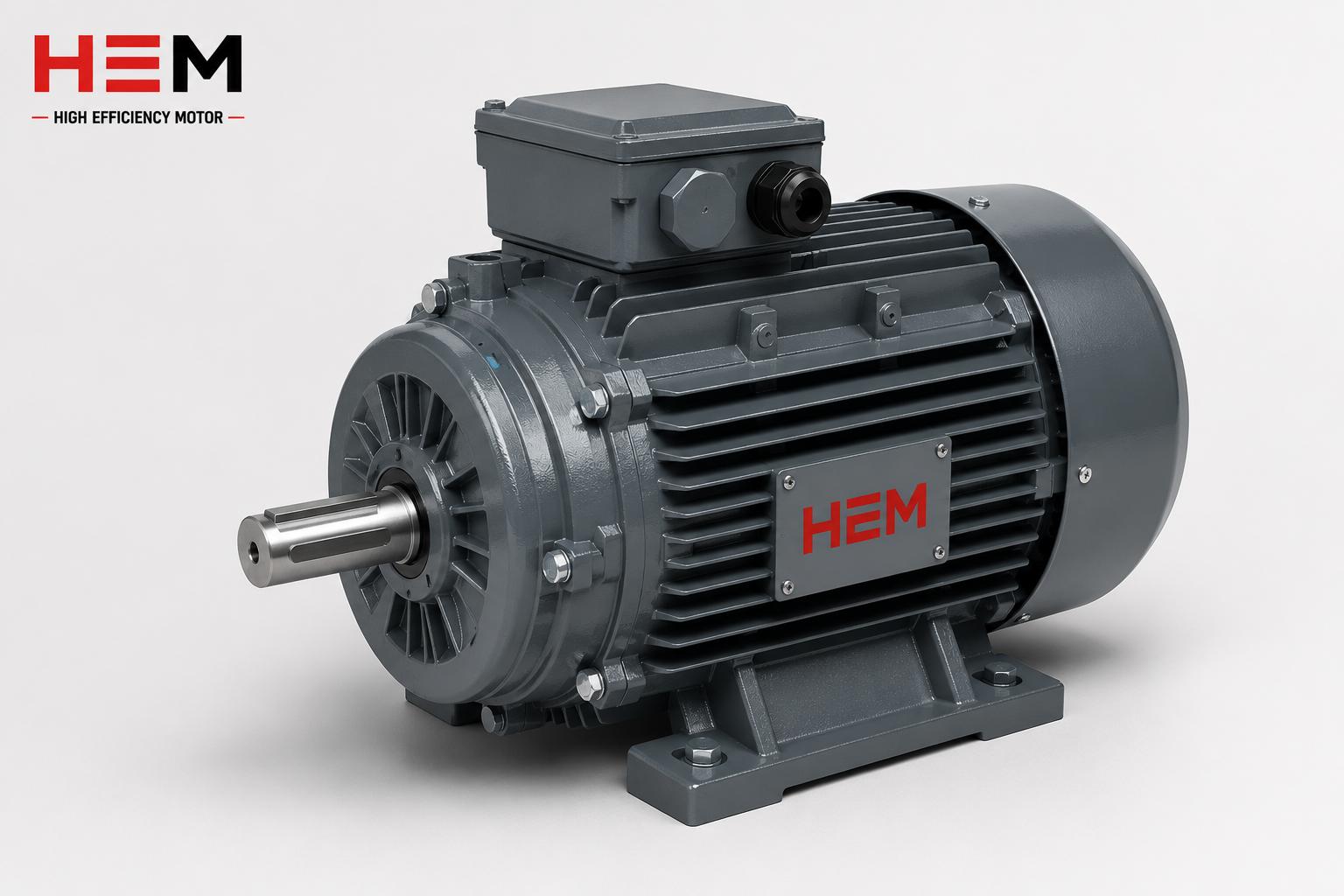

As a crane lowers a load, as a centrifuge stops its high-inertia rotor, or as a conveyor rapidly decelerates, the motor enters an interesting state: it no longer draws energy, it generates it. The load pushes the motor, the motor turns into a generator and sends the energy it produces back to the drive's DC bus. At this point there are two paths: convert this energy into heat on a braking resistor and dump it, or feed it back to the grid through regenerative braking. Which path is chosen directly determines how fast the motor can stop, how much energy is saved and which drive-motor package is sourced. In this article we examine regenerative braking and braking resistor selection on IE5 synchronous reluctance (SynRM) motors across the axes of fast stopping, energy recovery and correct supply.
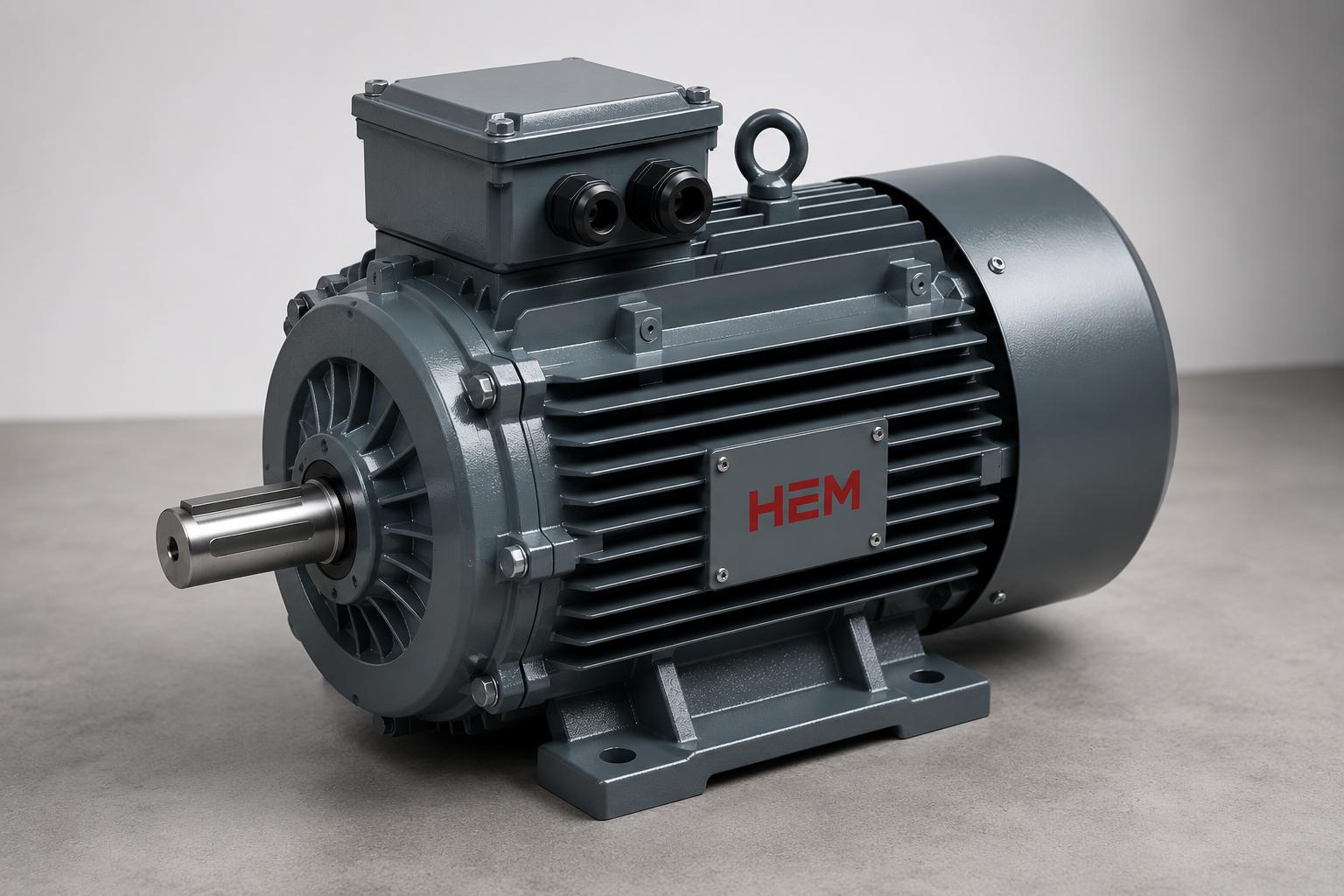
At HEM Motor, we always offer IE5 Ultra Premium synchronous reluctance motors together with a frequency drive, because these motors do not run without a drive by their very nature. The braking strategy is an inseparable part of this drive-motor package. The right braking solution is a matter not only of stopping performance but also of energy and system cost.
Why Does a Motor Generate Energy While Braking?
An electric motor enters generator mode when mechanical power from its shaft pushes it above its synchronous speed, or when the drive forces it to a speed lower than its current one. The kinetic (rotational) energy of the load converts to electricity and flows to the rectifier-intermediate circuit (DC bus) side of the drive. This energy has to go somewhere. If there is no path to dump it, the DC bus voltage rises; to protect itself the drive either trips or extends the braking time.
This phenomenon is pronounced in high-inertia and frequently stopping applications: cranes and lifting systems, centrifuges, large fans, reel systems and frequently reversing drives. The IE5 synchronous reluctance motor, since it runs with a drive, brings with it the ability to manage braking energy.
Two Fundamental Paths: Braking Resistor and Regenerative Braking
Braking Resistor (Dynamic Braking)
This is the most common and most economical initial-investment solution. When the DC bus voltage rises, the drive's brake chopper circuit engages and dumps the excess energy onto a braking resistor. This energy converts to heat on the resistor and is released to the atmosphere. Advantages and limits:
- Advantage: Low initial investment, simple circuit, fast and strong stopping capability.
- Limit: Recovered energy is dumped as heat, meaning no savings. In high-repetition braking, resistor heating and sizing become important.
- Where suitable: If braking is rare or moderately frequent; if energy recovery is not a priority.
Regenerative Braking (Feedback)
Here the braking energy is not converted to heat and dumped; it is returned to the grid through a feedback unit (active front end or regenerative unit). Advantages and limits:
- Advantage: Braking energy is recovered, reflected directly as savings on the energy bill. Since heat dissipation is low, the environment does not heat up.
- Limit: The initial investment is higher; it requires a feedback unit and usually grid-side filtering.
- Where suitable: If braking is frequent and the energy amount high (continuously lowering crane, frequently stopping centrifuge, large inertia); if the payback period is reasonable.
Which Solution When? Decision Axes
The right braking solution is not bound to a single rule; it requires several axes to be evaluated together.
- Braking frequency: Is it stopped once an hour or once a minute? In frequent braking, the regenerative solution eliminates heat and energy loss.
- Braking energy amount: How heavy is the load and how high the inertia? At high energy, regenerative recovery provides meaningful savings.
- Stopping speed need: If emergency stopping is required, both the braking resistor and the regenerative unit must be sized to provide sufficient torque.
- Environment and heat: If panel internal temperature is critical, the heat the resistor dumps can be a problem; the regenerative solution removes this load.
- Initial investment vs. operating cost: The total cost of ownership perspective drives the decision.
Considering that the IE5 motor is already selected with a high-efficiency goal, if there is frequent and high-energy braking the regenerative solution is consistent with the efficiency philosophy; dumping energy as heat contradicts the savings purpose of IE5. Conversely, where braking is rare and the energy amount remains low, a braking resistor is both simpler and sufficiently safe; putting a regenerative unit on every application can mean carrying an unused investment. The right decision always rests on the application's real braking profile.
The Relationship Between Braking Torque and Stopping Time
How fast an application must stop directly determines the size of the braking solution. As the stopping time shortens, the same kinetic energy must be dumped in less time; this means higher instantaneous braking power. For example, if you want to stop a high-inertia rotor within seconds, both the braking torque and the energy dissipation capacity (resistor peak power or regenerative unit capacity) must be selected larger accordingly. Conversely, if a longer stopping ramp is acceptable, the braking solution can be smaller and more economical. Therefore, clearly answering the question "how fast must it stop" before sourcing is critical for a correct and not unnecessarily oversized braking solution. The synchronous reluctance motor's precise drive control provides an advantage here: the drive can program the stopping ramp per application and apply the braking torque in a controlled manner.
The IE5 Synchronous Reluctance Motor's Advantage in Braking
The synchronous reluctance motor's rotor has no magnets; this also produces some practical consequences for braking. Since the motor is under drive control, the braking torque can be precisely managed by the drive. The drive decelerates the motor with the desired ramp and directs the produced energy to the chosen strategy (resistor or regenerative). The IE5 motor's high efficiency means low losses during both motoring and braking; this allows the recovered energy to be utilized more efficiently. We covered why the IE5 motor does not run without a drive and package selection in our IE5 synchronous reluctance motor drive package cost article.
Braking Strategy with Application Examples
Let us make concrete how the braking decision changes by application with a few typical scenarios.
Cranes and Lifting Systems
In a crane, as the load is lowered the motor continuously enters generator mode; that is, while the load descends with gravity the motor produces energy. This energy arises regularly and frequently. Here regenerative braking provides notable savings by returning the lowering energy to the grid. At the same time, for the load to descend in a controlled and safe way, the braking torque must be precisely managed by the drive. In lifting applications there is often also a mechanical holding brake; electrical braking provides deceleration while the mechanical brake provides full stop and holding.
Centrifuges and High-Inertia Rotors
Stopping a centrifuge from high speed means dumping a large amount of kinetic energy. If the centrifuge is frequently started and stopped, regenerative recovery becomes meaningful once the energy arising at each stop accumulates. On a rarely stopping centrifuge, a well-sized braking resistor may be sufficient.
Fans and Conveyors
Letting large fans coast down freely takes a long time; if fast stopping is needed, braking is essential. In conveyors, especially on inclined lines, the load can push the motor downward; in this case the motor controls the line with braking torque. A resistor or regenerative solution is chosen according to braking frequency and energy amount.
DC Bus Voltage and Braking Safety
The energy produced during braking first accumulates on the drive's DC bus and raises its voltage. The drive is set to engage the braking circuit (brake chopper + resistor or regenerative unit) when this voltage exceeds a certain threshold. If the braking path is insufficient or absent, the DC bus voltage reaches the drive's protection limit and the drive trips to protect itself. For this reason, correctly sizing the braking solution is a matter not only of performance but also of protecting the drive. We covered drive DC bus voltage and supply in detail in our drive DC bus voltage and supply article.
Braking Resistor Sizing: Points to Watch
Two magnitudes are decisive when selecting a braking resistor: peak power (how many kW will be dumped during instantaneous braking) and continuous power (how much heat on average will be dumped in repeated braking). A wrongly sized resistor either falls short and trips the drive or is unnecessarily large and expensive. Also:
- The resistor's mounting location must be ventilated; the heat it dumps must not heat the panel interior.
- The resistor's thermal protection must be set up to protect the circuit during overheating.
- The cable length and cross-section between drive and resistor must be selected correctly.
You can find drive-side parameterization and commissioning in our IE5 drive parameterization article.
Sourcing the Right Motor-Drive-Brake Package
In an IE5 synchronous reluctance application, the motor, drive and braking solution must be considered as a single whole. Sourcing these separately, unaware of one another, leads to incompatibility and commissioning problems. At HEM Motor we determine the braking strategy according to the application profile and recommend the motor, suitable drive and braking solution (resistor or regenerative unit) as a compatible package. This holistic approach also eliminates the most frequent field problem: mismatched parts coming together. When the motor is bought from one place, the drive from another and the braking resistor from a different supplier, compatibility problems arise during commissioning, responsibility scatters and problem resolution drags on. Single-source compatible package supply both speeds commissioning and provides clear responsibility with a single point of contact.
Information to Gather for Sourcing
- Application type: crane/lifting, centrifuge, fan, conveyor, etc.
- Load inertia and typical stopping time/frequency.
- Is there an emergency stop requirement?
- Panel ambient temperature and heat dissipation constraint.
- Energy recovery priority and target payback.
To determine the IE5 motor and braking package suitable for your application, you can review our product range for current electric motor prices and configuration options. We also covered drive and installation compatibility with a commissioning checklist in our IE5 drive and installation compatibility article.
Braking from a Total Cost of Ownership Perspective
The braking solution decision is most often made on initial investment alone; yet the right view is the total cost of ownership. A braking resistor is a cheap initial investment but dumps energy as heat at every braking; in a frequently braking application this turns into significant energy loss over the years. A regenerative unit requires a more expensive start but lowers operating cost because it recovers braking energy. The decision should be made by looking at the annual total of braking energy and the payback period. The purpose of selecting an IE5 synchronous reluctance motor is already the highest efficiency and lowest operating cost; with this motor, dumping energy as heat in a frequently braking application contradicts the philosophy of its selection.
Braking in Commissioning and Maintenance
After the braking solution is installed, several points must be verified during commissioning. The drive's braking parameters (ramp time, braking threshold, resistor value) must be set per application; an emergency stop test must be done; the heating behavior of the resistor or regenerative unit must be observed under typical operating load. During maintenance, the braking resistor's connections and thermal protection must be checked regularly; on a regenerative unit the grid-side connection and filter status must be monitored. This discipline ensures the braking solution runs safely and efficiently for years.
Frequently Asked Questions
Is regenerative braking required on every IE5 motor?
No. Regenerative braking becomes meaningful in applications where braking is frequent and the energy amount high, because there the recovered energy provides savings beyond the initial investment. If braking is rare or the energy low, a braking resistor (dynamic braking) is usually a more economical and sufficient solution. The decision must be made according to the application's braking profile.
Can a braking resistor and regenerative braking be used at the same time?
In some systems a hybrid approach is possible: while normal braking is done with the regenerative unit, the braking resistor can engage as a safety layer during emergency stops or peak moments where the feedback unit is insufficient. This is designed according to the application's safety and performance requirement. At HEM Motor we determine the suitable architecture according to the application profile.
Does regenerative braking affect the grid?
While returning energy to the grid, the feedback unit must operate compatibly in terms of voltage and harmonics; therefore grid-side filtering and correct connection are usually required. A correctly sized and compatible regenerative unit is designed to feed clean energy to the grid. This compatibility is achieved by planning the motor-drive package together from the start.