English
 Türkçe


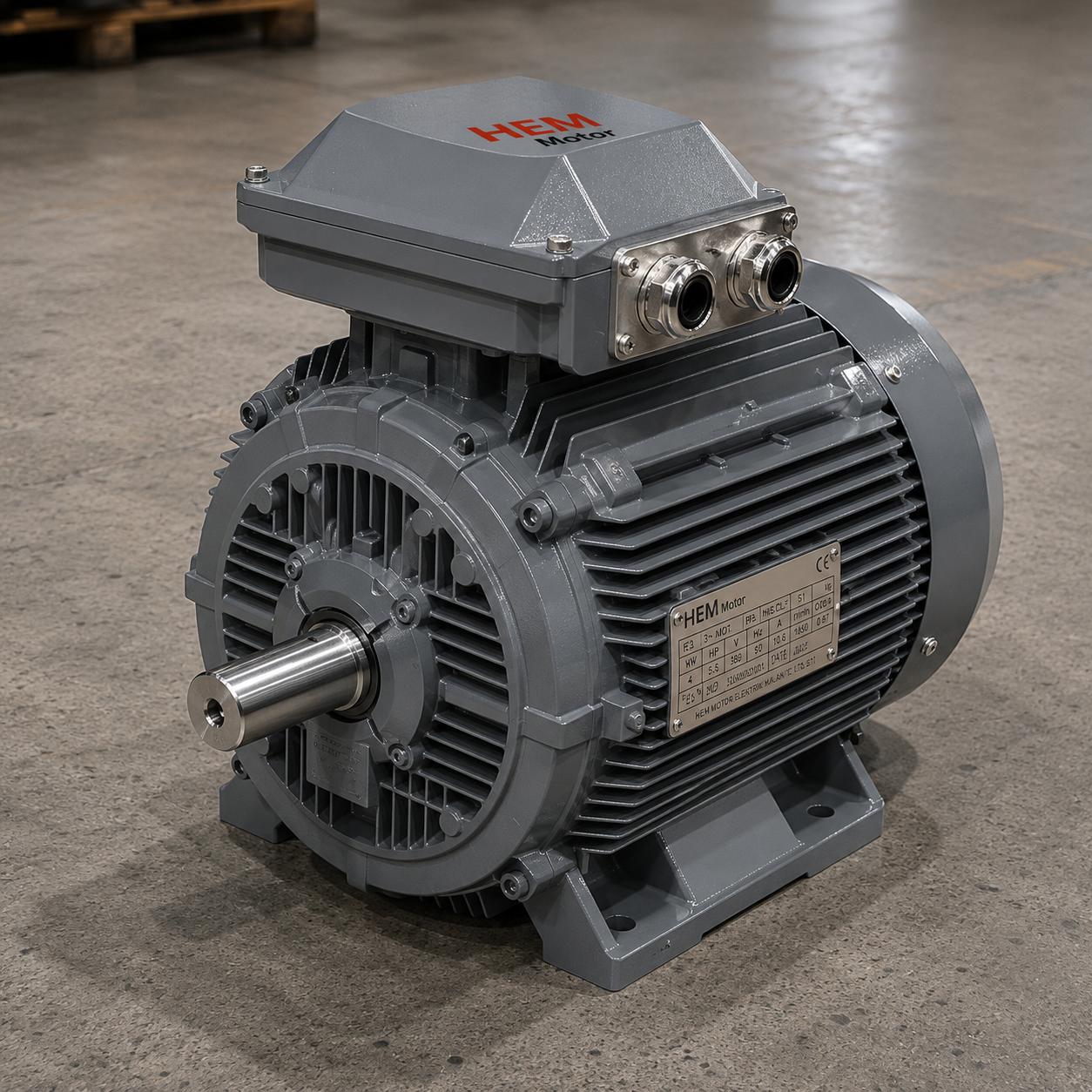
An IE5 synchronous reluctance motor runs with lower losses in the same frame size thanks to its magnet-free rotor and ultra-premium efficiency; but this advantage assumes that the environment in which the motor operates matches its nameplate ratings. Nameplate power values are valid under standard reference conditions, namely 40°C ambient temperature and 1000 m altitude. When the ambient temperature rises above 40°C, or installation is at an altitude above 1000 metres, the power the motor can safely draw decreases. This is called derating (power reduction). This article examines, from a purchasing perspective, the thermal effects of high ambient temperature and high altitude on IE5 synchronous reluctance motors, how derating is calculated, when forced (external) cooling is required, and how to select and supply the correct motor.
Why Does an IE5 Synchronous Reluctance Motor Not Run Without a Drive?
Let us first clarify a basic fact: an IE5 synchronous reluctance motor (SynRM) cannot be connected directly to the grid and started. Unlike an induction motor, the SynRM rotor has no cage winding; it has no mechanism to produce starting torque. The rotor produces torque only through reluctance difference (magnetic permeance asymmetry), and this is possible only when a variable frequency drive (VFD) drives the rotating field at synchronous speed and the correct angle. So an IE5 SynRM must always be considered as a motor-drive package. This matters in two ways for derating: both the motor and the drive must be sized for the ambient conditions.
The presence of the drive also creates a derating advantage. Because the speed can be set freely with a drive, at high temperature or altitude the speed, and therefore the power draw, can be limited in software if needed; an external forced cooling fan can be added to provide sufficient cooling even at low speeds. We cover why a SynRM must be supplied together with a drive package and the cost balance in detail in our article on the drive package and cost of an IE5 synchronous reluctance motor.
Thermal Behaviour of the Magnet-Free Rotor
One of the greatest safety advantages of the IE5 SynRM is that its rotor contains no permanent magnets. In permanent magnet (PM) motors there is a risk of irreversible demagnetisation when rotor temperature rises; high ambient temperature directly increases this risk. The SynRM has no such limitation; the rotor consists of pure steel laminations and is robust against magnet loss at high temperature. This makes the SynRM a safer choice than PM motors in high ambient temperature applications.
However, this does not mean "the SynRM is unaffected by heat." The component that actually sets the temperature limit is the winding insulation in the stator. Class F insulation has a limit temperature of 155°C, Class H of 180°C, and the motor's permitted temperature rise is determined by the difference between ambient temperature and the insulation limit. At 40°C ambient, Class F insulation stays comfortably within limits, but when ambient rises to 55°C the same losses keep the winding much closer to its limit. This is the physical basis of derating: the hotter the ambient, the more the heat the motor can produce (i.e. the losses, i.e. the load) must be reduced.
Derating at High Ambient Temperature
Nameplate power is valid for 40°C. When ambient temperature rises above this, the power drawn from the motor must be reduced so the winding stays within the same temperature rise. As an approximate guide the following factors are used; exact values vary with the manufacturer's thermal class and frame design:
- Up to 40°C: 100% of nameplate power usable; no derating needed.
- 45°C: Approximately 95% of rated power.
- 50°C: Approximately 90% of rated power.
- 55°C: Approximately 82-85% of rated power.
- 60°C: Approximately 75% of rated power; beyond this, forced cooling or a one-size-larger motor is strongly recommended.
In practice there are two routes. The first is to use the motor at the derated power: for example running a 30 kW nameplate motor at about 25 kW load in a 55°C ambient. The second, if you cannot change the load, is to select a one-size-larger motor or strengthen cooling with an external forced cooling fan. Since the drive is already present in a SynRM, at low speeds where the shaft-mounted fan is insufficient, an independently powered forced cooling fan is often the most economical solution.
The SynRM Advantage Over Induction Motors at Temperature
The SynRM produces less heat at the same output power than an induction motor because its rotor losses are almost zero. In an induction motor, slip-related losses arise in the rotor bars and this heat must be removed from the rotor; in the SynRM, since no current is induced in the rotor, this loss item is largely eliminated. As a result, at the same ambient temperature the SynRM generally runs at a lower winding temperature than its induction counterpart, providing additional thermal margin in high ambient temperature scenarios. This thermal advantage of IE5 over IE3 at high temperature raises the derating thresholds somewhat.
Derating at High Altitude
The second reason for derating is high altitude. Nameplate values are valid up to 1000 m altitude. As altitude rises, air density falls; thinner air carries less heat away from the motor surface and the fan blades. So the same motor cools worse at 2000 metres than at sea level. In addition, thin air also somewhat reduces the dielectric strength of the insulation. Together these two effects require power reduction at high altitude:
- Up to 1000 m: No derating needed; 100% power.
- 2000 m: Approximately 93-95% of rated power.
- 3000 m: Approximately 86-88% of rated power.
- 4000 m: Approximately 78-80% of rated power.
The detailed factor tables and calculation logic we give for IE4 motors on altitude derating also apply to the IE5 SynRM; if you want to go deeper, our article on high-altitude derating and power reduction in IE4 motors shows the calculation steps with examples.
When the Two Effects Combine: Multiplying Temperature and Altitude
The critical point is this: when high ambient temperature and high altitude occur together at the same site, the derating factors are applied by multiplication, not addition. Consider a motor installed at 2500 m altitude and 50°C ambient. If the temperature factor is about 0.88 and the altitude factor about 0.90, the usable power ratio is 0.88 × 0.90 ≈ 0.79; that is, only 79% of nameplate power can be safely drawn. A 30 kW nameplate motor is suitable for about 23.7 kW load under these conditions. Skipping this multiplication rule means burnt windings and out-of-warranty failure in the field. So in mining, cement and mountain-region water-pumping projects with high-altitude sites, motor selection must always be done with dual derating.
Forced (External) Cooling: Recovering the Derating
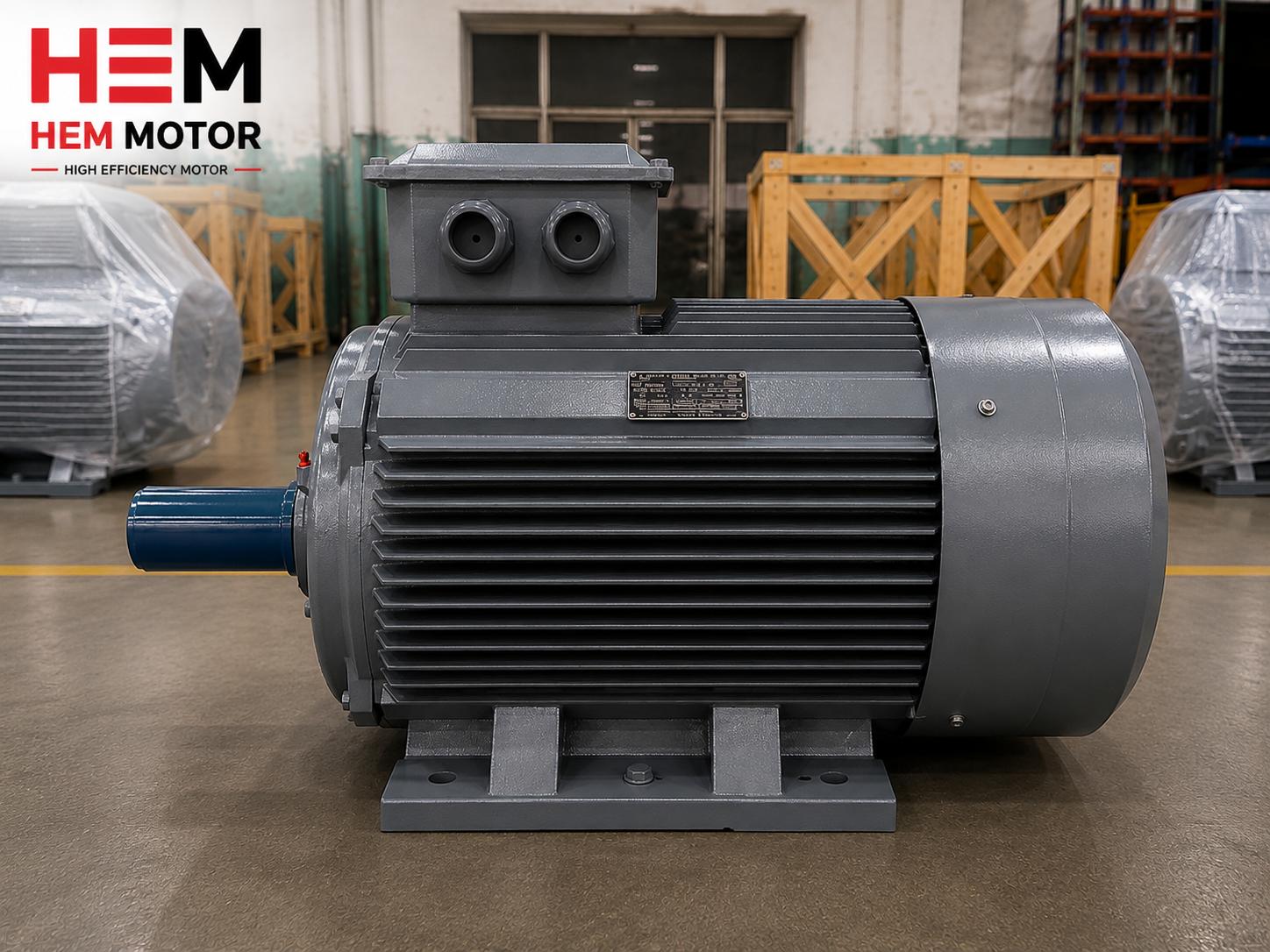
The most effective way to compensate for the power loss caused by derating is to strengthen the motor's cooling. A standard TEFC motor (IC411) cools itself with a fan fixed to its shaft; but this fan turns at the same speed as the motor. In drive operation, while the motor runs at low speed the airflow of this fan drops and cooling becomes insufficient. An external forced cooling fan (IC416) turns at constant speed with its own separate supply, independent of motor speed, and provides full cooling whatever the speed. This solution mitigates both the low-speed and the high ambient temperature problems at once.
- Speed-independent cooling: Even if the motor runs at low speed, the fan turns at full airflow.
- High ambient temperature margin: Increased airflow lowers winding temperature rise; partially recovers the derating.
- Continuous low-speed applications: Needed in pump, fan and conveyor drives requiring constant torque over a wide speed range.
- Alternative to a larger motor: Forced cooling is often a more economical and space-saving solution than moving up a frame size.
We explain how the external forced cooling fan is sized for low-speed drive operation and in which applications it is mandatory, with examples, in our article on the external forced cooling fan, low speed and VFD. For the general thermal behaviour and cooling strategy of the SynRM, see our guide on thermal behaviour, cooling and drive in IE5 synchronous reluctance motors.
Correct Selection: Oversizing or Forced Cooling?
When high ambient temperature and altitude are involved, the right decision depends on the site conditions. The general approach is:
- If load is fixed and cannot be reduced: Either select a one-size-larger motor (oversizing) or add forced cooling. Thermal margin and space constraints determine which is economical.
- If load is variable and low-speed dominant: A forced cooling fan is almost mandatory; the shaft-mounted fan is insufficient at low speed.
- If both high temperature and high altitude exist: Apply dual derating and request a Class H insulated motor, preferably one frame size larger.
- If thermal margin is wanted: Class H insulation (180°C) gives extra margin over Class F; request this difference at high ambient temperature.
When making the selection, looking only at nameplate power is misleading. The right questions are: what is the site's design ambient temperature, what is the installation altitude in metres, does the motor run continuously or intermittently, what is the speed range, what is the insulation class? With this data, motor and drive must be sized together. For options in our IE5 SynRM family and other high-efficiency motors, see our high-efficiency electric motors product category.
Purchasing Checklist: IE5 SynRM for Harsh Environments
- Design ambient temperature and installation altitude clarified; dual derating applied.
- Insulation class selected to suit high ambient temperature (Class F or preferably Class H).
- External forced cooling fan (IC416) specified for low-speed applications.
- Motor and variable frequency drive (VFD) sized together; a SynRM does not run without a drive.
- Protection class (IP55/IP65) and body material suited to the environment.
- Stock, lead time and manufacturer assurance planned to match the project installation schedule.
At HEM Motor we supply IE5 synchronous reluctance motors together with matched drives and, where needed, an external forced cooling fan option, sized for high ambient temperature and high altitude applications, with the advantage of stock and fast supply. Share your site's temperature and altitude data; let us determine the most suitable motor-drive package together with the right power, the right insulation class and the right cooling solution. For current electric motor prices and a quote, please contact us.
Frequently Asked Questions
Why is the IE5 SynRM safer than a PM motor at high temperature?
Because the synchronous reluctance motor rotor has no permanent magnets. In permanent magnet motors, high rotor temperature can cause irreversible demagnetisation, which is a permanent loss of power and efficiency. The SynRM rotor consists of pure steel laminations, so it does not carry this risk. Even so, the temperature limit of the stator winding insulation still applies, so derating and appropriate insulation class selection are essential at high ambient temperature.
Why do we multiply, not add, the temperature and altitude derating?
Because both effects independently reduce the motor's heat dissipation capacity and their effects are cumulative. Adding the two factors overstates the real thermal capacity and overloads the motor. The correct method is to multiply the temperature factor by the altitude factor and apply the resulting ratio to nameplate power. For example 0.88 × 0.90 ≈ 0.79; that is, safe power is about 79% of the nameplate value.
Is forced cooling or a one-size-larger motor more sensible?
It depends on the application. If the motor runs continuously over a wide speed range and especially at low speeds, an external forced cooling fan (IC416) is usually both technically mandatory and economical, because the shaft-mounted fan is insufficient at low speed. If the load is fixed and the speed is high, a one-size-larger motor (oversizing) may be a simple solution. The decision should be made by evaluating the site's speed profile, space constraints and thermal margin together.