English
 Türkçe

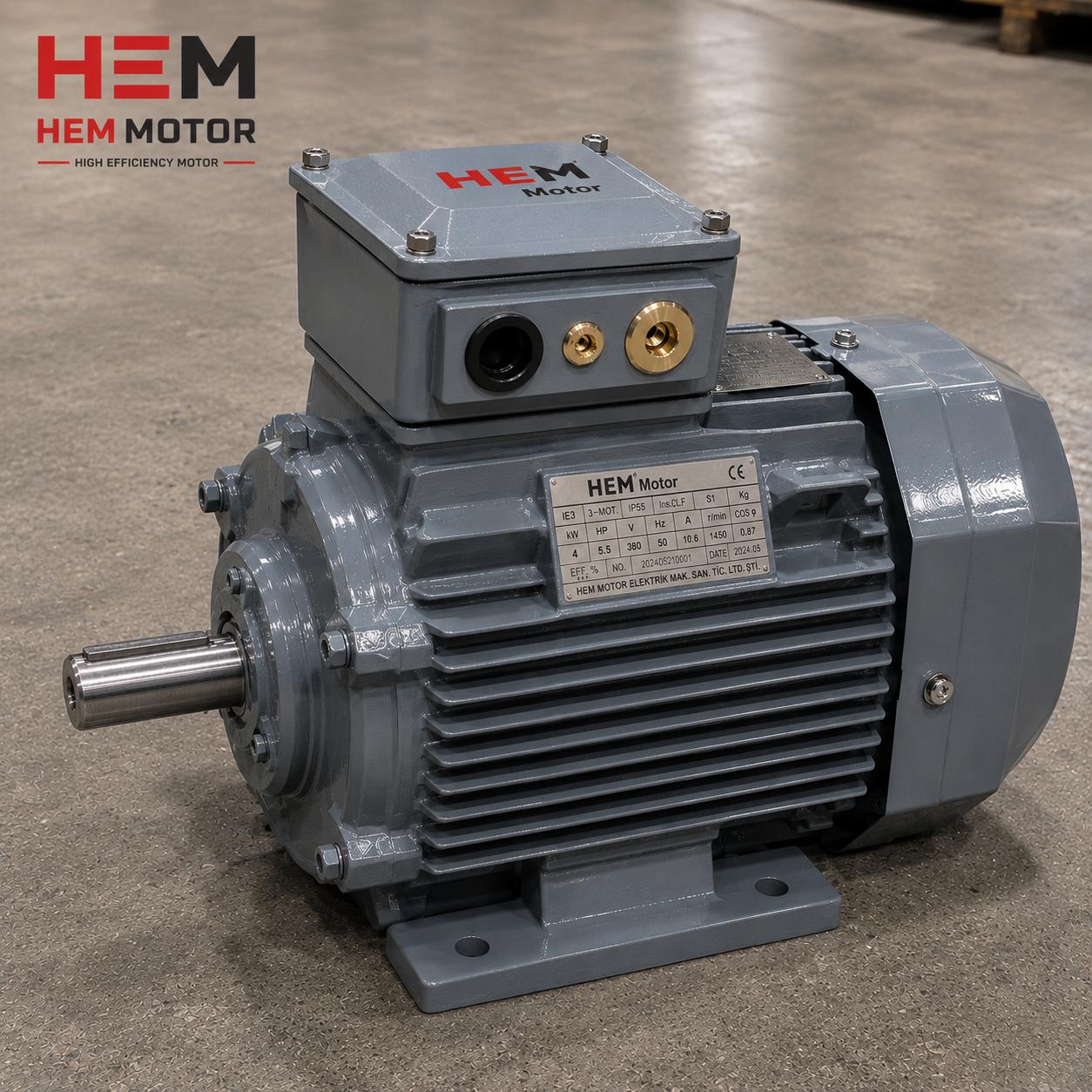

When buying an IE5 synchronous reluctance motor, looking only at the sticker price is like seeing only the visible tip of an iceberg. The real cost of an industrial motor to a business is not defined by its purchase price, but by the energy it consumes throughout its working life, the maintenance it requires and the cost of downtime. This holistic view is called the Total Cost of Ownership (TCO). For a continuously running motor, the purchase price is often a small slice of the lifetime total; the decisive item is electricity consumption. In this article, from a buyer's perspective, we explain step by step how to calculate the TCO components of an IE5 synchronous reluctance motor, why you must include the drive cost in the equation, and when the investment pays for itself.
As HEM Motor, when we supply high-efficiency electric motors, we care about offering our customers not only the product but also the right decision-making method. Because a correctly calculated TCO analysis clearly shows which efficiency class is genuinely economical for your application.
What Is Total Cost of Ownership (TCO) and Why Does It Matter More Than the Sticker Price?
TCO is the sum of all costs an asset generates from purchase to scrapping. For an industrial electric motor these costs fall under three main headings: purchase (initial investment) cost, energy (operating) cost, and maintenance/repair cost. In a continuously running motor, the energy item makes up the overwhelming majority of the lifetime cost. That is why buying a low-efficiency motor simply because it is cheap is often the most expensive option in the long run.
IE5 synchronous reluctance technology stands out precisely here. The IE5 Ultra Premium efficiency class minimizes losses, doing the same work with less electricity. The more and the longer the motor runs, the greater the energy saving, and the faster the initial price difference dissolves in the TCO equation.
The Three Core Components of TCO
- Initial investment cost: The motor itself and the drive (VFD) required to run an IE5 synchronous reluctance motor. This item is one-time.
- Energy cost: The electricity consumed depending on annual running hours, load factor and efficiency. This is the largest lifetime item.
- Maintenance and downtime cost: Losses from bearings, windings, cooling and unplanned stops. Thanks to the magnet-free rotor, this item is predictable in IE5 SynRM.
Why You Must Include the Drive Cost in TCO
The most important difference between IE5 synchronous reluctance motors and asynchronous motors is that they cannot start directly from the grid. These motors are designed to be driven by a variable frequency drive (VFD). Therefore the initial cost of an IE5 SynRM investment is the sum of motor and drive. While this may look like a disadvantage at first, it does not create an extra burden in most modern applications because a drive is already used there.
The drive does not only keep the motor efficiency steady at full load; in variable-load applications such as pumps, fans and compressors it adjusts speed to the load, delivering substantial extra savings. So the drive is both a cost item in the TCO equation and a major source of savings in the energy item. A correct TCO analysis treats the drive on both the cost and the gain side.
What to Watch in TCO Calculation for a Drive-Based System
- Evaluate motor and drive as a single package; pricing them separately is misleading.
- Make sure the drive is compatible (autotune capable) with the motor; a mismatched pairing causes efficiency loss.
- In variable-load applications, reflect the savings from speed control in the energy item.
- Remember the drive also has an efficiency; system efficiency is motor + drive efficiency.
Energy Cost: The Decisive Item in TCO
In a continuously running industrial motor, the great majority of the lifetime cost comes from energy consumption. That is why every point of improvement in the efficiency class flows directly into the operating budget. An IE5 synchronous reluctance motor has lower rotor losses than IE3 and IE4 motors, because the magnet-free reluctance rotor does not suffer the rotor copper loss seen in asynchronous motors.
Three variables determine the energy item: motor power, annual running hours and average load factor. As these variables grow, so does the saving created by the efficiency difference. In a three-shift plant the same motor amortizes itself far faster than in a single-shift plant.
Superiority at Part Load
In real life, motors rarely run at full load; most of the time they run at a fraction of their load. The greatest strength of IE5 synchronous reluctance motors is that their part-load efficiency stays high. While efficiency in asynchronous motors drops noticeably at low loads, SynRM technology maintains efficiency across a wide load range. This further improves TCO in applications such as fans and pumps whose load varies over time, and shortens the payback period.
How Is the Payback Period Calculated?
The payback period is how long it takes for the extra investment you paid for an IE5 synchronous reluctance motor to repay itself through the annual energy saving it provides. The logic is simple: the difference paid for the more efficient motor is divided by the electricity it saves per year. The result shows in how many years the investment recovers itself.
The factors that shorten payback are:
- High annual running hours (continuous or multi-shift operation).
- Large motor power (savings grow in absolute terms).
- High electricity unit cost.
- Speed control with a drive in variable-load applications.
When these factors come together, the payback period of an IE5 investment stays quite short compared to the motor's lifetime; for the remaining years the motor keeps producing net savings. In low-runtime or very small-power applications the payback lengthens; in that case IE4 may be more sensible. A correct analysis lets you make exactly this distinction.
Maintenance and Long Life: Hidden TCO Gains
The magnet-free rotor of IE5 synchronous reluctance motors offers an important advantage in maintenance and supply. In permanent-magnet motors, magnets containing rare-earth elements carry both cost and supply risk; the SynRM rotor contains only a laminated steel pack. This eliminates demagnetization risk, increases temperature resistance and provides a more predictable maintenance profile over the long term.
Lower operating temperature extends bearing and winding life. Reduced unplanned downtime can be even more valuable than energy savings in most plants, because a production stop means direct loss. This item is often neglected in TCO analysis, yet it is decisive in real operating cost.
Common Mistakes in TCO Analysis
When evaluating an IE5 synchronous reluctance motor investment, certain typical mistakes make the TCO result misleading. The most common mistake is comparing only the sticker price and ignoring the energy item. The second frequent mistake is assuming running hours are lower than they really are; on a continuously running line the actual running time turns out to be far above the estimate, and the saving grows accordingly.
The third mistake is ignoring the load profile. If the motor is assumed to always run at full load, the superiority of IE5 SynRM in part-load efficiency does not enter the calculation and the investment looks less attractive than it is. The fourth mistake is treating the drive only as a cost and ignoring the speed-control saving it provides. A correct analysis handles all four items with real data.
- Compare not just the purchase price but the lifetime energy and maintenance total.
- Set annual running hours from the real production calendar, not from a guess.
- Measure the load profile; under variable load the IE5 advantage rises markedly.
- Evaluate the drive in both directions, as a cost and a source of savings.
- Include the cost of unplanned downtime and lost production in the equation.
Which Application Pays Back the IE5 Investment Fastest?
The TCO advantage of an IE5 synchronous reluctance motor is not the same in every application. The scenarios where the investment amortizes fastest are applications where the motor runs a lot and the load is variable. So defining your application profile correctly before the purchase decision directly determines the payback period.
Applications with the Shortest Payback
- Pump systems: In continuously running pumps with varying flow, speed control with a drive delivers large savings in the energy item.
- Fan and blower applications: In ventilation and process fans part-load efficiency is decisive; IE5 stands out here.
- Compressor drives: In high-runtime compressors even a small efficiency difference turns into a large annual saving.
- Continuous production lines: In conveyor, extrusion and process lines, uninterrupted operation shortens payback markedly.
By contrast, in applications that run only a few hours a day, stand idle as backup, or are very small power, the payback of an IE5 investment lengthens. In these cases an IE4 efficient motor may be a more balanced choice. A correct analysis clearly reveals which class suits your application; the goal is not to choose the most expensive motor but the one with the lowest total cost.
How Does TCO Change Over the Motor's Lifetime?
TCO is not a static number but a cost that accumulates over time. In the first year the investment cost dominates, while in later years the energy item moves ahead in the total. In an efficient motor this curve rises far more slowly than in a low-efficiency motor. By the middle of the motor's life, the total cost of the IE5 motor drops below the low-efficiency alternative, and this gap widens every year.
For this reason TCO should be considered not only at the moment of purchase but as a lifetime curve. High-efficiency electric motors, though they look slightly higher in initial investment, deliver a clear gain on the lifetime cost curve. The predictable maintenance profile of a motor bought with manufacturer assurance makes this curve smoother and more foreseeable still.
Choosing the Right Efficiency Class with HEM Motor
Not every application needs IE5; in some cases IE4 is the most economical choice. What matters is making the decision not by guessing but with a correct TCO analysis. As HEM Motor, we evaluate your application's running hours, load profile and power requirement together, and clarify which efficiency class will give you the shortest payback. With manufacturer assurance we share stock and lead-time information transparently and solve motor-and-drive compatibility as a package.
To make the right decision among efficiency classes and to get current electric motor prices and lead times, get in touch with us. For ultra-premium solutions you can review our IE5 electric motors content, for our wide efficient-motor range the high-efficiency electric motors family, and for those seeking a balanced investment our IE4 electric motors options.
Frequently Asked Questions
Is the payback of an IE5 synchronous reluctance motor really short?
In applications with high running hours and medium-to-large power, yes. Payback is found by dividing the extra investment by the annual energy saving; the more the motor runs, the shorter the period. In low-runtime or very small-power applications IE4 may be more economical; a TCO analysis is essential for the right decision.
Is the investment still sensible once the drive cost is included in TCO?
In most applications, yes. The drive is a one-time cost and provides substantial extra savings through speed control in variable-load applications. Moreover, since a drive is already used in many modern systems, this item creates no extra burden. Evaluating the drive together with the motor as one package gives the correct result.
How does the magnet-free rotor affect TCO?
Positively. The magnet-free reluctance rotor removes rare-earth magnet supply risk and demagnetization concerns, and extends bearing and winding life with lower operating temperature. This lowers maintenance cost and improves real operating cost by reducing unplanned downtime.