English
 Türkçe

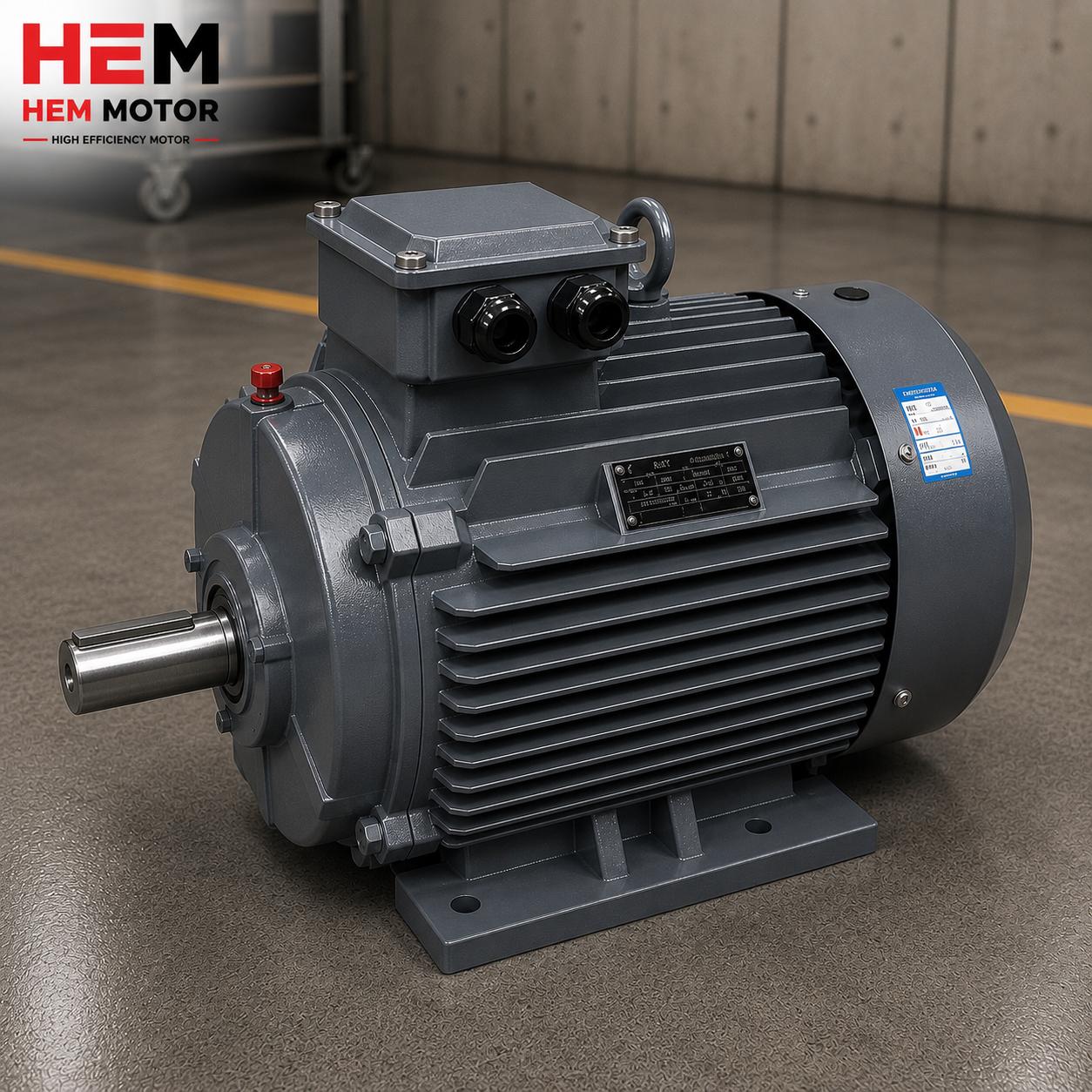

Air-gap eccentricity may look like a minor geometric imperfection at first glance, yet it is a critical quality parameter that directly affects the vibration level, noise, bearing life and even the efficiency of an IE4 Super Premium motor. When the rotor does not turn precisely at the center of the stator bore, the air gap becomes circumferentially uneven; this unevenness breaks the symmetry of the magnetic field and produces a one-sided force known as unbalanced magnetic pull (UMP). Because losses in IE4-class motors are already pushed to very low levels, the additional losses and mechanical stresses caused by eccentricity become proportionally more significant within the total performance budget. In this article we examine the types of eccentricity, the physical origin of UMP, its impact on bearing life, and how correct manufacturing tolerances minimize this risk, both from an engineering and a purchasing perspective.
What Is Air-Gap Eccentricity?
In an asynchronous or synchronous reluctance motor, the radial clearance between rotor and stator is called the air gap. Ideally this gap is perfectly constant around the circumference, with the rotor shaft turning at the geometric center of the stator bore. In real manufacturing, however, machining tolerances, bearing housing position, shaft deflection and assembly errors mean this centering is never flawless. The displacement of the rotor relative to the stator center is called eccentricity and is usually expressed as a percentage of the nominal air gap.
Eccentricity matters because the air gap is the "softest" link in the magnetic circuit. Magnetic flux prefers the lowest reluctance, that is, the narrowest air gap. When the gap narrows on one side, the flux density there rises while it falls on the opposite side. This asymmetry produces both electromagnetic and mechanical consequences.
Static Eccentricity
Static eccentricity is the condition where the position of the narrowest air gap stays fixed in space. Even as the rotor turns, the minimum gap remains at the same angular point. Typical causes are an oval-machined stator stack, axially misaligned end shields, or a rotor positioned off-center within the stator. Static eccentricity produces a UMP of fixed direction; this force does not change over time but continuously applies a one-directional extra load to the bearings.
Dynamic Eccentricity
Dynamic eccentricity is the condition where the position of the narrowest air gap rotates together with the rotor. It usually arises when the rotor's geometric center does not coincide with the axis of rotation, from shaft deflection, an off-center rotor stack press-fit, or bearing wear. With dynamic eccentricity the UMP direction rotates with the rotor speed, creating characteristic vibration components at the rotational frequency and its sidebands. In practice many motors exhibit both static and dynamic eccentricity together (mixed eccentricity).
How Does Unbalanced Magnetic Pull (UMP) Arise?
When the air gap narrows on one side, the magnetic attraction there becomes larger than on the opposite side because of Maxwell stress. Since the pull force rises approximately in inverse proportion to the square of the air-gap length, even a small eccentricity can produce a disproportionately large net side force. This net force is unbalanced magnetic pull (UMP), and it always draws the rotor toward the narrowest air gap, that is, the side closest to the stator.
The most insidious aspect of UMP is that it is a self-reinforcing mechanism: as the force pushes the rotor toward the narrow side, the gap there narrows further, the pull grows, and the effect intensifies. With an insufficiently rigid shaft and inadequate bearing support, this loop amplifies vibration. UMP directly affects the following motor behaviors:
- Increased vibration and noise: Pronounced vibration components appear especially around the rotational frequency and slot-passing frequency.
- Extra radial load on bearings: UMP rides on the bearings as a constant side force, a load often ignored in catalog load calculations.
- Local heating: Iron losses and heating increase in the narrow region where flux concentrates.
- Acoustic tonality: The asymmetry of the magnetic force can trigger resonance at certain frequencies, creating a characteristic hum.
Impact on Bearing Life
Bearing life is inversely proportional to roughly the cube of the applied equivalent dynamic load. This means even a small increase in load corresponds to a large drop in life. Because UMP is a component continuously added to the radial load a bearing must carry, the bearings in a high-eccentricity motor fatigue far earlier than expected. The practical consequences are:
- Premature bearing failure: Continuous one-directional load creates local fatigue marks and noise on the raceway.
- Lubrication film breakdown: Excessive side load thins the oil film in the bearing and accelerates metal-to-metal contact.
- Unplanned downtime: In continuous processes a single bearing failure can stop an entire line and cause major production losses.
For this reason, heavy-duty bearings, correct preload and proper housing tolerances in IE4 motors are not merely a comfort feature but a direct matter of operational reliability. The bearing life of a high-vibration motor and that of a motor with a controlled vibration class can differ by many times. Our article on the electric motor shaft radial and axial load bearing limit details how external mechanical loads affect bearing selection.
Manufacturing Quality: Preventing Eccentricity at the Source
Eccentricity and UMP can be largely prevented with correct manufacturing and assembly practices. A few key manufacturing parameters are decisive here.
Concentricity and Tolerance Control
Machining the bearing housings, bearing seats and stator bore against a single reference axis minimizes static eccentricity. A cast-iron frame, thanks to its high rigidity and dimensional stability, offers a clear advantage in maintaining these tight tolerances. The flatness of the end shields and the coaxiality of the bearing housings are critical for keeping the air gap circumferentially balanced. On this topic we recommend our article on cast-iron motor end shield and bearing housing machining.
Rotor Balance and Shaft Rigidity
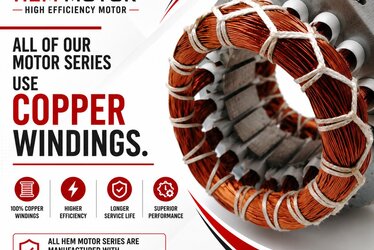
Preventing dynamic eccentricity requires precise rotor balancing and a sufficiently rigid shaft. A well-balanced rotor aligns the axis of rotation with the mass center, reducing both mechanical unbalance vibration and dynamic air-gap deviation. 100% copper windings provide lower winding temperature and longer insulation life, supporting the motor's thermal stability; since temperature-driven dimensional changes affect the air-gap geometry, this also indirectly contributes to eccentricity control.
Vibration Class and Acceptance Tests
A quality IE4 motor is subjected to vibration measurement at the factory. A motor with a low vibration class (e.g. balanced, with tight acceptance criteria) is far more likely to actually deliver its declared bearing life. HEM Motor supplies its IE4 Super Premium motors with the combination of a cast-iron frame, low vibration, 100% copper windings and heavy-duty bearings, backed by manufacturer assurance.
Choosing the Right Supplier: Quality, Stock and Lead Time
Keeping eccentricity and UMP under control comes not from cheap, uncontrolled manufacturing but from a controlled production line. If you want low vibration and long bearing life in a motor, your supplier must guarantee not just the IE4 label but the manufacturing quality. Points to watch when selecting the right supplier:
- Manufacturer assurance: Nameplate values, material and vibration class should be documented.
- Stock depth: Fast availability of a spare motor in an unplanned failure limits production loss.
- Fast quotation and clear lead time: Compliance with the project schedule determines purchasing reliability.
- Technical consultancy: Correct product guidance based on frame, mounting type and application load.
As a manufacturer and seller, HEM Motor offers IE4 motors across a wide power range from stock, with fast quotation and clear lead times. Our article that takes a broader look at the relationship between efficiency and quality, high-efficiency motor loss mapping and thermal behavior, together with the HEM Motor homepage where you can reach our full product range, helps you make this decision.
Effect of Eccentricity on the Efficiency and Thermal Budget
Eccentricity is not only a mechanical problem; it directly affects electromagnetic efficiency as well. When the air gap narrows on one side, the flux density there rises and the tendency toward iron saturation becomes pronounced. As saturation increases, the magnetizing current drawn grows, which raises copper losses. At the same time, local iron losses and eddy-current losses increase in the narrow region where flux concentrates. Because losses in an IE4-class motor are already designed to be very low, these additional eccentricity-driven losses become proportionally more visible within the total efficiency budget.
Another consequence of this is thermal imbalance: the motor does not heat evenly around its circumference, and the region of concentrated flux runs hotter. A local hot spot forms the weakest link of the insulation and shortens winding life. Temperature-driven expansion can distort the air-gap geometry a little further, creating a small vicious circle. For this reason, low eccentricity is a quality indicator for both efficiency and thermal stability. Our article on high-efficiency motor loss mapping, where we detail where losses come from and how they are managed, examines this relationship more broadly.
Recognizing the Symptoms of Eccentricity in the Field
Whether a motor suffers from an eccentricity problem can often be understood from its behavior in the field. The symptoms to watch for are:
- Dominant vibration at the rotational frequency: A vibration similar to mechanical unbalance but intensifying as load increases may point to magnetically driven UMP.
- Increasing noise under load: A motor that is quiet at no load but hums under load may show signs of magnetic asymmetry.
- Recurring bearing failure: Bearings that wear in the same direction at the same location are the trace of a fixed-direction UMP (static eccentricity).
- Sideband components: Sidebands forming next to the rotational frequency in the vibration spectrum are the characteristic signature of dynamic eccentricity.
Recognizing these symptoms early is the first step in preventing unplanned downtime. The most robust solution, however, is to prevent the problem at its source, that is, with a correctly manufactured motor from the start, rather than diagnosing it in the field. An IE4 motor purchased from the right supplier and with a controlled vibration class is the strongest assurance that these symptoms never appear.
Frequently Asked Questions
What is the main difference between static and dynamic eccentricity?
In static eccentricity the narrowest air gap stays at a fixed angle in space and produces a UMP of constant direction; in dynamic eccentricity the narrowest gap rotates with the rotor and creates a force component that varies at the rotational frequency. In most real motors both occur together (mixed eccentricity), leaving distinct signatures in the vibration spectrum.
Why does eccentricity shorten bearing life so much?
Because UMP is a force continuously added to the radial load a bearing must carry, and bearing life is inversely proportional to roughly the cube of the applied load. Even a relatively small increase in load corresponds to a large drop in life; that is why heavy-duty bearings, low vibration and correct tolerances all matter together.
How does HEM Motor reduce UMP risk in its IE4 motors?
The combination of the cast-iron frame's high rigidity, coaxially machined end shields, a precisely balanced rotor, the thermal stability of 100% copper windings and heavy-duty bearings limits eccentricity at the source and keeps UMP low. This yields quieter operation and longer bearing life, all delivered with manufacturer assurance, stock and clear lead times.