English
 Türkçe

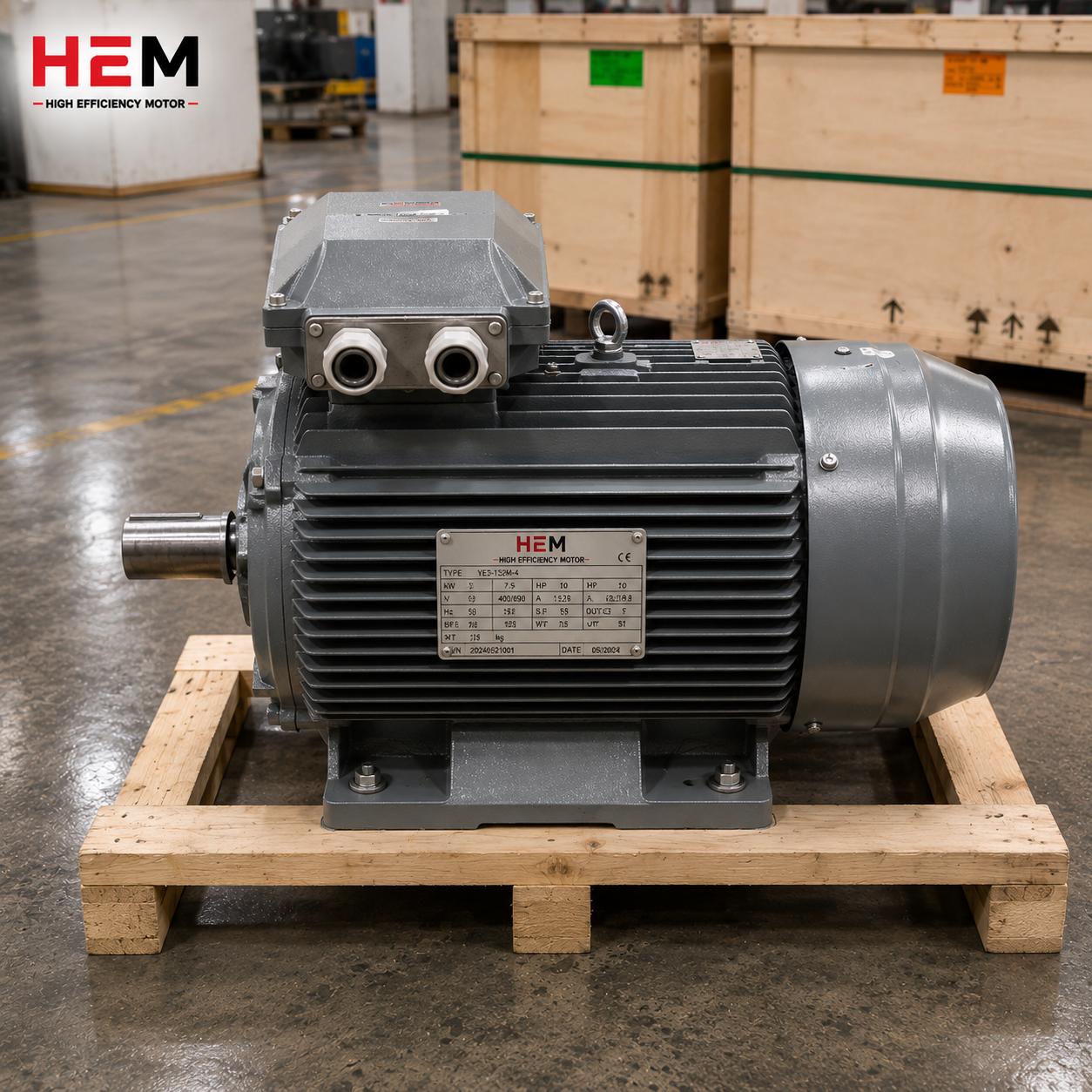

In continuously running heavy-duty applications such as pumps, fans, compressors and crushers, a 90 kW or 110 kW class motor alone determines a large share of the plant's energy bill. Choosing an IE4 super premium efficient electric motor in this power range directly lowers the electricity cost you will pay over the years; but correct buying is not only about the nominal efficiency printed on the label, it is about the motor's load curve (its part-load efficiency), speed and pole selection, frame size and, most importantly, stock and lead-time. This article addresses the large-power selection of 90 and 110 kW IE4 motors from a purchasing perspective: the relationship between efficiency and load curve, the choice of 2/4/6/8 poles and 3000/1500/1000/750 rpm, IEC 280/315 frame size, and fast supply from stock; explaining which motor, at which speed and with which lead-time, you should choose for your application.
Why Is IE4 So Important in the 90 and 110 kW Class?
In large-power motors, even small efficiency differences translate into very large numbers as absolute losses. A one-percent efficiency gain on a 90 kW motor means a significant saving when you consider the energy consumed over the motor's entire life; because motors in this class typically run 16-24 hours a day, thousands of hours a year. An IE4 efficient electric motor lowers losses even further than the IE3 premium class and pays for itself precisely in this continuous-running regime. The purchase price of the motor is small next to the plant's annual energy spend; so in the 90 and 110 kW decision, the first question should not be "which is cheapest" but "which has the lowest total cost over its life".
The IE4 class is achieved with higher-grade electrical steel, lower-resistance windings, an optimized air gap and better cooling. This reduces both the copper and iron losses; in the end the motor produces the same shaft power while drawing less power from the grid. At large power, the return on this difference comes back many times faster than on small motors.
Is Nominal Efficiency Enough on Its Own?
The IE4 nominal efficiency value on the label shows the motor's efficiency at full load (100% load). Yet most pumps and fans do not run continuously at full load; during hours when flow is throttled, a valve is choked or process demand falls, the motor runs at part load. This is where the motor's load curve comes in: a well-designed IE4 motor largely retains its efficiency at 75% and 50% load too; a poorly designed motor rapidly loses efficiency at part load. So in the buying decision you must look not only at full-load efficiency but at efficiency at your application's real operating point.
Load Curve and Part-Load Efficiency: Correct Sizing
Fitting a 110 kW motor to an application that needs 90 kW "to be safe" is a common habit; but a heavily oversized motor will run continuously at part load, moving away from the peak of the efficiency curve and lowering the power factor (cosφ). Although IE4 motors offer a flat efficiency curve over a wide load range, sizing the motor close to the real demand is best for both efficiency and power factor. Oversizing not only raises the initial investment but also brings reactive penalty and unnecessary copper cross-section due to low cosφ.
- Real operating point: Select the motor for the load point at which it will run continuously, not for the maximum possibility.
- Part-load efficiency: Efficiency at 75% and 50% load is more decisive than full-load efficiency in pump/fan applications.
- Power factor: In an oversized motor cosφ falls; this increases the reactive power drawn from the grid.
- Service factor: Margin for short-term overload; prefer correct power + service factor over continuous oversizing.
If you want to go deeper into part- and low-load efficiency and correct sizing, our article on part- and low-load efficiency and correct sizing in IE4 motors covers the load curve and selection logic in detail.
Speed and Pole Selection: 2/4/6/8 Poles and 3000/1500/1000/750 rpm
The speed at which 90 and 110 kW power is bought is determined by the application's torque and the machine's operating speed. At the same power, as the pole count increases the speed drops and the nominal torque rises; a low-speed motor comes in a larger frame with higher torque. So speed selection is not only a speed but also a torque and frame-size decision.
- 2 poles (3000 rpm): High-speed centrifugal pumps and compressors; low torque, high speed. At large power, noise and bearing strain are more critical.
- 4 poles (1500 rpm): The most common choice; for pumps, fans and general drives the balance of efficiency, torque and frame size is at its best.
- 6 poles (1000 rpm): Large fans, exhaust hoods, cooling towers and conveying systems needing low speed; high torque.
- 8 poles (750 rpm): Crushers, mills and heavy drives requiring very low speed; the highest nominal torque, the largest frame.
As the pole count rises, shaft torque increases at the same power and the motor turns at lower speed; this can reduce the need for a gearbox (reducer). However, the efficiency-torque balance of low-speed IE4 motors requires different design finesse than high-speed ones. Our article on low-speed 6 and 8 pole IE4 motor efficiency and torque selection explains which pole structure is correct for which application.
Use With a Frequency Inverter
Most 90 and 110 kW pump and fan drives are driven by a frequency inverter (VFD); because throttling flow with an inverter saves far more energy than valve choking. When you use an IE4 motor together with an inverter, the motor's high efficiency and the inverter's speed control combine at part-flow points. In this application you should clarify topics such as insulation class, bearing-current protection and, if needed for cooling at low speed, an external fan (forced cooling) with the manufacturer.
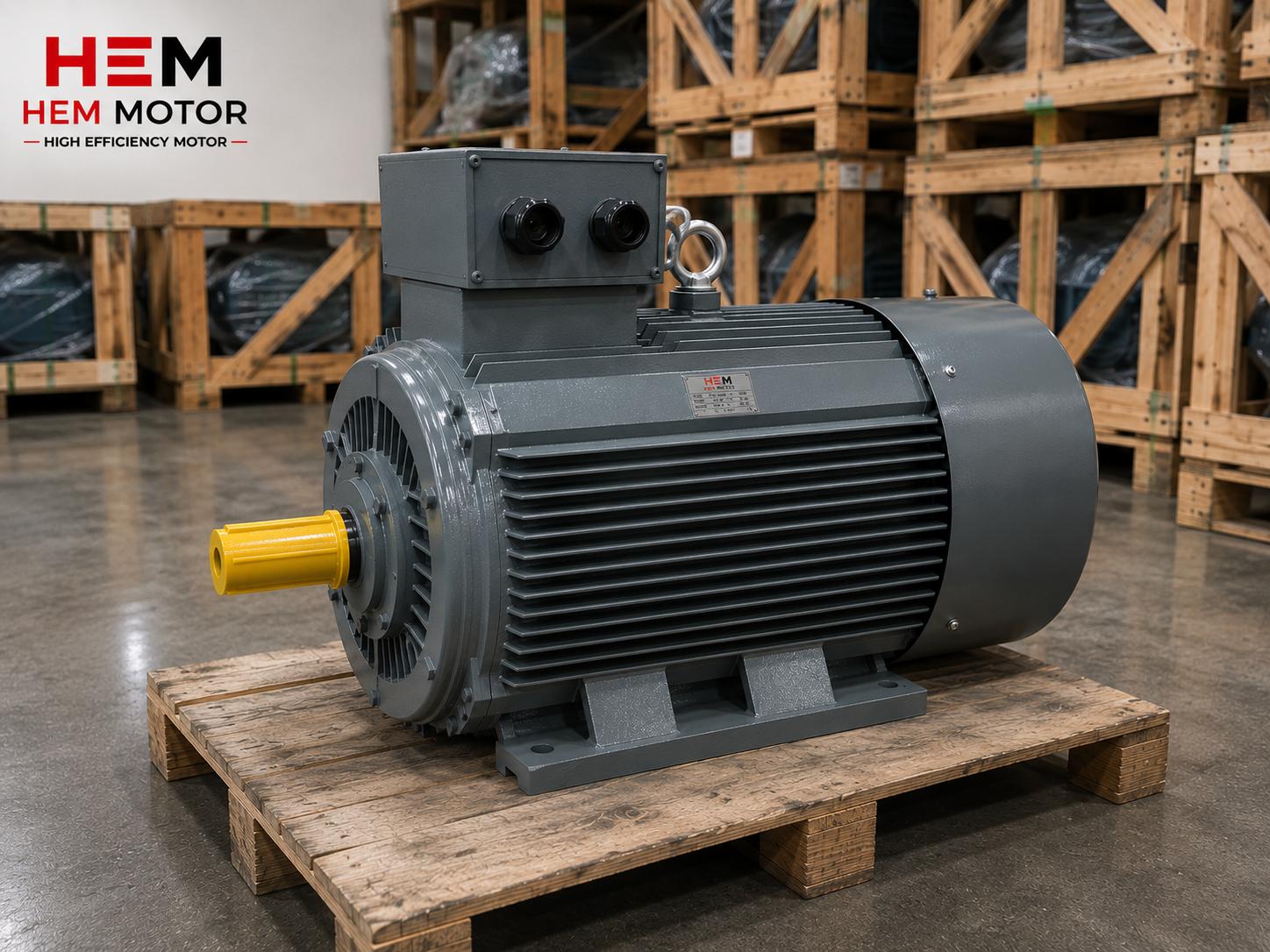
Frame Size: IEC 280 and 315 at Large Power
Depending on speed, 90 and 110 kW powers mostly come in IEC 280 and 315 frame sizes. The frame size determines both the mounting dimensions (foot-hole spacing, shaft diameter, shaft height) and the motor's weight and handling/lifting requirement. As motors in this size are now of serious tonnage, the base, anchoring, lifting lugs and mounting tolerances are far more important than on small motors.
- Shaft height and diameter: The IEC 280/315 shaft end defines your coupling and pulley selection; check compatibility with the existing installation dimensions.
- Weight and lifting: Motors in this class are handled by lifting lugs and a suitable crane; this must be planned before installation.
- Cooling and terminal box: At large power the cable cross-section and terminal connection grow; terminal box orientation and cable entry are chosen in advance.
- Bearings and lubrication: Regreasable bearings with grease nipples on the large frame extend maintenance life.
If you want to compare the balance of efficiency, size, speed and price in this class against IE3 premium, our article on IE3 90 and 110 kW large-power motor stock, speed and pole selection gives the selection logic between the two efficiency classes comparatively.
Stock and Supply: At Large Power, Lead-Time Is Decisive
At large powers such as 90 and 110 kW, the most common problem is not selecting the right motor but getting it to the field at the right time. Motors in this class may not be on the shelf in every frame and every speed; especially 6 and 8 pole low-speed options and special terminal/mounting requests may require lead-time. When a plant's pump or fan fails, production stops and the only thing expected is fast supply. So in purchasing, not only the technical specification but stock status and lead-time assurance are decision criteria.
- Fast supply from stock: The most-used 4 pole IE4 large powers usually ship fast from stock; ask about this for a critical spare.
- Lead-time assurance: For selections needing special speed/mounting, get a clear lead-time; plan according to your project's installation schedule.
- Manufacturer assurance: Warranty, spare parts and technical support; critical because failure cost is high at large power.
- Correct quote: Request a quote by clearly stating power, speed, frame, mounting type and protection class.
To learn which kW and speeds ship fast from stock, see our article on which kW and speeds ship fast from stock. You can review the full IE4 product range in our IE4 high-efficiency electric motors category.
Purchasing Checklist: 90 and 110 kW IE4
- Efficiency class IE4 super premium; lowest life cost for continuously running heavy duty.
- Speed/pole suited to the application: mostly 4 poles for pumps/fans; 6-8 poles for crushers/mills.
- Efficiency and cosφ at the real operating point (part load) evaluated for the application.
- Frame size IEC 280/315; shaft, coupling, base and lifting planned.
- If used with a frequency inverter, insulation, bearing current and cooling clarified.
- Stock and lead-time: correct frame and speed, in time for the project's installation schedule.
At HEM Motor we offer large-power IE4 super premium motors with the right frame and speed option, with the advantage of stock and fast supply. For your 90 and 110 kW pump, fan, compressor or crusher drive, we can determine the right efficiency class, speed and lead-time plan together; request a quote tailored to your application from our electric motor prices page.
Frequently Asked Questions
Can I buy 110 kW instead of 90 kW to be safe?
You can, but it is often unnecessary. If you fit 110 kW to an application that really needs 90 kW, the motor runs continuously at part load; in that case the power factor (cosφ) falls and the initial investment rises. Because IE4 motors retain their efficiency over a wide load range, the correct approach is to select power close to the real demand and cover short-term overloads with the service factor. Correct power + inverter is more efficient than continuous oversizing.
Should I buy 4 poles or 6 poles?
This depends on your machine's operating speed and torque need. For centrifugal pumps and general drives, 4 poles (1500 rpm) is the most common and balanced choice. For large fans, cooling towers, crushers and mills requiring low speed and high torque, 6 or 8 poles are preferred; this selection can reduce the need for a reducer but brings a larger frame. If you share your application's speed and torque data, we determine the right pole structure together.
Why are stock and lead-time so important at large power?
90 and 110 kW motors may not be on the shelf in every frame and speed; especially low-speed and special-mounting options can require lead-time. As production stops during a pump or fan failure, fast supply becomes critical. So in purchasing, stock status, a clear lead-time and manufacturer assurance must be evaluated alongside the technical specification; for critical applications, planning a spare motor is the safest path.