English
 Türkçe

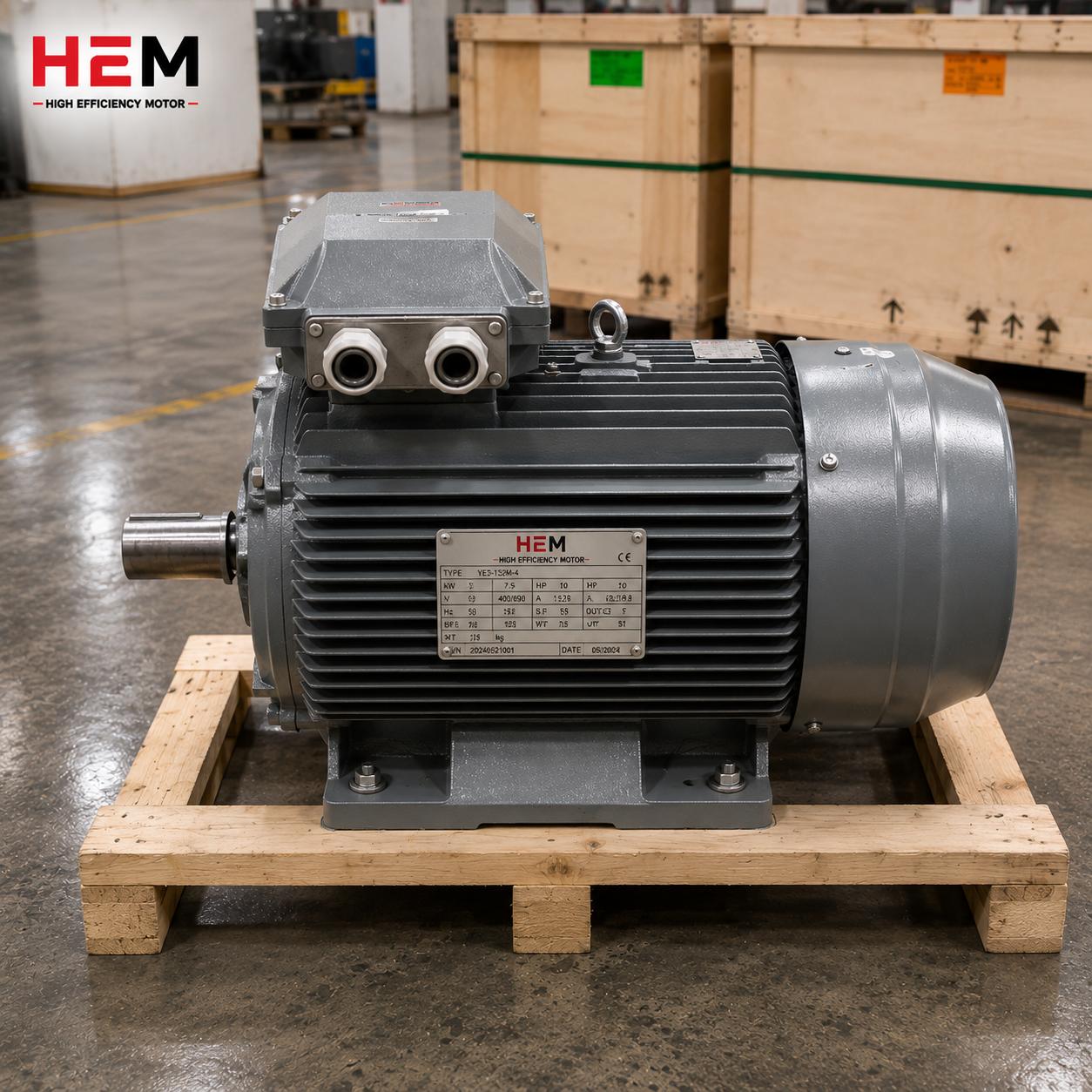

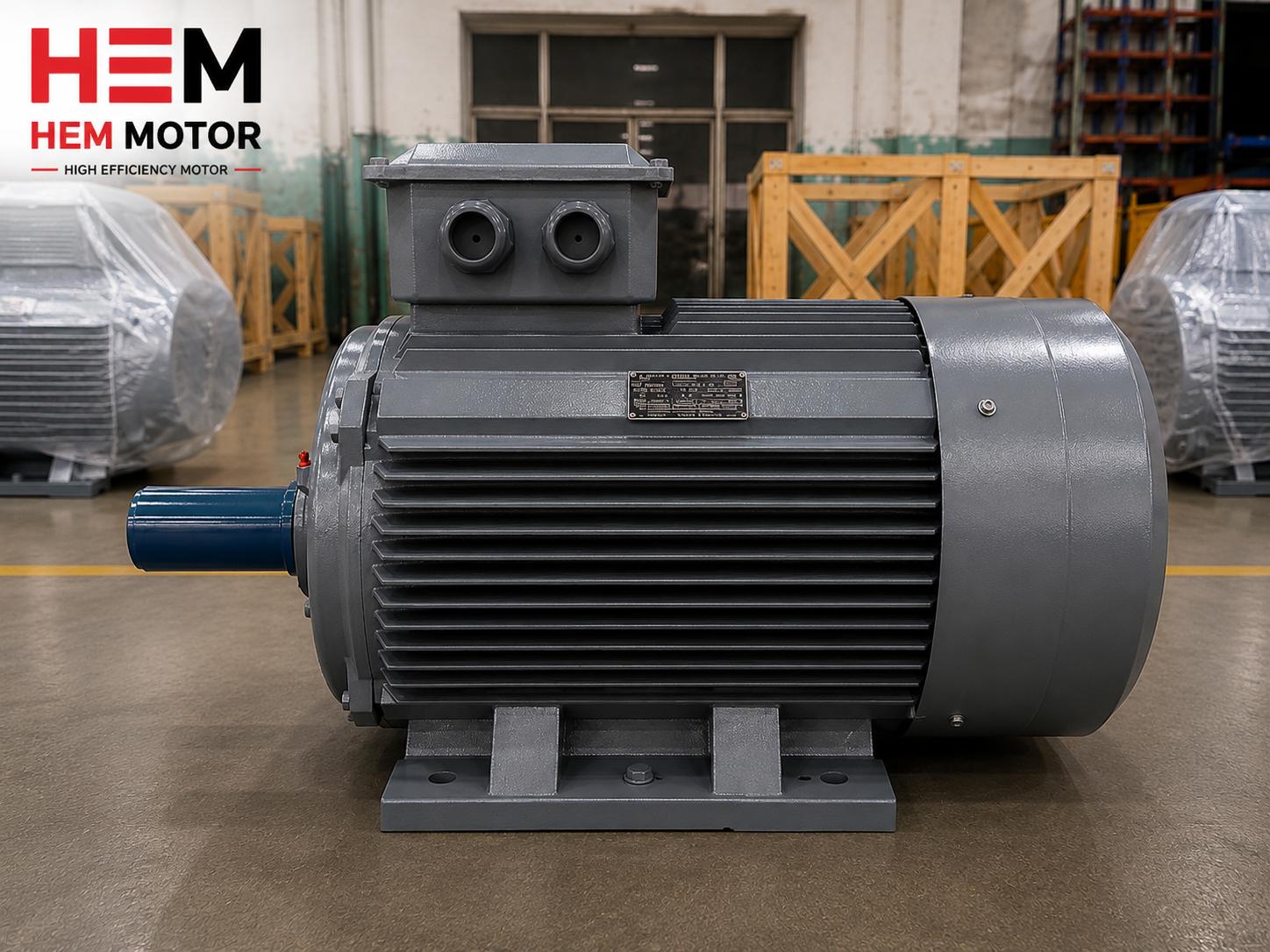
Electric motor selection in the large-power class demands a completely different engineering discipline than small and medium-power applications. At high power values such as 200 kW and 250 kW, the annual energy consumption of the motor reaches hundreds of thousands of kilowatt-hours, and at this scale even a one-percent difference in efficiency becomes a serious line item in the operating budget. This is precisely why IE4 Super Premium class cast-iron motors are by far the most rational choice in this power range, both for legal compliance and for total cost of ownership. In this article, HEM Motor examines every topic that influences the purchasing decision for 200 and 250 kW IE4 motors, from the efficiency curve to pole and speed selection, from the starting method to the difference between stock and project-based supply, with a fully technical perspective.
Why IE4 Super Premium at Large Power?
MEPS (Minimum Energy Performance Standards) regulations in the European Union and Türkiye impose a minimum efficiency class requirement on motors placed on the market within certain power ranges. The IE4 efficiency class represents the highest efficiency level achievable among current series-production asynchronous motors, and in the 200-250 kW band this class both complies with regulations and minimizes payback time.
The importance of efficiency at large power emerges from simple arithmetic. If a 250 kW motor runs 8000 hours per year, it consumes more than two million kilowatt-hours of energy. Even the half-to-one point efficiency difference between IE3 and IE4 means tons of CO2 saved and significant energy savings over the entire life of the motor. The cast-iron frame is the only correct material in this power class that guarantees heat dissipation, mechanical strength and vibration damping; aluminum frames are not preferred at these powers.
- Legal compliance: Directly meets MEPS efficiency class requirements.
- Low operating cost: High efficiency permanently lowers the energy bill.
- Long service life: Cast-iron frame and F/H insulation class provide high thermal and mechanical durability.
- Low carbon footprint: Lifetime CO2 emissions are markedly reduced.
Part-Load Efficiency Curve and the Right Operating Point
The most critical issue overlooked in many purchasing decisions is at which load point the motor actually operates. The part-load efficiency curve of IE4 motors stays fairly flat from about 50% to 100% of full load. This means the motor can run at half load with an efficiency close to full load; however, this does not justify oversizing.
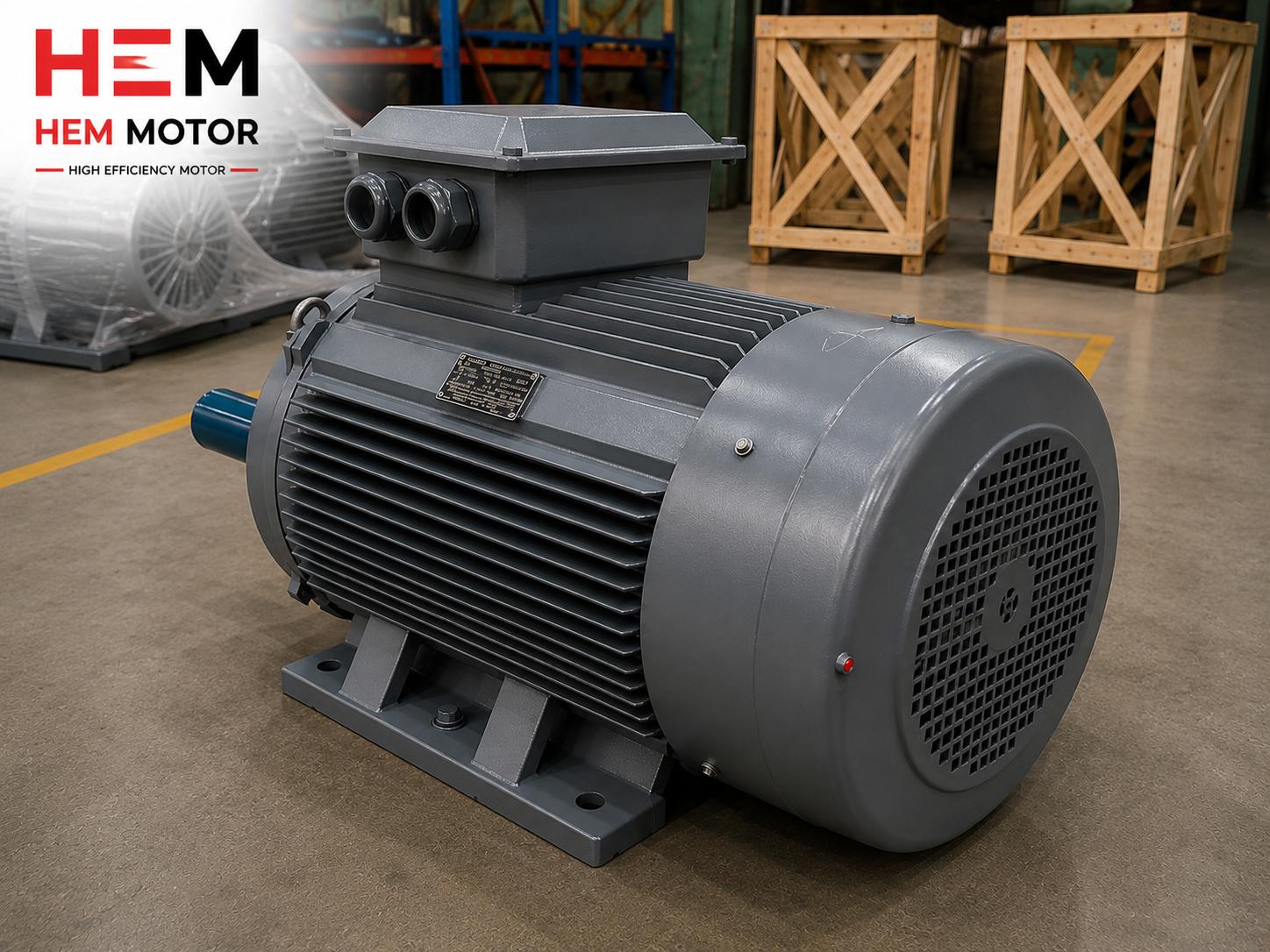
If a 200 kW motor is continuously operated at 120 kW load, the initial investment cost is wasted, the power factor drops, and reactive energy penalties may arise. The correct approach is to measure or calculate the real operating point, then select the motor whose rated power is closest to that point. Instead of oversizing, analyzing the expected load profile and determining the most suitable power minimizes total cost. To correctly read the efficiency value and IE code on the motor nameplate, see our motor nameplate efficiency reading guide.
Load Profile Analysis
A pump or fan running at constant load is evaluated very differently from a conveyor or crusher drive running at cyclically varying load. At constant load the motor is selected directly for that load point. For variable load, the equivalent thermal load (RMS power) must be calculated and used as the basis. Correctly defining the load type also requires determining whether it has a constant-torque or quadratic-torque characteristic.
Speed, Pole and Frame Selection: 315 and 355 Frame
After the rated power is determined, the second critical decision is the rotational speed, which is directly related to the pole count. On a 50 Hz grid a 2-pole motor gives about 3000 rpm synchronous speed, a 4-pole about 1500 rpm, and a 6-pole about 1000 rpm; actual speed is lower by the slip.
- 2-pole (3000 rpm): For high-speed compressors and some pump and blower applications.
- 4-pole (1500 rpm): The most common choice; balanced torque-speed for pumps, fans, conveyors and general drives.
- 6-pole (1000 rpm): For crushers, mills and heavy drives requiring high torque and low speed.
In the 200-250 kW power class, typical frame sizes fall within the 315 and 355 frame range. Frame selection is determined not only by power but also by pole count and mounting needs. For example, at the same power a 2-pole motor fits a smaller frame, while a 6-pole motor requires a larger frame because it produces more torque. Mechanical connection dimensions such as shaft diameter, foot hole spacing and shaft axis height (H dimension) are standardized by frame. To examine power-speed-frame matching in detail, our power-speed motor H-to-kW power map is a useful resource.
Mounting Type and Mechanical Fit
Large-power 355 frame motors are mostly supplied with B3 (foot-mounted) configuration, but B5 and B35 options are also available for vertical or flange-mounted applications. The coupling, belt-pulley or direct-coupled connection method with the driven machine affects shaft-end dimensions and the required bearing type. Motors at this power usually have a two-bearing structure, and a reinforced bearing option should be considered for belt drives requiring high radial load.
Starting: Why DOL Is Unsuitable at Large Power
Direct-on-line (DOL) starting, common at small powers, is unsuitable on most grids at large powers such as 200-250 kW. The main reason is that during start-up an asynchronous motor draws a locked-rotor current reaching 6-8 times its rated current. In a 250 kW motor this current causes serious voltage dips on the grid, affects other equipment, and stresses the transformer.
Therefore two main methods stand out at large power:
- Soft starter: Limits start-up current and mechanical shock. It is an economical and effective solution for pump and fan applications that run at constant speed and need no speed control after starting.
- Variable frequency drive (VFD): Provides both soft starting and variable speed control throughout operation. It maximizes energy savings in variable-flow pumps and fans; it requires inverter duty winding insulation.
Grid capacity, the utility's start-up current limits and the application's speed-control need determine the choice between these two methods. For a winding structure resistant to voltage spikes in inverter-driven motors, our IE4 inverter duty winding du/dt article contains important technical details.
Distinguishing Stock from Project-Based Supply
For large-power motors, supply strategy is an inseparable part of the purchasing decision. Clearly understanding the difference between stock supply and project-based (made-to-order) supply is of great importance in lead-time planning.
- Stock supply: Frequently requested configurations such as standard 200 and 250 kW, 4-pole, B3-mounted IE4 motors can usually be delivered quickly. Ideal for emergency failure replacement and short-lead-time projects.
- Project-based supply: Non-standard requests such as special voltage, 60 Hz, special paint, ATEX, special shaft or high IP protection require a lead time tied to the production schedule.
In every case, confirming lead time, shipping conditions and the offer directly with the manufacturer prevents surprise delays. HEM Motor offers both fast stock supply and project-specific production options together, creating the solution best suited to your facility's needs. You can reach our full motor portfolio from our homepage.
Insulation, Thermal Class and Site Conditions
In large-power motors, insulation class and temperature rise are factors that directly determine service life. As standard, F-class insulation with B-class temperature rise increases the motor's thermal reserve and ensures safe operation even in hot environments. In demanding conditions such as high ambient temperature, high altitude or tropical humidity, H-class insulation and special tropicalization measures should be considered. To examine the relationship between insulation thermal class and temperature rise in depth, see our IE4 motor insulation thermal class F/H article.
Altitude derating must also not be forgotten: in installations above 1000 meters the density of the cooling air decreases, so the power the motor can deliver drops. Site conditions must always be stated at the quotation stage.
Power Factor and Reactive Energy Management
A topic often overlooked in large-power motors is the power factor and the associated reactive energy management. An asynchronous motor draws magnetizing current, that is, reactive power, from the grid to establish its magnetic field. At high powers such as 200 and 250 kW, this reactive load, if not compensated, leads to serious reactive energy penalties on the facility's electricity bill.
IE4 Super Premium motors offer a high power factor at full load thanks to their optimized magnetic design. However, operating the motor at part load lowers the power factor; this is another hidden cost of oversizing. A motor running at half load is disadvantaged in both efficiency and power factor. Correct sizing provides a double gain in terms of both active energy savings and reactive energy management.
- Full load: High power factor, optimum efficiency, minimum reactive draw.
- Part load: Falling power factor, increasing reactive load, possible need for compensation.
- Compensation: When needed, reactive power is balanced with a capacitor bank.
This reactive load must always be taken into account when sizing the facility's transformer and distribution panel. In installations using a variable frequency drive, the power factor and harmonics on the input side form a separate topic, and the need for a harmonic filter should be evaluated.
Cooling, Maintenance and Field Service
In the 200-250 kW power class, the cooling method is also part of the selection. Standard motors usually have a self-fan (IC411) structure, where a fan at the shaft end cools the motor. However, in inverter-driven applications running at very low speed for long periods, the motor's own fan may not provide enough air; in this case an independently driven (forced) cooling fan (IC416) may be needed. This detail is critically important in applications producing continuous high torque at low speed.
In terms of maintenance, large-power motors can be equipped with a re-lubricatable bearing structure, temperature sensors (PTC or PT100) and vibration monitoring points. In a continuously running critical motor, monitoring the winding and bearing temperature prevents unexpected failures and enables planned maintenance. The bearing structure of cast-iron frame motors provides long maintenance intervals in field conditions.
- Re-lubrication: External grease nipples on large-frame motors ease maintenance.
- Thermal protection: PTC/PT100 sensors monitor winding temperature to prevent overheating.
- Vibration monitoring: Vibration tracking per ISO 20816 limits protects bearing life.
On critical production lines, a spare-motor strategy should also be considered. Contracted consignment stock agreements minimize production downtime in case of a critical motor failure; we detailed this in our contracted consignment critical spare motor stock agreement article.
Total Cost of Ownership Perspective
When purchasing a large-power motor, focusing only on the initial investment cost is the most common and most expensive mistake. The true cost of a motor emerges from an equation in which the initial investment is very small next to the energy it consumes over its life. In a continuously running 250 kW motor, the lifetime energy cost is many times the initial investment.
Therefore, the correct decision must be made from a total cost of ownership (TCO) perspective. The extra initial cost of the IE4 efficiency class is amortized by energy savings in a short time at high operating hours and then turns into a permanent profit item. In addition, because a high-efficiency motor produces less heat, the cooling load and thermal aging also decrease, which indirectly extends life and lowers maintenance cost.
- Initial investment: Forms a small part of the total cost.
- Energy cost: The largest item over the life; directly related to the efficiency class.
- Maintenance and downtime: A reliable motor and planned maintenance lower the cost of unexpected downtime.
Frequently Asked Questions
How do I decide between 200 kW and 250 kW?
The decision depends on your real operating point and load profile. If your continuous load is in the 180-200 kW band, a 200 kW motor is suitable; but if the load occasionally exceeds 220 kW or you plan a future capacity increase, 250 kW is a safer choice. Since oversizing raises cost, a measured real load value should always be preferred over an estimate.
Is a variable frequency drive always required at this power?
No, a VFD is not always required. If the application runs at constant speed and limiting the start-up current is sufficient, a soft starter is an economical and adequate solution. A variable frequency drive is preferred in pump and fan applications requiring variable flow or speed control because it provides energy savings. Your need is determined by the application's speed profile.
How quickly does the extra cost of an IE4 motor pay back?
At large power and high operating hours, the extra cost of IE4 over IE3 is usually amortized by energy savings in a short time. The more hours the motor runs, the faster the payback; for a continuously running 250 kW motor this period is often an advantageous range of a few years. At full load and long running times, IE4 always offers the lowest total cost of ownership.