English
 Türkçe

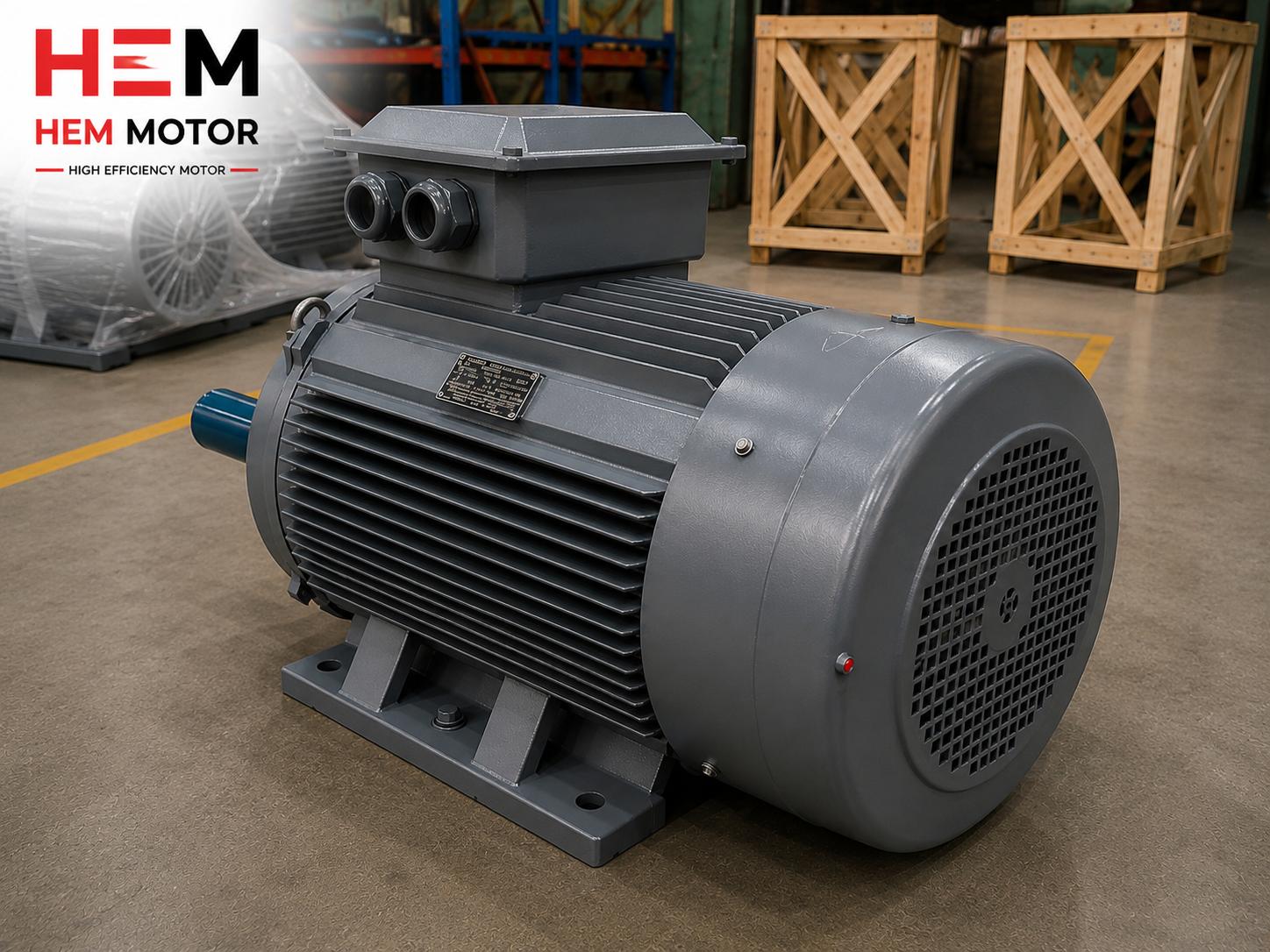

In industrial plants, motors in the 132 kW and 160 kW class are the most critical and highest-value equipment forming the backbone of production lines. A correct choice in this power band directly determines a facility's energy cost, maintenance expenditure and production continuity for years to come. 132 kW IE4 and 160 kW IE4 super premium efficiency motors are designed for facilities that want to meet this large-power demand with the lowest possible losses. In this guide we examine efficiency and load curve, speed and pole selection, frame sizes, mounting types and most importantly stock-based supply and lead time, so you can make the right buying decision.
Selecting a large-power motor cannot be done by looking only at the nameplate power, as is often done with small motors. The difference between a 132 kW IE4 motor and a 160 kW IE4 motor produces serious consequences in terms of rated current, panel and cable cross-section, starting characteristics and total investment. As HEM Motor, the manufacturer and seller of these motors, we deliver them quickly from our warehouse with the right pole count and the right frame. Below we open up each technical heading to clarify which model you should choose in which situation.
Importance of Efficiency and Load Curve in 132 kW and 160 kW IE4 Motors
The IE4 super premium efficiency class is the single most decisive factor for energy saving in this power band. When a large power motor runs 16 to 24 hours a day, the small-looking efficiency gap between IE3 and IE4 turns into an enormous energy cost by year end. Even a one-point efficiency increase at full load on a 132 kW or 160 kW motor delivers a notable annual energy recovery on a continuously running line. For this reason, the efficiency class in large power is a far more important decision than the purchase price.
However, efficiency is not measured only by the full-load nameplate value. In real facility conditions, motors often run at partial load. This is where the load curve comes into play. The load curve is a characteristic curve showing the efficiency and power factor (cos phi) the motor delivers at 25, 50, 75 and 100 percent load points. The greatest advantage of IE4 motors is that this curve stays flat and high across a wide range; in other words, the motor largely preserves its efficiency even at 50 percent load.
- Full-load efficiency: The critical value for compressors, fans and pumps running continuously at nominal load.
- Partial-load efficiency: Decisive in applications with variable load, controlled by a drive (VFD), or running mostly at low load.
- Power factor (cos phi): Affects reactive power penalties and panel load; generally higher on IE4 motors.
- Partial-load resilience: On a 160 kW IE4 motor, a load curve that does not sag at low loads increases energy saving on variable lines.
Knowing the load profile of your application is the first step to selecting the right motor. If your line mostly runs at full load, full-load efficiency is decisive. If the load is variable, the behavior at partial-load points of the load curve becomes more important. The HEM Motor technical team helps you choose the most suitable option between 132 kW and 160 kW based on your application's load profile.
Speed and Pole Selection: 2, 4 and 6 Poles
In large-power motors, the pole count is the fundamental parameter that determines the motor's speed and therefore its torque characteristic. On a 50 Hz grid, synchronous speeds are fixed by pole count, and the selection is made according to the speed required by the driven equipment.
- 2 poles (about 3000 rpm): Preferred for high-speed applications such as centrifugal compressors, high-pressure pumps and some fans.
- 4 poles (about 1500 rpm): The most common choice; standard for general-purpose pumps, fans, conveyors and general drives.
- 6 poles (about 1000 rpm): Suitable for mixers, crusher-mills and slow fans requiring low speed and high torque.
As pole count changes, the physical size, weight and frame size of a motor at the same power also change. As a general rule, for the same power the motor grows larger and heavier as pole count increases (as speed decreases), because delivering the same power at lower speed requires more torque and therefore a larger magnetic circuit. Hence a 6-pole 160 kW motor may have a noticeably larger frame than a 2-pole 160 kW motor.
How Does Speed Selection Affect the Investment?
High-speed (2-pole) motors are generally smaller-framed and can be more economical, but they demand more careful operating conditions in terms of bearing life, vibration and noise. Low-speed (6-pole) motors, on the other hand, can simplify mechanical transmission elements (belt-pulley, gearbox) and offer direct drive. The right pole selection affects both the initial investment and the long-term maintenance cost.
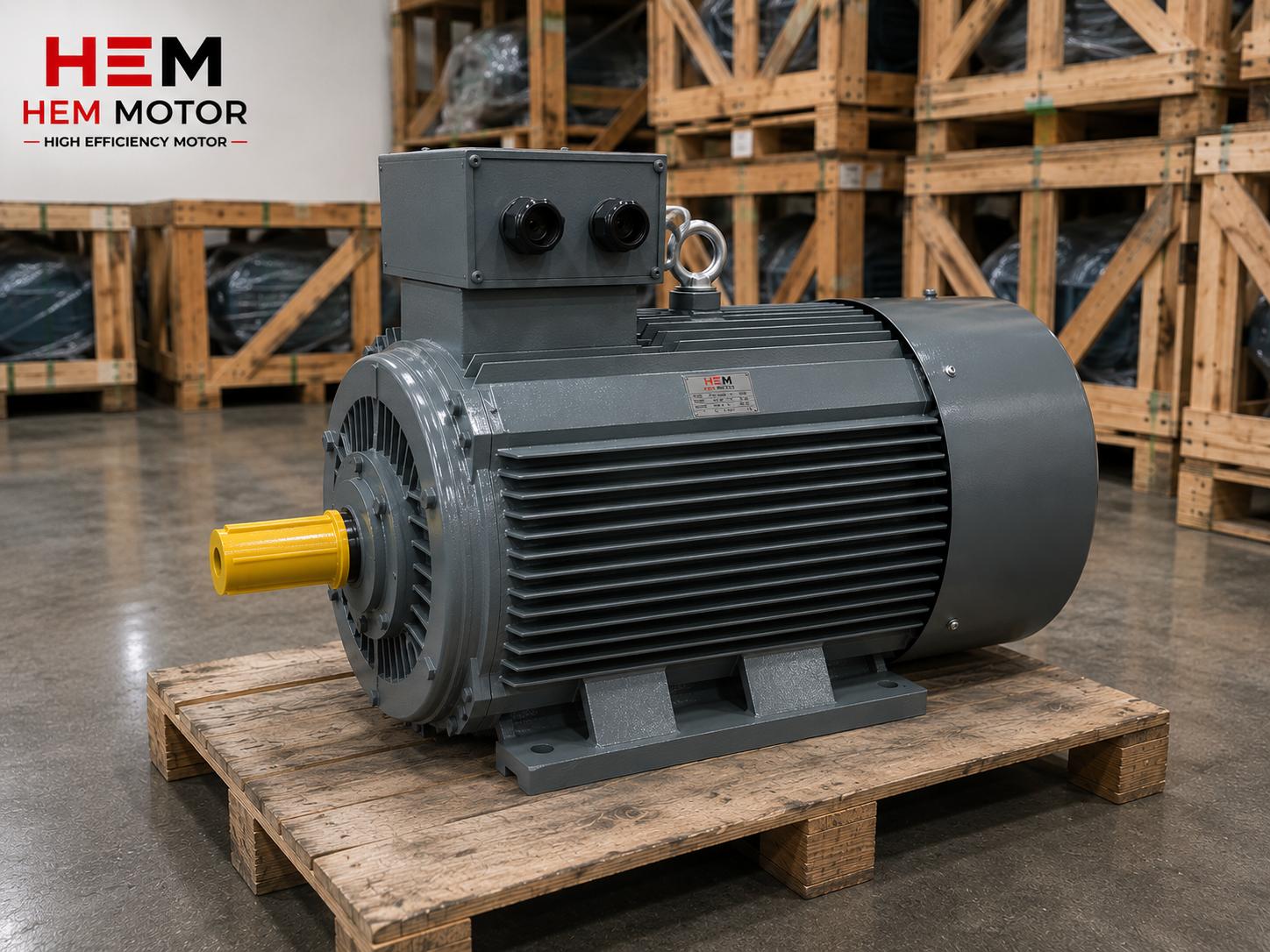
Frame Sizes, Cast Iron Frame and Mounting Types
Motors in the 132 kW and 160 kW class are typically produced in frame sizes of 280, 315 and above. The frame size determines shaft diameter, foot hole spacing and overall mounting dimensions. When replacing an existing motor, selecting the same frame size is important for foundation and coupling compatibility. When building a new facility, the frame size sits at the center of the connection and layout plan.
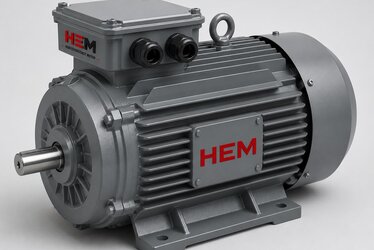
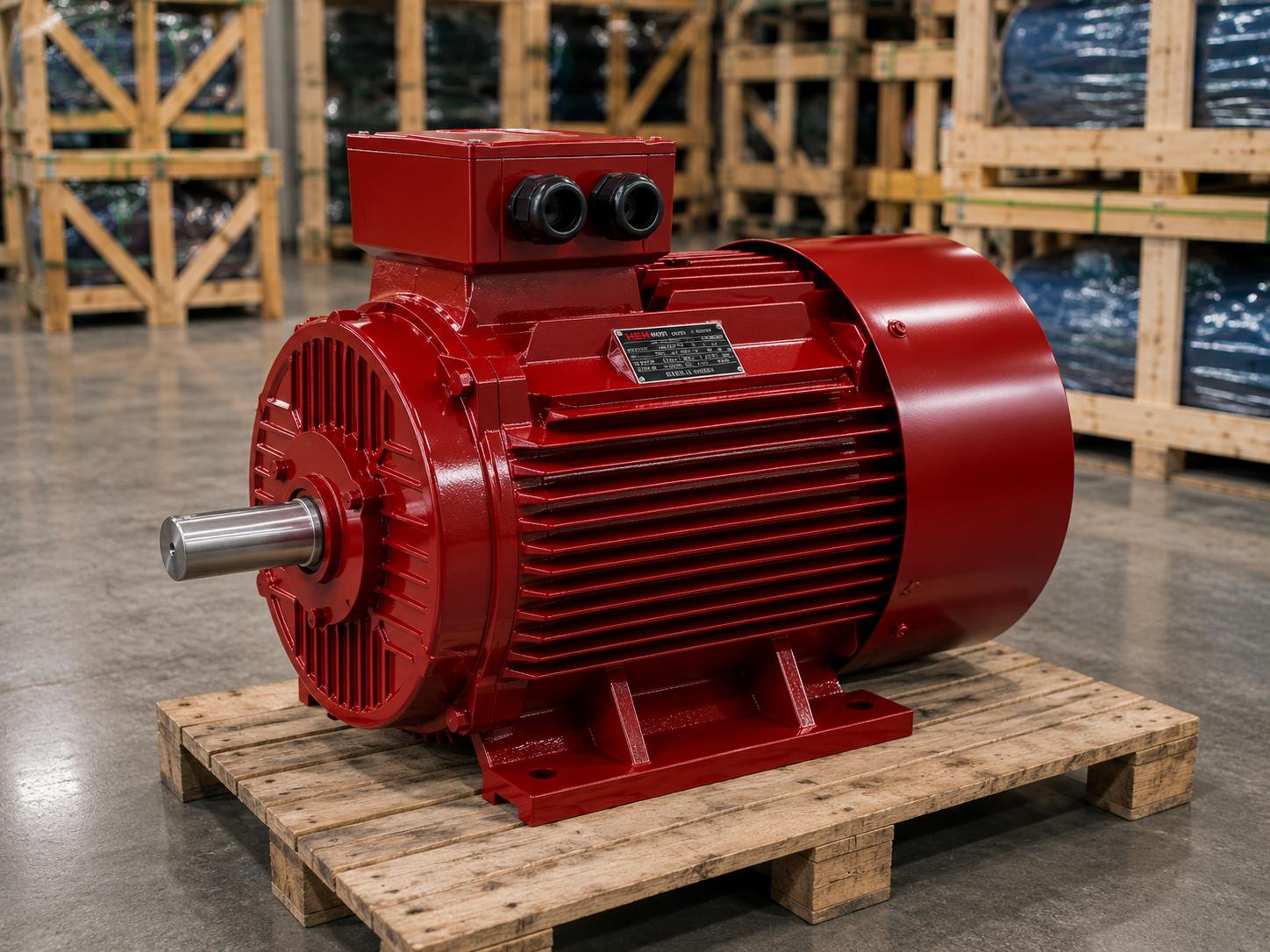
In this power band, a cast iron frame is standard. The cast iron (grey cast iron) frame offers superior performance in mechanical durability, vibration damping and heat dissipation. The robustness of the cast iron frame is indispensable for carrying the heat and mechanical stress produced by large-power motors, allowing the motor to provide a long service life under heavy industrial conditions.
- B3 (foot-mounted): Classic mounting to a foundation or chassis via feet; the most common standard.
- B5 (flange-mounted): Direct connection to equipment via a large flange; for pump and gearbox applications.
- B35 (foot + flange): The most versatile mounting type, offering both feet and flange.
In large power, the mounting type and frame size can also affect delivery time, since not every combination is always in stock simultaneously. Therefore, clarifying frame size, pole count and mounting type is critical for correct and fast supply. For other power bands in the IE4 class, our guide on 15 and 18.5 kW IE4 motor efficiency and load curve selection shows the same logic applied at medium power.
Rated Current, Panel and Cable Impact
The most important practical difference that separates large-power selection from small power is the magnitude of the rated current. A 132 kW or 160 kW motor draws a serious current, and this affects the entire electrical infrastructure. The motor's rated current directly determines fuse, contactor, thermal protection, cable cross-section and panel sizing. Therefore, when selecting a motor, you must consider not only the power but also the rated current and power factor, which vary with pole count.
- Cable cross-section: High current requires thicker and more costly cable; voltage drop must be watched as distance increases.
- Starting current: Direct-on-line starting creates high inrush; a soft starter or VFD limits this load.
- Panel sizing: Protection components selected by rated current affect the physical size and heat management of the panel.
- Power factor: The high cos phi value of IE4 motors reduces reactive power demand and compensation load.
These infrastructure impacts can multiply the cost of a wrong motor selection in large power. For example, choosing an oversized motor unnecessarily increases both the motor price and the panel and cable cost; choosing an undersized one overloads the motor and shortens its life. Correct sizing is best done with HEM Motor technical support.
IP55 Protection and F Insulation Class
In industrial environments, 132 kW IE4 and 160 kW IE4 motors are offered as standard in IP55 protection class. IP55 means dust-protected and resistant to water jets from any direction, making the motor safe to use in dusty, humid and demanding production environments. F class insulation allows the windings to withstand high temperatures, increasing the motor's thermal reserve and service life.
F class insulation, often applied together with a B class temperature rise limit, leaves an additional thermal safety margin for the motor. This provides a major advantage especially in facilities with high ambient temperatures or in applications where the motor is occasionally stressed. In large power, thermal durability is the guarantee that the motor runs continuously without unexpected stops.
Stock-Based Supply and Lead Time: Right Buying in Large Power
The most overlooked yet most critical issue in large-power motors is supply time. A 132 kW or 160 kW motor is not found in every warehouse like small motors; poor planning can leave your production line waiting for weeks. As HEM Motor, we offer the advantage of stock-based supply by keeping the most demanded pole and frame combinations in this power band in our warehouse. Thus, in urgent needs, your motor ships quickly.
In addition to holding stock, a clear lead-time commitment for special combinations or high-volume projects is also important. Because we are the manufacturer, we can supply even a non-stock configuration within a predictable time. Right buying in large power is the combination of correct technical selection and reliable supply. Our article on IE4 premium motor supply and lead time provides additional information on the supply process and delivery planning.
- Stock check: We clearly report the current status of the pole and frame combination you need.
- Fast dispatch: Your in-stock large power motor orders are prepared in the shortest time.
- Manufacturer assurance: Warranty, spare parts and technical support are provided from a single source for products we manufacture.
- Project planning: Phased delivery and storage solutions are offered for high-volume purchases.
For those who want to review lower power bands, the guide on 7.5 and 11 kW IE4 motor efficiency and speed selection will be useful. If you want to compare the same technical logic with large power on the IE3 side, our article on IE3 132 and 160 kW large-power motor selection provides a good benchmark. To see the full IE4 product range, you can review the IE4 electric motor product page and the IE4 high-efficiency electric motors category. For current electric motor prices and a quotation, you can contact HEM Motor.
A Step-by-Step Approach to the Right Large-Power IE4 Motor Selection
Right buying in the 132 kW and 160 kW class requires four basic steps. First, the application's load profile is determined and the IE4 efficiency and load curve advantage is evaluated accordingly. Then the right pole count and speed are selected based on the driven equipment. Next, the frame size, cast iron frame and mounting type (B3, B5, B35) are clarified. Finally, rated current, panel and cable impact are taken into account, and lead time is planned with stock-based supply.
This systematic approach ensures a purchase that is both technically correct and commercially advantageous. HEM Motor, as manufacturer and seller, stands with you at every step of this process; delivering the right motor, in the right configuration, to your facility in the shortest possible time.
Frequently Asked Questions
How should I choose between a 132 kW and a 160 kW IE4 motor?
The choice should be based on the real power demand of the driven equipment. An oversized motor increases both the investment and the panel and cable cost; an undersized motor becomes overloaded and shortens its life. If you share your application's load curve and operating profile with us, we will determine together the most suitable and economical choice between 132 kW and 160 kW.
Are large-power IE4 motors supplied from stock?
We keep the most demanded pole and frame combinations in our warehouse, so common configurations are supplied from stock and dispatched quickly. For non-stock special combinations, we commit to a clear and predictable lead time thanks to our advantage of being the manufacturer.
How does pole count affect the motor's frame size?
For the same power, as pole count increases, meaning speed decreases, the motor must produce more torque, so its frame grows larger and heavier. Therefore a 6-pole 160 kW motor may be noticeably larger than a 2-pole motor of the same power; you should take this into account in your mounting and layout plan.