English
 Türkçe

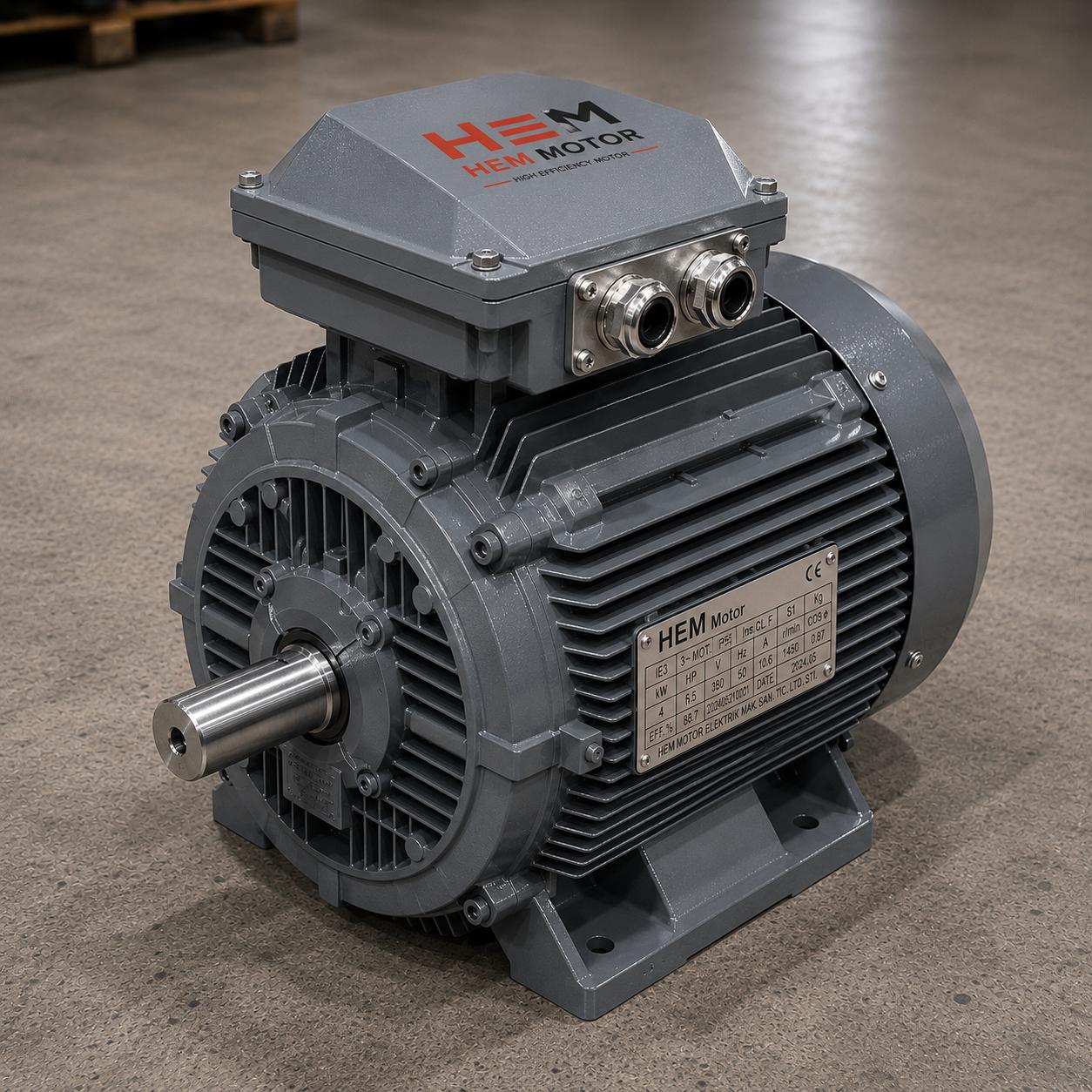

Electricity no longer costs the same at every hour of the day. Hourly (spot) electricity prices fluctuate markedly through the day; energy is cheap in some hours and expensive in others. In a motor-heavy plant, where the bulk of the energy bill comes from electric motors, this fluctuation creates two big opportunities: lowering cost simultaneously by managing when you consume (flexible load) and by improving how efficiently you consume (efficient motors). Combining these two levers in an efficient-motor plant both lowers operating cost and accelerates the return on a new motor investment. In this article we examine the logic of hourly tariffs, in which processes load shifting is possible, and how to make the decision to switch to efficient motors together with the realities of the spot market.

What Is the Spot Electricity Price and the Hourly Tariff?
In the spot (day-ahead) market the electricity price is set separately for each hour and varies with the supply-demand balance. In hours of high demand (usually daytime working hours and the evening peak) the price rises; in the night and weekend hours when demand drops, it falls. A plant that buys electricity on an hourly tariff pays for the cost of every kilowatt-hour it consumes at that hour's price. This reveals a fundamental truth: there is a serious cost difference between doing the same job in an expensive hour and shifting it to a cheap one.
- Peak hours: The hours when demand and price are highest; flexible loads are kept away from these windows where possible.
- Off-peak hours: Hours such as night and weekend when the price drops; the ideal window for shiftable loads.
- Transition hours: The intermediate hours when the price rises and falls; production planning is optimised to this curve.
This structure is a cost-management tool for motor-heavy plants; but first one must know which of the plant's loads are flexible.
Flexible Load: Which Motor-Driven Processes Can Be Shifted?
Not every load can be shifted; the parts of the production line that must flow continuously are time-bound. But many motor-driven processes can be shifted between hours without disrupting production. Identifying the load-shifting potential is the first step of a flexible-load strategy.
- Processes producing storable output: Cold-store compressors, water-tank/booster pumps, ice banks, compressed-air receivers — these store energy in a buffer, so they can be run in cheap hours and held idle in expensive ones.
- Batch production: Operations that can be done in batches, such as grinding, crushing and mixing, can be scheduled into cheap hours.
- Auxiliary systems: Processes such as irrigation, filling and pre-packaging preparation are usually flexible.
- Non-shiftable loads: Continuous-flow lines, ovens and real-time production tied to the customer are generally fixed.
It is also possible to partly modulate flexible loads by lowering speed with a VFD; we explained in detail the gain of reducing speed, especially on pumps and fans, in our content on energy savings on pumps and fans with a VFD (the affinity law).
How Does the Efficient-Motor Decision Meet the Spot Price?
Flexible-load management optimises when you consume; an efficient motor reduces how much you consume. The two create a multiplier effect: a high-efficiency motor already draws less energy, and if you also shift that energy to a cheap hour, the savings combine. Moreover, when calculating savings, most plants use the average electricity price; yet an inefficient motor running in expensive peak hours produces a cost far above the average. In other words, the return on an efficient motor, when the spot price is taken into account, is often faster than imagined.
To prioritise the investment in switching to efficient motors, the ISO 50001 energy management system framework is a powerful tool; we covered this subject in our article on the ISO 50001 energy management system and motor efficiency. To calculate savings correctly it is also essential to know the difference between nameplate efficiency and field efficiency; our content on the difference between nameplate and field efficiency helps you measure the real savings correctly.

A Roadmap for the Investment Decision
- 1. Build a motor inventory: Which motor is how many kW, in which hours, and how long does it run? The longest-running and least-efficient motors are priority candidates.
- 2. Match the load profile to the hourly tariff: Which motors run in expensive hours? These motors are doubly priority for renewal and load shifting.
- 3. Identify the flexible loads: Schedule shiftable processes into cheap hours; manage processes producing storable output according to the buffer.
- 4. Prioritise efficient-motor renewal: Replace the motors that run the most, are the least efficient and carry load in the most expensive hours with IE4/IE5.
- 5. Measure and document the result: Verify the real savings by monitoring consumption after renewal and load shifting.
For the inventory work that is the first step of this roadmap, our content on preparing for an energy efficiency audit and motor inventory provides a practical start. At HEM Motor we supply IE4 and IE5 efficient motors at the points where your plant will gain the most, with the advantage of stock and fast delivery; contact us for current electric motor prices and renewal planning.
Peak Power and Demand Management
Alongside the spot price, a second cost item for motor-heavy plants is peak power, that is, the maximum power the plant draws at one moment. In many subscription structures, extra charges arise when the contracted power is exceeded or when the peak power drawn in a given period is high. A load-shifting strategy does not just shift to a cheap hour; by spreading the large motors that run simultaneously across time, it also lowers the peak power.
- Prevent simultaneous starting: Not all high-power motors should be allowed to start at the same moment; sequential (staged) starting lowers both the high starting current and the peak power.
- Spread large loads over time: Distributing large loads such as grinding, compressor charging and pump lifting across different hours reduces the power the plant draws at one time.
- Choose the contracted power correctly: An unnecessarily high contracted power means a fixed charge, while too low a power means an overshoot penalty; the right balance is set with the load profile.
Managing peak power, especially combined with a night tariff, is a powerful saving tool; we covered this subject in detail in our content on the night tariff, demand management and peak avoidance. We examined how exceeding the contracted power creates cost in our article on demand/peak power overshoot and its effect on the bill.
Quantifying the Saving: Measure First, Then Invest
A spot-price and flexible-load strategy turns into an investment decision only when it rests on a numerical basis. Instead of the intuition "this motor is very old, let's replace it," one must know how many hours a year each motor runs and in which hours it carries load. This data makes it possible to calculate both the return on efficient-motor renewal and the real gain of load shifting.
- Annual operating hours: How many hours a year a motor runs is the basis of the saving calculation; a heavily used motor produces large savings even from a small efficiency difference.
- Hourly consumption: Knowing in which hours the motor runs reveals the real cost when multiplied by the spot price.
- Reactive consumption: A low power factor can create a separate reactive-penalty item on the bill; an efficient motor and correct compensation also reduce this item.
To calculate a motor's annual energy cost correctly, our content on the annual kWh calculation by operating hours guides you step by step. We covered the hidden cost of a low power factor reflected on the bill in our article on the reactive penalty and its effect on the bill. When these two calculations are combined, which motor to renew first and which load to shift first emerge clearly.
Frequently Asked Questions
Does flexible-load management make sense even without switching to an hourly tariff?
The direct cost gain of flexible-load management appears when electricity is bought on an hourly (spot) tariff, because only then does consuming in a cheap hour have a monetary reward. For a plant on a fixed tariff, the main benefit of load shifting may be on the contracted-power/demand-management and grid-constraint side. For this reason, clarifying your tariff structure first is the foundation of a flexible-load strategy.
Which should come first, switching to efficient motors or load shifting?
The two are not rivals but complementary. For a quick gain, flexible-load management can be started first with the existing motors; this requires no capital investment and brings a gain through planning alone. Switching to efficient motors requires investment but provides a permanent reduction in consumption. The best approach is to identify, through the inventory, the motors that run the most and carry load in the most expensive hours, and to combine both renewal and load shifting on those same motors.
Which motor-driven processes are most suitable for load shifting?
Processes that store their output in a buffer are most suitable: cold stores, compressed-air receivers, water tanks/boosters, ice banks and the like. These can "build up" energy in cheap hours and be held idle in expensive ones. Grinding, crushing and mixing that can be done in batches can also be shifted. Continuous-flow production lines and ovens, however, are generally fixed and cannot be shifted.