English
 Türkçe

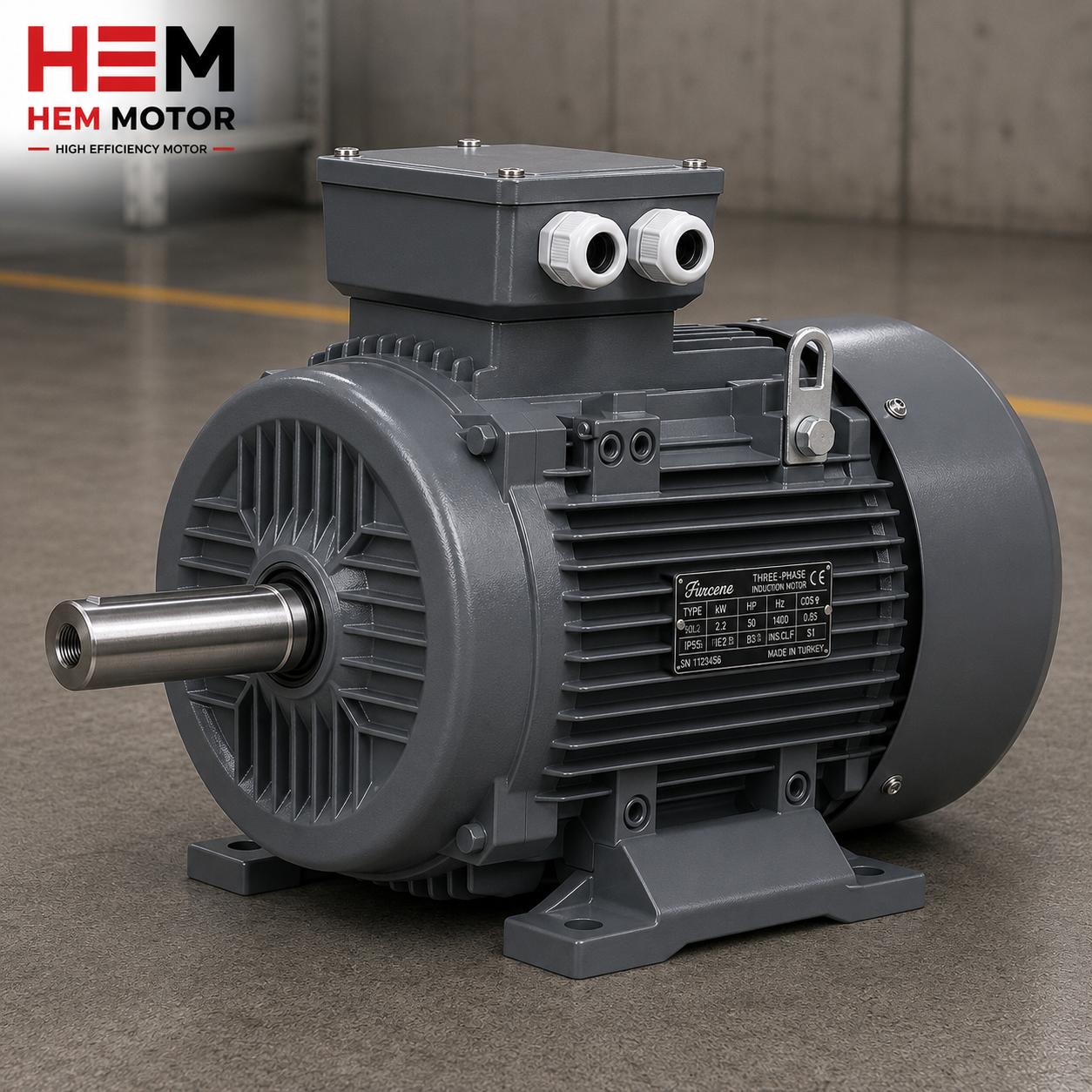

One of the most common and most expensive mistakes in industrial facilities is selecting an electric motor larger than necessary, "just in case." The belief that "a bigger motor is safer" is widespread; yet an oversized motor lowers both its efficiency and power factor at part load, consumes unnecessary energy and raises the investment cost. The correct approach is to select the motor based on the real load requirement, that is, to apply deliberate downsizing when appropriate.
As the manufacturer and supplier, we deliver the right-power motor to our customers from stock. In this article we examine, on a technical basis, why oversizing is not a saving but a loss, how the efficiency curve behaves at part load, and how to make the correct power selection.
Why Is Oversizing Such a Common Mistake?
Oversizing in motor selection often stems from a well-intentioned but mistaken engineering reflex. The designer adds a large safety margin to the load calculation, then rounds up to the next standard power rating, then bumps it up one more step "in case capacity grows later." These compounding margins ultimately lead to a motor far above the real requirement.
As a result, in the field we frequently encounter motors running at only 40-50 percent of their rated power. These motors appear to turn without issue, yet they harbor a serious hidden loss in terms of efficiency and power factor. This loss appears on the bill month after month but is rarely noticed.
The Efficiency and Power Factor Curve: The Effect of Part Load
An electric motor's efficiency is not constant; it varies with the load ratio. In modern efficient motors, the efficiency curve usually reaches its peak between 75 and 100 percent load and stays relatively flat in this range. However, when load drops below 50 percent, efficiency begins to fall rapidly. At 25 percent load, efficiency drops well below its rated value.
Power Factor Falls Even Faster
More dramatic than efficiency is the behavior of the power factor. The motor's magnetizing current remains almost constant regardless of load. As load decreases, the active current drops but the magnetizing current stays the same, causing the power factor to fall rapidly. A power factor of 0.86 at 100 percent load can drop below 0.5 at 25 percent load. A low power factor leads to reactive energy penalties and increased grid burden.
- At full load: high efficiency, high power factor, efficient operation.
- At half load: efficiency still acceptable, but power factor noticeably lower.
- At quarter load: both efficiency and power factor seriously low, losses rise.
For this reason, oversizing, while looking "safe" on paper, is in practice a continuous loss of energy and money. Correct power selection aims to run the motor in the highest region of the efficiency curve.
How to Carry Out Correct Downsizing
Downsizing is not blindly shrinking the motor; it is measuring the real load profile and reducing the motor to the power best suited to that profile. The steps to follow for correct downsizing are:
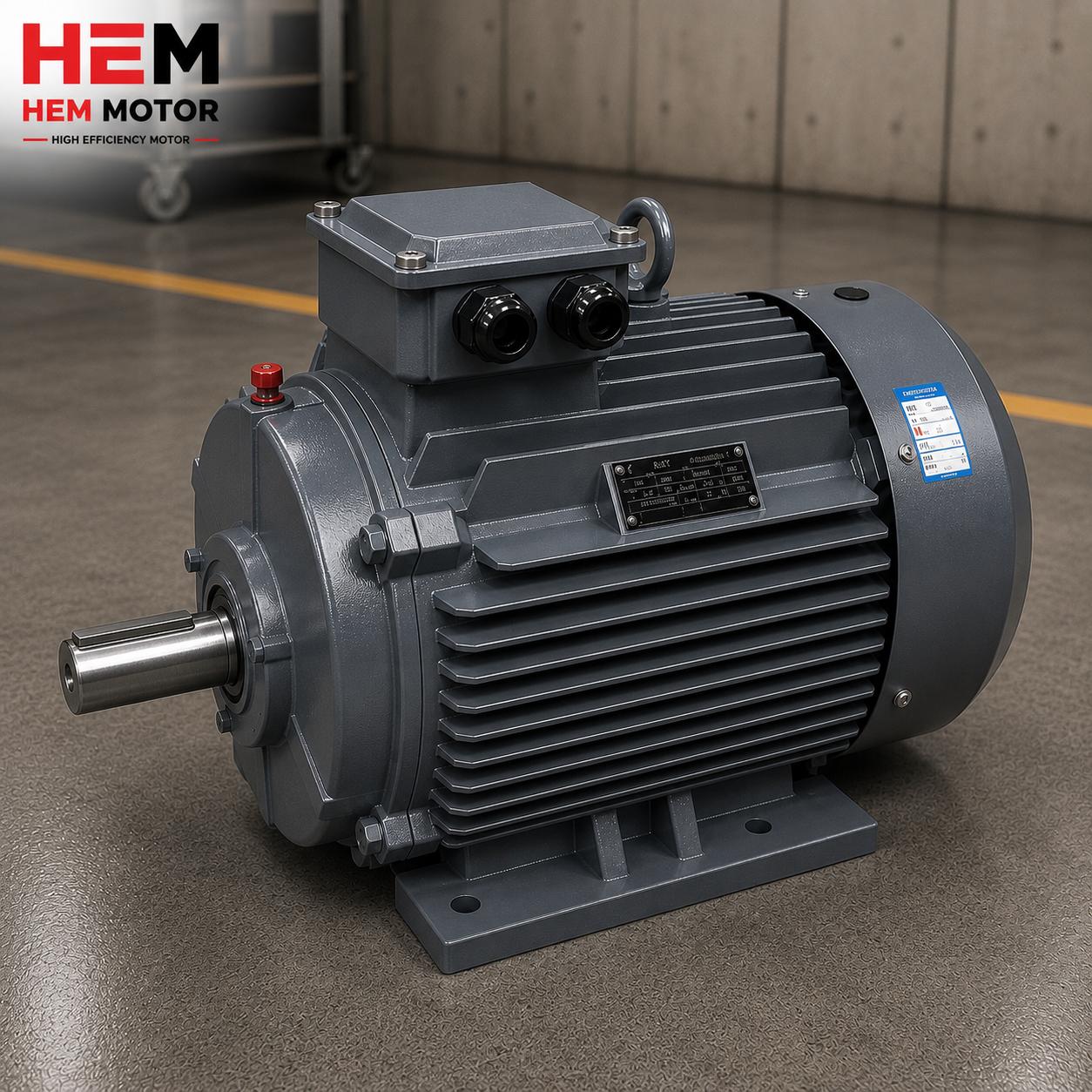
1. Measure the Real Load
Measure the current or power drawn by the existing motor under different operating conditions. If the motor continuously draws current far below its rated value, it is a downsizing candidate. A single instantaneous measurement is not enough; take readings at different times of the day and production phases to map the real load profile.
2. Determine Peak Loads and Starting Conditions
When downsizing, you must look not only at the average load but also at peak loads and starting torque. The motor must produce sufficient torque even at the moment of highest load. For impact loads such as conveyors and shredders, a slightly higher margin is therefore kept.
3. Select the Correct Efficiency Class
Moving to a high efficiency class (IE4 or IE5) along with downsizing multiplies the gain. A motor selected at the right power and right efficiency class optimizes both investment and energy. Drive type also matters; we recommend evaluating direct drive versus belt losses as well.
A Flexible Solution with Variable Frequency Drives
If the load varies, driving a fixed-power motor with a frequency converter is the most effective way to save from part-load efficiency. Especially in variable-flow applications such as pumps and fans, speed control with a drive always runs the motor according to the real need and prevents wasteful energy use. In pump and fan motors, surge protection additionally extends motor life.
So that we can deliver the right-power motor from stock, simply share your application's real load profile with us. Our technical team will determine the most suitable power and efficiency class based on your measurement data and provide a fast quote. For more, visit our homepage.
Oversizing Myths and Realities
Several beliefs are frequently put forward to justify oversizing. Addressing them one by one makes it easier to reach the right decision. The first myth is the idea that "a bigger motor heats less and lasts longer." Although partly true, the additional losses and grid burden brought by the falling power factor at part load largely cancel out this advantage. Moreover, a correctly sized modern efficient motor already runs at low temperature.
The second myth is the idea that "a bigger motor will be useful if capacity grows later." In practice this capacity increase often never happens, and the motor loses continuously by running at part load throughout its life. The third myth is the belief that "a bigger motor withstands sudden loads better"; yet sudden-load endurance relates to the motor's torque reserve and thermal capacity, which can be managed through correct sizing and, where needed, a drive. Replacing these myths with realities lowers both investment and operating cost.
The Difference Between Continuous and Intermittent Operation
In correct power selection, the motor's duty cycle is decisive. In a continuously running (S1) motor, correct sizing is more critical, because every hour of loss is reflected directly on the bill. In an intermittently running motor (such as S3, S4), peak loads and start-stop cycles come to the fore. Even in the same application, if the regime changes the motor selection changes. We therefore take the motor's real duty cycle into account when deciding on downsizing.
The Hidden Costs of Oversizing
The invisible costs of oversizing are not limited to the energy bill. A larger motor means a larger frame, a larger cable cross-section, a larger protective breaker and a larger frequency converter. This chain of growth raises the initial investment cost at every step. Often, choosing one size smaller saves not only on the motor but across the entire electrical installation.
Another hidden cost is starting current. A large motor draws a current many times its rated value at the moment of starting. The high starting current of an oversized motor can temporarily drop the grid voltage, falsely trip protection equipment and unnecessarily stress the transformer and cables. A correctly sized motor draws lower starting current and simplifies protection coordination.
The Difference Between the Efficiency Label and Real Efficiency
The IE3, IE4 or IE5 efficiency class written on the motor nameplate states the motor's efficiency at rated (that is, full) load. But if your motor runs continuously at half load, you will never reach that high efficiency value on the label. So the thought "I already bought an IE4 motor, my efficiency is high" is misleading if the motor runs at part load. To truly benefit from efficiency, the motor must run in the load region where the efficiency curve is highest, which means correct power selection, that is, downsizing when appropriate.
Which Applications Are Suitable for Downsizing?
Not every motor is a downsizing candidate, but some applications are typically oversized. The following situations indicate high downsizing potential:
- Motors continuously drawing current below 60 percent of their rated value.
- Facilities sized extra-large years ago "to grow into" but that never grew.
- Lines whose load has dropped after a process was downsized or made more efficient.
- Old, low-efficiency motors that have reached renewal time.
Variable-load applications such as pumps and fans in particular carry great saving potential through both downsizing and variable speed drives. In these applications, when flow is controlled by motor speed instead of valve throttling, energy consumption falls dramatically. This is because pump and fan load varies with the cube of speed; reducing speed by 20 percent can almost halve the power.
Measurement and Data-Driven Decisions
A correct downsizing decision must never be based on guesswork. Recording the motor's real load profile for a week with an energy analyzer or smart meter is the most reliable method. This record shows the average load, peak loads, operating times and load fluctuations. Based on this data, downsizing the motor by one or two steps usually delivers permanent energy savings with no performance loss. Our technical team interprets this measurement data together with you to determine the most suitable power.
Frequently Asked Questions
Will my motor struggle at startup if I downsize it?
A properly executed downsizing carries no such risk. During downsizing, not only the average load but also the starting torque and peak loads are taken into account. If your application requires high starting torque, we select a motor with a rotor design suited to that requirement. Where needed, soft starting with a frequency converter can also be provided.
Does oversizing damage the motor?
It causes no direct mechanical damage but creates hidden costs. Low power factor at part load increases the risk of reactive penalties, low efficiency raises the energy bill, and a larger motor is more expensive. In addition, a larger motor has higher starting current, which complicates the sizing of grid and protection equipment.
What should the correct load ratio be?
As a general rule, it is ideal for the motor's continuous operating load to be in the range of 75-90 percent of rated power. This range keeps the motor in the highest region of the efficiency curve while leaving a reasonable margin for peak loads. Motors running at much lower loads are good candidates for downsizing.