English
 Türkçe

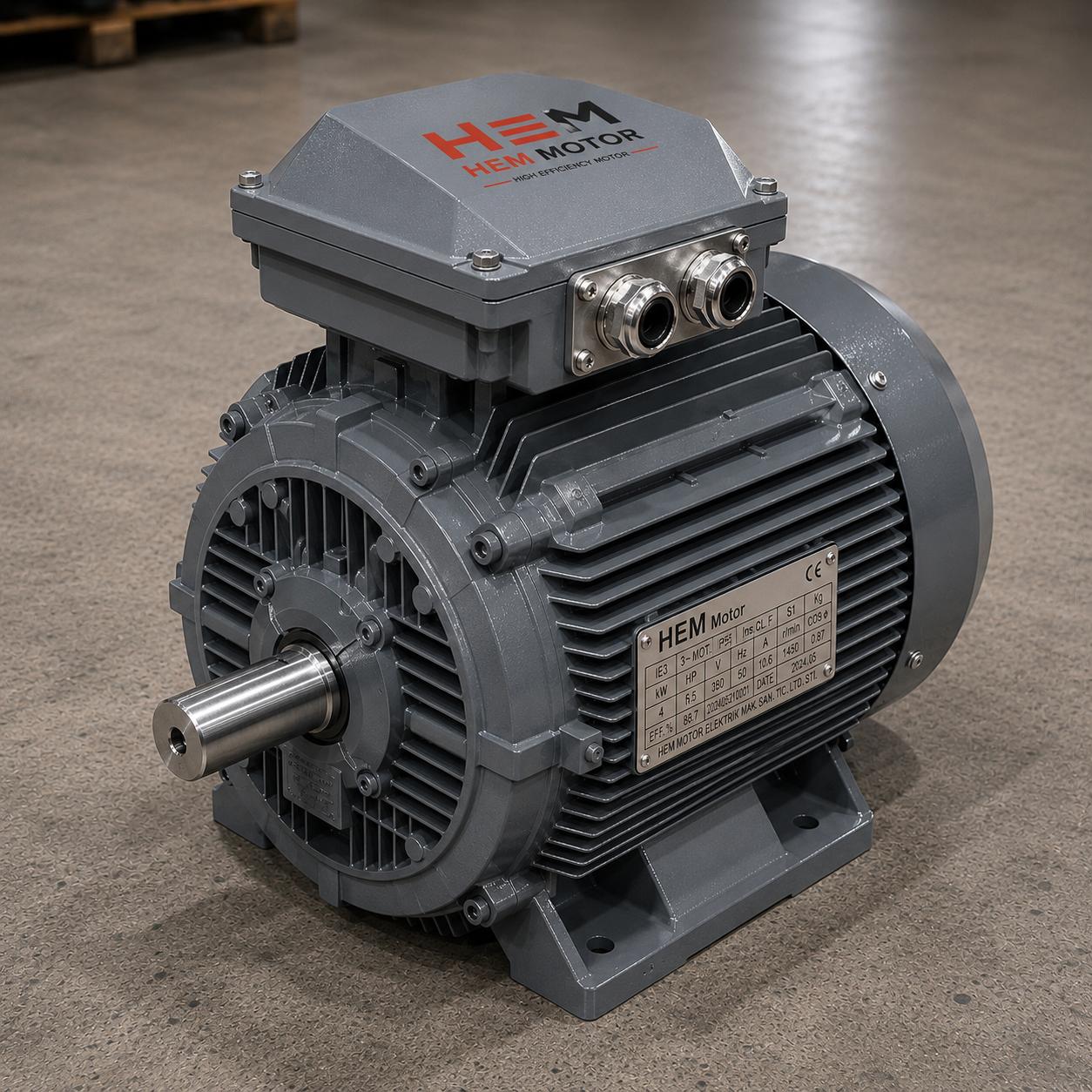

When an efficient electric motor is fed by a variable frequency drive (VFD/inverter), a quiet damage mechanism rarely discussed in catalogues comes into play: bearing currents. The PWM voltage pulses at the drive output create a very high rate of voltage change (du/dt) in the motor windings; these pulses impose a voltage on the shaft through the parasitic capacitances between winding, rotor and shaft. When the shaft voltage breaks down the bearing oil film, a tiny electrical discharge (EDM, electrical discharge machining) occurs and opens craters in the bearing races and balls, finally producing the characteristic "fluting" pattern. This article approaches the topic from the perspective of shaft grounding ring selection, du/dt mitigation and ordering the right protection package, explaining how to prevent bearing EDM damage when running an efficient motor on a drive and which protection combination you should order.
Why Do Bearing Currents Arise in Drive-Fed Efficient Motors?
In a sinusoidal motor fed directly from the grid, bearing current is practically not an issue; the common-mode component of three-phase sine voltage is negligible. The problem starts the moment the motor is driven by a variable frequency drive (VFD). A PWM inverter produces a common-mode voltage at its output whose instantaneous sum of the three phases is not zero. This common-mode voltage is transferred to the shaft through the capacitances between winding-frame, winding-rotor and rotor-stator. Because the switching edges of modern IGBT and especially SiC drives are very sharp, du/dt values reach the order of 5-10 kV/µs; this sharpness directly increases capacitive coupling and therefore shaft voltage.
In efficient motors (IE3, IE4) this phenomenon is even more pronounced. The high-grade laminations, low-loss design and tight packing used for high efficiency change the distribution of the motor's parasitic capacitance; moreover efficient motors are mostly preferred in larger frames and drive applications. As shaft diameter grows, bearing surface area and thus accumulated charge increase; this is why larger-frame motors are more critical in terms of bearing current risk. Typically, protection becomes almost mandatory in IEC 280 and larger frames.
EDM Damage: From Shaft Voltage to Bearing Fluting
When the voltage on the shaft exceeds the dielectric strength of the bearing oil film, it punctures the film and a spark jumps across. This micro-discharge, just like an erosion machine (EDM), tears a tiny piece of metal away; it leaves a micron-scale crater on the ball or race surface. A single discharge seems harmless; but as the motor turns for hours and days, these discharges repeat hundreds of times per second. Over time the surface takes on a frosted-glass appearance (frosting), then a pattern synchronised with the ball-pass frequency forms and fluting (washboard pattern) appears. Once fluting begins, bearing noise rises, vibration increases and the bearing fails far sooner than expected, sometimes within a few months.
- EDM craters: Micron-scale melt marks opened by oil-film breakdown.
- Frosting: Matting of the surface with dense micro-craters, the first sign of noise.
- Fluting: Regular transverse grooves; advanced damage, high vibration.
- Grease degradation: The spark locally carbonises the grease and lowers lubrication performance.
Shaft Grounding Ring: Opening a Low-Resistance Path for the Current
The most direct way to prevent bearing current is to discharge the charge on the shaft to the frame before it reaches the bearing. A shaft grounding ring does exactly this: it is a ring placed around the shaft containing thousands of conductive microfibres (usually conductive carbon fibre). These microfibres provide continuous, low-resistance and mechanically non-abrasive contact with the shaft; they discharge shaft voltage before it reaches the level that would break down the oil film. The current thus flows through the ring (the least-resistance path) to the frame, and from there to the protective earth (PE); the bearing is protected from the EDM pulse.
The points to watch in ring selection are clear. The ring must fit the shaft diameter exactly, the conductive fibre must wrap 360 degrees around the circumference (partial contact is insufficient), the environment must be protected from grease and dirt, and it must connect to the frame through a conductive surface. In applications with high drive common-mode noise, the mounting surface being unpainted, clean metal is critical to the ring's function. Ordering a motor with a factory-fitted shaft grounding ring from the manufacturer eliminates the risk of field disassembly and alignment.
Drive End and Non-Drive End Strategy
A proven approach against bearing current is to protect the two bearing ends differently. A shaft grounding ring is applied at the drive end (DE), and an insulated (hybrid ceramic) bearing at the non-drive end (NDE). The ring lowers the voltage by discharging the shaft charge; the insulated bearing prevents the current from passing through the motor and jumping (via the coupling) to the driven machine, and from forming a circulating current. Placing an insulated bearing at only one end and leaving the other open can divert the current to the other bearing; so the ring + insulated bearing combination is considered together.
- DE (drive end): Shaft voltage is continuously discharged by the shaft grounding ring.
- NDE (non-drive end): Circulating current is cut by a hybrid ceramic (insulated) bearing.
- Coupling side: With the ring at the DE, current jumping to the driven machine is reduced.
- Large frames: Both ring and insulated bearing are recommended together.
du/dt Mitigation: Softening the Problem at Its Source
While the shaft grounding ring discharges the current, du/dt filters reduce the problem at its source, the drive output. The sharp edges of PWM pulses increase both bearing current and the voltage overshoots imposed on winding insulation (pulses that can double due to reflection, especially in long motor cables). A du/dt filter placed at the output rounds these edges and lengthens the voltage rise time; it thus lowers both the common-mode-induced shaft voltage and the winding stress. In more aggressive applications a sine filter is used; this turns the drive output into almost pure sine, minimising du/dt and common-mode noise, but it is larger and more costly.
Filter selection is directly related to cable length and switching frequency. The longer the cable between motor and drive, the more pronounced the reflected wave and voltage doubling become; in long-cable applications a du/dt or sine filter is almost mandatory. Filtering does not replace the shaft grounding ring; the two complement each other. The ring discharges the existing charge, while the filter reduces the formation of that charge in the first place.
EMC Grounding and Shielded Cable: Often the Missing Link
The most neglected leg of bearing current protection is the system's EMC grounding. The common-mode current needs a low-impedance path to return to the drive; if there is no such path, the current completes its circuit through the bearings. For this reason the motor and drive must be connected with a shielded motor cable, and the shield must be bonded to the frame 360 degrees (via cable gland/EMC cloth) at both ends. Single-point, pigtail-style grounding does not work at high frequency. The bonding connections between motor frame, drive chassis and machine must be short and of large cross-section. Our article on motor grounding, shielded cable and EMC connection in VFD systems shows correct shield termination step by step.
Correct connection of the protective conductor is as important as the ring; for the current discharged by the shaft ring to flow safely from the frame to PE, the rules in our article on the protective conductor (PE) terminal and bonding connection in electric motors must be followed. Otherwise the charge discharged to the shaft rises on the frame and loses its protective function.
Bearing and Mounting Selection: Considering Current and Heat Together
In drive-fed efficient motors, bearing selection must be evaluated not only for load and speed but also for current and heat. Hybrid ceramic bearings (ceramic balls, steel races) are electrically insulating and cut the circulating current; however, bearing clearance selection is a separate matter in drive applications. Motors running long at low speed on a drive cool less and the bearings run hotter; in that case C3 bearing clearance is preferred. We detail this balance in our article on C3 bearing clearance, hot ambient and VFD bearing selection.
- Insulated (hybrid ceramic) bearing: Cuts circulating current at the NDE; recommended in large frames.
- Shaft grounding ring: Discharges shaft voltage at the DE; prevents EDM cratering.
- C3 clearance: Provides thermal margin in drive-fed, low-speed and hot running.
- Insulated bearing housing: In some designs an insulated end cap is used instead of a ceramic coating.
Ordering the Right Protection Package
Bearing current protection is less an accessory added after installation and more a protection package that should be defined in the motor order. The right package is determined by frame size, drive type, cable length and application. A typical correct order looks like this: IE4 efficient motor + DE shaft grounding ring + NDE insulated bearing + suitable du/dt or sine filter recommendation + shielded cable and EMC gland advice. Taking this whole from a single supplier, with the right lead time, eliminates both installation error and responsibility ambiguity.
- If the frame is IEC 280 or larger, shaft grounding ring + insulated bearing are planned together.
- If the cable is long (reflection risk) a du/dt or sine filter recommendation is added to the order note.
- The motor is requested with a factory-fitted ring and an EMC-gland-compatible terminal box.
- For IE4 efficient motor selection, our IE4 high-efficiency electric motors category offers suitable frame and speed options.
- Stock, lead time and manufacturer assurance: the protection package in time for the project's commissioning schedule.
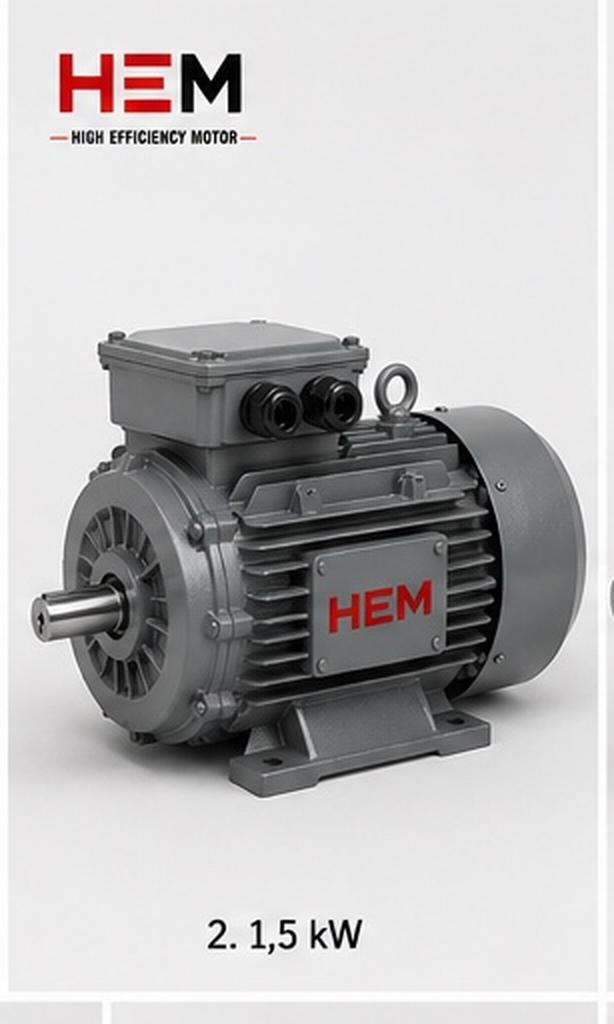
At HEM Motor we offer IE3 and IE4 efficient motors with protection packages including shaft grounding ring, insulated bearing and filter recommendation for drive applications, with the advantage of stock and fast supply. For the right frame, protection combination and lead time, request a quote from our electric motor prices page; we can determine the most suitable bearing current protection together according to your drive type and cable length.
Frequently Asked Questions
Does a shaft grounding ring prevent bearing current on its own?
In most small and medium frames, a shaft grounding ring fitted at the drive end is sufficient to prevent EDM damage; it discharges the shaft voltage before it reaches the level that would break down the oil film. However, in large frames of IEC 280 and above, because of circulating current risk, it is recommended to use the ring together with an insulated (hybrid ceramic) bearing at the opposite end. In long-cable systems, adding a du/dt or sine filter completes the protection.
If there is a du/dt filter, is a ring still needed?
Yes, the two complement each other. The du/dt filter softens the voltage edges at the drive output, reducing common-mode voltage and winding stress; that is, it shrinks the problem at the source. The shaft grounding ring still discharges the remaining voltage imposed on the shaft and protects the bearing. In critical applications, when filter and ring are used together, both winding insulation and bearing are protected at the highest level.
Which motor can I run safely on a drive?
A motor to run on a drive should have inverter-rated (reinforced) winding insulation, correct bearing clearance and a bearing current protection package. An IE4 efficient motor with a factory-fitted shaft grounding ring, an NDE insulated bearing and an EMC-compatible terminal box offers the lowest risk in a drive application. In purchasing, this protection combination should be specified clearly alongside power and speed.