English
 Türkçe


At the heart of ore beneficiation and mineral processing plants there is a piece of equipment that is often overlooked yet carries the entire production: the rotary dryer, the ore drying drum. This large, heavy, continuously rotating drum dries moist ore or concentrate by bringing it into contact with hot gases, and if it is not driven correctly it can turn into a bottleneck that halts the whole plant. The drive motor that turns this drum is one of the most critical, yet most frequently underestimated, components to select.
The drive motor of an ore drying drum cannot be treated like an ordinary pump or fan motor. This motor must start the high moment of inertia created by tons of mass, and then turn that mass throughout the day, often without interruption, in a continuous heavy-duty regime. Moreover, it must do all this while operating in a hot, dusty and abrasive environment. In this article we examine in technical detail the criteria of inertia, heat, dust, protection class and body strength to watch for when selecting a rotary dryer drive motor, and we explain why a wrong choice leads to overheating, frequent faults and costly stoppages.
High Inertia: The Difficulty of the Starting Moment
The greatest mechanical challenge of the rotary dryer is the instant of setting the huge stationary mass into motion. The drum, together with the ore inside it, reaches tons of weight, and the moment of inertia (GD²) created by this mass is extremely high. At the moment of starting, the motor must produce a starting torque far above its rated torque to overcome this inertia.
A motor with insufficient starting torque cannot accelerate the drum; it draws high current for a long time and burns its windings, or it trips the protection system and stops repeatedly. For this reason, when selecting a rotary dryer motor, not only the continuous running power but also the starting characteristic must be evaluated. In practice these applications either use motors with high starting torque or employ a variable frequency drive (VFD) that accelerates the mass gradually. Soft starting with a drive both protects the mechanical system from shock and reduces the motor's thermal load.
- High inertia requires a starting torque above rated torque.
- Frequent starts strain the motor thermally; the duty cycle (S1, S4, etc.) must be defined correctly.
- Soft starting with a frequency drive largely solves the inertia problem.
If you plan to use a drive in this application, our article on the VFD frequency drive with an asynchronous motor is a valuable resource for establishing motor-drive compatibility correctly.
Continuous Heavy Duty: Uninterrupted Operation in S1 Regime
In mineral plants the rotary dryer is often located at the head of the entire production line, and when it stops, every process behind it stops too. For this reason the motor operates for most of the day, often across shifts without interruption, in the S1 continuous duty regime. Continuous heavy duty makes it mandatory to design the motor's thermal behaviour for this load.
In a continuously running motor the winding temperature reaches an equilibrium point over time. If the motor has not been selected for this load, the winding insulation operates constantly at its limit and its life shortens rapidly. That is why the insulation class (usually Class F insulation with Class B temperature rise is preferred) and service factor must be carefully chosen for a rotary dryer motor. Spare motor planning must not be neglected for these critical pieces of equipment either; our article on the critical spare motor list and stock planning helps you plan which motors should be kept in reserve so the plant does not stop.
Heat and Dust: The Effect of the Environment on the Motor
The ore drying drum, by definition, operates in a hot environment. The radiant heat produced by the drum, hot gas leaks and ambient temperature all heat the air in which the motor works. Motor rated values are usually given for a 40 °C ambient temperature; if the environment exceeds this, the motor's power must be derated or a motor with higher temperature endurance must be selected. Otherwise the winding exceeds its insulation limit and overheating becomes inevitable.
Alongside heat, dust is the greatest enemy of this application. With its fineness and abrasiveness, ore dust tries to penetrate every gap of the motor. Dust sticks to the cooling fins and blocks heat dissipation, enters the bearing seals causing wear, and if it reaches the terminal box it causes electrical faults. For this reason a high IP protection class is essential on a rotary dryer motor. For such environments at least IP55 is generally preferred, and often IP65 or higher protection. Choosing the correct IP protection class is the most fundamental measure for keeping dust out of the motor.
- High ambient temperature reduces motor power (requires derating).
- Dust lowers cooling efficiency and shortens bearing life.
- A high IP protection class prevents dust from entering the motor.
- Special protection solutions may be required for the mining environment.
Cast Iron Body: The Foundation of Mechanical Strength
In heavy-duty applications the material of the motor body directly determines the motor's life. While lightweight aluminium bodies are sufficient in light applications, a cast iron body should be preferred in a vibrating, impact-loaded and continuously loaded environment such as a rotary dryer. Cast iron adapts far better to these demanding conditions with its superior mechanical strength, vibration-damping capability and resistance to wear.
The cast iron body also allows the bearing seats and shaft seals to be seated more firmly. This is critical for maintaining sealing in a dusty environment. To see the importance of shaft seal and sealing solutions in more detail, our article on cast iron motor oil seal and sealing protection offers complementary information. Taking a holistic view of motor protection in harsh environments such as mines and quarries requires evaluating all of these details together.
Power and Speed Calculation: The Drum's Real Requirement
The power of a rotary dryer motor must be sufficient not only to turn the drum, but also to lift and tumble the ore inside the inclined drum and to overcome friction losses. The drum's diameter, length, rotation speed, fill ratio and the density of the ore are parameters that directly affect the required power. A safety margin is usually added to this calculation, because the amount of ore and the moisture content in the drum change over time, and the motor must be able to meet the heaviest operating condition too.
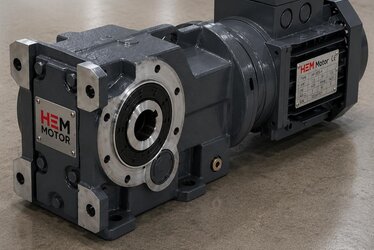
Speed selection is also critical. Rotary dryers generally turn at low speed; the motor is therefore not connected directly to the drum but through a gearbox. The motor's pole count (4-pole, 6-pole, etc.) and the gearbox ratio together create the slow, powerful rotation the drum needs. If the wrong pole count is chosen, the gearbox ratio becomes mismatched and the system turns either too fast or too slow. Motor and gearbox selection must therefore be evaluated together.
- Power is calculated from drum geometry, fill ratio and ore density.
- A safety margin must be added for variable moisture and fill.
- Motor pole count and gearbox ratio together set the drum's speed.
- Low-speed, high-torque drive is the fundamental character of this application.
Bearings and Lubrication: Critical Details in a Hot Environment
In a motor running in continuous heavy duty and located in a hot environment, the bearings are among the most heavily stressed components. High temperature lowers the viscosity of the bearing grease and reduces lubrication performance. For this reason, rotary dryer motors use special high-temperature grease and, where needed, re-greasable bearing systems. This allows periodic lubrication to be performed during operation without dismantling the motor, extending bearing life.
The dusty environment also directly threatens the bearing seals. If fine ore dust penetrates the seal, the bearing wears quickly. Double-lip or labyrinth sealing solutions are therefore critical details that determine motor life in this application. The right sealing choice protects both the bearing and the winding and prevents unplanned stoppages.
The Cost of a Wrong Choice: Overheating, Faults and Downtime
When a rotary dryer motor is wrongly selected, the problems do not appear one by one; they paralyse the plant in a chain reaction. Insufficient power or a low IP class first shows up as overheating. The overheating motor repeatedly trips the protection system, and production is constantly interrupted. With the accumulated effect of dust and heat, bearings wear early, winding insulation weakens, and finally the motor fails.
At this point the real cost is not the motor itself, but the stoppage of the whole plant. When the rotary dryer stops, every process it feeds stops, and the production loss grows exponentially. That is why choosing the right motor from the start is the most economical decision. With our wide heavy-duty motor stock, our cast iron-bodied and high-protection-class models and our experience in mining applications, we can determine together the right power, the right protection class and the right starting solution for your rotary dryer. You can reach all of our motor solutions from our homepage, and by sharing the details of your application you can contact us for the right selection.
Commissioning and Alignment: Getting the Drive Train Right
Even a correctly selected motor can fail prematurely if it is not commissioned properly. Because the rotary dryer turns through a gearbox and a large, slowly rotating drum, the alignment of the motor shaft with the gearbox input is a critical detail. Misalignment imposes continuous side loads on the bearings, generates vibration and shortens both bearing and coupling life. For this reason the coupling must be aligned within the manufacturer's tolerances, and the motor must be mounted on a rigid, level base that does not flex under load.
The starting behaviour must also be verified during commissioning. Because of the drum's high moment of inertia, the first starts should be observed closely to confirm that the motor accelerates the mass within the expected time and that the starting current settles to the rated value without nuisance tripping. When a variable frequency drive (VFD) is used, the acceleration ramp should be tuned so that the drum reaches speed smoothly without overloading the motor thermally. Commissioning records of starting current, run-up time and steady-state temperature provide a valuable baseline for future condition monitoring.
Key commissioning checks for a rotary dryer drive include:
- Verify shaft alignment between motor and gearbox within tolerance.
- Confirm the base is rigid, level and free of soft-foot conditions.
- Observe starting current and run-up time against expected values.
- Tune the VFD acceleration ramp to avoid thermal overload.
- Record steady-state winding and bearing temperatures as a baseline.
Condition Monitoring and Preventive Maintenance
For a motor that sits at the head of the entire production line, an unexpected failure is far more costly than the motor itself. The most effective way to avoid such failures is to move from reactive repair to preventive maintenance based on condition monitoring. By tracking a few key signals over time, the early signs of a developing problem can be caught long before they lead to a breakdown.
Temperature is the most telling indicator in this hot, dusty environment. A slow but steady rise in winding or bearing temperature usually means that cooling fins are clogging with dust, that lubrication is degrading, or that the load has changed. Vibration is the second key signal; an increase in vibration points to bearing wear, misalignment or a fouled drum. Periodic re-greasing with the correct high-temperature grease, regular cleaning of the cooling fins, and inspection of the bearing seals keep the motor running reliably in continuous heavy duty.
A simple but disciplined maintenance routine extends motor life dramatically in this application. Cleaning dust from the cooling surfaces restores heat dissipation; checking and topping up bearing lubrication prevents premature wear; and monitoring the protection relay records reveals whether the motor is approaching its thermal limit. Combined with a well-planned spare motor strategy, this preventive approach ensures that the rotary dryer, and therefore the whole plant behind it, keeps running without unplanned stoppages. Sharing the operating details and environment of your application with us lets us recommend not only the right motor but also a sensible maintenance and protection plan around it.
Frequently Asked Questions
Why is a frequency drive recommended for a rotary dryer motor?
Because the drum and the ore inside it have very high inertia. A frequency drive accelerates the mass gradually and softly, eliminating the high current surge and mechanical shock at the moment of starting. This both reduces the motor's thermal load and protects the mechanical system.
Which IP protection class is sufficient for this application?
In environments with dense ore dust, at least IP55 is generally preferred, and in many cases IP65 or higher protection. The finer and denser the dust, the higher the protection class should be. We can assess the environment and determine the protection class suited to your application together.
Why should a cast iron body be preferred over aluminium?
A rotary dryer is a vibrating, impact-loaded and continuously loaded heavy-duty application. The cast iron body is far more durable under these conditions thanks to its superior mechanical strength, vibration-damping capability and firm seating of the bearing seats, and it extends motor life.