English
 Türkçe

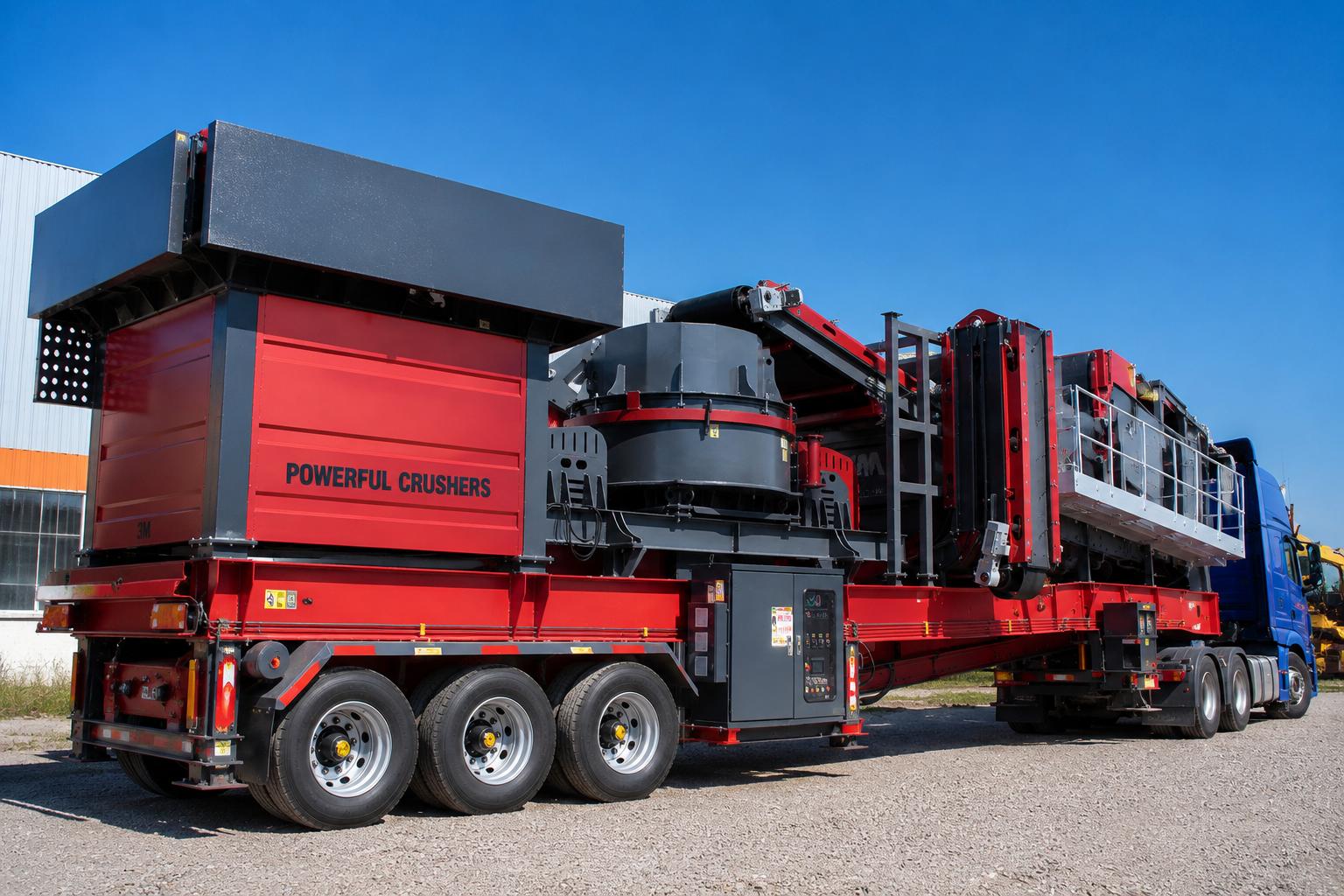

In a crushing plant, sizing and classifying the material is just as critical as the crushing capacity itself. At the heart of this task sits the vibrating screen, which separates raw aggregate into fractions through vibration. Many people assume vibrating screens run only on unbalanced (vibrator) motors; however, in medium and large crushing-and-screening plants the common solution is an eccentric exciter unit mounted on the screen box, driven through a belt-and-pulley system by a standard foot-mounted IE3/IE4 electric motor. In other words, the motor does not carry the unbalanced mass directly; it sits on a fixed base and transmits power to the exciter shaft via a cardan shaft or V-belts. This arrangement demands a completely different engineering approach to motor selection than dedicated unbalanced vibrator motors. In this guide we build the drive motor selection step by step around power, pole count, starting torque, impact load, inertia (GD²) and dust sealing, so you can supply the correct motor from stock.
Screen Drive: Exciter Drive vs. Unbalanced Motor
There are two basic approaches to driving a vibrating screen, and before choosing the right motor you must be clear about which system you have. The first approach is unbalanced (vibrator) motors bolted directly to the screen body; they carry adjustable counterweights on the shaft ends and generate the vibration themselves. The second approach, preferred in larger plants, is the eccentric exciter drive: an exciter gearbox mounted on the screen box, containing gear-synchronized counterweight shafts, is rotated by a standard drive motor seated on a fixed base through a belt-and-pulley system.
This distinction is critical because in an exciter-driven system the motor is not a vibrator motor but a normal industrial asynchronous motor. Therefore the standard IE3/IE4 foot-mounted (B3) motor range is used; yet the application puts the motor through a far harder operating regime than an ordinary fan or pump motor. The motor must start a heavy rotating mass (the exciter shaft plus counterweights), serve a continuously impacting and vibrating line, and cool itself under heavy dust. To make sure the plant has selected the right motor, the roles of all drives should be assessed together, as covered in screen, feeder and conveyor drive motors in a crushing-and-screening plant.
High Inertia (GD²) and Starting Torque: Spinning Up the Exciter Mass
In an exciter-driven vibrating screen, the toughest load the motor faces is at the moment of starting. The exciter shaft carries heavy counterweights, and the moment of inertia (GD² / J) of this rotating mass is considerable. The motor must accelerate this mass from standstill up to running speed, and the run-up time is further extended by the fluctuating counter-torque produced by the unbalanced mass. In practice this means motor selection cannot look at rated power (kW) alone; it must also consider high starting torque and the thermal capacity to heat up during the run-up.
A critical point to watch is that during start-up the screen passes through its resonance speed (critical speed). The running speed is above the resonance band; however, while the motor accelerates, the screen passes through this critical zone, and the slower the transition, the larger the amplitude at which the screen oscillates and the longer the motor draws high current. The drive motor's starting torque reserve must therefore be strong enough to bring the screen up to running speed quickly, without getting stuck in resonance. An undersized motor will push the winding temperature to dangerous levels while the screen "hangs" in resonance.
- Inertia matching: The reflected GD² of the exciter shaft is carried to the motor shaft by the belt-pulley ratio; the motor must accelerate this equivalent inertia in a reasonable time.
- Starting torque reserve: For a fast pass through resonance, the motor's starting torque must be well above the running torque.
- Run-up time and thermal: A long acceleration heats the winding; F-class insulation and correct kW selection provide thermal safety.
- Cold-weather start: At low temperatures grease stiffens and the inertia effect grows; this must be accounted for on site.
Impact Load and Mechanical Strength on a Vibrating Line
A vibrating screen is, by its very nature, a machine that produces continuous shaking, and the drive motor works right beside this vibrating environment. Even though it is coupled by belt-and-pulley, the motor base feels the vibration coming from the screen and the impact load fluctuations created as aggregate drops onto the deck. For this reason the mechanical construction of the drive motor must be sturdier than that of an ordinary motor.
Cast Iron Body and Reinforced Bearings
For crusher and screening applications, cast iron body motors are standard. Cast iron offers far higher mechanical strength against vibration and impact than an aluminum body; it damps body resonance and ensures long service life. In HEM Motor's stone crushing-and-screening range, bodies are cast iron and the bearings have a reinforced bearing design for impact loads. On a vibrating line, bearing life is exposed simultaneously to the radial load from belt tension and to the vibration load, so bearing selection and the greasing interval are critically important.
Belt-Pulley Tension and Shaft Load
Since power in exciter drive is transmitted by V-belts, a permanent radial load is imposed on the motor shaft. If the belt is too loose, slippage and wear occur; if too tight, the bearing and shaft are overstressed. Choosing the correct pulley diameter and number of belts is important both to achieve the correct running speed and to avoid overloading the motor shaft. To understand the screen's own vibration and the separate world of feeder vibrator motors, crusher feeder and bunker vibration motor selection should be reviewed alongside the drive motor.
Working in Dust: IP65/IP66 Protection, Cooling and Insulation
In a stone crushing-and-screening plant, the harshest ambient condition is dust. Operating right beside the vibrating screen, the drive motor is continuously exposed to quartz and aggregate dust. Standard IP55 protection is the starting point for most applications; however, in heavily dusty and wash-down sites, IP65/IP66 level dust sealing is preferred. When dust enters the motor, it erodes the winding insulation, coats the cooling fins and impairs heat dissipation, and contaminates the bearing grease.
- IP65/IP66 dust sealing: Completely prevents dust ingress; significantly extends motor life on dusty sites.
- F-class insulation: Provides a high temperature reserve; protects the winding during long starts and continuous load.
- Fan and cover cleanliness: A surface and maintenance plan matters so the cooling fan and fins do not trap dust.
- Seals: A V-ring or labyrinth seal at the shaft exit forms an extra barrier against dust and moisture.
Because the motor runs continuously at full load and high ambient temperature, cooling performance directly determines its life. A dust-coated motor, even if outwardly sound, overheats and fails prematurely. The guide on dust sealing and IP65/IP66 protection in crusher motors helps you determine the right protection class for your site.
Power (kW) and Pole Selection: Right Speed, Right Torque
In exciter-driven screens, the running speed is most often around 1500 rpm, so the most common choice is a 4-pole (1500 rpm) motor. Since the screen's actual vibration frequency is set by the pulley ratio, the motor speed stays constant and the exciter speed is brought to the desired value with pulleys. In some low-frequency, large-amplitude screening applications, 6-pole (1000 rpm) motors can also be used; but the exciter speed recommended by the screen manufacturer is the deciding factor.
The critical mistake in power selection is to choose the motor only for its continuous running power and to ignore the starting load. In exciter drive, even if the continuously drawn power is relatively moderate, the torque and inertia demand at the moment of starting is far higher. Therefore kW selection is usually made with a power margin above the continuous requirement, to cover the starting torque reserve and the long run-up time. The drive power recommended by the screen manufacturer is taken as the basis; when in doubt, the next power size up is chosen to stay on the safe side.
- 4-pole (1500 rpm): The most common speed for exciter drive; compatible with standard pulley ratios.
- 6-pole (1000 rpm): For special screening applications requiring low frequency and high amplitude.
- Power margin: A kW above the continuous requirement is recommended for starting and impact load.
- IE4 efficiency: Lowers energy cost in a continuously running plant; a high-efficiency motor pays off in the long run.
Stock, Supply and Manufacturer Assurance for Correct Buying
In a crushing-and-screening plant, failure of the screen drive motor means the whole line stops, because crushed material can no longer be classified and production halts. The drive motor is therefore one of the parts that should be kept in stock as a critical spare. As HEM Motor, we supply stone crushing-and-screening plant motors from stock with manufacturer assurance over a wide power range; the range covers IE4 motors from 0.25 kW up to 355 kW with cast iron bodies, F-class insulation and reinforced bearings.
To procure the right motor quickly, it is enough to request a quotation with the plant's recorded running speed, pulley ratio, mounting type (usually B3 foot-mounted) and the required protection class (IP55 standard, IP65/IP66 on request). You can review the range on the IE4 electric motors for stone crushing plants product page and determine the power and frame suitable for your project. For current electric motor prices and stock availability, contacting us with your plant details lets you obtain the right motor with the shortest lead time.
- Critical spare plan: The screen drive motor should be kept in stock to reduce downtime cost.
- Fast quotation: When speed, kW, frame and protection class are clear, the supply time shortens.
- Manufacturer assurance: A motor fit for heavy duty with a cast iron body, F insulation and reinforced bearings.
- Replacement compatibility: An exact equivalent can be supplied to match the existing motor's nameplate and mounting dimensions.
Commissioning, Alignment and Maintenance: Practical Notes for Long Life
As important as supplying the right motor is commissioning it correctly on site, which determines the life of the vibrating screen drive. In an exciter-driven system, the belt-and-pulley alignment between the motor and the exciter shaft is extremely important for both vibration and premature wear. If the pulleys are not in the same plane, the belts are stressed sideways, heat up and wear quickly; at the same time the motor shaft carries radial load in the wrong direction, shortening bearing life. Before commissioning, pulley alignment should be checked with a laser or straightedge, and belt tension set to the manufacturer's recommended value.
Because the drive motor works beside a vibrating line, the motor foot bolts and base connections must be checked periodically. Vibration can loosen the bolts over time, and a loose foot creates additional vibration and noise in the motor itself, accelerating bearing damage. A regular inspection schedule should record foot-bolt torque, belt tension, bearing greasing interval and the dust condition of cooling surfaces. These simple measures significantly reduce the risk of an unexpected field failure of a critical drive motor.
- Pulley alignment: Check pulley plane alignment before commissioning; misalignment shortens belt and bearing life.
- Belt tension: Neither too loose nor too tight; use the manufacturer's recommended tension value.
- Foot bolts: Periodic torque checks are essential as vibration can loosen them.
- Lubrication and cleanliness: Shorten the bearing greasing interval on dusty sites and keep cooling surfaces clean.
Correct sizing, correct protection and regular maintenance of these motors, which run in a continuous and heavy duty regime, are the key to keeping the plant's screening capacity uninterrupted. The drive motor is an invisible yet indispensable component of the crushing line; selected and supplied correctly, it serves trouble-free for years. For this reason, paying attention during procurement not only to the immediate price but also to heavy-duty criteria such as body material, insulation class, bearing design and protection class is the smartest approach to lowering total cost of ownership.
Frequently Asked Questions
Should I choose an unbalanced vibrator motor or a standard drive motor for a vibrating screen?
It depends entirely on the screen design. If the screen has an eccentric exciter box, a standard foot-mounted IE3/IE4 drive motor is selected to rotate it, and power is transmitted by belt-and-pulley. If the screen produces vibration with unbalanced motors bolted directly to its body, then a dedicated vibrator motor is required. Most medium and large crushing-and-screening plants use exciter drive, in which case a normal industrial motor is the right choice.
What protection class is needed for the screen drive motor?
The standard starting point is IP55, but on dusty, wash-down crushing sites IP65/IP66 level dust sealing is recommended. Dust is the factor that wears the winding insulation and bearings the most; the right protection class clearly extends motor life. In HEM Motor's range the standard protection is IP55; IP65/IP66 protection for dusty sites is supplied on request.
Is it enough to select the drive motor by continuous power alone?
No. The high moment of inertia (GD²) of the exciter shaft and the pass through resonance at start-up demand from the motor a far higher high starting torque and long run-up capacity than continuous power alone. So kW selection is made leaving a power margin to cover the starting torque reserve and the impact load fluctuations. The drive power recommended by the screen manufacturer is taken as the basis, and when in doubt the next size up is chosen.