English
 Türkçe

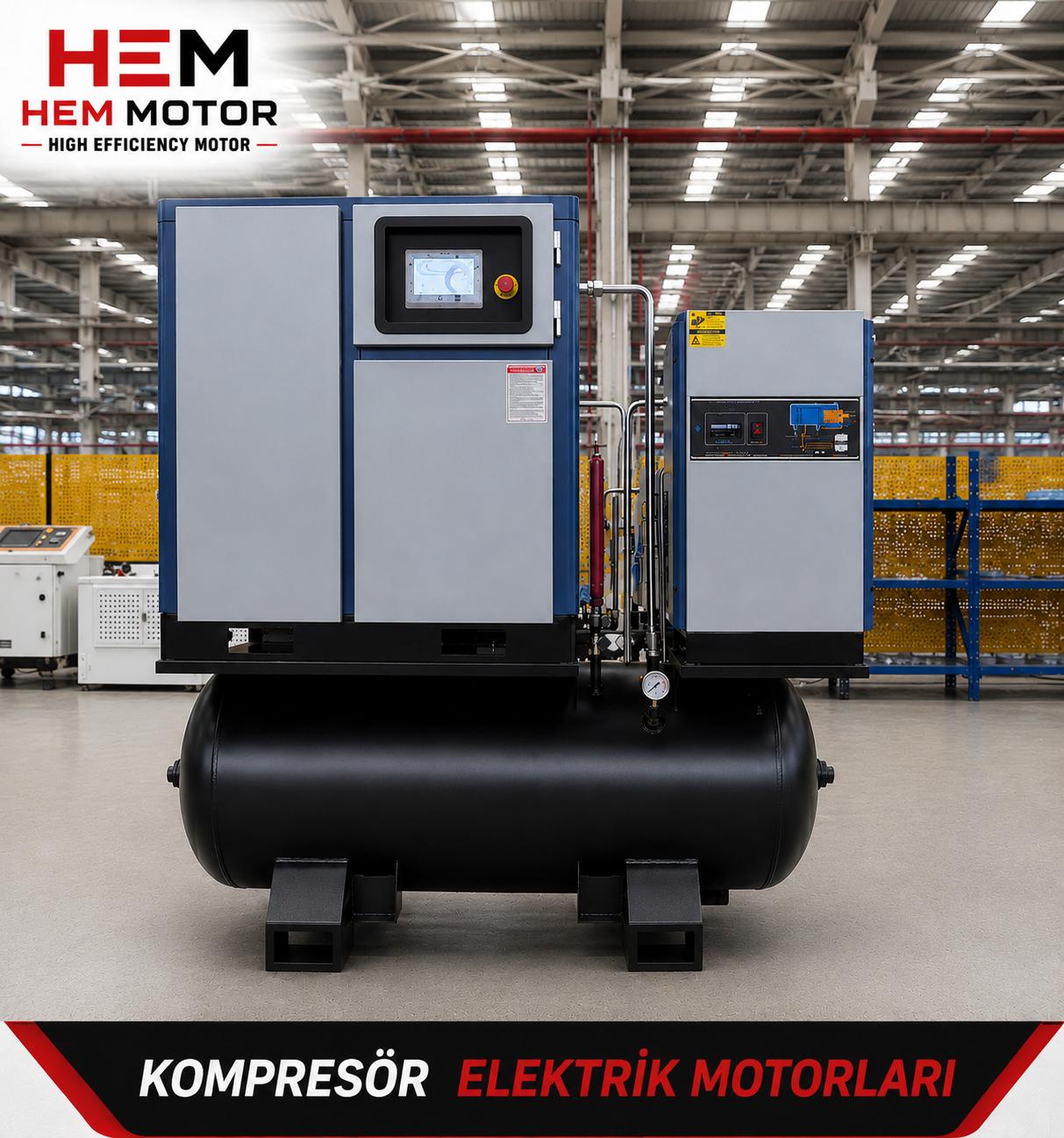

In crusher and mining plants, compressed air is often as critical an infrastructure as the main crusher. Pneumatic cylinders, clamps, filter cleaning systems, dust suppression and instrument air all depend on continuous and reliable compressed air. The air compressor drive motor that produces this air must work in a dusty, hot and vibrating environment, often under continuous duty 24 hours a day. A wrongly selected compressor motor carries the risk of both air interruption and premature failure, which can bring the whole plant to a halt. In this guide we examine air compressor drive motor selection in crusher and mining plants in terms of compressed air demand, continuous duty and correct power, from a manufacturer and seller point of view.
The Role of Compressed Air in Crusher and Mining Plants
In a crushing-screening or mining plant, compressed air is an invisible but indispensable service. Its main uses are:
- Dust collection and filter cleaning: In jet-pulse filters, sudden compressed-air bursts are used to shake off accumulated dust.
- Pneumatic actuators: Gates, diverters and feeder flaps operate with pneumatic cylinders.
- Dust suppression and misting: Dust suppression systems with a water-air mixture need compressed air.
- Maintenance and cleaning: Equipment cleaning and pneumatic hand tools in field maintenance.
- Instrument air: Control valves and automation equipment are fed with clean, dry compressed air; cutting this line affects the control of the plant.
Most of these uses are continuous or create sudden high demand; therefore the compressor motor must be selected to handle both continuous duty and variable load. Our content on motor protection in stone quarry and mine sites addresses how motor protection against dust, moisture and shock is provided.
Continuous Duty (S1) and the Load Character of a Compressor Motor
Air compressors, especially screw types, mostly run in continuous duty (S1). A screw compressor follows a cycle of loading when pressure drops and going unloaded once the set pressure is reached; however, the motor usually rotates continuously. Therefore the motor must be selected to handle heating under continuous full load. In piston compressors the load is more pulsating; the motor faces a torque demand that changes with each piston stroke.
The requirements brought by the load character in compressor motor selection:
- Since it will run in continuous duty, the motor should be selected to run at a load point below its nominal power; a heating margin should be left.
- In a screw compressor the start is usually done unloaded; nevertheless, the starting method (star-delta or soft starter) must be chosen correctly.
- A piston compressor may require high starting torque; the motor starting torque must suit the load profile.
- Since cooling paths can clog in a dusty environment, IP55 and above protection with regular cooling maintenance is critical.
Our content on IE4 screw compressor motor selection offers detailed information for correct supply in continuous duty on power and speed selection.
Correct Power Selection: Pressure, Flow and Demand Curve
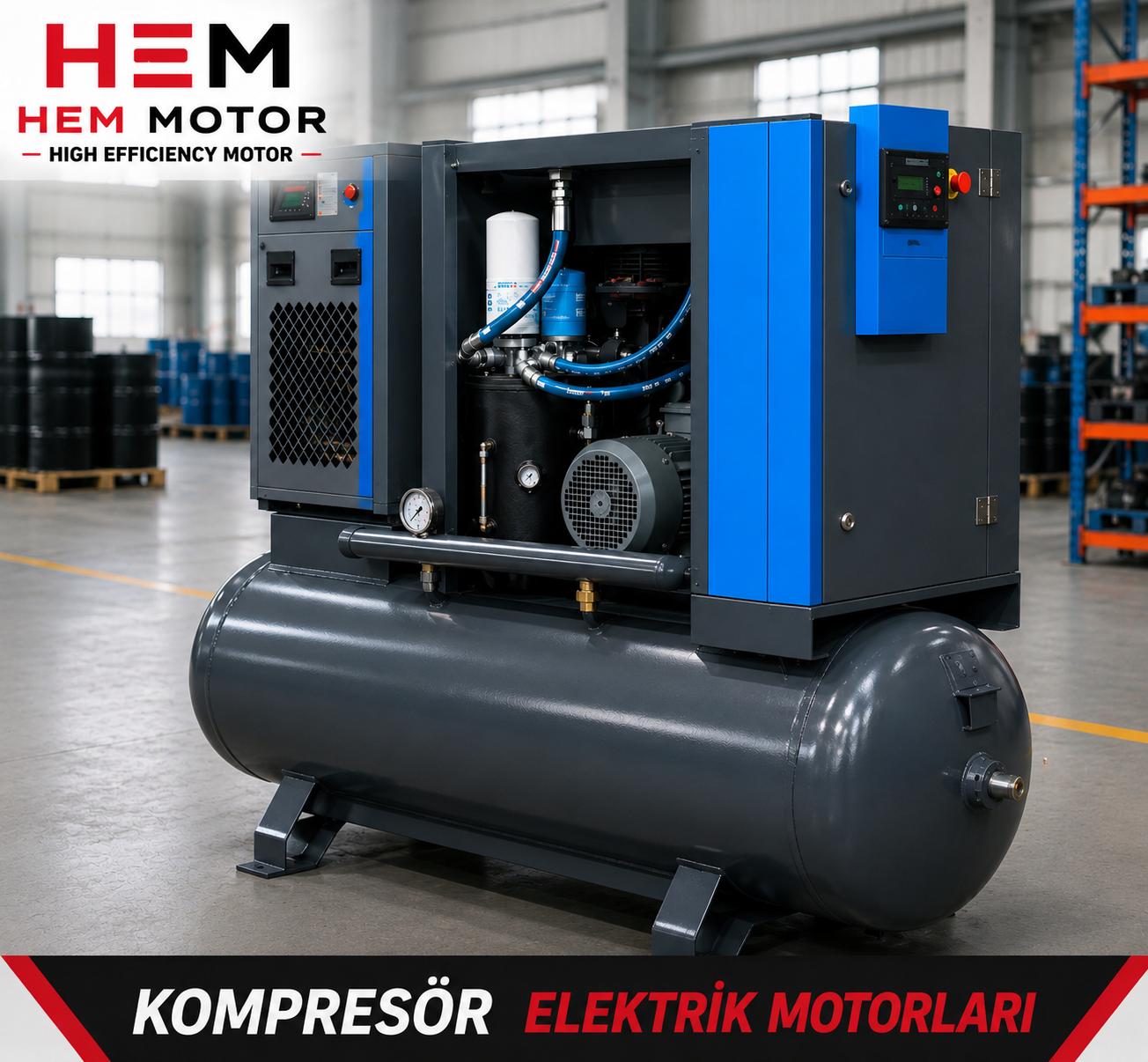
The power of the compressor motor is directly related to the pressure (bar) and flow (m3/min) the compressor produces. Higher pressure and higher flow mean more power. However, correct power selection is not done by looking only at the nominal values of the compressor; the real air demand of the plant must also be taken into account. The correct approach is:
- The peak air demand of the plant should be determined; sudden filter cleaning bursts and simultaneous pneumatic uses should be considered.
- The compressor should be sized to meet the peak demand but not to be choked at continuous full load; the motor should be selected to suit this compressor.
- The air receiver (tank) capacity reduces frequent loading and unloading of the motor by meeting sudden demands; this extends motor life.
- In continuously running large compressors, the IE3/IE4 efficiency class provides significant savings in annual energy cost.
Our content on power selection for compressed air and screw compressor motors addresses power and speed selection more broadly.
Motor Protection in a Dusty and Harsh Environment
Crusher and mining plants are one of the harshest environments for an electric motor. The dense dust in the air clogs the cooling fins and fan cowl, preventing the motor from cooling; moisture and rain stress the sealing; and vibration fatigues bearings and fasteners. For the compressor motor to run reliably in this environment:
- Protection class: At least IP55, and IP65/IP66 should be evaluated at very dusty points.
- Cooling maintenance: The fan cowl and fins must be cleaned regularly; clogged cooling heats the winding directly.
- Body material: A cast iron body provides durability against shock and mechanical stress.
- Temperature monitoring: In motors running under continuous load, the winding temperature should be monitored with a PTC thermistor or PT100.
Our content on motor cooling in crusher plants addresses the heating risk brought by continuous full-load operation in a dusty environment. Our cast-iron-body, IP55-protected compressor electric motor range is designed for these environments with continuous duty (S1) and 100% copper windings. In short, in a dusty crusher and mining environment, motor protection is not a single measure but a combination of the correct protection class, a robust cast iron body, regular cooling maintenance and temperature monitoring; when these come together, the compressor motor runs reliably even under the harshest field conditions.
Stock, Supply and Manufacturer Assurance
In crusher and mining plants the downtime cost is very high; the failure of a compressor motor can stop the whole plant with an air interruption. Therefore fast supply and spare motor planning are critically important. As a manufacturer and seller, we keep the most-used powers and speeds in compressor applications in stock as continuous-duty type, which minimizes downtime with fast delivery from stock in a failure. For the correct motor, when the compressor existing motor nameplate, mounting type, pressure and flow values are sent, a fast and error-free quote can be issued.
- Motors designed for continuous duty (S1) are suitable for the 24-hour operation of the compressor.
- IP55 and above protection with a cast iron body ensures safe operation in dusty and harsh field conditions.
- Spare holding for critical compressor motors prevents downtime caused by air interruption.
Our content on motor supply contracts in mining addresses critical stock assurance. For the current product range and electric motor prices, you can contact us with your plant compressor information.
Starting, Star-Delta and Variable-Speed Compressors
The way the compressor motor is started directly affects both the grid and the motor itself. In crusher and mining plants the grid is often fed over long lines and is exposed to voltage fluctuations; therefore high starting current can adversely affect both the motor and the other equipment of the plant. The choice of starting method is therefore important:
- Direct-on-line (DOL): Suitable for small compressors; however, in large motors the high starting current stresses the grid.
- Star-delta: Widely used to lower the starting current in medium and large compressors; effective together with unloaded start in screw compressors.
- Soft starter: Reduces both current and mechanical stress by softening the start; advantageous in frequently stopping-starting systems.
- Frequency inverter (VFD): Provides energy savings in variable-speed compressors by adjusting the speed according to air demand; in this case the motor must be selected with bearings and insulation suitable for the drive.
Our content on starting a crusher motor: soft starter, star-delta and direct-on-line details how to choose the correct starting method. In VFD-driven compressors, the motor bearing current and insulation strength must also be considered.
Maintenance, Monitoring and Spare Motor Planning
The compressor motor in a crusher and mining plant requires planned maintenance due to its continuous and harsh operation. Skipping maintenance leads to a rapid performance drop and unexpected failures in a dusty environment. Points to consider in an effective maintenance program:
- The fan cowl and cooling fins must be cleaned at regular intervals against dust accumulation; this interval shortens in a dusty site.
- Bearing greasing should be done according to the period and grease type specified by the manufacturer; the lubrication interval may shorten in motors running under continuous load.
- The winding temperature and bearing vibration should be monitored so that failure signs are caught before they grow.
- Terminal connections should be checked periodically since they can loosen due to vibration.
In addition, keeping a spare on site for a critical compressor motor prevents air interruption and thus the stopping of the entire plant in a failure. As a manufacturer and seller, we offer spare holding and fast replacement planning for critical compressor motors; when the plant compressor power and speed information is recorded in advance, the correct motor is quickly supplied from stock when needed. Our content on bearing life in crusher and mill motors regarding the effect of shock, dust and lubrication on bearing life offers complementary information for maintenance planning.
Frequently Asked Questions
Why should a compressor motor in a crusher plant be continuous-duty type?
Because compressed air is a service the plant continuously needs and the compressor usually rotates 24 hours. A motor not designed for continuous duty (S1) overheats under continuous full load and its winding is damaged. An S1-type motor carries this continuous load safely, leaving a heating margin.
How do I protect a compressor motor in a dusty environment?
At least IP55, and IP65/IP66 protection class at very dusty points, should be preferred. In addition, the fan cowl and cooling fins must be cleaned regularly, mechanical strength should be provided with a cast iron body, and the winding temperature should be monitored with a PTC or PT100. These measures significantly extend motor life in a dusty site.
How many kW should I select for the compressor motor?
Power is determined according to the compressor pressure and flow values and the plant peak air demand. The motor should be selected to meet the peak demand but not to be choked at continuous full load. For the most accurate result, the compressor nameplate values and the plant air requirement are evaluated together; with this information a motor of suitable power is matched quickly.