English
 Türkçe


Summary (TL;DR)
- In a cast iron motor, the terminal board and busbar inside the terminal box must carry the motor's rated current without overheating; an undersized connection means hot-spots and failure.
- A correct connection relies on three matched components: an adequate busbar cross-section, a proper cable lug, and the catalog-specified tightening torque.
- Low contact resistance equals low heat loss; a loose or undersized joint produces power loss that rises with the square of the current and burns the insulation.
- Manufacturing in the 0.55-355 kW range, HEM Motor supplies IE3 and IE4 efficient, IP55, Class F cast iron body motors with the right terminal box configuration from stock and with a fast quote.
- At high power (315/355 kW) the high rated current makes busbar and lug sizing critical; ordering the correct terminal box with manufacturer assurance extends the life of the entire installation.
No matter how robust a motor's body or how high-grade its winding is, if the terminal box, the very first point where energy enters the motor, is weak, the whole system is weak. In cast iron motor applications, especially at medium and high power, the selection of the terminal board, busbar, and cable lug directly determines whether the motor runs safely, efficiently, and for a long time. This article covers current capacity, cross-section selection, tightening torque, contact resistance, and the correct high-current connection strategy from both a technical and purchasing perspective.
What Is a Terminal Board and Why Is It Critical?
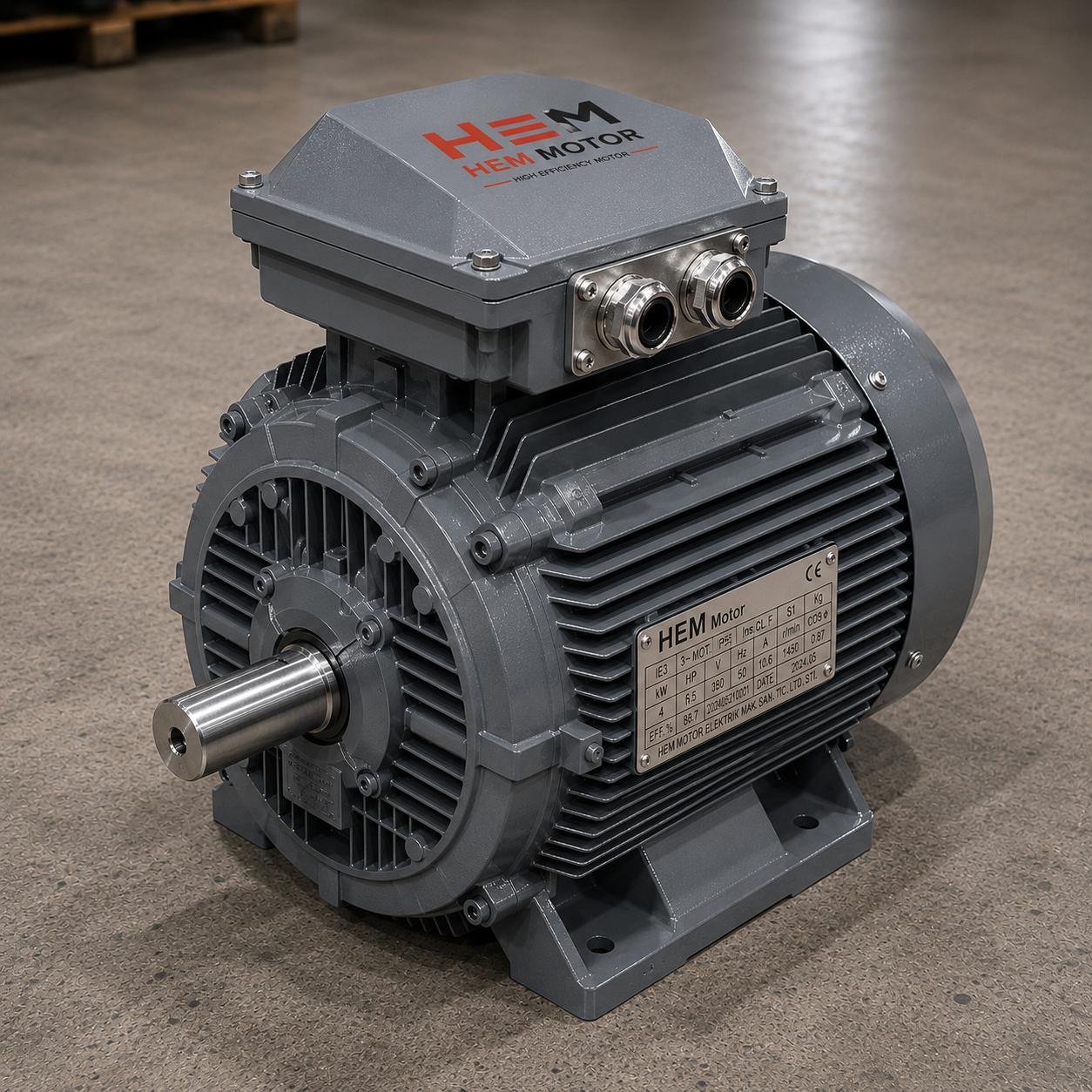
The terminal board is the insulating plate where the motor's winding ends (U1-V1-W1 and U2-V2-W2) meet the external supply cables. It carries six connection bolts, and the star (Y) or delta (Δ) configuration is made with the bridges (busbars) on this board. It is not just a mechanical carrier; it is an electrical transition point that transfers current from the winding to the cable.
The board material, bolt quality, and busbar cross-section must be sized for the current the motor draws. A board that is adequate for a small motor will overheat, deform, and loosen at high powers like 315 or 355 kW, dramatically increasing the contact resistance at the joint. A cast iron motor body resists thermal expansion, but this advantage requires the terminal box to be chosen with the same care.
Star-Delta Bridges and Busbar Position
The bridging arrangement on the terminal board matches the motor to its supply voltage. Horizontal bridges give a delta connection, vertical bridges give a star connection. These bridges are in fact small busbar pieces, and their cross-section must also be capable of carrying at least the phase current. Incorrect bridging or an undersized bridge is one of the leading causes of problems that can end in a burnt motor.
Busbar Current Capacity and Cross-Section Selection
A busbar is a rectangular-section conductor usually made of copper or aluminum. Its current capacity depends on cross-sectional area, material conductivity, surface area (heat dissipation), and operating temperature. A copper busbar offers higher conductivity and greater current capacity in a smaller cross-section than aluminum, which is why copper busbars compatible with 100% copper windings are preferred in high-power motors.
The following factors are considered when determining a busbar's current capacity:
- Cross-sectional area: the larger the section in mm², the more current it carries; but as the section grows, the current density (A/mm²) is reduced to stay within a safe limit.
- Surface/heat dissipation: a thin, wide bar cools better than a thick, narrow bar of the same area, which is why flat sections are preferred in busbar design.
- Ambient temperature: as the temperature inside the terminal box rises, the current the bar can carry decreases (derating).
- Current density: the safe current density of a copper bar is kept limited; exceeding it overheats the bar.
When selecting a high-power cast iron motor, the busbar cross-section cannot be determined without knowing the motor's rated current. As a manufacturer, HEM Motor provides the correct busbar and terminal box configuration for every power class, eliminating the risk of running with the wrong section in the field.
Rated Current and Sizing the Connection
Rated current is the full-load phase current stated on the motor nameplate and is the fundamental value to base connection sizing on. As power increases, current increases too; the terminal box, busbar cross-section, and lug size of a 0.55 kW motor and a 355 kW motor are worlds apart.
Each link in the connection chain should be selected to carry the rated current with at least a 25% safety margin. Since the current drawn at startup can be several times the rated current, the connection components must also thermally tolerate this transient load. For tightening torque and bolt value in cable lug selection, our guide on IE4 motor terminal tightening torque Nm values is a great practical help.
Cable Lug (Lug) Selection
A cable lug converts the end of a multi-strand supply cable into a single connection surface. In connections made without a lug, the strands spread out, the contact surface shrinks, and the contact resistance rises. Correct lug selection rests on three parameters:
- Cable section match: the barrel diameter of the lug must exactly match the cable cross-section; crimping a thin cable into a large lug means a loose joint.
- Hole (eye) diameter: the lug's connection hole must suit the bolt diameter on the terminal board.
- Material and plating: copper lugs should be protected against corrosion and oxidation with a tinned surface, since an oxide layer raises resistance.
The lug must be crimped to the cable with the correct crimping tool; soldered or loose lugs should never be used. For detailed information on lug selection and correct crimping, our article on electric motor cable connection and cable lug selection is a solid starting point.
The Relationship Between Tightening Torque and Contact Resistance
The electrical quality of a joint is directly related to the mechanical clamping force. Tightening torque measures how firmly the bolt is tightened and determines the real contact area between the joint surfaces. Insufficient torque = loose joint = high contact resistance; excessive torque can crack the bolt or board by overstressing them.
When contact resistance is high, heat is released at that point per the P = I²R formula. When the current doubles, this loss quadruples, so in high-current applications a loose joint quickly creates a hot-spot and burns the insulation. The correct torque value is determined by bolt diameter and material and must always be applied with a torque wrench.
- Flat and clean surface: oxide and dirt reduce the contact area; the joint surface must be clean.
- Spring washer and nut: prevent loosening under vibration.
- Periodic check: torque should be checked at intervals after first commissioning.
Hot-Spot Formation at High Current
A hot-spot forms when current concentrates at the weakest link in the connection chain and heat accumulates there. This weak link may be an undersized busbar, the wrong cable lug, low tightening torque, or an oxidized surface. A hot-spot first softens the insulation material, then leads to carbonization, and finally arcing or fire.
To reduce hot-spot risk, a holistic approach to connection design is essential: busbar, lug, bolt, and torque must all be matched. Periodic inspection with a thermal camera catches invisible heating early. While the cast iron motor body distributes some heat thanks to its high thermal mass, it does not on its own solve local heating inside the terminal box; the connection must be correctly sized.
Cast Iron Body Advantage and Correct Motor Selection
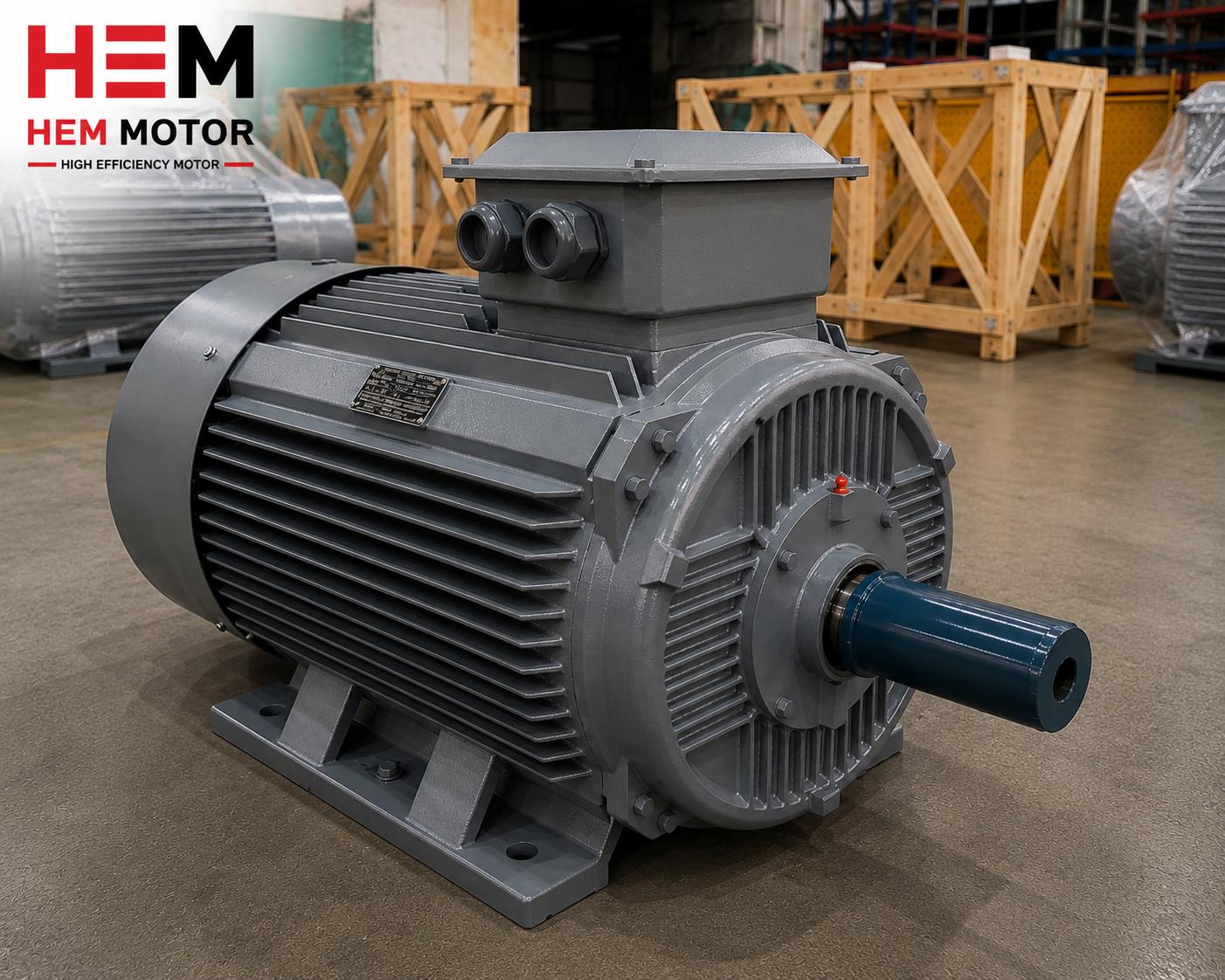
A cast iron body is superior to sheet-metal bodies in mechanical strength, vibration damping, and thermal stability. This is why cast iron motors are preferred in high-power and heavy-duty applications. The body's strength also allows the terminal box to be designed larger and suitable for higher current. You can find more on the technical advantages of the cast iron body in our content on cast iron body motors.
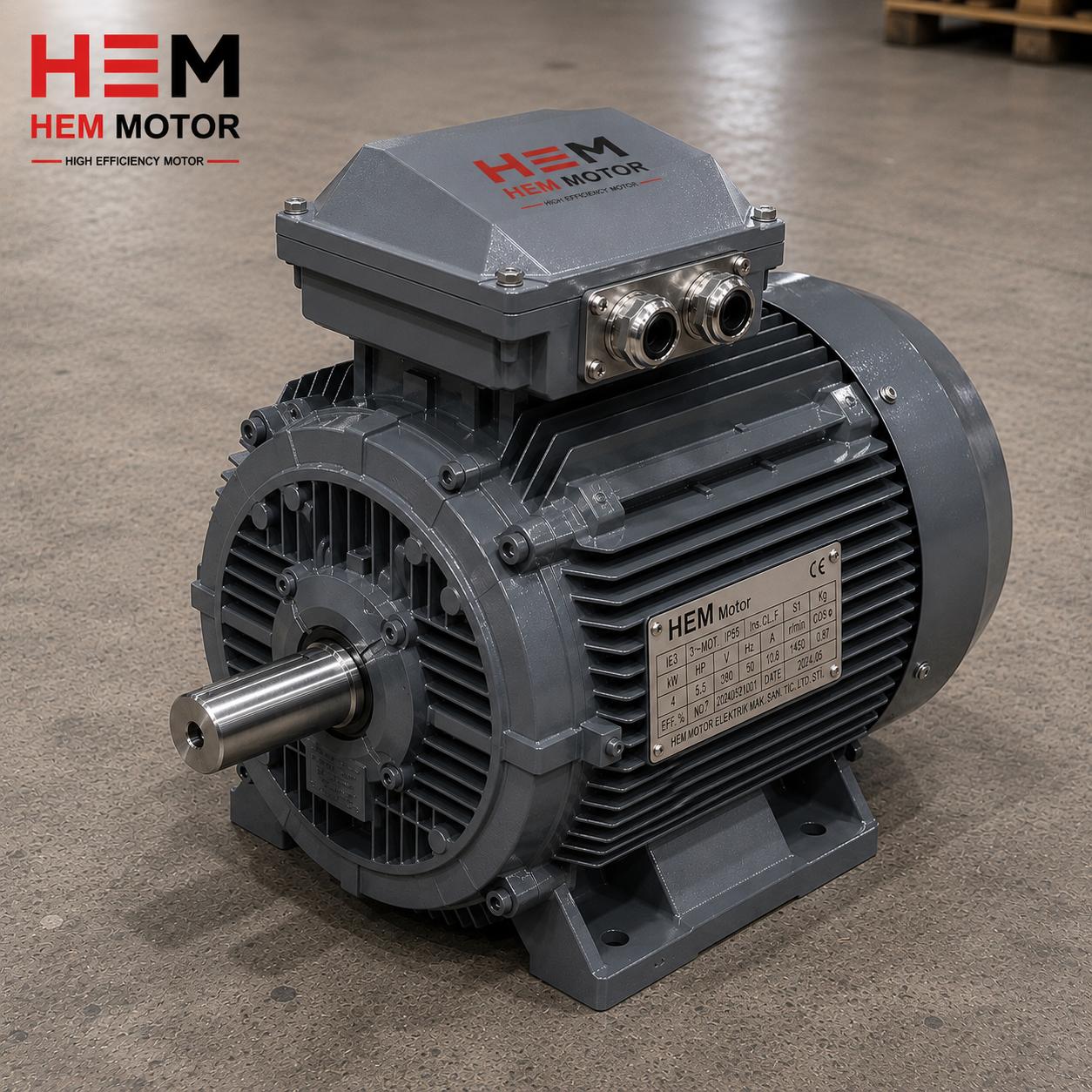
HEM Motor manufactures cast iron motors in IE3 Premium and IE4 Super Premium efficiency classes, in the 0.55-355 kW power range, at 1000/1500/3000 rpm, with B3/B5/B35 mounting options, IP55 protection, Class F insulation, 100% copper winding, and suitability for S1 continuous duty. You can reach the whole product family via our cast iron electric motors product page.
Purchasing: Order the Right Terminal Box Configuration
When selecting a motor, consider not only power and speed but also the application's current profile and cabling requirement. Working with manufacturer assurance ensures the terminal box, busbar cross-section, and bolt arrangement are delivered suited to the application. With its identity as a manufacturer and seller, HEM Motor offers delivery from stock, a fast quote, and clear lead times so your project does not wait. For current electric motor prices and the right terminal box configuration, all you need to do is request a quote.
The right motor + the right terminal board + the right busbar + the right lug + the right torque = a long-lasting, efficient, and safe installation. Sourcing this whole chain from a single manufacturer, with manufacturer assurance, is the smartest route in terms of both cost and maintenance.
Frequently Asked Questions
How should I select the busbar cross-section?
The busbar cross-section is determined by the motor's rated current and the safe current density. The higher the rated current, the larger the section required; the terminal box temperature and heat dissipation conditions must also be taken into account. HEM Motor supplies terminal boxes configured with the appropriate busbar section for every power class.
What happens if the tightening torque is insufficient?
Insufficient tightening torque reduces contact between the joint surfaces and raises the contact resistance. High contact resistance creates a heat loss that rises with the square of the current, which means hot-spots, insulation damage, and ultimately failure. Torque must always be applied to the catalog value with a torque wrench.
Does the cast iron motor come with a terminal box as standard?
HEM Motor cast iron motors are delivered with a terminal box and terminal board appropriate for the power class. At high powers, the busbar and bolt arrangement are sized for higher current. When you specify your application-specific cabling needs, we provide the correct terminal box configuration as the manufacturer.