English
 Türkçe


In automotive supplier plants, press lines are the heart of production: sheet forming, deep drawing, cutting and shaping all happen here. When selecting an electric motor for a press line, the question "how many kW" is only the tip of the iceberg. Because of its flywheel-based design, sudden shock loads and frequent-cycle (stop-start) operation, a press has a special load profile. The wrong motor selection either causes the motor to overheat continuously or fails to refill the flywheel, leading to pauses. In this article we cover press line electric motor selection in automotive suppliers from the perspective of the flywheel, shock load, frequent cycling and correct power.
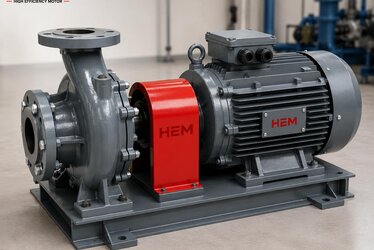
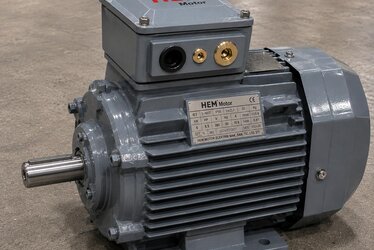
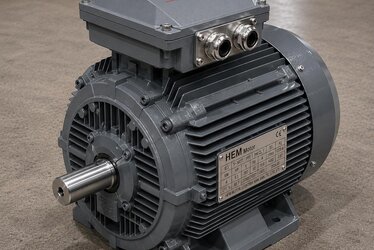
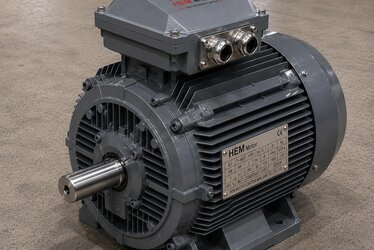
At HEM Motor, as both manufacturer and seller, we see that correctly understanding the load profile is decisive when supplying motors to the press, CNC and robot lines of automotive suppliers. The right motor on a press line directly affects production continuity, part quality and energy cost. For current electric motor prices and suitable power options for a press line, review our product pages.
Why Is the Load Profile of a Press Line Special?
Most industrial loads (pump, fan, conveyor) require constant or slowly varying torque. A press is entirely different: during the press slide stroke, at the moment of contact with the material, a very short but very high torque demand arises. This sudden demand is met not by the motor but largely by the flywheel.
The Role of the Flywheel
The press flywheel stores kinetic energy as it rotates. When the press strikes the material, most of the required energy is drawn from the flywheel, and the flywheel speed drops somewhat. During this time, instead of directly meeting the high torque, the motor re-stores energy by re-accelerating the flywheel in the idle time between cycles. Therefore the press motor's job is not to "meet the sudden load" but to "continuously feed and recover the flywheel."
To understand the flywheel-inertia relationship under impact load, our article on motor selection under impact load: flywheel, inertia and drive reinforces the subject through similar physics.
Shock Load and Motor Durability
When the press operates, the load reflected to the motor is not a flat line but a wavy profile with peaks. Although the flywheel largely dampens these peaks, the motor is still exposed to repetitive load fluctuations. In this case the motor must have:
- Sufficient breakdown torque margin so it does not stall at sudden load peaks.
- A robust mechanical structure; a cast iron body provides durability against repetitive stresses and vibration.
- Good balance and bearing quality; under repetitive load, vibration determines bearing life.
For the durability of super premium motors under sudden load, our article on overload capacity and breakdown torque margin guides correct selection in peak-load applications such as presses. For the impact strength of the cast iron body, our article on impact strength and rigidity in cast iron bodies is an important resource.
Frequent Cycling: Duty Type Selection
Automotive supplier press lines often run not at continuous constant load but with frequent stop-start (cyclic) operation. In each cycle the motor accelerates, recovers the flywheel and prepares for the next stroke. This way of working determines the motor's duty type:
- S1 (continuous duty): The motor runs continuously at constant load. If the press main motor's flywheel rotates continuously, this profile is suitable.
- S4 (intermittent, cyclic duty): In applications with frequent starts, the motor should be selected to S4 because of the heating effect of the starting current. The number of cycles (starts per hour) is a critical parameter.
Selecting the correct duty type determines how much the motor will heat up and how long it will last. For the cyclic duration percentage and heating limit in S3/S4 intermittent duty, our article on S3/S4 intermittent duty and heating limit clarifies correct power selection in a cyclic press application. For the general duty type logic, our article on duty type (S1-S6) selection is a fundamental reference.
Correct Power and Speed Selection
There are two common mistakes when selecting power for a press motor: choosing too large and choosing too small. An oversized motor often runs at low load; this both lowers the power factor and makes the investment unnecessarily large. An undersized motor cannot recover the flywheel between cycles; this slows the press and constantly stresses the motor.
- Speed: The motor speed is determined by the pulley-belt ratio of the press flywheel. In most press applications, 4 poles (1500 rpm synchronous) are common.
- Power: Determined by the energy the flywheel spends per cycle and the cycle frequency; sized by the average energy requirement, not by peak torque.
- Starting: In applications with frequent starts, the starting method (star-delta, soft starter) and contactor sizing are important.
Our article on automotive supplier electric motors: press, CNC and robot line supply, which addresses the motor supply of the press, CNC and robot lines holistically, complements line-based planning.
Efficiency and Continuous Production
In automotive suppliers, press lines often run multi-shift; that is, the motor produces by turning thousands of hours per year. Therefore the efficiency class (IE3/IE4) directly affects energy cost in the long run. A high-efficiency motor does the same work with fewer losses and runs cooler; this positively reflects on bearing and insulation life. On continuous production lines, the efficiency class choice is not just a cost but also a reliability decision.
Order Information for Correct Supply
At HEM Motor, to correctly supply a press line motor, we recommend clarifying the following:
- Press type (eccentric, hydraulic), flywheel structure and capacity.
- Cycles/starts per hour (for duty type).
- Flywheel pulley-belt ratio and target speed.
- Drive structure (belt-pulley/coupling) and shaft information.
- Efficiency class preference and operating hours profile.
- Mounting type, frame and environmental conditions.
With this information, we can supply a motor of the correct power and duty type suited to the press line's load profile, from stock or to lead time. The right press motor selection preserves production continuity, reduces pauses and lowers energy cost.
The Auxiliary Motors of a Press Line
A press line is not made up only of the main press; around it are many auxiliary drives, and each requires a motor according to its own load profile. A typical press line in automotive suppliers includes the following auxiliary motors:
- Sheet feeder motor: A servo or asynchronous drive that pushes the sheet from the coil into the press in precise steps. Position precision is important.
- Decoiler and straightener motor: The drive that uncoils and straightens the sheet roll; it requires torque according to sheet thickness.
- Hydraulic unit motor: The hydraulic pump motor that feeds the press's clamping, balancing or die-change systems. It runs at continuous load.
- Lubrication and cooling pump motor: Low-power, continuously running motors for die and mechanism lubrication.
- Conveyor/scrap removal motor: Belt motors that carry cut parts and scrap.
Each of these motors has a different load type than the main press motor; for example, the hydraulic unit motor runs at continuous load (S1) while the feeder motor stops and starts frequently. When planning at the line level, these auxiliary motors must be selected in the correct power and duty type just as much as the main motor. A single incorrectly selected auxiliary motor can affect the efficiency and continuity of the whole line.
Die Change and Flexible Production
In automotive suppliers, the same press line works with different dies for different parts. As the die changes, the press's load profile also changes: a heavy deep-drawing die and a light cutting die demand different energy from the motor. Therefore the press motor must be selected to meet the energy requirement of the heaviest die per cycle.
In facilities with flexible production, it is important that the motor is sized for the heaviest scenario but preserves its efficiency at low load with light dies. Because high-efficiency motors can maintain their efficiency over a wide load range, they provide an advantage for flexible press lines that work with a great variety of dies. This means both sufficient power on the heaviest job and low losses on the light job.
Vibration, Noise and Occupational Safety
Press lines are by nature environments that produce vibration and noise. Selecting the motor suitable for this environment is important for both the motor's life and working comfort. A well-balanced motor with quality bearings and a robust body withstands press-induced vibration better and does not add its own vibration to the line.
In addition, on a press line the motor often works near operators; therefore a low noise level is also valuable in terms of occupational health. High-efficiency motors generally run quieter thanks to an optimized cooling fan and low-loss design. The motor's mounting base and vibration-damping elements also affect the overall vibration and noise behavior of the line.
Frequently Asked Questions
Should I select the press motor by peak torque?
No. The press peak torque is largely met by the flywheel; the motor is not sized to meet this peak alone. The motor is selected for the average power that can re-store, in the idle time between cycles, the energy the flywheel spends per cycle. Selecting by peak torque leads to an unnecessarily large, low-efficiency motor.
Which duty type is suitable for frequent stop-start operation?
In applications with frequent starts, S4 (intermittent, cyclic duty) should be the basis, because the high current drawn at each start heats the motor. The number of starts per hour is the critical parameter that determines the motor's heating limit. On presses whose flywheel rotates continuously and rarely stops, S1 continuous duty may be suitable.
Is a cast iron body essential on a press motor?
In applications with repetitive shock load and vibration such as presses, a cast iron body provides an advantage in mechanical strength and vibration damping. The rigidity of the cast iron body positively affects body and bearing life under repetitive stress. For this reason, cast iron motors are commonly preferred in heavy press applications.
When selecting a press line motor in automotive suppliers, the role of the flywheel, the shock load, the frequent cycling and the duty type must be evaluated together. The correct power is determined by the average energy requirement, not by peak torque. At HEM Motor, as both manufacturer and seller, we supply a durable and efficient motor suited to your press line's load profile, from stock or to lead time. The right selection means uninterrupted production and low operating cost.