English
 Türkçe




Marmara is the heart of Turkiye's industrial output. From automotive to textiles, food to chemicals, machine manufacturing to metalworking, countless sectors are concentrated in this basin. In such a dense production geography, only one thing is expected from an electric motor supplier: a clear, fast answer to the question "Is it in stock, can you ship today?" In this article we explain how fast electric motor supply from stock to Bursa and the Marmara basin works; the stocked power-speed combinations and the emergency replacement process.
When a motor fails in a facility, or a new machine needs one fitted, every hour lost is reflected directly in production. In Marmara's high-tempo industry this loss is often many times the price of the motor. So the supply strategy for the region is built on speed and stock availability. The right motor waiting ready in stock and able to ship the same day is the guarantee of production continuity.

Why Is Speed So Critical in Marmara?
The Marmara basin concentrates a major share of Turkiye's production volume in a single geography. This density also raises the supply expectation. For an Istanbul, Bursa, Kocaeli or Sakarya facility, motor supply is seen not as a slow process but as an extension of the production line.
- High production tempo: In shift-working facilities a stoppage turns instantly into an order delay.
- Supply-chain pressure: One motor's delay can shake an entire production plan.
- Dense machine park: In facilities where many motors run together, the probability of failure is also high.
- Competitive market: Late delivery means a disadvantage against rivals, so speed becomes a priority.
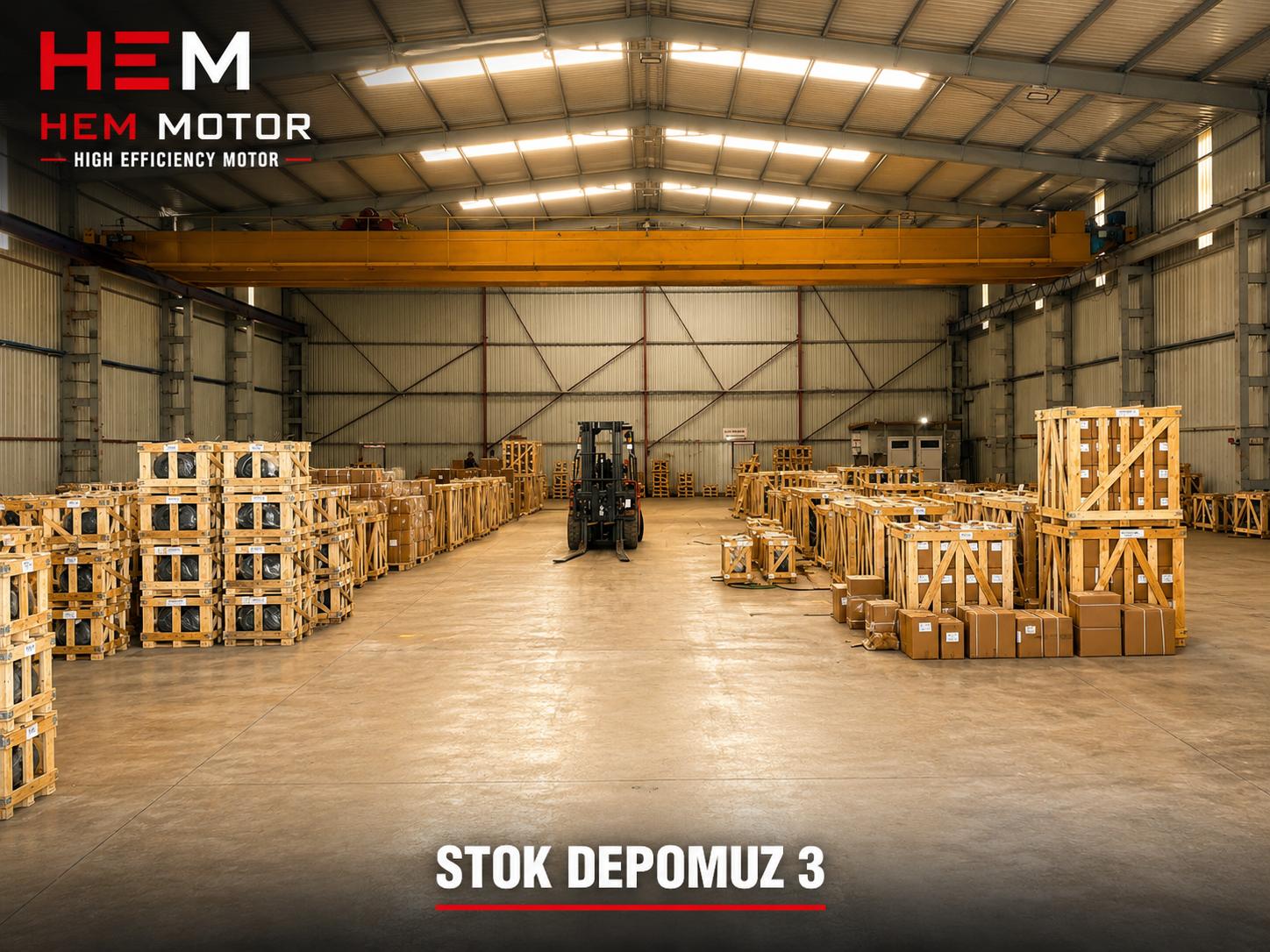
For this reason the basic principle in supply to Marmara is keeping the most sought-after motors ready in stock and fit for same-day shipping.
Stocked Power-Speed Combinations
The secret of fast delivery is the right products being in stock in advance. The motors most often requested in industry concentrate in certain power and speed steps. Keeping these steps in stock makes it possible to meet the majority of demand instantly.
Most sought-after power steps
- 0.75 - 1.1 - 1.5 - 2.2 kW: For small pumps, fans and auxiliary drives.
- 3 - 4 - 5.5 - 7.5 kW: For medium-scale pump, conveyor and machine drives.
- 11 - 15 - 18.5 - 22 kW: For larger pump, fan and compressor applications.
- 30 - 37 - 45 - 55 kW and above: For heavy industry and large drives.
Most sought-after speeds
- 2-pole (~3000 rpm): High-speed pump and fan applications.
- 4-pole (~1500 rpm): The most common speed; the standard for conveyor and geared drives.
- 6-pole (~1000 rpm): Applications requiring low speed and high torque.
The majority of these combinations are stocked at least in IE3 efficiency class. You can find the detail of the most sought-after power-speed combinations in our IE3 stock guide.
Marmara's Sectoral Diversity and Motor Need
The most distinctive feature of the Marmara basin is its sectoral diversity. This diversity requires the motor need to be multi-faceted too. A facility in automotive supply industry and a food business or a textile factory have motor demands with different priorities. Understanding these differences is the basis of the right stock strategy.
- Automotive and machine manufacturing: Demands high precision and continuity; 4-pole motors are heavily used in conveyor, press and machine-tool drives.
- Food and beverage: Due to hygiene and regular cleaning, high protection class (IP55 and above) motors are preferred; pump and mixer drives stand out.
- Textile: Many small and medium-power motors; diversity is high in fan, pump and drive applications.
- Chemical and metal: Harsh conditions; cast iron frame, durable motors and high power bands are required.
Knowing this sectoral map determines which motors should be kept ready in stock. Supply to Marmara rests on a wide stock range to meet this diversity, so that demands from different sectors can be met at the same speed.
Fitting a Motor to a New Machine
Supply is critical not only during a failure but also in new machine installations. When a new line or machine is commissioned, choosing the motor correctly sets whether the system runs healthily from the start. Here the motor's power, speed and compatibility with the reducer must be clarified in advance. A wrongly chosen motor means early failure and efficiency loss even in a new machine.
In new installations it is wise to choose the motor to meet not only today's need but also possible future capacity increases. However, an oversized choice also brings efficiency loss at low load factor, so balance is important. The right power and speed selection optimises both the initial investment and the long-term energy cost.
Emergency Replacement Process: From Failure to Running
When a motor stops suddenly, the speed of the process depends directly on the clarity of information. Emergency replacement starts with a correctly defined request and is completed with fast shipping.
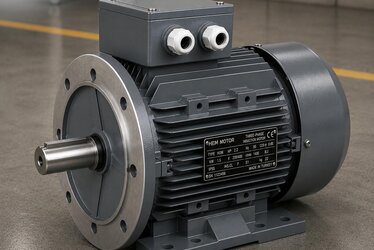
- Nameplate data: A photo of the failed motor's nameplate presents power, speed, frame size, mounting type and shaft diameter in a single frame.
- Stock check: If the requested combination is in stock, shipping can begin the same day.
- Shipping channel: According to the motor's weight, courier or freight channel is chosen.
- Delivery and commissioning: When the motor reaches the site, transport-damage inspection and first-startup steps are applied.
Thanks to Marmara's developed transport infrastructure, a motor ready in stock often reaches the site in a very short time. This minimises downtime.
Defining the Right Motor Correctly
At the heart of fast delivery lies a completely defined request. A wrongly or incompletely defined request slows even the fastest supply channel. So clarifying the following before ordering is critical:
- Power (kW): The mechanical power the application requires.
- Speed / pole count: According to the desired output speed.
- Efficiency class: At least IE3; according to regulation and energy targets.
- Frame and mounting: IEC frame size, mounting type (B3/B5/B35), shaft diameter and protection class.
If you are replacing an existing motor, a photo of the old motor's nameplate presents all this data in a single frame and is the most reliable source. You can reach our wide product range from our homepage.
A Supply Approach That Adds Value to Marmara Industry
Supply to Bursa and the Marmara basin is not just selling products; it is securing production continuity. The right motors waiting ready in stock, fast shipping and a clear emergency replacement process enable a facility to restart production quickly even in an unexpected failure. This approach turns the motor from a mere part into a tool of production assurance.
The Effect of Stock Availability on Total Cost
For a facility manager the motor's price is often only the visible part of the iceberg. The real cost appears when the motor cannot be supplied on time. In a high-tempo industry like Marmara, waiting days for a motor that is not in stock triggers hidden costs such as production loss, delayed shipments and contract penalties. So stock availability is a factor that directly affects total cost of ownership.
A standard motor waiting ready in stock makes both delivery time and pricing predictable. Facilities can build their maintenance and spare strategies accordingly by knowing in advance whether their most critical motors are in stock. This minimises the cost of unplanned stoppages and protects the production plan. The essence of the supply approach for Marmara industry is precisely to provide this predictability.
- Predictable delivery: A motor in stock simplifies planning with same-day shipping.
- Prevention of hidden costs: Indirect costs such as downtime, delay and penalty are reduced.
- Alignment with maintenance strategy: When critical spares are known in advance, the maintenance plan is strengthened.
Frequently Asked Questions
How quickly is a motor delivered to Bursa and Marmara?
If the requested motor is a power-speed combination ready in stock, shipping can often begin the same day. Thanks to Marmara's developed transport infrastructure the motor reaches the site quickly. The main factors setting the time are whether the motor is in stock and the shipping channel chosen by its weight. Motors in standard steps are the fastest to deliver.
Which powers and speeds are kept in stock?
The most frequently requested power steps in industry (from 0.75 kW up to 55 kW and above) and 2, 4 and 6-pole speed options are kept ready in stock. The majority of these combinations are at least IE3 efficiency class. 4-pole (~1500 rpm) motors form the widest stock band because they are the most common choice in conveyor and geared drives.
What information should I give first in an emergency failure?
The most critical information is a photo of the failed motor's nameplate. The nameplate presents power (kW), speed (pole count), frame size, mounting type and shaft diameter in a single frame. With this data the right spare is identified quickly, and after a stock check shipping can begin the same day. If the nameplate is unreadable, the old motor's dimensions and a description of the application also provide a sufficient start.