English
 Türkçe

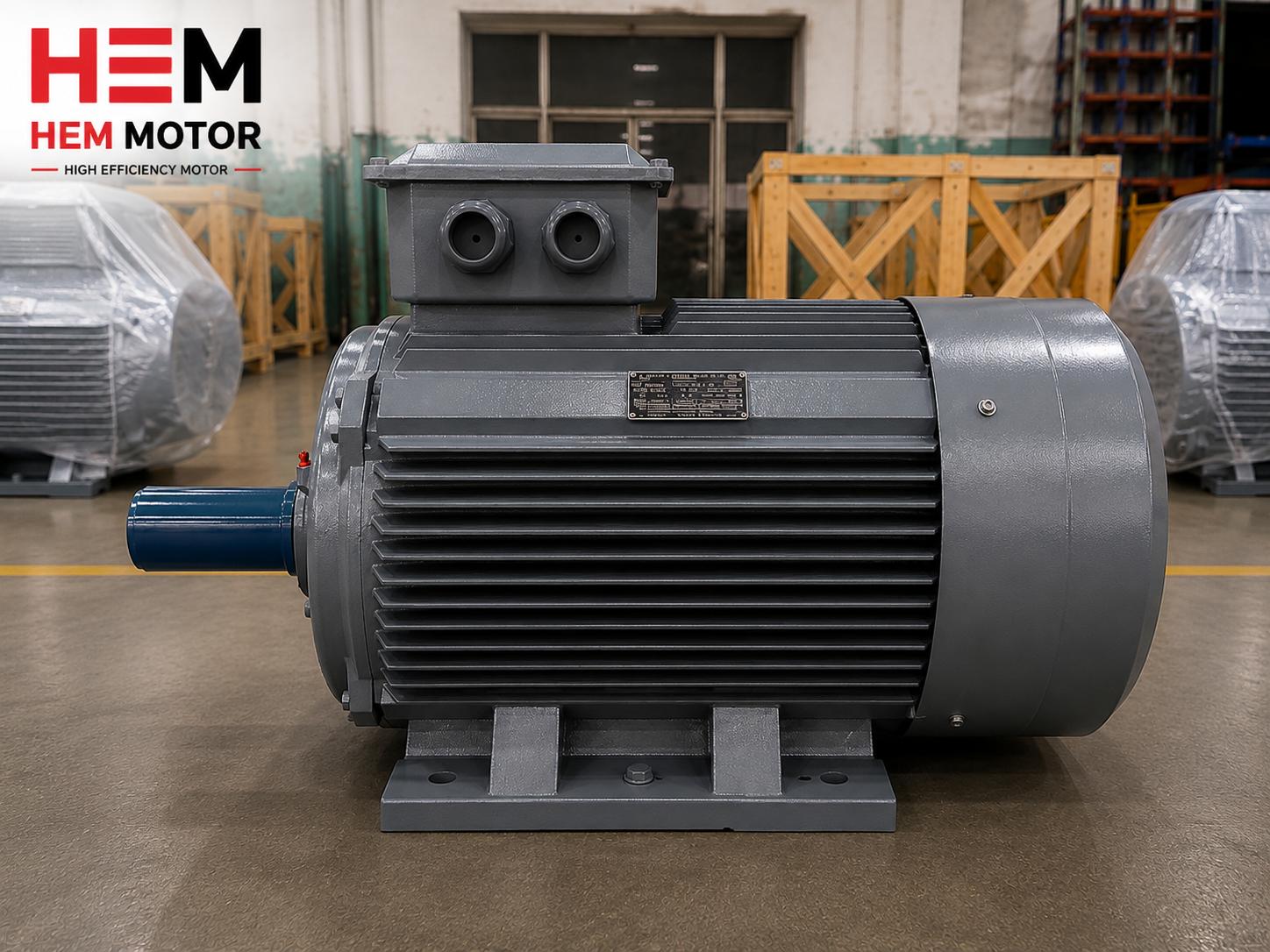

Switching a facility to high-efficiency motors solves only part of the electricity bill. The reason is that electric motors draw two kinds of power from the grid: active power (kW) that turns into useful work, and reactive power (kVAr) that builds the magnetic field but does not directly become work. An IE4 electric motor noticeably lowers active consumption, yet it does not on its own eliminate the magnetizing current. That is why reactive power compensation and correct capacitor selection are a complementary step that protects the return on an efficiency investment.
Reactive power becomes most visible when a motor runs at partial load. A power factor (cos φ) that is reasonable at full load drops quickly when the load falls to the 50-60% band. A falling power factor means more reactive current drawn from the grid and the reactive energy penalty applied by the distribution utility. In this article we look at the logic of reactive power compensation for IE4 motors, the per-motor kVAr calculation, the points to watch in drive-fed applications, and correct sizing from a field perspective.
Our goal is not only to explain the theory but to let you plan the right-rated motor and the recommended compensation value together and supply both quickly from stock. You can reach the full range from the homepage and review the product families.

What Are Reactive Power and Power Factor?
Asynchronous motors draw a magnetizing current from the grid to build the rotating magnetic field. This current is shifted roughly 90 degrees from the voltage and, on average, does not become work; it produces no torque at the shaft, yet it flows through the lines, the transformer and the meter. Active power (P, kW) represents real work, reactive power (Q, kVAr) the cost of the magnetic field, and apparent power (S, kVA) the vector sum of the two.
Power factor is the ratio cos φ = P / S. The closer this ratio is to 1, the larger the share of the drawn apparent power that turns into work. A typical asynchronous motor at full load has a cos φ between 0.82 and 0.88. The problem is that a motor rarely runs at full load; in the real field most motors run in the 50-75% band of rated power, where cos φ can fall below 0.7.
Why Doesn't an IE4 Motor End the Reactive Draw?
A high efficiency class lowers active consumption by reducing losses (copper, iron, friction). However, the magnetizing current is a fundamental quantity needed to saturate the stator core, and it is largely independent of the efficiency class. Therefore an IE4 electric motor, while spending less active power than an IE2 counterpart, draws a similar reactive power. For this reason the assumption "I switched to an efficient motor, so I no longer need compensation" is wrong; the reactive penalty can quietly erode the gain of the efficiency investment.
Per-Motor kVAr Calculation
Three pieces of information are needed to determine the compensation capacitor value: the motor's active power (kW), the current power factor, and the target power factor you want to reach. The required capacitor power follows this logic:
Q_capacitor = P × (tan φ_current − tan φ_target), where the φ angles are the inverse trigonometric values of the current and target cos φ. For example, raising a motor running at 0.75 cos φ to 0.95 requires roughly 0.55 times the motor power in kVAr. For a 7.5 kW motor this means roughly a 4 kVAr capacitor.
Choosing Current and Target cos φ
Keeping the target power factor in the 0.95-0.98 band is usually sufficient. Forcing it all the way to 1.0 brings an unnecessarily large capacitor, over-compensation and the risk of capacitive overshoot at low load. Distribution utilities apply both an inductive and a capacitive limit; over-compensation can trigger the capacitive penalty.
Individual or Central Compensation?
In individual (per-motor) compensation the capacitor is connected directly to the motor terminal and switches in and out with the motor. This method reduces the reactive load on the lines at its source and relieves cable cross-section. In central compensation, stepped capacitor groups are switched in at the main panel by an automatic reactive power controller. In facilities with many small motors a central system is more flexible, while individual compensation is more efficient for large, continuously running single motors.
A Critical Warning for Drive-Fed (VFD) Motors
One of the most common mistakes is connecting a capacitor to the terminal of a motor fed by a variable frequency drive (VFD). This must never be done. The drive output is not a clean sine wave but a series of high-frequency PWM pulses; these pulses cause excessive currents and resonance across the capacitor and damage both the capacitor and the drive output stage.
In drive-fed systems, power factor correction is always done on the drive's input (grid) side. Modern drives already provide a high apparent power factor at the input; if needed, a line reactor or active front end (AFE) is added on the input side. Thus the compensation strategy for an IE5 synchronous reluctance motor or a drive-fed IE4 motor is completely different from a fixed-speed motor connected directly to the grid.
The Importance of Correct Sizing
Oversizing a motor (choosing a larger power than needed) increases both the initial investment and the reactive penalty. An oversized motor runs at a lower load ratio, and at partial load the power factor falls. For this reason correct power selection and compensation must be planned together. To clarify power and speed selection, review our power and speed selection guide.
How the Reactive Penalty Reaches the Bill
Distribution utilities apply a penalty when the reactive energy drawn (kVArh) exceeds a certain threshold relative to the active energy consumed (kWh). In industrial subscriptions the charge typically kicks in once inductive reactive energy passes a set percentage of active energy. This charge reflects the cost of loading the transformer, cable and meter more heavily as apparent power grows. The trouble is that the reactive penalty often goes unnoticed; even though it appears as a separate line on the bill, the plant manager usually looks only at the total.
When you lower active consumption with an IE4 electric motor, the reactive-to-active ratio can paradoxically worsen. As the denominator (active energy) shrinks while the reactive draw stays largely constant, the ratio rises and the penalty threshold is crossed more easily. This is the most common reason behind the question "why didn't the bill drop as much as I expected?" after switching to efficient motors. Correct compensation removes this paradox and lets the full efficiency gain reach the bill.
Capacitor Type and Protection
Compensation capacitors may be dry type (self-healing metallized polypropylene) or oil type. In industrial use, ambient temperature, harmonic content and switching frequency directly affect capacitor life. In facilities with heavy harmonics (many drives, rectifier loads) detuned capacitor groups with blocking reactors should be preferred instead of standard capacitors; otherwise harmonic currents overheat the capacitor and create a resonance risk.
Each capacitor group must have a discharge resistor, properly rated fuse or contactor protection and an appropriate switching step. In per-motor individual compensation the capacitor switches with the motor, so a separate contactor is unnecessary; however, the capacitor value must not exceed the motor's magnetizing power, otherwise self-excitation and overvoltage can occur when the motor is de-energized.
Practical Application Steps
- Read the power (kW), full-load current and cos φ from the motor nameplate.
- Determine the real load ratio in the field; remember cos φ falls at partial load.
- Choose a target power factor in the 0.95-0.97 band; do not force it to 1.0.
- Calculate the kVAr value with P × (tan φ_current − tan φ_target).
- Use an individual capacitor on a directly grid-connected motor and central compensation in a multi-motor panel.
- On a drive-fed motor do NOT connect a capacitor to the terminal; correct on the drive input side.
- Evaluate low-load scenarios as well to avoid capacitive overshoot.
Planning the right-rated IE4 electric motor together with the compensation value secures both energy savings and reactive penalty protection at once. You can review the efficient motor families on the IE4 motor product page and evaluate the frame and speed options that fit your project.
Return on Investment and Correct Planning
The payback period of reactive compensation is quite short in most industrial facilities. Considering the avoided reactive penalty and the freed transformer/cable capacity, a correctly sized compensation system usually pays for itself within a few months. Moreover, as the power factor improves the line current falls, so cable losses (I²R) decrease, providing an indirect energy saving as well.
The most common planning mistake is to treat compensation separately from motor selection. Yet the motor power, speed, load profile and whether a drive is used directly determine the compensation strategy. For a fixed-speed, directly grid-connected pump motor running continuously, individual compensation is the cleanest solution. On a line with variable load, frequent stop-start or a drive, central automatic compensation or input-side solutions come to the fore. You can find the effect of pole and speed selection on the load factor of asynchronous motors in our pole selection article.
Frequently Asked Questions
I switched to an IE4 motor; do I still need compensation?
Yes. The IE4 efficiency class lowers active (kWh) consumption but does not on its own eliminate the reactive (magnetizing) power the motor draws. If the facility power factor stays below the threshold, the reactive penalty still arises. So correct compensation must be planned alongside the efficient-motor investment.
Can I connect a capacitor to a motor with a frequency drive?
No. The high-frequency PWM pulses at the drive output can damage the capacitor and the drive output stage. Power factor correction is always done on the drive's input (grid) side with a line reactor or active front end.
How do I calculate the kVAr value?
It is found from the motor power (kW), current cos φ and target cos φ with Q = P × (tan φ_current − tan φ_target). For example, going from 0.75 to 0.95 needs roughly half the motor power in kVAr. We plan the right-rated motor and the recommended compensation value together and supply from stock.