English
 Türkçe


There is no single secret to quality in a printing plant or press facility, but there is one common denominator: control of motion. As paper, film, or flexible packaging material travels through the machine, even a millisecond deviation in speed, tension, or vibration shows up as register drift, tonal shift, or color mismatch on the printed sheet. This is precisely why the electric motors at the heart of a print line are a performance factor that is often invisible yet reveals itself on every meter of stock. The right motor selection ensures not only that the machine turns, but that the print is sharp, waste is low, and production runs without interruption.
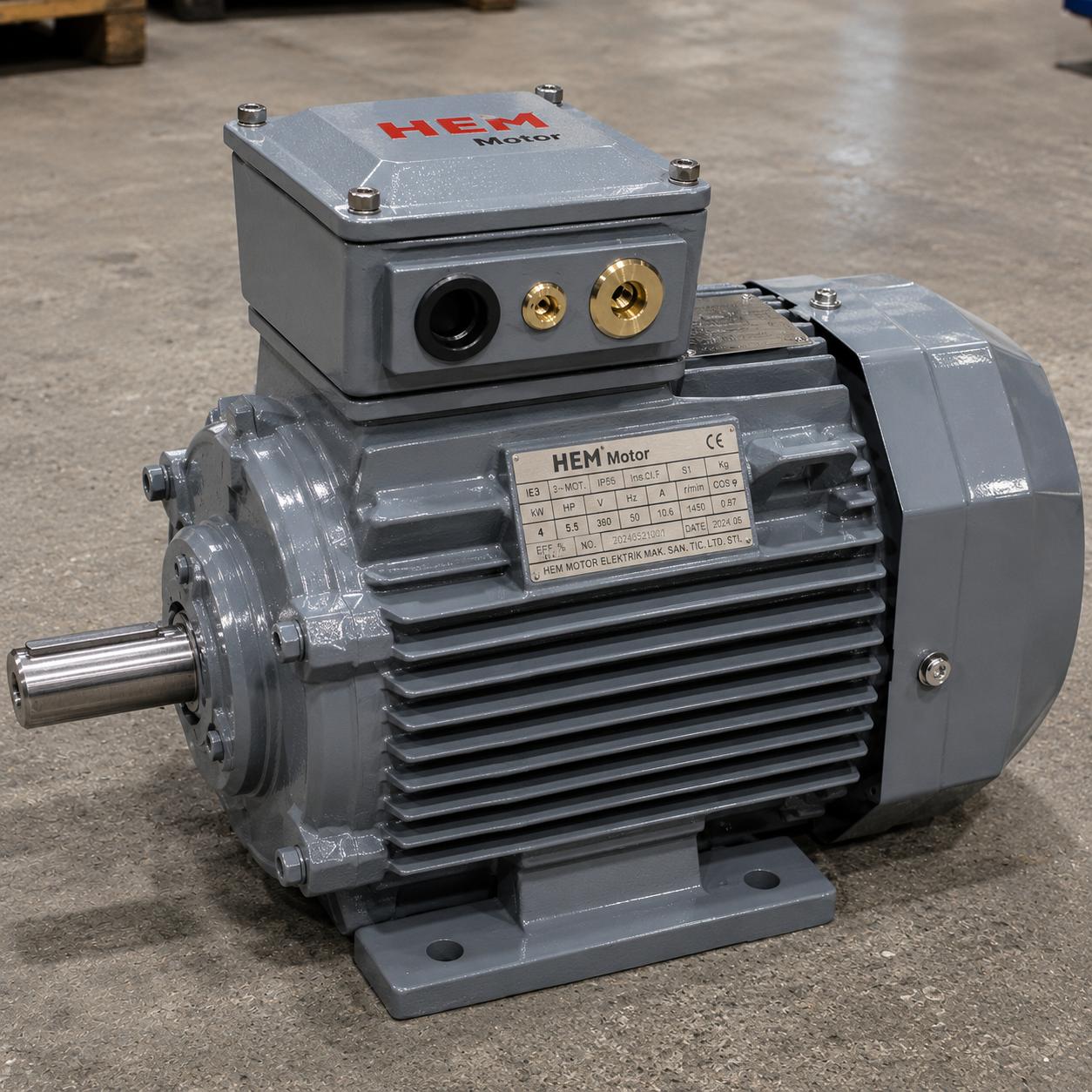
At HEM Motor, our priority in motor selection for the printing sector centers on two critical factors that directly affect print quality: low vibration and precise speed control. Our motors in the IE3 Premium and IE4 Super Premium efficiency classes cover a wide power range from 0.55 kW up to 355 kW, with 1000, 1500, and 3000 rpm speed options. They are engineered to meet nearly every drive requirement in a print facility — from printing cylinder drive to drying fan, from the winder unit to the ink pump. With F-class insulation, IP55 protection, and S1 continuous duty rating, these motors are suited to the demanding conditions of multi-shift, long-run production environments.
In this article, we examine the main drive points in a print facility one by one, explaining which power, speed, mounting, and efficiency class is appropriate for each, where you should use a reducer and a drive (inverter), and how vibration affects print quality. Our aim is to help you make your investment decision on a technical foundation with measurable criteria.
The Role of the Motor in a Printing and Press Plant
A modern print line is made up of the harmony of dozens of synchronized drive points. The unwinder that pulls stock from the reel, the printing cylinder drives that turn the print units, the pumps that carry ink, the drying fan that blows hot air for curing, and the winder that rewinds the printed product — all of these leave their mark on a single product. If one link in this chain vibrates, suffers speed fluctuation, or overheats and stops, the entire production is affected.
When selecting a motor in a press facility, the question of "how many kilowatts" alone is not enough. The character of the load, starting frequency, speed range, ambient temperature, mounting type, and vibration sensitivity must be evaluated together. For example, a drying fan draws a steady, continuous load, while the load of a winder unit changes constantly as the reel fills. The same motor cannot be expected to suit both applications; correct matching is decisive for both energy efficiency and print quality.
Printing Cylinder Drive: Precise Speed and Low Vibration
The printing cylinder is the most sensitive drive point of a press. The smallest fluctuation in the cylinder's rotation speed appears as tonal differences, doubling, or slur in the screen dots on the paper. For this reason, two fundamental properties stand out in the motor used for cylinder drive: stable torque production and low vibration.
HEM Motor's balanced rotor construction and low-vibration operating characteristic come into play at exactly this point. Thanks to 100% copper winding, motor heating is kept under control; F-class insulation preserves winding life even during long shifts. When precise speed adjustment is required in cylinder drive, the motors are used together with a frequency drive (inverter). The drive adjusts the motor speed to the print speed at the millisecond level, maintaining the synchronization of the line.
- Speed selection: In cylinder drive, a 1500 rpm base motor is generally reduced to the appropriate output speed with a reducer.
- Efficiency class: For continuously running cylinder drive, IE4 Super Premium offers the fastest energy payback.
- Vibration: The balanced rotor preserves print sharpness and reduces unnecessary maintenance and adjustment stops.
- Mounting: A B5 flanged body is preferred for direct-coupled drive, and a B3 footed body for belt-pulley drive.
Winder and Unwinder: Variable Load and Tension Control
In reel-fed printing systems, material is drawn from an unwinder reel and rewound onto a winder reel after printing. The biggest challenge of these two units is that the load and required torque change instantly because the reel diameter changes continuously. As the reel fills, the diameter grows and momentum increases; as it empties, the opposite occurs. If constant tension cannot be maintained, the material either stretches and breaks or slackens and wrinkles.
In this application, it is almost mandatory for the motor to operate within a tension control loop together with a frequency drive. The motor continuously adjusts its torque according to the signal from a tension sensor or dancer arm. HEM Motor's IE3 and IE4 motors are suited to winder and unwinder applications thanks to their ability to produce stable torque across a wide speed range. When needed, with worm gear or bevel-helical reducer options, ideal output values are achieved in winding operations that require low speed and high torque.
Points to Consider in Winder Unit Motor Selection
- Because the load profile is variable, the motor should be sized not by the peak torque point but by continuous-duty heating.
- For sufficient cooling at low speeds, externally fanned (forced ventilation) solutions can be evaluated when needed.
- A bevel-helical reducer is preferred in winder drives for its high efficiency and compact structure.
- In unwinders with constant forward-reverse and frequent starting, soft start via a drive extends winding life.
On the correct management of variable load profiles, our article on plastic injection and crushing machine motor selection — which shares similar logic — covers load-profile-based sizing in greater depth.
Drying and Exhaust Fans: Continuous Load, High Efficiency
To dry ink or varnish after printing, facilities use drying fan systems that blow hot air and exhaust fans that evacuate solvent vapor. Fans are among the highest energy-consuming load groups in a print facility and typically run at a steady level all day. For this reason, the efficiency class in fan motors is directly reflected in the energy bill.
Fans are typically variable-torque loads; when speed drops, the power requirement decreases by a cubic ratio. This is why adjusting the fan speed with a frequency drive provides significant energy savings by cutting unnecessary airflow. HEM Motor's IE4 Super Premium motors offer the lowest operating cost in continuously running fan applications. The S1 continuous duty rating and IP55 protection ensure safe operation in dusty and hot print environments.
In fan applications involving dust and vapor evacuation, motor selection requires correct calculation of flow rate and pressure loss. On this subject, our aspirator and dust collection fan motor selection guide offers a practical roadmap for sizing fan motors.
Conveyor, Transport, and Ink Pumps
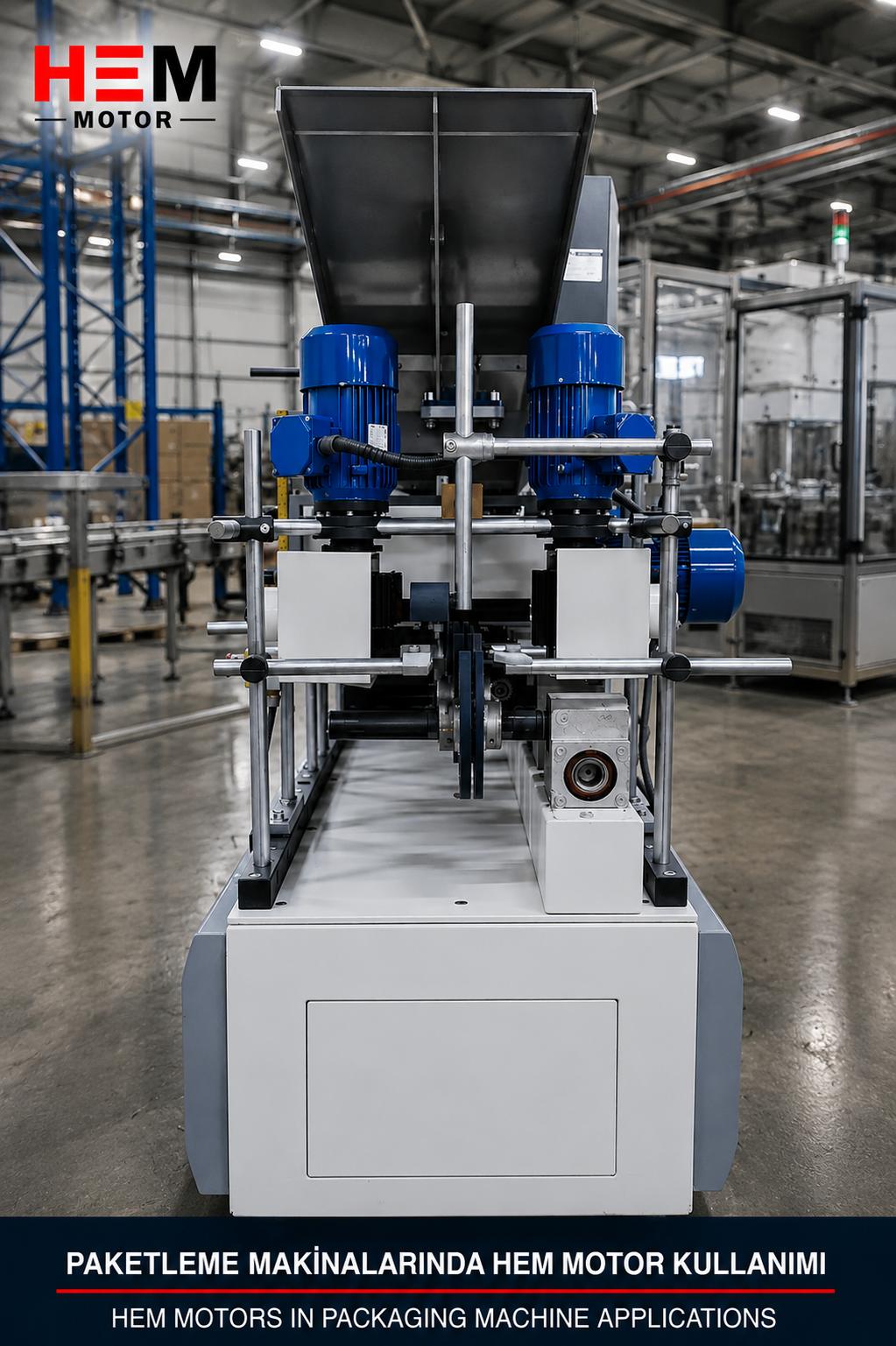
In print facilities, conveyor and transport systems are used to move the product between units and transfer it to the cutting and stacking sections. Since these drives generally require low speed and high torque, the motor is selected not directly but together with a reducer. Bevel-helical or worm gear reducers convert the motor's high speed into the slow, powerful motion required for the conveyor.
Ink and varnish pumps, on the other hand, are generally small-power, continuously running motors. What matters here is the motor's stable operation suited to the pump load and its safe operation in a chemical vapor environment. The IP55 protection class protects the motor's internal parts against dust and splashing in such environments.
- Conveyor drive: A compact solution with a B5 or B35 flanged motor + bevel-helical reducer.
- Transport belts: Controlled start via a drive is recommended for frequent start-stop.
- Ink pumps: Continuously running IE3/IE4 motors in the 0.55–3 kW range.
- Stacking units: A low-vibration motor supports precise positioning.
Power and Speed Calculation: Correct Sizing
In a print facility, the power and speed requirement of each drive point is different. Incorrect sizing leads either to unnecessary energy consumption (oversized motor) or to excessive heating and premature failure (undersized motor). For a correct calculation, the type of load, speed range, operating duration, and ambient temperature must be evaluated together.
If you want to see the power calculation of different load types such as pumps, fans, and conveyors step by step, our article explaining motor power calculation with applied examples covers this subject in detail. For print facilities that work alongside packaging lines, we recommend reviewing our packaging machinery motors product page.
Choosing the Efficiency Class: IE3 or IE4?
In continuously running print facility drives, the efficiency class directly affects the payback period of the investment. IE3 Premium motors offer a balanced price-performance, while IE4 Super Premium motors minimize losses in applications such as drying fans and cylinder drives that run 16–24 hours a day. Switching to IE4 at every drive point with high annual operating hours is an investment that amortizes itself within a few years. For current electric motor prices and a selection tailored to your application, you can contact our technical team.
Mounting Types and Environmental Conditions
Print facility machines require different mounting forms of the motor. HEM Motor offers all of the B3 (footed), B5 (flanged), B14 (face-mounted), and B35 (footed + flanged) mounting options. A flanged body is preferred for direct-coupled cylinder drives, and a footed body for belt-pulley systems. For the body material, both cast iron and aluminium options are available; while the aluminium body is lighter and corrosion-resistant, the cast iron body provides additional durability under heavy industrial conditions.
Print environments often contain dust, paper fiber, ink vapor, and high temperatures. For this reason, the IP55 protection class allows the motor to operate safely under these demanding conditions. The correct combination of all these factors extends both print quality and motor life.
- B5 / B35 flanged: Ideal for direct drive and reducer mounting.
- B3 footed: For belt-pulley systems and general drive.
- Aluminium body: Light structure, easy handling, corrosion resistance.
- Cast iron body: High mechanical strength and vibration damping.
Frequently Asked Questions
Why is a low-vibration motor important in printing cylinder drive?
The smallest fluctuation or vibration in the rotation speed of the printing cylinder appears as tonal differences, doubling, and color drift on the paper. A low vibration, balanced-rotor motor ensures that the print is sharp and consistent; it lowers the waste rate and preserves print quality. HEM Motor's balanced construction targets exactly this precision.
Is it mandatory to use a drive in winder and unwinder units?
Yes, it is almost mandatory. In winder and unwinder units, the torque and tension change instantly because the reel diameter changes continuously. A frequency drive provides constant tension by adjusting the motor torque according to the signal from the tension sensor, which prevents the material from wrinkling or breaking. When needed, the low-speed high-torque requirement is met with a reducer.
Should I choose an IE3 or IE4 motor for the drying fan?
A drying fan is generally a high-energy-consuming load that runs continuously throughout the day. Therefore, if operating hours are high, the IE4 Super Premium motor is the most sensible choice; thanks to its low losses it provides measurable savings on the energy bill and amortizes the price difference within a few years. At lower operating hours, IE3 Premium is a balanced alternative.