English
 Türkçe

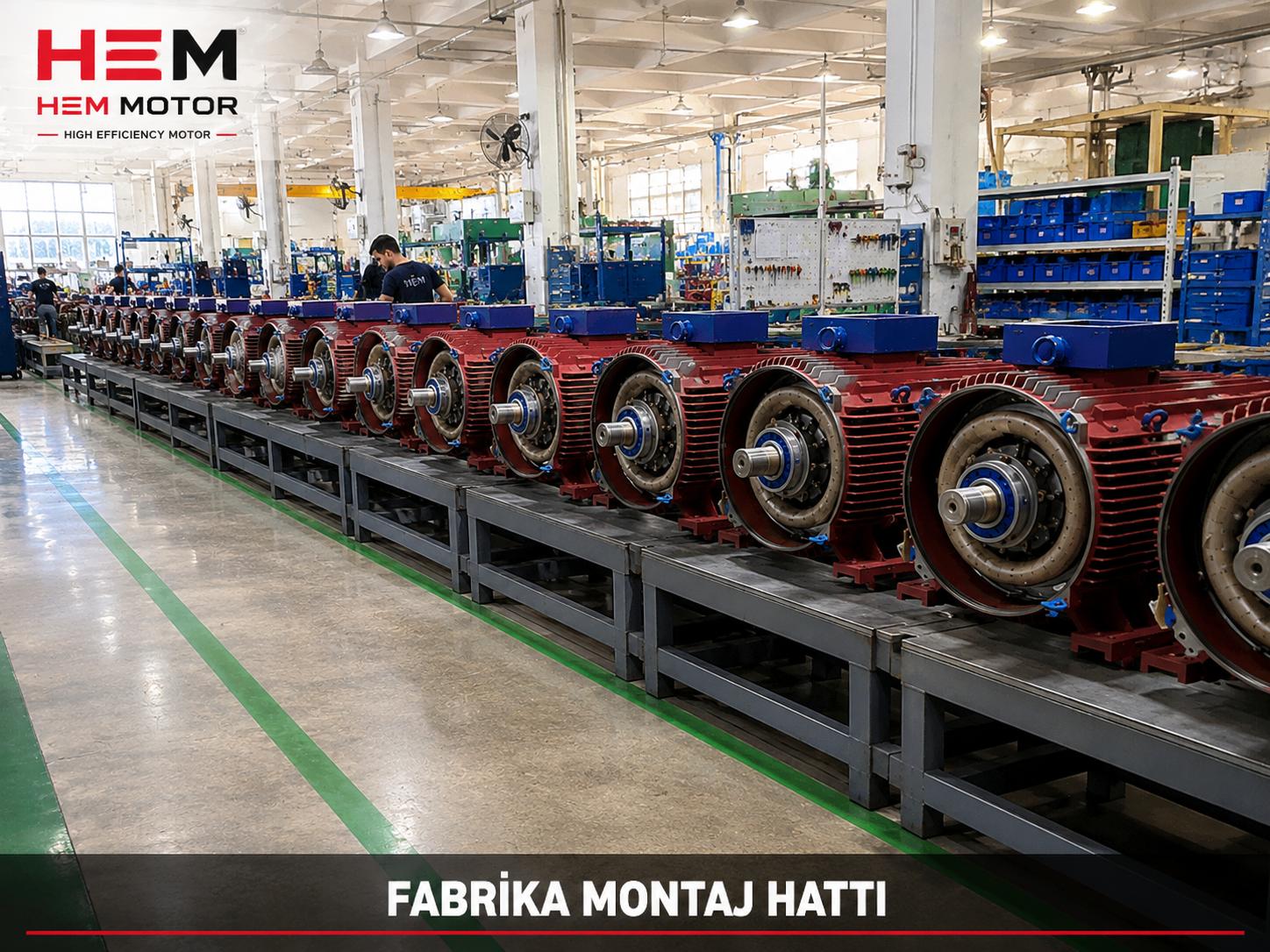

Foundries and metal melting plants combine some of the harshest operating conditions found anywhere in a factory. The radiant heat spreading around induction furnaces and ladles pushes the ambient temperature well above 40°C; foundry sand, casting dust and metallic particles hang permanently in the air and cling to every moving piece of equipment; and vibration, mechanical shock and splashing molten metal rapidly exhaust the life of ordinary industrial gear. In such a plant, electric motor selection demands criteria very different from a routine industrial application. A poorly chosen furnace fan motor causes cost not only through its own failure, but through the lost production of the melting line it shuts down — often hundreds of thousands of liras of output per hour. In this article we examine the main drive points of a foundry and metal melting plant one by one — furnace cooling and exhaust fans, burner and cupola blower motors, sand and charge conveyors, cooling-water and hydraulic pumps, dust-collection aspirators and ladle/crane drives — and explain how to select a motor suited to a hot, dusty environment from both a technical and a supply standpoint.
How the Foundry Environment Affects the Motor
Before starting motor selection, it is essential to clearly understand the four fundamental stresses the foundry environment places on a motor. These four factors drive every decision, from winding insulation class and body material to protection rating and bearing grease.
- High ambient temperature and radiant heat: A motor near an induction furnace, arc furnace or ladle is loaded not only by hot air but also by radiated heat. The motor body can reach a surface temperature higher than the surrounding air.
- Conductive and abrasive dust: Foundry sand, graphite and metallic dust are both abrasive and, at times, electrically conductive. Once inside an inadequately protected motor, this dust destroys the winding insulation and bearings.
- Vibration and mechanical shock: Moulding lines, shake-out conveyors and impact loads produce constant vibration that directly affects bearing life and the strength of fasteners.
- Continuous and heavy duty cycle: A melting line typically runs without interruption across shifts. Motors must be selected for S1 continuous duty and a stable thermal equilibrium.
High Ambient Temperature and Derating
A standard induction motor is rated, per IEC standards, to deliver its nameplate power at 40°C ambient temperature and up to 1000 metres altitude. In a foundry, however, the temperature around a motor at the furnace can climb to 50–60°C and even higher at local hot spots. Using the full nameplate power under these conditions drives the winding temperature past the insulation limit and causes premature winding failure. The solution is a high ambient temperature derating calculation: as ambient temperature rises, the continuous power the motor can deliver is reduced, or a motor of the next frame size and a higher insulation class is selected.
In practice, a stepped reduction in continuous power is allowed for each 5°C above 40°C; at altitudes above 1000 metres, the thinner cooling air requires additional derating. For a foundry at high altitude, both factors must be evaluated together. With HEM Motor's IE3 Premium and IE4 Super Premium range from 0.55 to 355 kW, it is possible to move up one power and frame size to cover this derating margin safely. Our article on high altitude and hot environment motor derating explains the calculation logic step by step.
Insulation Class: F or H?
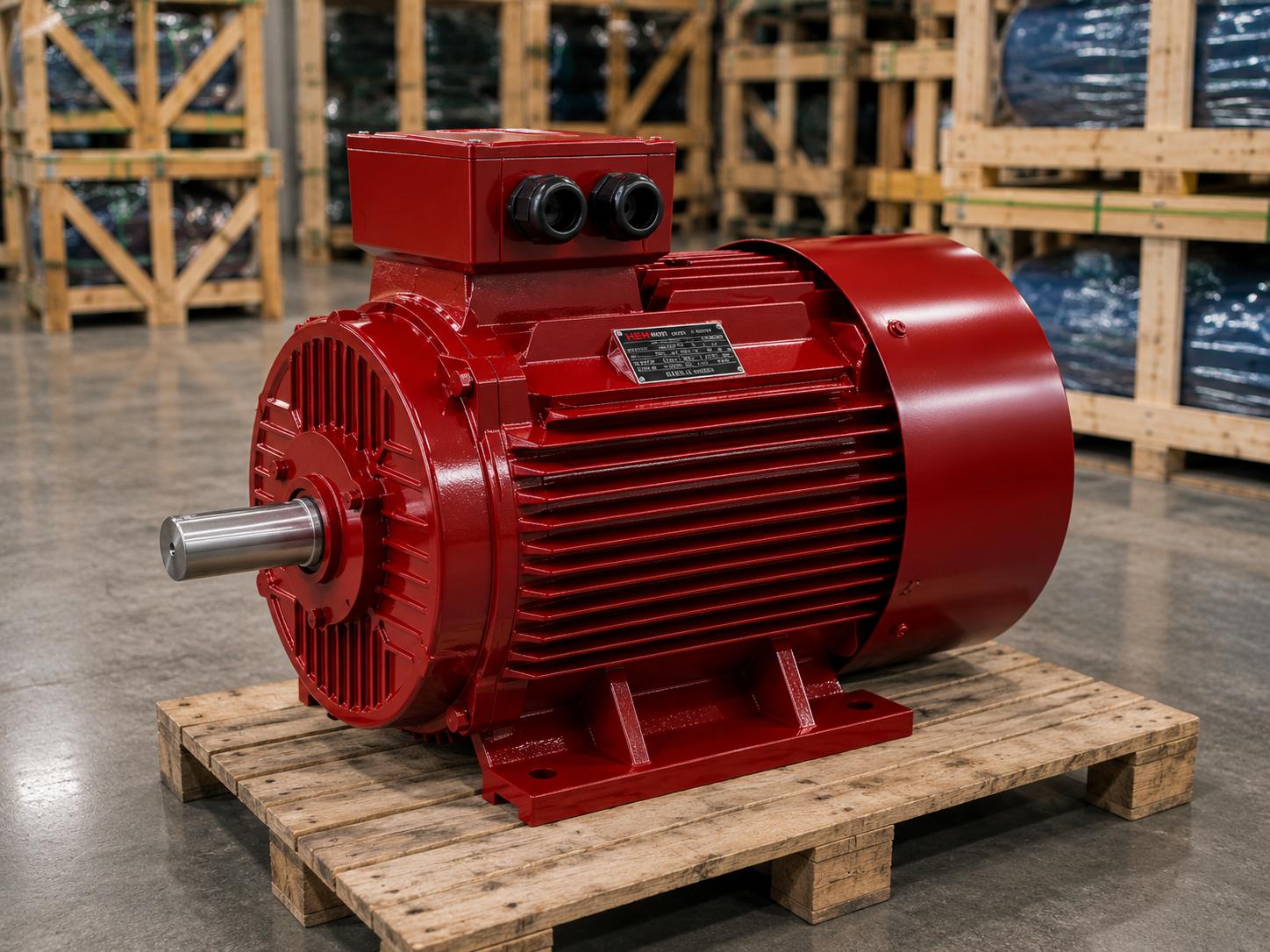
The insulation class defines the maximum temperature the winding can withstand. Class F insulation withstands up to 155°C and class H up to 180°C. HEM Motor's standard insulation class is F, with class H insulation offered on request for hot environments such as foundries. On a hot furnace fan or a motor near a ladle, class H insulation increases the thermal reserve of the winding, both relaxing the derating margin and extending motor life. In many foundry applications, the preference is to run a class F winding only to a class B temperature rise (leaving extra thermal margin) or to move directly to class H. Our article on insulation class and cast iron body in hot, dusty environments makes this decision easier.
Cast Iron Body and Protection Rating
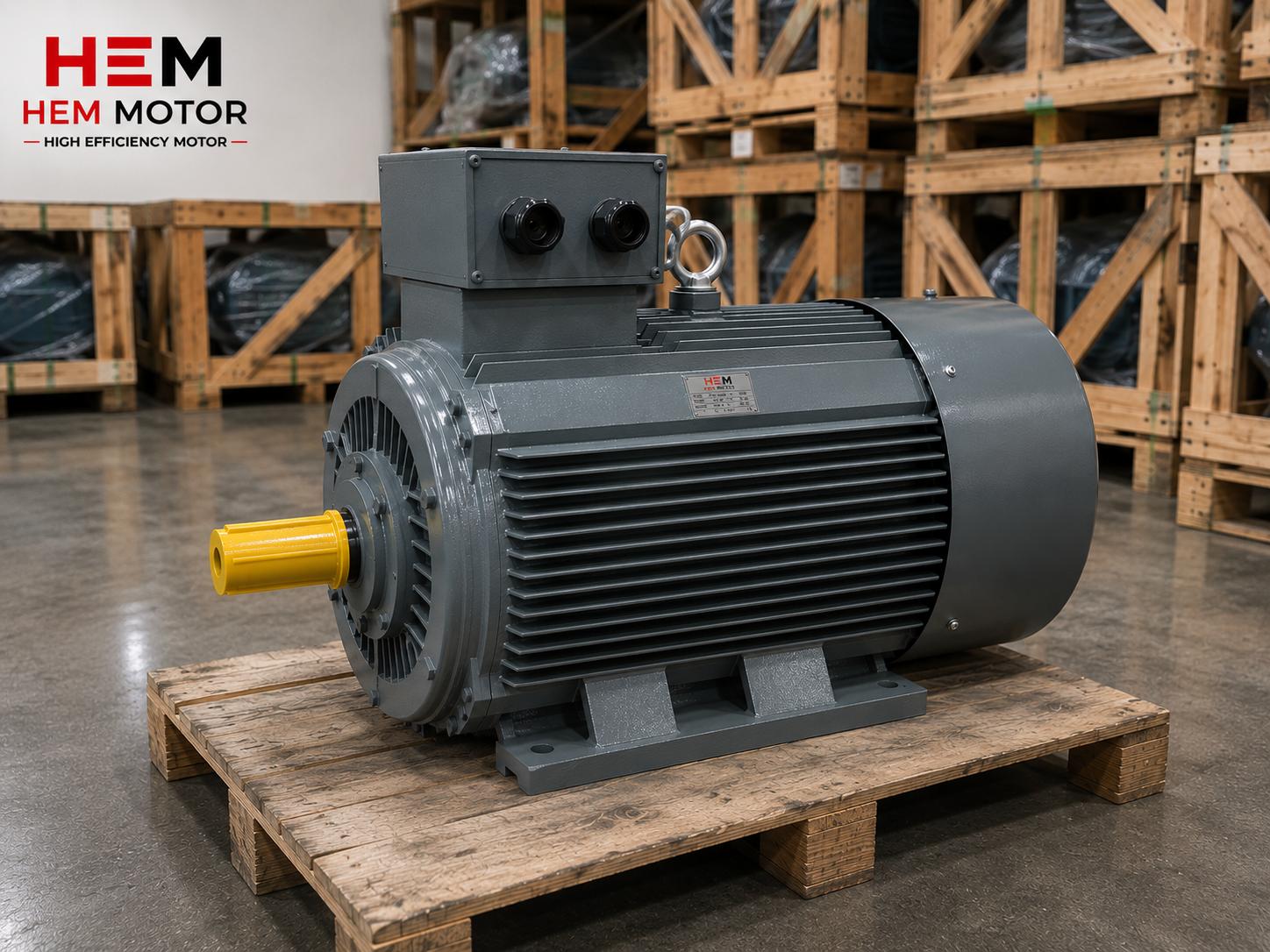
In foundry motors, the body material is a major topic in its own right. Aluminium bodies are preferred at small ratings for their light weight and good heat conduction; but in a foundry environment with intense radiant heat and high mechanical shock, a cast iron body is far more suitable. A cast iron body retains its dimensional stability under thermal expansion, is far more resistant to splashing molten metal and mechanical impact, and damps vibration better. HEM Motor's large-frame and heavy-duty motors are built with cast iron bodies, making them a natural choice for furnace fans and large power pumps. For applications exposed to radiant heat, the efficient cast iron body electric motors family stands out in mechanical robustness and thermal endurance.
The protection rating (IP) is perhaps the most critical parameter in a dusty foundry environment. HEM Motor's standard protection rating is IP55 — dust-protected and resistant to water jets from any direction. However, in environments with heavy casting dust and sand, where particles can be conductive, an IP65 or IP66 rating is recommended on request. IP65/66 makes the motor fully dust-tight, preventing conductive particles from reaching the windings and bearing clearances. On aspirator motors near the dust-collection system and on exposed conveyor drives, this higher protection rating markedly reduces failure frequency.
Main Drive Points and Motor Selection
Dozens of electric motors perform different duties in a foundry. Because each has a different load characteristic, ambient condition and degree of criticality, motor selection must be tailored to the drive point.
Furnace Cooling and Exhaust Fan Motors
The cooling systems of induction and arc furnaces, together with the exhaust fans that remove hot gas and fumes from the melting zone, are the lifeblood of a foundry. These fan motors are directly exposed to the hot gas stream and radiant heat. A high insulation class, a cast iron body and, where needed, IP65/66 protection are indispensable here. Fan applications are often driven by a frequency inverter for variable air flow, in which case a winding structure suited to inverter supply becomes important. For furnace and exhaust fans, motors are selected to suit continuous, hot operating conditions, and our high power motor supply above 90 kW guidance helps size the larger units.
Burner and Cupola Blower Motors
Blower motors supplying combustion air in cupola furnaces and gas/oxygen melting systems operate continuously at high torque. Because the stability of the air flow directly affects melting efficiency, these motors must be selected for S1 continuous duty with comfortable thermal margin. They typically run at 1500 or 3000 rpm in the medium to high power range.
Sand and Charge Conveyor Motors
Belt and chain conveyors carrying foundry sand, scrap charge and mould material operate under high starting torque and variable load. In these applications the motor is usually paired with a gear reducer that lowers speed and raises torque. On these lines, rich in abrasive dust, the IP protection rating and bearing sealing are critical. For heavy-duty conveyors, general-purpose industrial motors with a robust cast iron body option are a suitable starting point.
- Selecting the motor with enough nameplate torque margin for high breakaway torque
- Thermal protection and a suitable starting method against conveyor jamming
- IP65/66 and sealed bearings on dusty lines
- An IEC frame size (range 56–355) compatible with the reducer input shaft
Cooling-Water and Hydraulic Pump Motors
The coil cooling water of the induction furnace, the mould cooling circuits and the hydraulic units of the moulding machines are fed by pumps that must run without interruption. Because a stopped cooling-water pump means overheating of the furnace coil, these motors fall into the critical equipment class. Pump motors typically run at 1500 or 3000 rpm in S1 continuous duty and are expected to be highly reliable. HEM Motor's pump motors, with 100% copper windings and reinforced bearings, are well suited to this continuous duty.
Dust-Collection Aspirator Motors
One of the most important systems for environmental and occupational health in a foundry is the dust-collection (filter) plant. The motors driving the large aspirator fans operate at high power, continuously and under suction load. Because these motors are often located outdoors or in dusty areas, IP65/66 protection and a suitable insulation class come to the fore. Aspirator fans frequently fall into the large power class.
Ladle and Crane Drives
Ladle cars carrying molten metal, foundry cranes and transfer systems are driven by a motor-plus-reducer combination. In these applications, safety, braking and a repetitive duty cycle take priority. On these safety-critical drives, the motor and reducer must be sized together as a system.
Large Power Motors and Supply Strategy
Furnace fans, main aspirators and large pumps mostly fall into the medium-high and large power class. HEM Motor can manufacture IE3/IE4 motors up to 355 kW, delivering large ratings such as 315 and 355 kW at 1500 rpm. In these large power motors, a cast iron body, reinforced bearings and a high thermal reserve are standard. You can find the technical details of large power motor supply and delivery-time planning in our guidance referenced above.
It must be stressed that in a foundry, the supply strategy is as important as the technical selection. The failure of a critical motor such as a furnace fan means the melting line stops for hours, and that downtime generates a production loss many times the cost of the motor itself. For this reason, keeping spare motor stock for critical drive points is a strong recommendation. Spare motors held in standard frame sizes and common ratings can be brought online within hours of a failure, minimising downtime. For current electric motor prices and delivery terms, the soundest approach is a technical review together with your critical equipment list.
Bearings, Grease and Condensation Protection
High temperature also stresses the motor's mechanical components. Standard bearing grease melts at high temperature and loses its lubricating performance, so foundry motors should use special high-temperature grease and, where needed, a re-greasable bearing arrangement. HEM Motor's reinforced bearing structure extends life in both high-temperature and high-vibration environments.
Another important issue is condensation. When the melting line stops, the hot motor cools and the moist air inside can condense, forming water droplets on the winding. This condensation lowers insulation resistance and, over time, leads to winding failure. The solution is to add space heaters that energise the moment the motor stops. On critical motors in humid regions and in plants that stop between shifts, an anti-condensation heater is a strong precaution.
- High-temperature grease and a re-greasable bearing arrangement
- Space heaters against condensation during shutdown
- PTC/PT100 thermistor protection to monitor winding temperature
- A balanced rotor and solid mounting against vibration
Summary of Correct Motor Selection
Correct electric motor selection in a foundry and metal melting plant requires a layered approach: derating and class H insulation for high ambient temperature, IP65/66 protection for the dusty environment, a cast iron body for radiant heat and mechanical shock, S1 duty and reinforced bearings for continuous production, and space heaters for condensation during shutdown. Each of these decisions must be evaluated not in isolation but together, according to the duty and criticality of the drive point. Keeping spare stock for critical fan and pump motors is, in turn, a supply decision as valuable as the technical selection itself.
Frequently Asked Questions
Which insulation class should be used on a foundry furnace fan motor?
While standard class F insulation is sufficient for many applications, class H insulation is recommended on request for furnace fan motors directly exposed to hot gas streams and radiant heat. Class H offers thermal endurance up to 180°C, providing an extra safety margin at high ambient temperatures and extending motor life. In many foundries the preference is to run a class F winding to a lower temperature rise or to move directly to class H.
Is IP55 enough in a dusty foundry environment, or is IP65/66 required?
IP55 protection is dust-protected and resistant to water jets, and is sufficient for many general industrial environments. However, at foundry points with heavy casting sand, graphite and metallic dust where particles can be conductive, IP65 or IP66 is recommended. These higher ratings make the motor fully dust-tight, preventing conductive dust from reaching the windings and reducing failure frequency, especially on aspirator and exposed conveyor drives.
Why is spare stock recommended for critical furnace fan motors?
The failure of a motor such as a furnace fan or cooling pump causes the melting line to stop for hours, and that downtime generates a production loss far exceeding the cost of the motor itself. Keeping spare motor stock in standard frame sizes and common ratings allows a swap within hours of a failure, minimising downtime. For this reason, spare motor planning for critical drive points is a supply decision as important as the technical selection.