English
 Türkçe

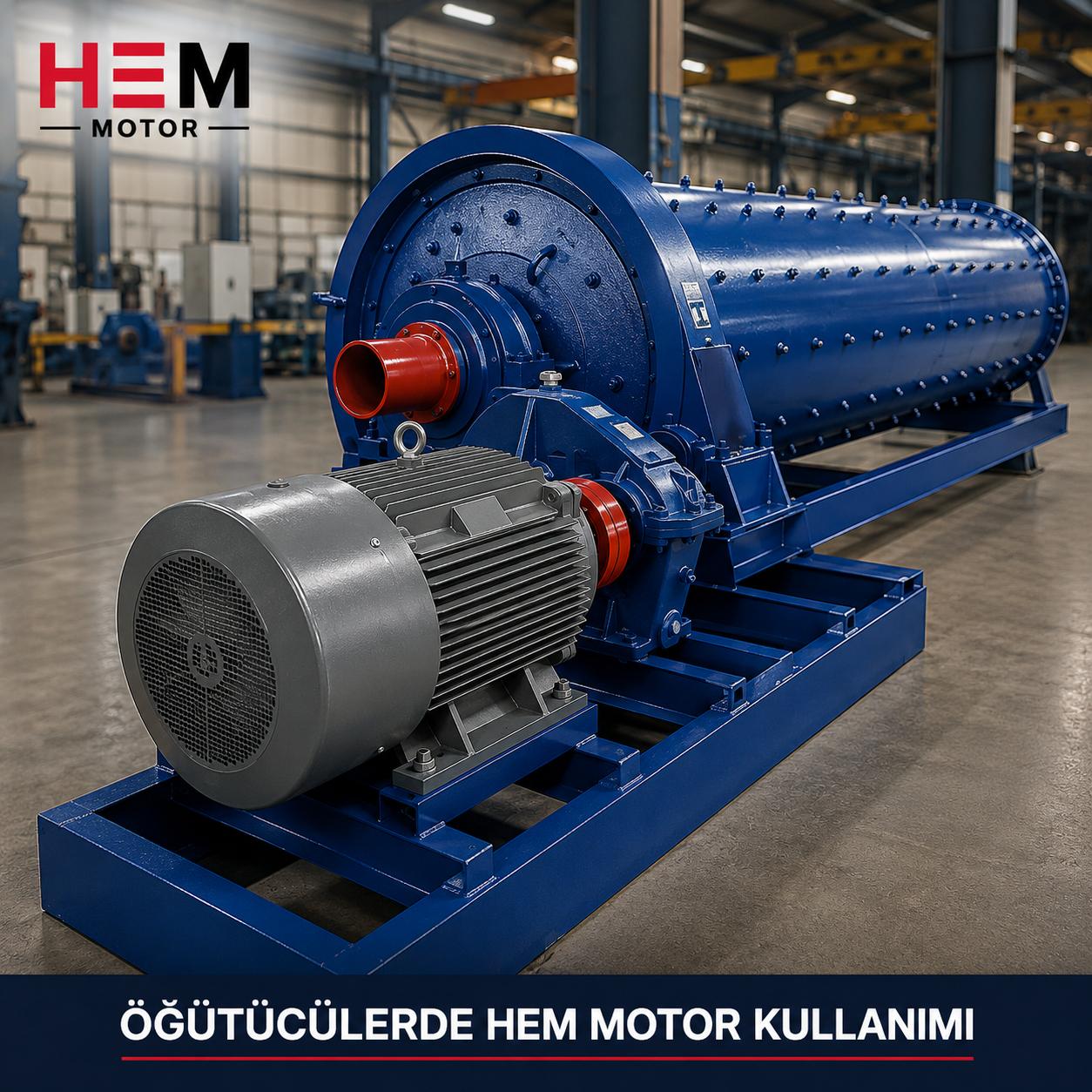

In mining and ore beneficiation plants, a pelletizing process is applied to turn finely ground ore into transportable and furnace-ready agglomerates. One of the most common pieces of equipment for this process is the disc pelletizer, which forms pellets by rolling moist ore powder on a large, inclined, rotating disc. This large disc must rotate slowly and steadily, with high torque and without interruption. The electric motor that drives the disc is a critical component operating in a dusty environment, in continuous duty and under variable load. Disc pelletizer drive motor selection requires bringing together the correct power, correct torque, correct protection and correct procurement decision. In this guide we cover the criteria by which to select the motor for mining pelletizing applications.
The Challenges the Disc Pelletizing Application Brings to the Motor
From the motor's perspective, disc pelletizing presents several distinct challenges simultaneously. The first is the high torque requirement: a large-diameter, inclined disc full of ore requires high torque both at start and in operation. The second is the need for low, steady speed: pellet quality depends on the disc rotating at the correct, constant speed; therefore the motor is usually used together with a reducer. The third is dust: ore dust penetrates everywhere and threatens the motor's cooling, bearings and windings. The fourth is continuity and load: the plant often runs 24/7 and the load varies with the amount of material on the disc.
Because of these challenges, the pelletizing drive motor, unlike an ordinary general-purpose motor, must be selected to suit heavy-duty conditions and the mining environment. Motors positioned specifically for the mining sector, producing high starting torque and high running torque and designed for heavy-duty conditions, are the natural choice for this application.
The pelletizing drive motor must also work in harmony with the surrounding equipment. In a pelletizing plant, besides the disc pelletizer there are feeders, conveyors, screening and return lines, and water/binder dosing systems. The synchronous and uninterrupted operation of this whole system determines pellet quality and plant efficiency. A stoppage of the disc can stop the entire line; therefore the disc drive motor is one of the most critical motors in the plant and its selection must be made accordingly. In a mining environment, motor selection is a decision that affects not just a single machine but the reliability of the whole line.
High Torque and Geared Drive
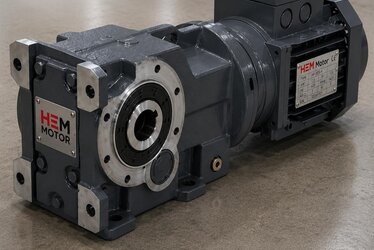
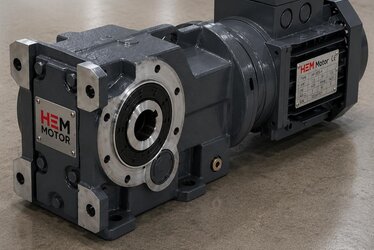
In a disc pelletizer the disc speed is low (slow) and its torque is high. An electric motor alone cannot economically provide this low speed and high torque; therefore the motor usually works together with a reducer. The reducer reduces the motor's high speed while increasing the torque. Bevel-helical gear reducers are common in such heavy drives thanks to their 90-degree power output and high torque capacity. To match the motor and reducer correctly, our comparison of bevel-helical versus worm gear reducers and our guide on matching a motor to a reducer (IEC frame/flange) provide guidance.
Whether to buy the motor and reducer separately or as a monoblock is also an important decision; both approaches have advantages in terms of maintenance, stock and commissioning.
Dusty Environment: Protection Class and Cooling
In mining and ore-processing plants, dust is the motor's number one enemy. Dust clogs the motor's cooling fins and causes overheating; it fills the fan cowl and disrupts cooling; when it penetrates, it abrades the bearing grease and the windings. For this reason, the protection class is critical in dusty-environment motors:
- IP55 protection: Provides basic protection against dust and external influences; it is standard for most mining applications.
- Higher protection: A higher protection class may be considered in very heavy dust or wash-down environments.
- Periodic cleaning: Regular cleaning of the cooling fins and fan cowl prevents overheating regardless of the protection class.
- Cast iron frame: A cast iron frame, resistant to impact and abrasion and damping vibration, is suited to heavy-duty conditions.
- Sealed terminal box: The sealing of the terminal box and cable glands must be checked so that dust cannot reach the windings.
- Protective paint/coating: Protecting the frame against corrosion in an abrasive and humid mining environment extends life.
Another indirect effect of dust is that the material in a pelletizing application is moist. When moisture combines with dust, a sticky layer can form on the motor's surface and cooling fins; this layer seriously impedes heat dissipation. For this reason, surface and fin cleaning must be a regular item in the maintenance plan of the pelletizing drive motor. A well-designed motor base and accessible mounting make this cleaning easy and safe to perform. The abrasive character of the environment also requires regular inspection of the bearing seals and sealing elements.
To see the effect of cold/hot and dusty sites on motor selection collectively, our mining-specific content and our article on motor supply contracts and critical stock in mining are a valuable reference.
Continuous Duty (S1) and Efficiency
Pelletizing plants mostly run without interruption. This requires the motor to be of S1 continuous-duty type, with Class F insulation and resistant to high operating hours. In a high-power motor running continuously, the efficiency class is the direct determinant of the annual energy cost. IE3 and IE4 high-efficiency motors, with 100% copper windings and cast iron frames, provide both durability and savings. In applications combining high power and continuous operation, such as mining, the supply and commissioning planning of high-power motors is also important; our guide on high-power motor supply above 90 kW addresses the lead time, transport and commissioning dimension.
Load Profile and Starting Characteristic
In a disc pelletizer the load varies with the amount of material on the disc, and when the disc is started fully loaded high starting torque is needed. Therefore the motor must have a starting-torque characteristic capable of handling a fully loaded start and, where needed, be supported by a suitable starting method (soft starter or frequency drive). A frequency drive both softens the start and allows the disc speed to be adjusted according to pellet quality; this is a separate advantage in the pelletizing application.
Another important point regarding the load profile is that the amount of material on the disc changes over time. When feed increases, the load on the disc increases and the motor demands more torque; when feed decreases, the load drops. This variable load requires the motor to be selected so that it continuously operates in a comfortable region. A balanced power class that is not strained at peak loads but is also not chosen excessively large for low loads is ideal in terms of both reliability and energy efficiency. A frequency drive also helps keep the motor at its most efficient point under this variable load.
A matter to watch at starting is that material remains on the disc when it stops. When the disc stops fully loaded and is restarted, a high breakaway torque is needed for the motor to free this stationary, loaded disc from rest. If this scenario is ignored and motor selection is made only according to the running torque, the system may be unable to lift the loaded disc. Therefore the starting torque of the pelletizing drive motor must be verified against the worst case, a fully loaded disc start.
Redundancy and Critical Stock
In mining and ore-processing plants the cost of an unplanned stoppage is very high; a single day's lost production can be many times the value of the motor. For this reason, redundancy on critical drive motors is not a luxury but a necessity. For a component such as a disc pelletizer drive motor that can stop the whole line, having a one-to-one spare motor on site or in nearby stock makes it possible to bring the line online within hours of a breakdown. Otherwise, procuring a special power-speed-reducer combination can take days or even weeks.
In spare-motor planning, recording the motor's nameplate data and reducer-matching details in advance provides great convenience. This way, at the moment of a breakdown the correct motor is requested without hesitation and the risk of the wrong product arriving is eliminated. In plants using many similar drives, preferring standard power classes allows a single spare motor to rescue multiple lines; this lowers stock cost. In critical sectors such as mining, a stock-guarantee agreement made with the supplier ties redundancy to a contract and minimises the continuity risk.
The Correct Procurement Decision
In a mining pelletizing application, unplanned downtime is very costly; therefore correct procurement and redundancy are as important as the correct motor selection. Sharing the following information before ordering speeds up the process: required power and disc speed, reducer type and ratio, ambient dust/temperature conditions, mounting type (B3/B5/B35), starting method and the existing motor nameplate. As HEM Motor, we offer IP55-protected, cast iron frame IE3/IE4 motors suited to heavy-duty conditions from 0.55 kW to 355 kW, along with suitable reducer matching. For current electric motor prices and model recommendations suited to pelletizing drives, simply share your application with our technical team.
Frequently Asked Questions
What speed should a disc pelletizer motor be?
In a disc pelletizer, the disc itself rotates at low (slow) speed and requires high torque. Because an electric motor alone cannot economically deliver this low speed and high torque, the motor is usually used together with a reducer: the motor runs at standard speed (for example 1500 rpm) and the reducer lowers this speed while increasing the torque. For the correct disc speed, the reducer ratio is chosen according to the application and the desired pellet quality.
Which protection class is needed for a motor in a dusty mining environment?
In mining and ore-processing plants, at least IP55 protection is recommended; this provides basic protection against dust and external influences. A higher protection class may be considered in very heavy dust or wash-down environments. In addition to protection, periodic cleaning of the cooling fins and fan cowl is critical to prevent dust-related overheating. A cast iron frame also provides durability in heavy-duty, dusty environments.
Is a frequency drive necessary on a pelletizing drive motor?
It is not mandatory but provides a strong advantage. A frequency drive softens the start of a loaded disc, reducing starting current and mechanical shock; it also allows the disc speed to be finely adjusted according to pellet quality. In drive-free installations, a high-starting-torque motor and, where needed, a soft starter are preferred for a fully loaded start. The correct choice is made according to the load profile and process requirement.