English
 Türkçe

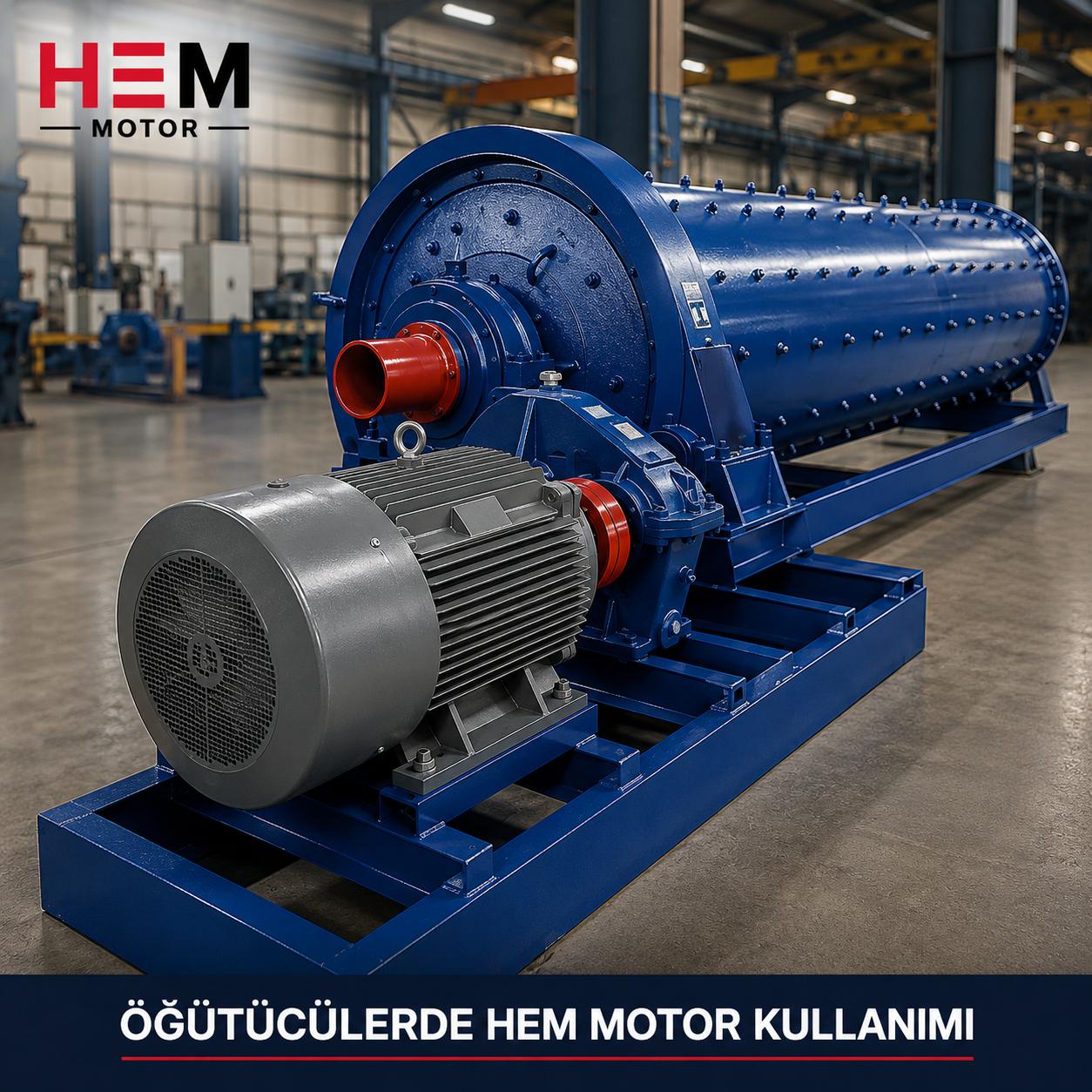

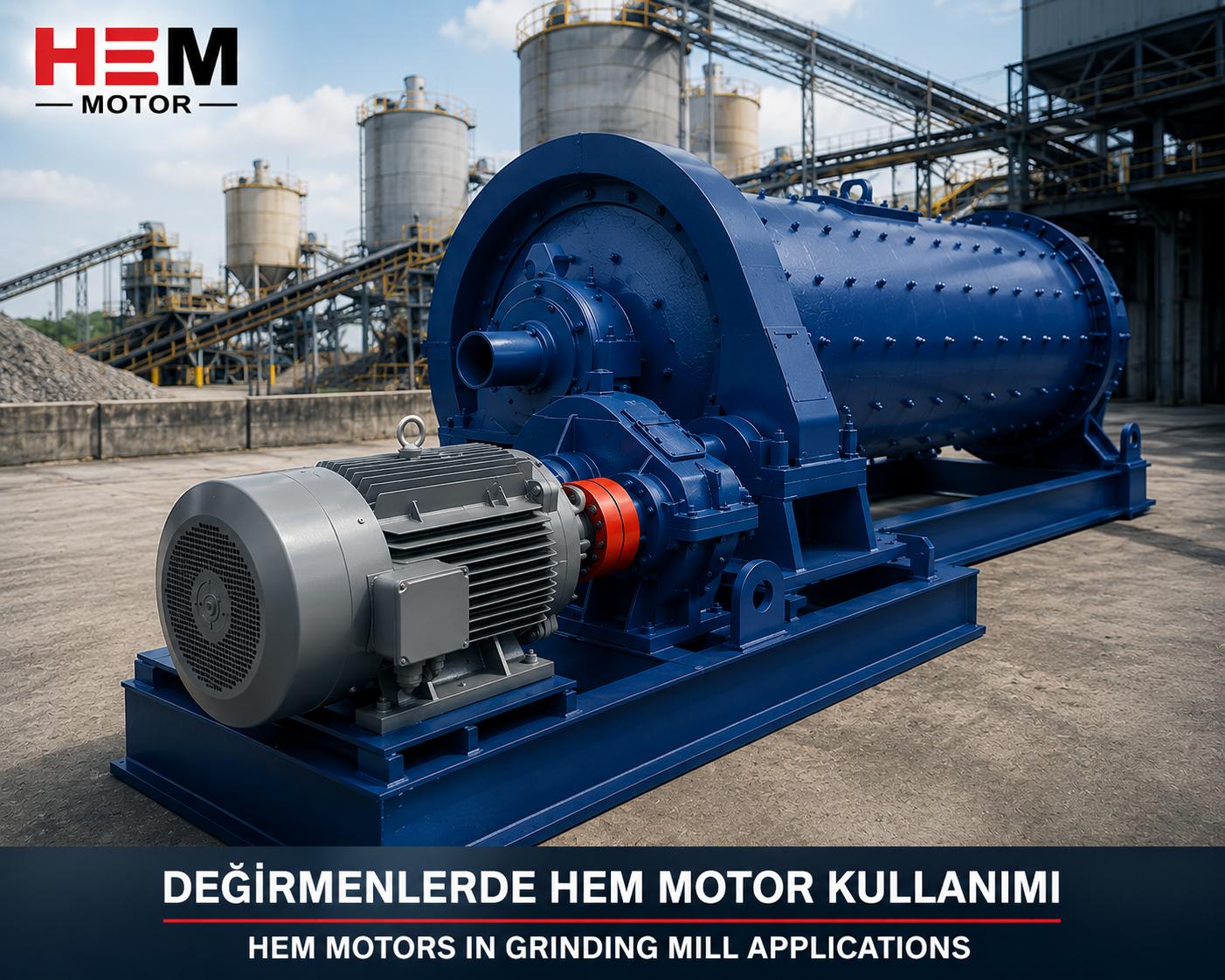
A ball mill is a heavy-duty machine that grinds ore, clinker or raw material with the steel balls loaded inside it, and setting its large rotating shell into motion is one of the most demanding drive problems in any plant. The vast majority of these machines are driven through a large ring gear fitted around the shell — the girth gear. The motor turns a small pinion gear; this pinion meshes with the girth gear and rotates the entire mill body. Behind this seemingly simple arrangement lies a very critical motor selection: the high starting torque needed to move the mill from rest while loaded with balls and material, the enormous inertia of the shell, the long run-up time, and continuous operation 24 hours a day. A wrongly chosen drive motor will either fail to turn the mill at all or overheat continuously and fail early. In this guide we examine girth gear drive motor selection step by step in terms of starting, torque and continuous duty, and explain how HEM Motor delivers solutions for this demanding application.
How Does the Girth Gear Drive Arrangement Work?
A ball mill can be driven by three main methods: central drive, gearless drive, and the most common girth gear–pinion drive. In the girth gear arrangement, a large girth gear ring gear is mounted around the mill shell. The electric motor turns a much smaller-diameter pinion gear, directly or through a reducer. The pinion meshes with the girth gear and transmits the drive torque to the body. The main advantages of this arrangement are:
- Distributing high torque over a wide gear surface allows enormous torques to be transmitted safely.
- The motor can be positioned independently of the mill axis, easing maintenance and installation.
- The pinion-to-girth-gear ratio reduces the motor speed to the low rotation speed the mill needs.
In this architecture the motor's job is not merely to deliver power, but to transmit a vibration-free, steady torque without straining the mesh between pinion and girth gear. For this reason, girth gear drive motor selection is a far more sensitive engineering decision than an ordinary industrial motor choice. We detail the general logic of mill main drives in our bilyalı ve çubuklu değirmen ana tahrik motoru seçimi article.
Moving a Loaded Mill: Starting Torque and Inertia
The most critical moment for a ball mill is when it starts from rest while loaded. The shell is full of tons of steel balls and material, and this load is mostly gathered on one side of the body. To begin turning the mill, a high starting torque — the breakaway torque — is needed to lift this load upward. This torque can be far above the motor's normal running torque. Points to watch in selection:
Breakaway Torque
The initial torque required to free the loaded mill body from standstill is the moment of highest torque demand. The motor and starting system must be selected to meet this moment without strain. Otherwise the motor cannot start, draws current, and protections trip.
Inertia and Long Run-Up Time
The inertia (moment of inertia) of the mill body is very large. This means the motor takes a long time to reach its rated speed. Throughout this long run-up the motor stays at high current and heats up; the motor's thermal capacity and the ability of the starting method to control current are therefore vital. We examine the need for soft starting at high inertia in detail in our sıvı dirençli yol verici ve bilezikli motor content.
Starting Method: Slip-Ring Motor, Soft Starter and VFD
High starting torque and large inertia often make direct-on-line (DOL) starting impossible on a ball mill. In direct starting, the inrush current both strains the grid and shocks the mechanical system. In practice, three main methods are therefore used:
- Slip-ring (wound-rotor) motor + liquid resistance starter (LRS): adding resistance to the rotor circuit gives high torque and low current at start; it is one of the safest soft-start methods at very high inertia.
- Soft starter: limits inrush current by ramping voltage gradually; preferred at medium powers and lower inertia.
- Variable-frequency drive (VFD): provides soft starting and the ability to adjust mill speed as needed; it is also ideal for low-speed inching/barring.
The inching/barring function, used to slowly rotate and position the mill during maintenance, is usually provided by a VFD or a separate auxiliary drive. How this function will be met must be planned from the outset in motor selection.
Speed, Pole Count and Reducer Choice
A ball mill runs at a relatively low shell speed; below the critical rotation speed of the body, at a speed where the balls tumble ideally for grinding. There are two ways to reach this low output speed:
- Low-speed motor (6 or 8 pole): provides high torque with less reduction needed, directly or through a small-ratio pinion stage.
- Standard-speed motor + reducer: a 4-pole motor is reduced to the desired low output speed through a reducer; the girth gear–pinion ratio completes the final reduction.
Which solution is chosen depends on mill diameter, the desired percentage of critical speed, and the existing mechanical layout. Low-speed motors offer a flatter torque characteristic and simplicity in direct drive, while a standard-speed-plus-reducer solution provides more flexible and often more economical supply. At HEM Motor we supply high-torque mill drive motors suited to both approaches. You can also find the right power and speed matching for high-torque grinding applications in our maden ve cevher değirmeni motorları yüksek tork guide.
Alignment, Backlash and Mounting Rigidity
In girth gear–pinion drive, the motor's mechanical connection is just as important as the electrical selection. The backlash between the pinion and the girth gear is very sensitive; if the motor and pinion unit are not seated on a sufficiently rigid base, vibration, noise and rapid tooth wear appear under load. Therefore:
- The motor must provide high mechanical strength with a cast-iron body and a solid frame that damps vibration.
- The mounting type (foot-mounted B3 or combined connection) must allow the pinion unit to be fixed rigidly and aligned.
- A reinforced bearing structure must withstand the reaction forces of the girth gear and continuous load.
A correctly aligned, rigidly mounted, strong-bodied motor extends the life of the girth gear and lets the mill run for years with low vibration. Misalignment or loose mounting can scrap the expensive girth gear prematurely.
Continuous Heavy Duty, Dust and Protection Class
Ball mills typically run 24 hours a day, 7 days a week, which makes selecting the motor for S1 continuous duty mandatory. Moreover, the grinding environment is extremely dusty and involves harsh conditions. Under these conditions, the motor is expected to have:
- IP55 protection as standard; on dustier, harsher sites IP65-level sealing may be preferred.
- F-class insulation for high temperature endurance; a winding safe against heating at continuous full load.
- A cast-iron body for resistance to impact and vibration; a design suited to heavy-duty conditions.
- A strong, quality bearing structure for long life and low maintenance needs.
The mining and heavy-industry motors in our catalogue range are designed for exactly these continuous heavy-duty conditions, with high starting torque, high torque production and a reinforced bearing structure. Our wide power range covers different capacities, from small pilot mills to large-frame main drives. You can review the use of these motors for stone crushing and grinding plants on our taş kırma eleme tesisi motorları page.
Determining the Drive Motor Power Correctly
The power of a ball mill drive motor is determined not only by the continuous power needed for grinding, but by the most demanding moment under starting and full-load conditions. Although the continuous running power stays relatively constant, the factors that decide the actual motor selection are broader:
- As mill diameter and length grow, the inertia of the body and the load to be turned increase steeply, raising the power requirement directly.
- As the ball filling ratio rises, the grinding load and therefore the continuous torque demand increase.
- Mechanical efficiency losses between the girth gear and pinion must be added as a small margin to the motor power.
- The starting method affects power selection because it determines the peak torque the motor must provide at start.
The mill drive motor is therefore selected slightly above the calculated continuous power, with a reasonable safety margin. This way the motor runs without strain during loaded start and the long run-up, and stays cool and steady at continuous full load. The HEM Motor technical team evaluates your mill's diameter, speed and load conditions together to determine the correctly rated drive motor.
Maintenance of Girth Gear Drive and the Role of the Motor
The girth gear–pinion drive, when set up correctly, runs safely for years, but it can produce costly surprises when maintenance is neglected. The motor is at the centre of this maintenance balance, because the smooth, vibration-free and steady rotation of the motor directly determines gear life. Points to watch in maintenance:
- Regular lubrication of the pinion and girth gear keeps the teeth from wearing; the vibration-free rotation of the motor contributes to the stability of the oil film.
- Periodic checking of the motor bearings allows vibration in the drive line to be noticed early.
- Because alignment can change over time due to thermal expansion, backlash should be re-measured during scheduled maintenance.
- The tightness of the motor's panel and starter connections should be checked, as they can loosen under continuous heavy duty.
A drive motor with a solid cast-iron body and reinforced bearing structure eases this maintenance burden and lowers the mill's total operating cost. The heavy-duty motors we offer at HEM Motor are designed precisely to meet this expectation of long life and low maintenance.
Downtime Cost and Spare Motor Strategy
A ball mill is the heart of a plant's production line. When the girth gear drive motor fails, the mill stops, and that stoppage can cause major production losses lasting hours or even days. Experienced operators therefore set up a spare motor strategy from the start:
- The power, speed, frame, mounting type and shaft data of the existing drive motor must be recorded; its exact equivalent determined in advance.
- At critical facilities, a spare motor of the same power should be kept ready on site or in supplier stock.
- Motor supply must be planned early ahead of scheduled maintenance periods, not left to the last moment.
To reduce this downtime risk, HEM Motor offers both stock delivery at standard powers and project-based planned supply at large powers. The mill drive motors we provide with manufacturer assurance, backed by fast quotation and clear delivery support, keep your mill from suffering unexpected stoppages. For current stock status and elektrik motoru fiyatları, contact our team and we will determine together the drive motor best suited to your mill's torque and speed needs.
Frequently Asked Questions
Why is direct-on-line starting unsuitable for a girth gear driven ball mill?
The inertia and starting torque of the loaded mill body are very high. In direct starting the motor stays at high current for a long time, strains the grid and shocks the mechanical system. Instead, soft starting with a slip-ring motor plus liquid resistance starter, a soft starter or a VFD is preferred. We can determine the right method together according to your application.
Should I choose a low-speed motor or a standard motor plus reducer?
Both are valid. A low-speed (6/8 pole) motor offers high torque and a simple drive with less reduction. A standard 4-pole motor plus reducer is a more flexible and often more economical solution. Based on mill diameter, desired speed and the existing mechanical layout, HEM Motor recommends the most suitable combination.
How quickly can you supply a mill drive motor in case of failure?
We deliver standard-power heavy-duty motors quickly from stock and supply large-frame special drives on a project basis. If you share your existing motor's nameplate data, we prepare an exact equivalent spare motor with manufacturer assurance and a clear delivery time, minimising your downtime cost.