English
 Türkçe

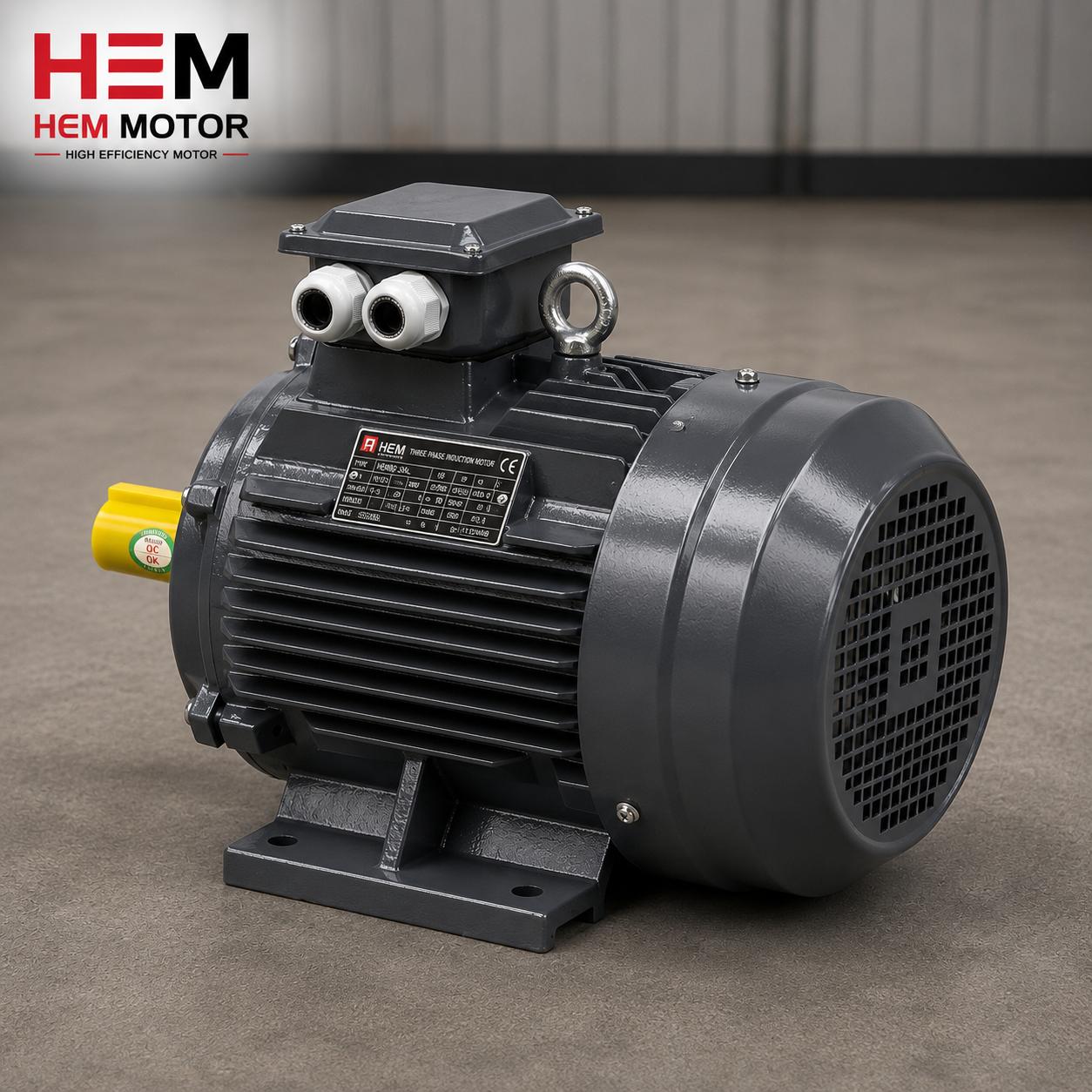

Dusty crushing-and-screening sites, pump stations saturated with water vapor and fan-blower units running outdoors all relentlessly test the most fragile point of an electric motor: the terminal box. While the winding is protected by Class F insulation and the body by cast iron, the terminal box that connects the cable to the motor is often left at the standard IP55 protection class. Yet real field failure statistics show that the majority of insulation breakdowns and phase-to-earth leakages do not begin in the winding, but precisely inside this box. Accumulated dust draws moisture and forms a conductive layer, the cover gasket ages, water seeps through the gland thread gap and one day the motor refuses to start. In this article we examine the terminal box IP66 protection upgrade on cast iron motors with field examples, explaining every link in the sealing chain and how to source the right motor.
At HEM Motor, we manufacture and sell cast iron bodied motors, and we treat terminal box protection with the same rigor as body protection. When selecting a motor for a dusty or wet site, looking only at the body IP rating is not enough; the box that brings the cable inside must offer the same protection level. Otherwise the chain breaks at its weakest link.
Why Is Protection More Critical in the Terminal Box Than the Body?
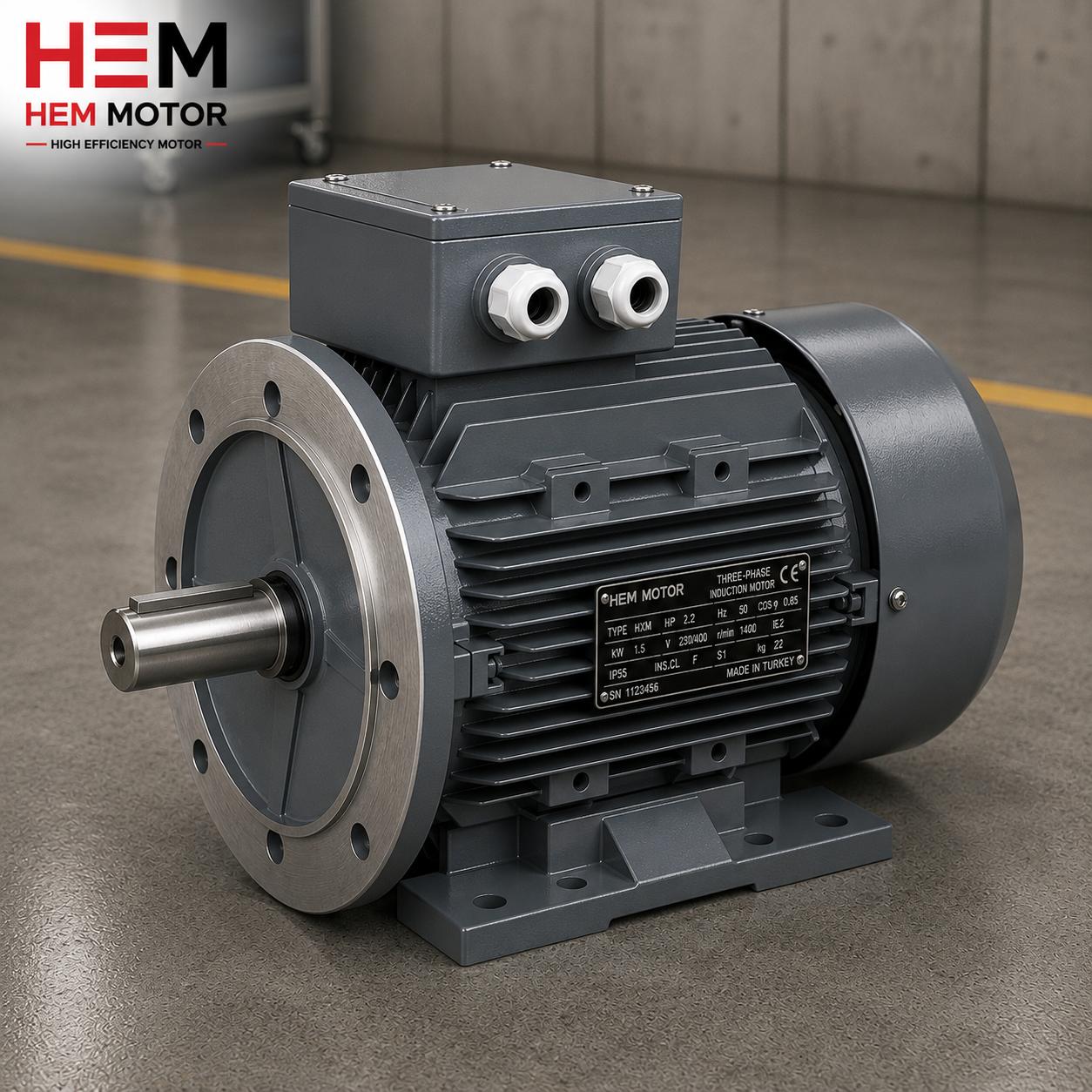
The motor body is a single cast iron piece; the only openings are the oil seal at the shaft exit and the cooling fins. The terminal box, by design, is a volume that opens and closes. It contains the cable entry (gland), the cover parting surface and the terminal plate. Every opening, every cable change re-tests the sealing chain. Therefore even if the same motor's body is IP66, when the box is left at IP55 the real protection of the system drops to IP55.
What Does the Difference Between IP55, IP65 and IP66 Mean in Practice?
- IP55: No complete dust-tightness; harmful dust does not enter but fine dust can accumulate over time. Withstands low-pressure water jets from any direction. Adequate for general industrial environments.
- IP65: The first digit is 6, meaning complete dust-tightness is achieved. The water side withstands low-pressure jets. The critical difference for dusty sites lies here.
- IP66: In addition to complete dust-tightness, it withstands powerful water jets. It is the correct class for washdown plants, open sites and locations with heavy rain or wash exposure.
On a dusty crushing site the first digit being 6 matters; in a wet environment the second digit being 6 matters. In a site that is both dusty and wet, that is a typical crusher or open-air pump group, IP66 protection is the safest choice.
The Links of the Sealing Chain
There is no single part that brings a terminal box to IP66 level; it is the whole of four complementary links. If one of these links is missing, the field protection drops no matter what the box label says.
1. The Cover Gasket
The parting surface between the box cover and the body is sealed with a permanent elastic gasket. For IP66 a disposable flat paper gasket is not enough; a profiled elastomer gasket (usually NBR or silicone based) that seats into its groove when compressed is required. The gasket groove should be a ready channel in the casting so that the clamping force does not push the gasket out. Cover bolts are tightened crosswise with equal torque; over-tightening one corner crushes the gasket on one side while opening it on the other.
2. The Cable Gland
The point where the cable enters the box is the most frequently breached part of the seal. In cable gland selection three conditions are required: correct cable outer diameter range, correct thread type (metric or NPT) and the gland's own IP rating. If the gland's rubber inner sleeve does not match the cable diameter, it either chokes the cable or leaves a gap when tightened. Empty gland holes must always be closed with a blanking plug (IP66 certified). On this subject we recommend reviewing our guide where we detail metric vs NPT cable glands.
3. The Terminal Plate and Internal Clearances
If dust inside the box becomes conductive, the creepage distances between phases and between phase and earth become critical. In an IP66 box this risk is largely eliminated since no dust enters; however, against the possibility of moisture condensation, the terminal plate material and clearances must comply with the standard.
4. Cover Bolts and Thread Sealing
In a cast iron box the cover bolts enter the body through tapped threads. It must not be forgotten that these threads are also a path. In IP66 boxes the bolt holes are designed blind (not opening into the box interior) or a sealing washer is placed under the bolt.
Protection Strategy by Site Type
Not every site creates the same exposure; that is why the terminal protection decision changes by application. Below we summarize the scenarios we most frequently encounter in the field at HEM Motor and the recommended approach.
Crusher and Stone Crushing Site
Here the dominant threat is fine mineral dust. Once dust enters the box it draws moisture, becomes conductive and opens leakage paths over the terminal plate. On these sites the first digit being 6 (complete dust-tightness) is unquestionably mandatory. Vibration is also high, so cover bolts may loosen over time; using vibration-resistant nuts or locking washers keeps the seal intact for years. For this reason an IP66 terminal box and vibration-resistant connection are our standard choice for crusher motors.
Pump Station and Booster Group
In these water-dominant applications, condensation and direct water splash are at the forefront. Relative humidity is high in the pump room; when the motor stops and cools, condensation inside the box is inevitable. On these sites both IP66 sealing and a drain/breather element should be considered together. In vertically mounted pump motors, positioning the terminal box and the drain point according to the mounting orientation requires separate attention.
Open-Air Fan and Blower Groups
Fan motors running outdoors are exposed to rain, sun and dust alike. The box, heating during the day and cooling at night, experiences the most intense condensation cycle. Here a combination of IP66 protection, UV-resistant gasket material and a breather element is recommended. Making the cable entry from below prevents rainwater from creeping in over the gland.
Condensation: The Invisible Enemy
An interesting fact is this: when the motor stops, the warm air inside the box cools, draws moisture from the outside environment and by early morning condensation forms on the inner surface of the box. This water does not come from outside; it is produced inside. That is why even a perfectly sealing box can accumulate moisture inside. The solution is balancing/drainage elements:
- Drain plug: An element placed at the lowest point of the box that expels water but does not let dust in. It must be positioned at the lower corner according to the mounting orientation.
- Breather element: Membrane elements that balance the pressure difference and release moisture vapor outward with their porous structure while not passing water and dust. Preferred in continuously wet/outdoor sites.
- Anti-condensation heater: In motors that will stand idle for long periods, it keeps the internal temperature above the dew point and prevents condensation. Recommended in high-power and open-air motors.
The Cast Iron Body's Contribution to Terminal Protection
The terminal box also being cast iron directly contributes to IP66 protection. Compared to sheet steel or plastic boxes, a cast iron box keeps the parting surface true for years thanks to its dimensional stability; it does not deform under thermal expansion or mechanical impact. This ensures the gasket is compressed with constant pressure and the seal does not degrade. Moreover, since the cast iron box offers an integral gasket channel and gland thread seat formed in the casting, the sealing elements seat in the correct place by design. In HEM Motor cast iron bodied motors, the box and body being from the same material family also creates an advantage in terms of thermal behavior compatibility. You can find more information about the general field durability of cast iron on our cast iron body electric motors product page.
Correct Motor-Terminal Sourcing: What to Specify at Order Time
Instead of trying to install IP66 terminal protection later in the field, ordering the motor correctly from the start is both more economical and safer. At HEM Motor we recommend clarifying the following information in a cast iron motor order.
Order Checklist
- Stating the body and box IP class separately: Saying "motor IP66" is not enough; "terminal box also IP66" must be written.
- Cable entry direction: The box orientation and gland entry must be chosen according to which side the panel is on. The wrong direction causes the cable to bend back into the box and the gland to leak.
- Gland thread type and count: How many cables will enter, at what diameter, metric? Empty holes must be closed with blanking plugs.
- Drain/breather requirement: Must be specified if it is an outdoor or washdown plant.
- Thermal protection output: Will the PTC/PT100 leads come out of the same box? It must be included in the sealing plan.
To select the right cast iron motor and terminal protection for a dusty and wet site, you can review our product range from our electric motor prices page and determine the configuration suitable for your application together. We cover dust sealing on crusher sites separately in our dust sealing on crusher motors article; and you can find terminal box cover gasket selection in depth in our terminal box cover gasket guide.
The Impact of an IP66 Terminal Box on Total Cost
Many buyers see the IP66 terminal box as an unnecessary extra cost and prefer to settle for the standard box. Yet from a total cost of ownership perspective the situation reverses. In a motor running with an IP55 box on a dusty or wet site, insulation leakage, unplanned downtime, production loss and often rewinding costs arise. A motor stopping costs not only the value of that motor but as much as the line it is connected to stopping. A small extra investment in terminal box protection eliminates these large risks. Trying to upgrade a wrongly selected box in the field is generally more expensive than sourcing the right motor from the start. For this reason, correctly defining the field exposure at the purchasing stage and selecting the appropriate IP66 configuration is the most rational decision both technically and commercially.
Quick Checks Before Commissioning
- The cover gasket must be visually verified to seat fully in its channel without being crushed.
- All cable glands must be selected to match the cable diameter and checked that they do not loosen by hand.
- Unused gland holes must always be closed with blanking plugs; even a single open hole nullifies the protection class.
- Cover bolts must be tightened in crosswise sequence with equal torque.
- In outdoor or wet environments, the drain/breather element must be verified to be in the correct position per mounting orientation.
- The cable entry must be checked to be made from below or the side where possible, so as not to draw water inside.
Frequently Asked Questions
Can I upgrade my standard IP55 motor to IP66 in the field?
It is partly possible: replacing the cover gasket with a profiled elastomer gasket, fitting an IP66 certified gland and closing empty holes with blanking plugs noticeably increases protection. However, if the cast box's parting surface and bolt hole design are not suitable for IP66 from the start, the full class cannot be guaranteed. On critical dusty and wet sites, sourcing a motor with an IP66 terminal box from the outset is the correct path.
Can I change the terminal box orientation after the order?
On many cast iron motors the terminal box is designed to be rotatable in 90-degree steps on the body. Still, an orientation change affects the gasket and gland arrangement; therefore specifying the panel side at order time both saves time and reduces sealing risk.
Is IP65 sufficient on a site that is both dusty and wet?
IP65 provides complete dust-tightness and withstands low-pressure water jets. However, if pressurized washing, heavy rain or high-pressure cleaning is involved, the second digit must be 6, that is IP66 is required. Determining the field exposure and selecting accordingly is the soundest approach; at HEM Motor we can determine the right class together according to your application.