English
 Türkçe


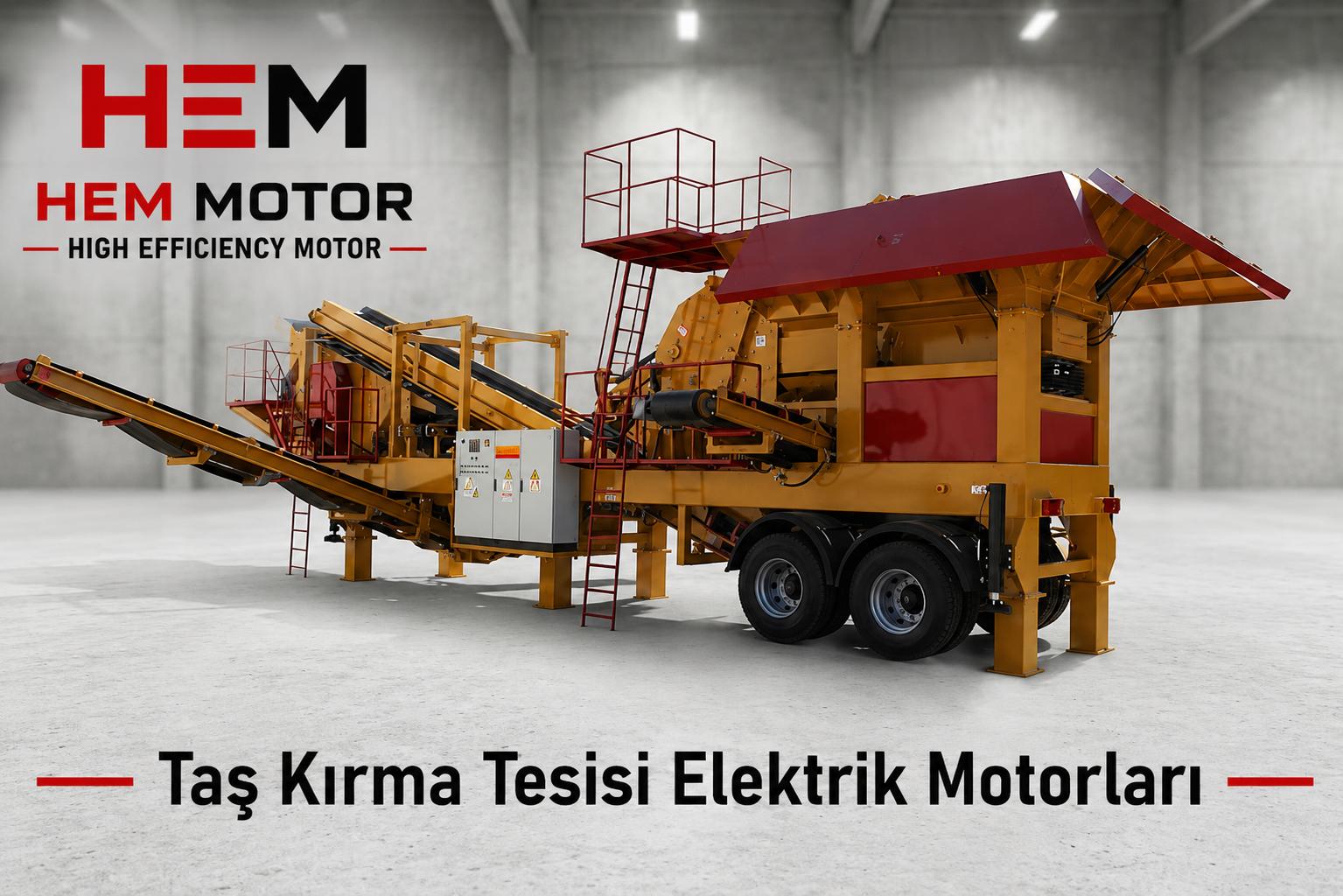
In mining and crushing plants, the heart of the ore beneficiation, dewatering and tailings management line is the paste thickener unit. These large-diameter settling tanks let the incoming slurry settle under gravity; clarified water overflows from the top, while the densified solid paste is discharged from the bottom. At the centre of the tank, a rotating rake mechanism slowly sweeps the settled solids toward the central cone discharge outlet. The rake drive motor that turns this rake is a continuously running system that produces extremely low speed but very high torque. A wrongly selected drive motor or reducer group can bring an entire dewatering line to a halt. This article explains how to select the correct motor + reducer combination for thickener rake drives in mining and stone-crushing plants, how to balance low speed with high torque, and how to plan the correct supply.
Why Is Paste Thickener Rake Drive a Special Application?
While a conventional pump or fan motor runs at thousands of revolutions per minute, a thickener rake turns only a few times per minute — often completing a single revolution over the course of many minutes. This means the high-speed motion from the motor shaft must be reduced by a very high ratio. As speed drops, the output torque rises proportionally, because at constant power torque is inversely proportional to speed. Because the rake has to plough a path through the dense settled paste layer, it requires a very high breakaway torque at start-up and when the sludge thickens.
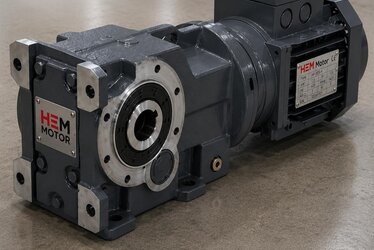
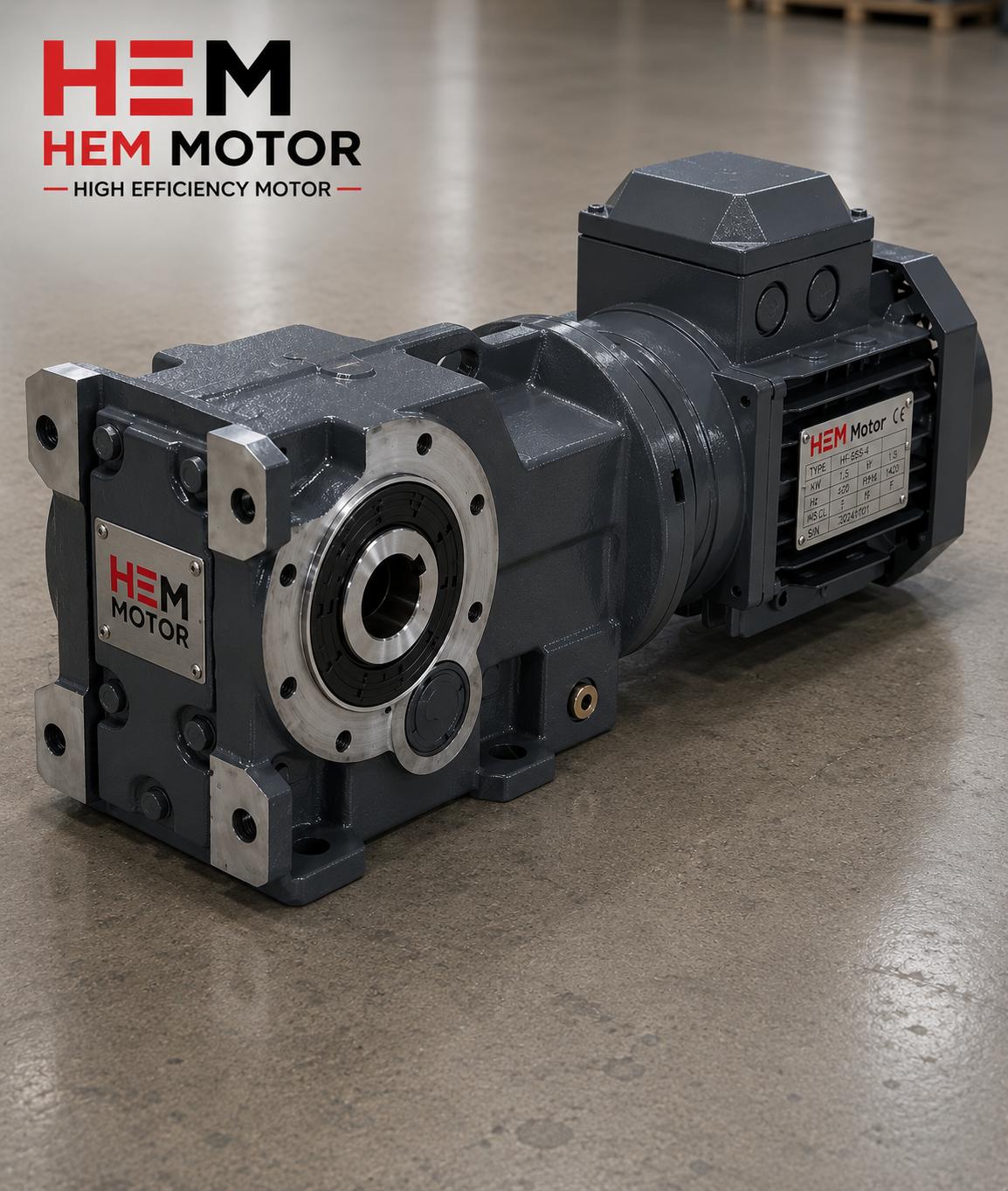
For this reason a thickener drive is almost never built from a single motor, but from a motor + worm-gear reducer (or multi-stage reducer) combination. The motor runs efficiently at high speed; the reducer converts this motion into a slow, powerful and controlled rotation. The worm-gear reducers in the HEM Motor range offer a wide span of reduction ratios from 1/7.5 up to 1/100, making it easy to obtain the very low output speed this application demands.
Balancing Low Speed With High Torque
When sizing a thickener drive group, the core goal is to safely and continuously deliver the required torque at the output shaft. Designers usually work with two torque values: normal running torque and transient peak (breakaway) torque. When the rake becomes buried in a heavily settled layer, the turning moment can suddenly multiply. The system must be powerful enough to meet this peak moment, and also equipped with a torque limiter / overload protection that prevents this moment from damaging the mechanism.
Determining the Correct Motor Power and Reducer Ratio
Selecting a thickener rake drive motor proceeds in reverse: first the required output shaft speed and torque are determined, then a suitable reducer ratio is selected, and finally the motor power needed to feed the reducer is calculated. Because HEM Motor's high-efficiency IE3 and IE4 motors are offered across a wide power range from 0.55 kW up to 355 kW, it is possible to build a suitable drive unit for every scale, from small pilot plants to large mining beneficiation tanks.
- Output speed target: The desired peripheral speed of the rake is set according to tank diameter and ore type. Very low output speeds (a few revolutions per minute or fewer) are typically targeted.
- Reduction ratio: High-ratio worm-gear reducers such as 1/30, 1/50, 1/80 or 1/100 bring the 1400–1500 rpm input speed down to an output that takes minutes rather than seconds.
- Motor power margin: A safety margin for breakaway torque and sludge density fluctuations is added to the calculated power. In a drive running continuously at full load, this power margin prevents overheating and premature failure.
- Number of poles: Typically 4-pole motors (around 1500 rpm) provide the ideal input speed to the reducer; 6-pole options are also considered for higher torque reserve.
- Mounting type: For motors coupled to a reducer, a B5 or B14 flanged connection forms a compact drive group compatible with vertical shaft arrangements.
The Advantage of the Worm-Gear Reducer: Self-Locking
One of the most important features of worm-gear reducers in the thickener application is their self-locking behaviour at high ratios. When the drive stops, the dense paste pushing back on the rake is largely prevented from rotating the mechanism unintentionally. This is valuable both for mechanical safety and process stability. The body series running from HEM30 to HEM130 pairs with different motor powers and IEC connection types, making it possible to build an application-specific drive solution.
Tank Diameter, Ore Type and Drive Configuration
To select the thickener drive motor correctly, you need to understand the tank geometry and the behaviour of the ore inside it. In small-diameter tanks a centre-drive arrangement is common; the drive group sits in the very middle of the tank, on a bridge, and turns the rake shaft directly. In very large-diameter tanks a peripheral-drive arrangement may be preferred; here the drive turns the rake bridge by means of a carriage running on a rail at the tank edge. The common point in both arrangements is an extremely slow but high-torque rotation.
The ore type also directly affects the torque requirement. With fine-grained, fast-settling ores the rake struggles against a denser layer, while with fibrous or sticky slurries resistance fluctuations occur more frequently. For this reason the drive group must be sized against the expected peak moment rather than the average running torque. The power margin applied during design prevents these fluctuations from overstressing the motor and reducer. Choosing the correct number of poles and power margin directly determines the service life of the drive group.
Continuous Operation, Heating and Duty Type
A thickener almost never stops; it runs uninterrupted for weeks and months. This makes it mandatory for the drive motor to be designed for S1 continuous duty. Heat management is critical in a motor running continuously at full load. F-class insulation and a correctly sized power margin keep the winding temperature within safe limits. Because the self-fan cooling of a low-speed motor may be reduced, the overheating risk must be evaluated with particular care.
Ambient conditions on a mine site also stress the motor. A drive motor working in a dusty, humid and at times corrosive atmosphere is expected to be at least IP55 rated; higher protection levels may be preferred under harsher conditions. A cast iron body is a suitable choice for such heavy-duty applications in terms of both mechanical impact resistance and heat dissipation.
Overload and Torque Limiting: Protecting the Mechanism
The most critical protective function of a thickener drive is to shield the mechanism against sudden torque increases. When the settled solid layer unexpectedly thickens, or a foreign object catches the rake, the load on the drive group can reach dangerous levels. Several protective layers guard against this:
- Torque-limiting device: A mechanical or electronic torque limiter raises an alarm or stops the drive when a defined threshold is exceeded.
- Motor protection relay: Overcurrent and thermal protection guard the winding against heat-related damage.
- Soft starting: Star-delta or a soft starter limits the inrush current, protecting both the grid and the mechanism. In this application, which involves high inertia and high breakaway torque, the starting method must be chosen carefully.
- Lifting device: Many thickener designs include a mechanism that lifts the rake when an overload is detected; the drive motor must work in integration with this automation.
The cost of downtime when a drive group fails in a mining plant is very high. For this reason, separately evaluating mining motor supply contracts and critical spare stock assurance minimises unplanned stoppages. Likewise, the experience in high-torque grinding applications described in high-torque supply for mine and ore mill motors offers valuable guidance.
Correct Supply: Thinking of Motor and Reducer Together
A thickener drive requires far more than buying a motor and a reducer separately and joining them on site. The healthiest approach is to plan motor power, number of poles, mounting type and reduction ratio as a single whole. By offering both high-efficiency electric motors and compatible worm-gear reducers from a single source, HEM Motor makes this integrity possible. A correctly matched motor + reducer group eliminates field assembly problems, speed mismatch and torque shortfall.
- Single-source solution: Having the motor and reducer arrive from the same supplier with compatible IEC connections simplifies assembly.
- Spare part continuity: If the mine site is remote, keeping spares of critical drive components in stock shortens downtime.
- Correct documentation: The motor nameplate, reducer ratio and shaft/keyway dimensions should be clarified before ordering.
- Efficiency-class compatibility: In a continuously running drive, an IE3 or IE4 motor makes a meaningful difference in annual energy consumption.
When planning the drive groups in your dewatering line, reviewing current electric motor prices and suitable power options also puts the project on a sound budgetary footing. To examine application-specific motor options, you can evaluate high-efficiency electric motors for the mining sector together with worm-gear reducer options for the low-speed / high-torque conversion.
Frequently Asked Questions
Is a motor alone sufficient for a paste thickener rake drive?
No. A thickener rake turns only a few times per minute or less while requiring very high torque. A standard asynchronous motor cannot deliver this speed on its own. The application is therefore built together with a worm-gear reducer that converts the motor's high speed into low output speed and high torque. Motor power, number of poles and reduction ratio must be sized as a single whole.
Why is a low-speed drive motor more sensitive to overheating?
A thickener drive motor mostly turns at standard speed at the reducer input; the actual slowing happens in the reducer. Even so, heat build-up matters in a motor running continuously at full load and against demanding breakaway moments. F-class insulation, a correct power margin and at least IP55 protection keep the winding temperature in a safe range, ensuring reliable operation in continuous S1 duty.
What protection class should a drive motor have on a mine site?
Mining and crushing plants are dusty, humid and at times corrosive environments. The drive motor is recommended to be at least IP55 rated and cast iron bodied; higher protection levels may be preferred under harsher conditions. Because it is a continuously running critical drive, keeping a spare motor in stock and planning the correct supply also significantly reduces downtime cost in the event of a failure.