English
 Türkçe


Summary (TL;DR)
- In a glass and ceramic factory, the biggest enemies of electric motors are high hot environment temperature, abrasive dust and non-stop operation; therefore a cast iron frame, IP55 protection and F/H insulation class should be standard.
- For kiln fan motor and ID (induced draft) fan applications, when ambient temperature exceeds 40°C, derating the motor and selecting one frame size up is essential to protect winding life.
- A mill motor (ball / wet-dry mill), conveyors, bucket elevators and screw conveyors require high starting torque and S1 continuous duty; correct speed (1000/1500/3000 rpm) and mounting (B3/B5/B35) determine efficiency.
- HEM Motor manufactures and supplies the full range of 0.55–355 kW IE3/IE4, 100% copper motors from stock with manufacturer assurance, covering an entire plant’s motor list end to end.
- Correct selection requires evaluating the fan curve, ambient temperature, dust class and duty type together; sharing this data at the quotation stage eliminates the risk of wrong selection and downtime.
Glass and ceramic production is among the most energy-intensive and environmentally demanding branches of industry. Fans spinning right next to melting furnaces, mills grinding raw material for hours, conveyors moving tonnes of material, and presses are all driven by electric motors. These motors cannot be selected like an ordinary workshop motor. Three factors are decisive here: high hot environment temperature, continuous abrasive dust and non-stop (S1) operation. In this article we take a technical look at which motor is the correct choice for which drive in a glass and ceramic factory, focusing especially on the kiln fan motor, ID fan, mill motor and conveyor side.
For an investor or maintenance manager, correct motor selection is not just a purchasing line item; it is a strategic decision that directly affects plant uptime, the energy bill and spare-part management. Evaluating current electric motor prices together with technical criteria optimizes both the initial investment and the operating cost over many years.
The Three Core Challenges a Motor Faces in a Glass and Ceramic Plant
Before starting motor selection for a plant, you must understand the environment in which the motor will actually operate. Conditions on glass-ceramic lines can directly invalidate the catalogue ratings of a standard general-purpose motor.
1. High ambient temperature
Near furnaces, dryers and spray-drying zones, ambient temperature easily reaches 45–55°C. Standard motors are rated for 40°C ambient and 1000 m altitude. When ambient temperature exceeds this threshold, the winding runs hotter than designed and insulation life shortens rapidly. The solution is derating — loading the motor below its nominal power to leave thermal reserve, or selecting one frame size up.
2. Abrasive dust and glaze particles
Clay, quartz, feldspar and glaze dust are extremely abrasive. This dust filling the motor fan, blades and bearing clearances both disrupts cooling and causes mechanical wear. Therefore a minimum IP55 protection class, a totally enclosed fan-cooled (TEFC) frame and, where necessary, sealed bearing arrangements are mandatory.
3. Continuous (S1) duty cycle
Glass furnaces run without stopping for years; ceramic presses and mills are under load throughout the shifts. This means the motor must be selected for S1 continuous duty, capable of reaching thermal equilibrium and staying stable there. Small motors designed for short-time (S2) or intermittent (S3) duty fail early here.
Kiln Fan and ID (Induced Draft) Fan Motors: Fighting Hot Gas
The furnace is the heart of the plant, and the fans feeding and exhausting it are critical for production continuity. Kiln fan motor selection is completely different from a simple ventilation fan, because here both a high hot environment and a hot-gas-carrying fluid are involved.
ID fan and flue gas side
Induced Draft fans draw hot flue gas out of the furnace. The motor is not directly in the gas, but when radiant heat, conduction heat from the fan hub and a hot ambient combine, the motor’s thermal load rises sharply. For this reason, even when F insulation is used on ID fan motors, operating to a B-class temperature rise (leaving thermal reserve) is recommended. You can find the detailed selection logic for the high-temperature gas side in our article Flue Gas and ID Fan (Aspirator) Motor Selection.
Fan curve and speed selection
Fan motors have a cubic torque-speed characteristic; as speed rises, the power demand grows cubically. Therefore selecting a motor without knowing the fan’s operating point is a mistake. Generally, large high-flow fans use low-speed motors corresponding to 1000 or 750 rpm, while small high-pressure fans use 3000 rpm motors. In cold weather a fan moves denser air and strains the motor more; this starting scenario must also be considered.
- At least F insulation, preferably H class, for the high hot environment.
- Cast iron frame: distributes heat better and is more durable under vibration.
- IP55 and, if needed, an external forced-cooling fan for adequate cooling even at low speed.
- Power and speed selected to the fan curve; continuous S1 duty.
You can review our industrial fan product family on the Industrial Fan Motors page.
Derating at High Ambient Temperature: Why Move One Frame Size Up?
Derating is the most neglected yet most critical topic in motor selection. A motor’s rated power is given assuming a certain ambient temperature (usually 40°C) and altitude (1000 m). When the furnace surroundings in a glass-ceramic plant reach 50°C, the safe power the motor can deliver drops.
As a practical approach: at 45°C ambient roughly 95% of rated power, at 50°C roughly 90%, and at 55°C roughly 85% is accepted as safe continuous power. So a 30 kW motor may not suffice for a 30 kW drive in a 50°C environment; selecting from the 37 kW frame and leaving thermal reserve is needed. We covered the detailed engineering rationale of this approach in our article Cast Iron Motor Derating at High Ambient Temperature.
The alternative or complement to derating is a higher insulation class. F insulation withstands 155°C and H insulation 180°C winding temperature. At high ambient temperature, operating an F-insulated motor to a B-class temperature rise (i.e. at a lower actual winding temperature) leaves a wide safety margin for the winding and considerably extends the motor’s expected life.
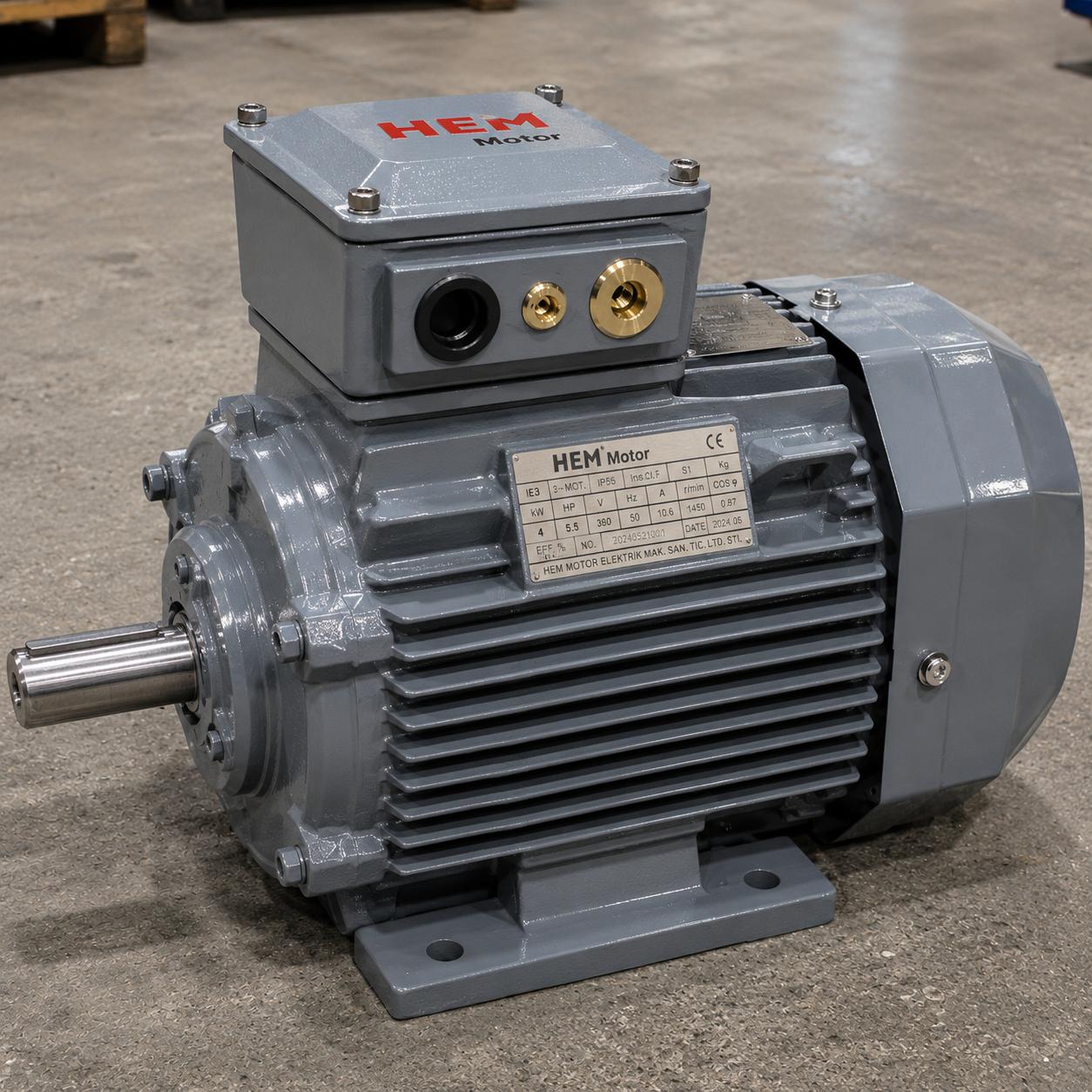
Mill Motors: Ball, Wet and Dry Grinding Drives
In ceramic production, raw material is ground in mills until it reaches the desired particle size. The mill motor is one of the heaviest and most continuously loaded drives in the plant. Ball mills set large rotating masses (balls + material charge) in motion, so they demand high starting torque.
Wet grinding and abrasive slurry
In wet grinding, material is mixed with water to form a slurry (slip); abrasive wear is very high in the pumps that carry and mix this slurry. Here, as much as the motor itself, the compatibility of the gearbox and coupling between motor and pump/agitator determines the selection. Slurry pump motors are preferred under continuous load, often around 1500 rpm with B5/B35 flange mounting.
Dry grinding and dust risk
In dry grinding the environment contains dense fine dust; here IP55 and, where needed, dust-protected special applications gain importance. The layout and filter arrangement matter so that the motor cooling air does not draw in dust.
Critical parameters in mill drives
- High starting torque: enough torque capacity to accelerate the heavy rotating mass from zero.
- S1 continuous duty and wide thermal reserve; the mill does not stop for hours.
- Cast iron frame and robust bearing arrangement: long life under vibration and shock load.
- Correct speed/gearbox matching: the mill drum turns slowly, so the motor is usually selected together with a gearbox.
Conveyors, Elevators and Screws: Material Handling Drives
Moving raw material from silo to mill, mill to press and furnace to packaging is done with belt conveyors, bucket elevators and screw conveyors. These drives are not high-powered but are numerous and define the plant’s flow; if one stops, the line jams.
Conveyor motors are usually selected as geared (gearmotors) with B5/B35 flange mounting. Full start (restarting a loaded conveyor after it has stopped) is the toughest scenario, so the starting torque must be adequate. Because of the dusty environment, IP55 and an enclosed frame are again standard. On bucket elevators, a brake or one-way clutch should be considered to prevent back-running.
- Belt conveyor: medium power, continuous duty, geared, B3 or B5 mounting.
- Bucket elevator: high loaded-start torque, back-run protection.
- Screw conveyor: high instantaneous torque capacity against jamming.
- All require IP55, cast iron frame and dust resistance.
You can find detailed information about all general-purpose and industrial drive motors in our Industrial General Purpose Motors category.
Press, Mixer and Spray Dryer Drives
Ceramic presses produce shock loads; in each pressing cycle the motor faces a sudden torque demand. Therefore, in press motors, torque reserve matters as much as power. Batch mixers demand high starting torque while mixing high-viscosity material. Spray dryer fans are again selected with criteria similar to the kiln fan, combining a hot environment and continuous duty. You can also find the effect of high-temperature calcination and furnace-side processes on motor selection in our article Lime Kiln and Calcination Plant Electric Motors.
Power, Speed and Mounting: A Practical Matching Guide for the Glass-Ceramic Line
The HEM Motor product family covers a wide power range of 0.55–355 kW, with 1000/1500/3000 rpm speed options and B3/B5/B35 mounting types. In a typical glass-ceramic plant the practical matching is as follows:
- Kiln / ID fan: medium-high power, low-medium speed (750/1000/1500 rpm), F-H insulation, derated selection, B3.
- Mill: high power, together with a gearbox, high starting torque, S1, B3.
- Conveyor / elevator: low-medium power, gearmotor, B5/B35.
- Press / mixer: medium power, high torque reserve, B35.
- Slurry pump: medium power, 1500/3000 rpm, B5 flange, abrasion resistance.
When all these drives can be supplied in IE3 or IE4 efficiency class, with 100% copper windings and a cast iron frame, energy cost drops and durability in hot, dusty environments increases.
Efficiency and Energy: Why Do IE3/IE4 Matter More in Glass-Ceramic?
Because glass and ceramic plants run continuously, the annual operating hours of the motors are very high. This magnifies the effect of the efficiency difference on the energy bill. An IE4 motor instead of IE3 does the same work with fewer losses; for a fan or mill drive running in continuous duty, this difference creates savings over the years that overshadow the motor’s initial cost. Moreover, a higher-efficiency motor heats up less, which is an extra advantage in a hot environment because the motor’s self-generated heat load is reduced.
HEM Motor Supply Assurance: An Entire Plant’s Motor List from a Single Source
A glass-ceramic plant’s motor list contains dozens of different powers, speeds and mounting types. Splitting this list across different suppliers means incompatible spare parts, varying delivery times and complex service management. HEM Motor, with manufacturer assurance, covers this entire 0.55–355 kW list from a single source, with the advantage of stock and fast supply.
- Manufacturer assurance: the motors come from the manufacturer; technical support and warranty are at a single point.
- Stock and lead time: standard powers from stock, special configurations with planned lead time.
- Project-based quotation: when the fan curve, ambient temperature and dust class are shared, the correct motor list is produced.
- Spare-part simplicity: when the whole plant is fed from the same series, managing spare bearings, fans and terminal boxes becomes simpler.
At the quotation stage, sharing operating point, ambient temperature and duty type data per drive eliminates the risk of wrong selection and downtime.
Frequently Asked Questions
What should I do for high temperature when selecting a kiln fan motor?
When selecting a kiln fan motor, have the ambient temperature measured; if it is above 40°C, apply derating or select one frame size up. Use at least F, preferably H insulation class, a cast iron frame and IP55. In a hot environment, if needed add an external (forced) cooling fan to ensure adequate cooling even at low speed.
Why is a mill motor selected differently from a conveyor motor?
A mill motor sets a large, heavy rotating mass in motion, so it requires high starting torque and wide thermal reserve; it is usually selected together with a gearbox and in S1 continuous duty. A conveyor motor is lower-powered, geared, and sized for the loaded-start scenario. Both should be IP55 and cast iron framed, but their torque and power profiles differ.
Can I buy all the motors of a glass and ceramic factory from one place?
Yes. HEM Motor supplies the entire motor list of a glass and ceramic factory — from kiln fan to mill, conveyor to press — in the 0.55–355 kW range, in IE3/IE4 efficiency class and with manufacturer assurance, from stock. Single-source supply greatly simplifies spare-part and service management.