English
 Türkçe

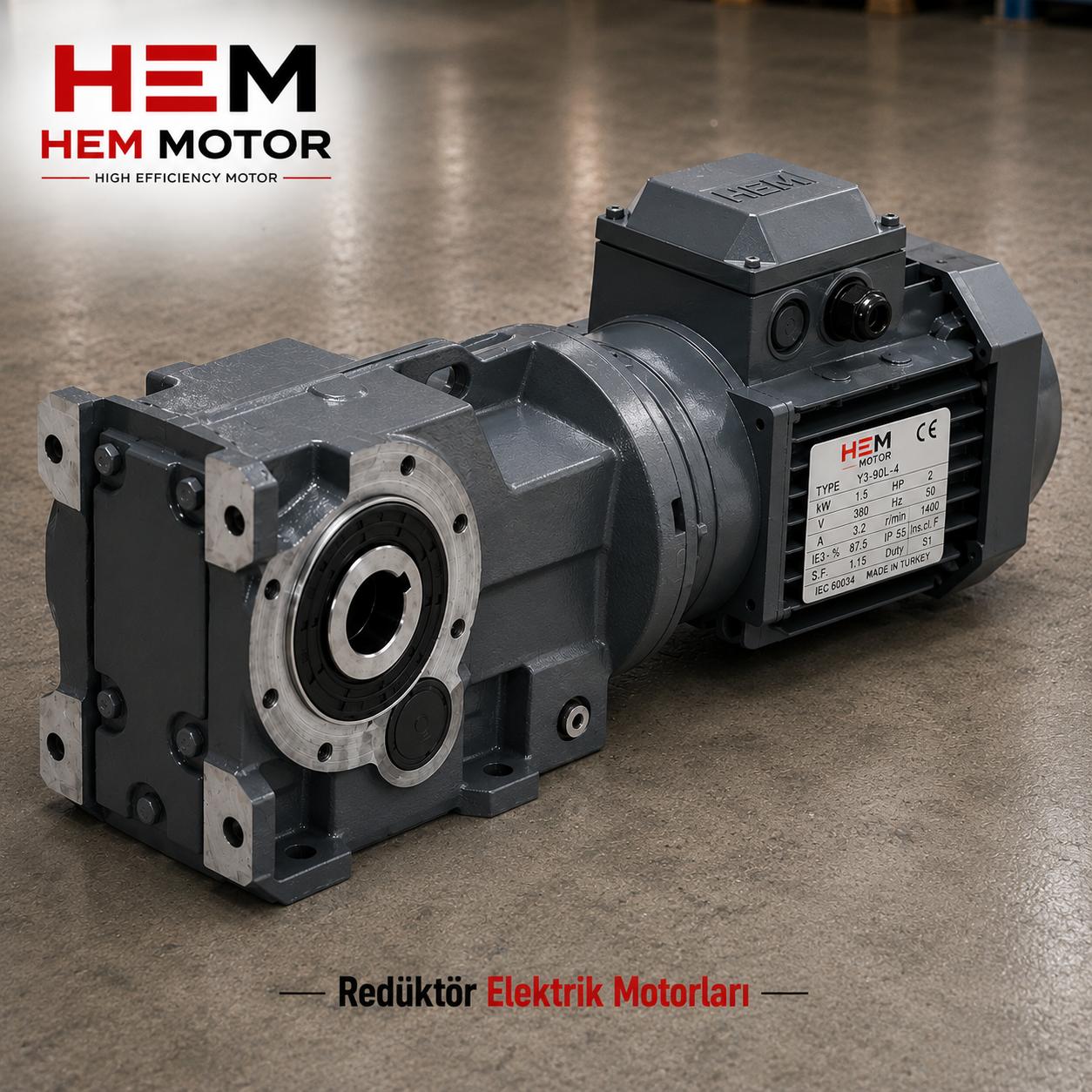

In a crushing plant, almost everyone's attention is fixed on the main drive motor; that large machine, rated at hundreds of kilowatts, is the real power that breaks the rock. Yet the bearings that form the very heart of this powerful machine are usually entrusted to a small, often overlooked motor: the lubrication unit (HPU) motor. The bearings of crushers and breakers operate under enormous impact loads, and to prevent metal-to-metal contact they require a continuous film of oil. The motor that drives the circulation pump responsible for maintaining this oil film may be modest in power, but its failure is critical enough to bring the entire plant to a standstill. In this article we examine in detail why the crushing-plant lubrication unit motor must be considered differently from the main motor, why selecting it for continuous duty (S1) is so important, how to choose the correct power rating and protection class, and why this motor must always be kept in stock as a critical spare.
Why Is the HPU Motor Different from the Main Drive Motor?
In a crusher system, two types of motor work side by side, and they perform entirely different tasks. The main drive motor turns the jaw or the cone of the crusher to do the actual work of breaking rock; this motor is generally high-powered, high-inertia, and subject to demanding starting conditions. The lubrication unit motor, on the other hand, is selected according to a completely different logic. Its job is not to break rock, but to provide uninterrupted bearing lubrication that makes the crushing work possible in the first place. For this reason its power rating is small, yet its reliability matters even more than that of the main motor.
This distinction also changes the criteria by which the motor is chosen. While the prominent concerns for the main motor are inrush current, the starting method, and inertia matching, for the HPU motor the priorities are continuity, thermal endurance, and long service life. In other words, the main motor is selected by asking "how powerful?", whereas the HPU motor is selected by asking "how reliable?". Grasping this difference is the key to understanding why such a small motor must be chosen with such great care.
The Oil Film and Bearing Protection
Crusher bearings carry the large and fluctuating loads generated during crushing. Under these loads, any direct contact between the metal surfaces means that the bearings can be damaged within seconds. The circulation pump continuously delivers pressurized oil to the bearings, forming a thin oil film between the surfaces and preventing metal-to-metal contact. The moment this oil film is interrupted, the bearings begin to heat up, wear, and ultimately seize. The stopping of the HPU motor means precisely the disappearance of this vital oil film.
Why Is Continuous Duty (S1) Essential?
Electric motors are selected according to different operating regimes, that is, according to duty types. Some motors are designed for applications that run for short periods and then stop, while others are built to run uninterrupted for hours or even days. The crusher lubrication unit motor falls into this second group, namely the continuous duty (S1) class. This is because, as long as the crusher is running, oil circulation must never stop; indeed, in many systems lubrication continues for a while even after the main motor has stopped, until the bearings have cooled down.
A motor not selected for the S1 duty type overheats under continuous operation, and its winding insulation ages prematurely. This in turn leads to an unexpected winding failure and therefore to the loss of the oil film. For this reason the HPU motor must be chosen with the correct thermal class for continuous duty, so that it can run uninterrupted at its rated power. The main points to watch for in a continuous-duty selection are as follows:
- Thermal balance: The motor must be able to dissipate the heat it generates during continuous operation without difficulty; this becomes even more important in plants with high ambient temperatures.
- Insulation class: Class F insulation provides a safe margin against the temperature rise that comes with continuous operation.
- Adequate cooling: The motor's fan and frame design must guarantee sufficient cooling under uninterrupted operation.
- Load continuity: Since the circulation pump draws an almost constant load, the motor must be sized to carry this steady load over long periods.
Interlock: The Crusher Will Not Run Without Oil Pressure
In modern crusher systems, the critical role of the HPU motor is reinforced by a safety lock, that is, by interlock logic. According to this logic, the main drive motor is not permitted to run until the lubrication system has established sufficient pressure. The system first starts the lubrication unit, confirms that the bearing oil pressure has reached a safe level, and only then allows the main motor to come online. If the oil pressure drops while the crusher is running, the interlock activates to stop the main motor and protect the bearings.
This interlock demonstrates most clearly why the HPU motor is so critical. When the small lubrication motor stops, it is not just that motor that stops but the entire crushing line. In other words, a motor rated at only a few kilowatts directly determines the operation of the hundreds-of-kilowatts main motor and of the whole production line. This makes plainly clear why the assumption of "small power, small importance" is such a dangerous fallacy in motor selection.
Selecting the Correct Power and Protection Class
The power of the HPU motor is determined by the requirement of the oil circulation pump it drives. The aim here is to provide, with a reasonable safety margin, the power needed for the pump to deliver the required oil flow rate and pressure. Selecting an oversized motor means both unnecessary cost and a loss of efficiency and power factor at low load; selecting too small a motor means the motor is constantly overstressed and runs the risk of early failure. For this reason the power selection must be based on the pump curve and the actual demand of the oil circuit.
Crusher sites are extremely demanding environments in terms of dust, moisture, and vibration. For this reason the HPU motor must be selected with protection and frame features that can withstand these conditions. In a dusty and humid environment a protection class of at least IP55 is required; this class protects the motor against the ingress of dust and against water jets. Cast iron is the preferred frame material in such sites in terms of both mechanical strength and vibration damping. Lubrication maintenance is also important in cast-iron-framed motors; on this topic our content on grease nipples in cast-iron-framed motors provides complementary information.
Technical Criteria to Watch for in Selection
- Power matching: The motor power must cover the most demanding operating point of the circulation pump with a reasonable margin.
- Protection class: In a dusty and humid crusher site, at least IP55 should be used, and in very heavy dust a higher protection rating should be considered.
- Frame material: A cast iron frame provides mechanical strength and long service life on a vibrating and impact-prone site.
- Mounting type: The correct foot-mounted (B3) or flange-mounted (B5/B35) type must be selected to suit the structure of the lubrication unit.
- Duty type: The correct thermal class for continuous duty (S1) is mandatory; otherwise the insulation will fatigue under uninterrupted operation.
The Importance of Critical Spare Stock
The HPU motor is a small and relatively economical component; yet its failure creates an impact large enough to halt the entire crushing plant. A crushing line standing still for hours or days means, together with the production lost, an enormous cost. For this reason the HPU motor must be evaluated not according to its purchase price, but according to the loss caused by its downtime. The cost of a small motor becomes almost meaningless next to the loss of a single day's production in its absence.
It is precisely for this reason that the lubrication unit motor must always be kept in stock as a critical spare. A spare motor of the correct power, speed, and mounting type waiting ready on the shelf allows the line to come back online within minutes in the event of a failure. This preparation is not a luxury but a fundamental part of the plant's continuity plan. To quickly source the correct motor across a wide power range, the electric motor solutions offered by HEM Motor provide technical support in critical spare planning and correct selection.
Building the Spare Plan Correctly
An effective spare plan is not merely a matter of placing a single motor on a shelf. The spare motor must be exactly the same as the running motor in power, speed, frame, and mounting type; otherwise, at the moment of failure, the motor will not fit the unit, and being ready will mean nothing. In addition, the nameplate data of the spare motor should be kept together with the records of the existing motor, and storage conditions should be checked at regular intervals. A similar approach should be followed for the other critical motors on the crushing line; for example, applications such as the baghouse filter fan motor and the autotransformer starter used for the main drive should also be considered within the continuity plan.
The Oil Circulation Pump and Motor Load
The heart of the lubrication unit is the circulation pump that continuously circulates the bearing oil, and the HPU motor drives precisely this pump. This pump draws oil from the tank, passes it through a filter and, where necessary, through a cooler, forces it to the bearings, and from there returns it to the tank. In this closed circuit, the power drawn by the pump depends on the viscosity of the oil, the resistance of the circuit, and the desired pressure. In cold environments the oil thickens and, as its viscosity rises, the pump draws more power; for this reason the motor must be sized for the most demanding operating moment, namely the cold-start condition.
The motor's load is relatively steady throughout operation, because the circulation pump runs at an almost constant flow rate. This steady load allows the motor to operate comfortably in continuous duty; however, when there is a blockage in the oil circuit, fouling of the filter, or a problem with the cooler, the resistance rises and the motor begins to be overstressed. For this reason the healthy operation of the oil circuit is directly decisive for the life of the motor as well. Monitoring values such as oil temperature, pressure, and flow rate works like an early-warning system that protects both the bearings and the motor.
Cold Start and the Effect of Viscosity
In open-air crusher plants, the oil temperature can drop significantly during the winter months, and this creates an additional challenge for the HPU motor. Cold, thickened oil markedly increases the power drawn by the pump; at this moment the motor may be forced to start under a load above its rated value. For this reason some systems use oil heaters or pre-heating periods, and the motor is selected to be able to handle the high load at cold start. When selecting the motor, it is not only the normal operating point but also this most demanding starting moment that must be taken into account.
Maintenance and Reliability Approach
The reliability of the HPU motor, a critical component, begins with correct selection but is sustained through regular maintenance. In a continuously running motor, the bearings, insulation, and cooling paths wear over time; recognizing this wear in advance is the most effective way to prevent an unexpected stoppage. For this reason the HPU motor must be included in the plant's planned maintenance program and inspected at regular intervals.
The main maintenance practices that increase reliability are as follows:
- Vibration monitoring: Bearing wear most often makes itself known through an increase in vibration; regular measurement provides early warning.
- Temperature monitoring: Tracking winding and bearing temperatures shows cooling problems and overloading at an early stage.
- Insulation resistance measurement: In continuously running motors, periodic measurement of insulation resistance helps monitor the aging of the windings.
- Lubrication maintenance: In re-greasable bearings, lubrication at the correct interval and with the correct grease extends bearing life.
- Connection check: On a vibrating site, the terminal connections and mounting bolts must be regularly checked for looseness.
This approach makes it possible to address the motor before a failure rather than at the moment of failure. Planned maintenance prevents the great majority of unexpected stoppages and, combined with critical spare stock, strongly safeguards the continuity of the plant. In the end, a small and seemingly insignificant motor turns, through correct selection, correct maintenance, and a correct spare plan, into a robust component that carries the reliability of the entire crushing line.
Frequently Asked Questions
Why can the HPU motor be more critical than the main drive motor?
Because no matter how powerful the main motor is, the bearings cannot operate without being protected by the oil film. When the HPU motor stops, oil circulation ceases, the bearings enter the risk of metal-to-metal contact, and in most systems the interlock activates and stops the main motor as well. In other words, the failure of this low-powered motor creates an impact large enough to halt the entire crushing line.
Why must it absolutely be selected for continuous duty (S1)?
As long as the crusher is running, oil circulation must never stop; in fact, even after the machine has stopped, it must continue for a while until the bearings have cooled. A motor designed for short-time duty overheats under this uninterrupted operation, and its insulation ages prematurely. For this reason the HPU motor must be selected with the correct thermal class for continuous duty (S1), so that it can run uninterrupted at its rated power.
Is it really necessary to keep a spare for such a small motor?
Yes. Even though the HPU motor is small and economical, its failure halts the entire plant, and this downtime creates a production loss far greater than the cost of the motor. A spare of the correct power, speed, and mounting type waiting ready in stock allows the line to run again within minutes in the event of a failure. For this reason critical spare stock is an indispensable part of the continuity plan.