English
 Türkçe

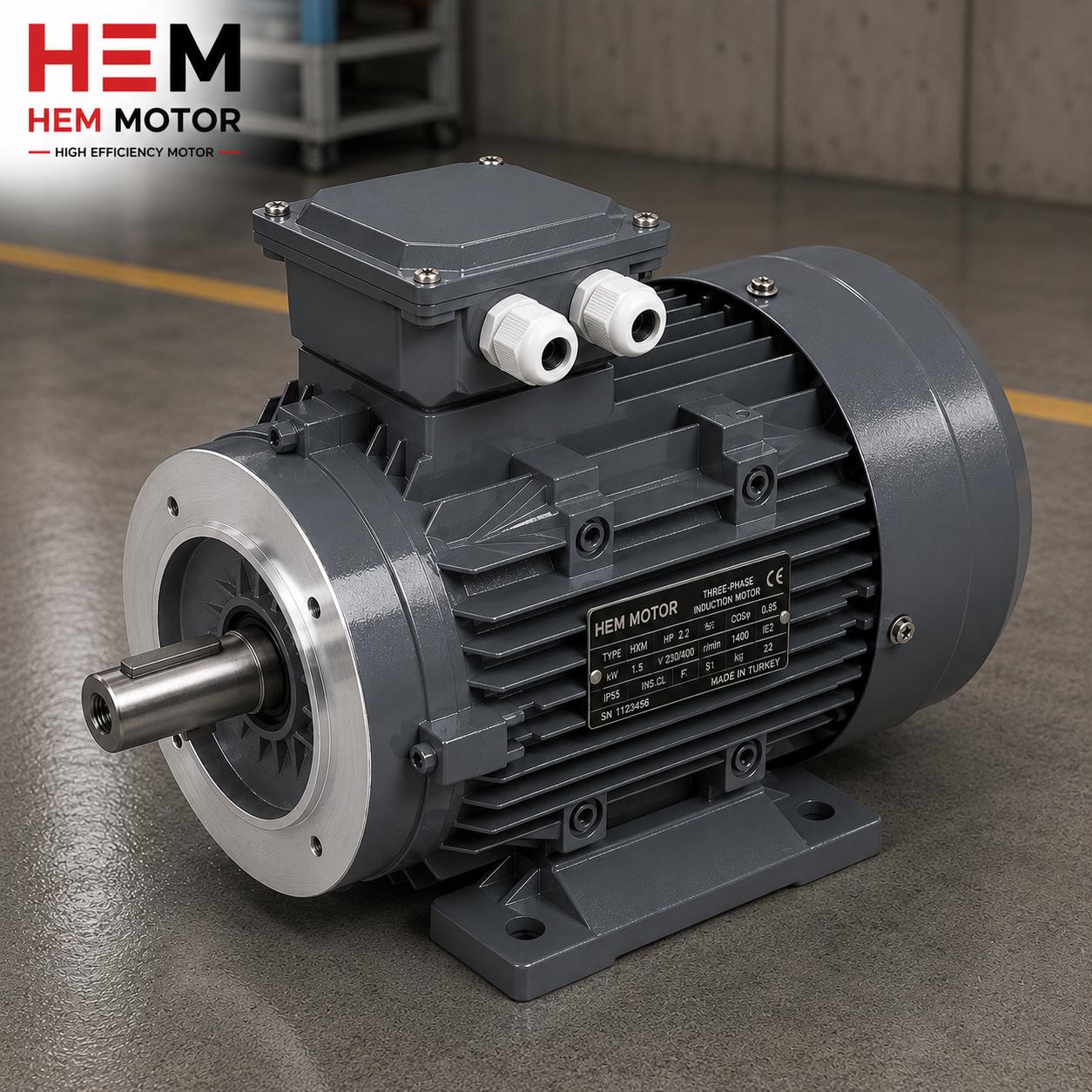

An electric motor turning at high speed faces completely different mechanical challenges than a low-speed equivalent. A 2-pole motor turns at about 3000 rpm at 50 Hz, which means 50 revolutions per second. At this speed, the centrifugal forces and vibration on the motor's rotating parts make mechanical durability a critical issue. In this article we address mechanical durability at 2-pole high speed (3000 rpm) in cast iron motors through vibration, balancing and bearing selection, from a technical and purchasing perspective.
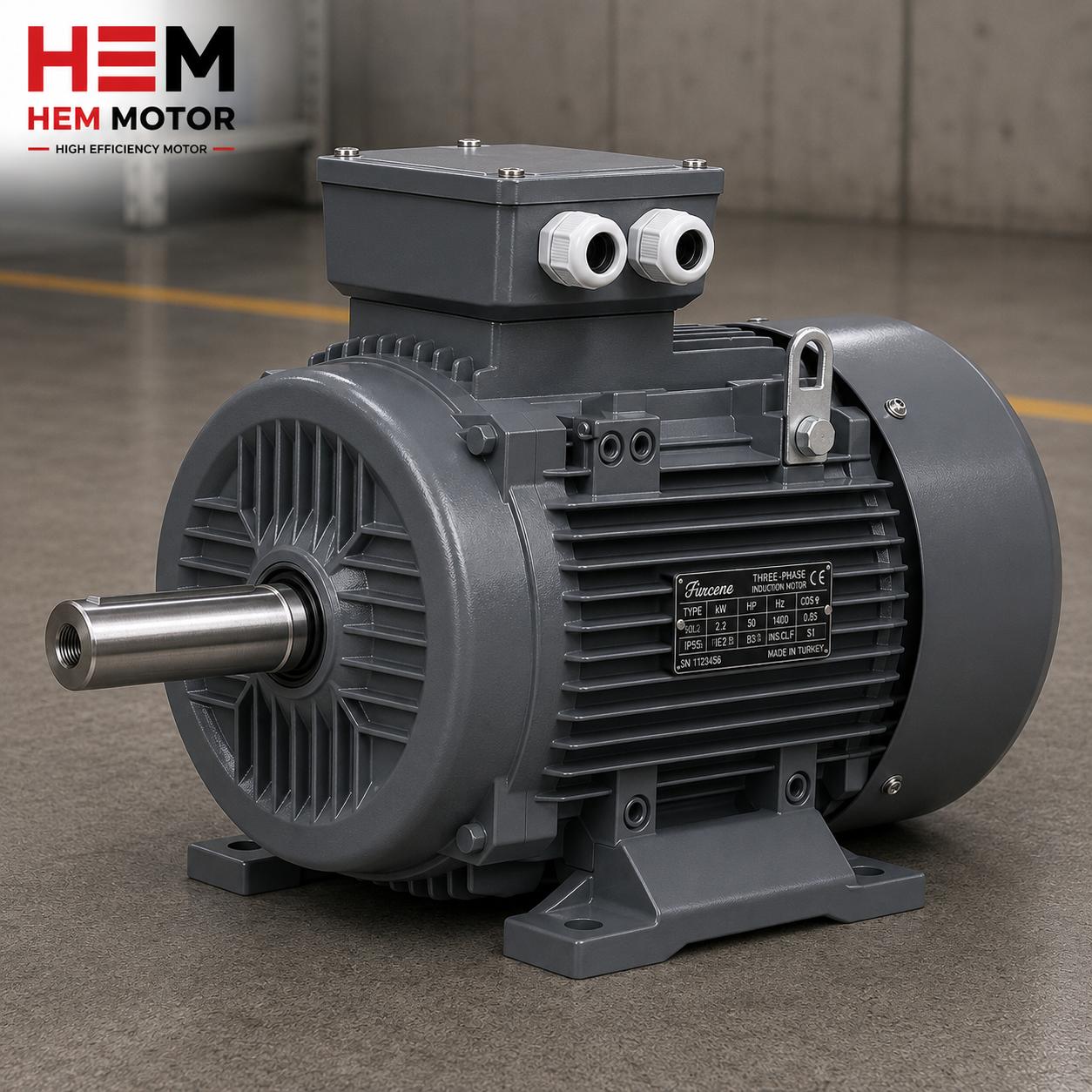
High-speed applications are common in centrifugal pumps, high-speed fans, compressors and some special drives. In these applications, the motor must be designed to withstand high speed not only electrically but also mechanically. The cast iron body provides a clear advantage here; with its high rigidity it damps vibration and moves resonance away from the operating speed.
Below we explain step by step why centrifugal force rises with the square of speed, how the cast iron body damps vibration, and why dynamic balancing and correct bearing selection are essential at high speed.
Centrifugal Force Rises with the Square of Speed
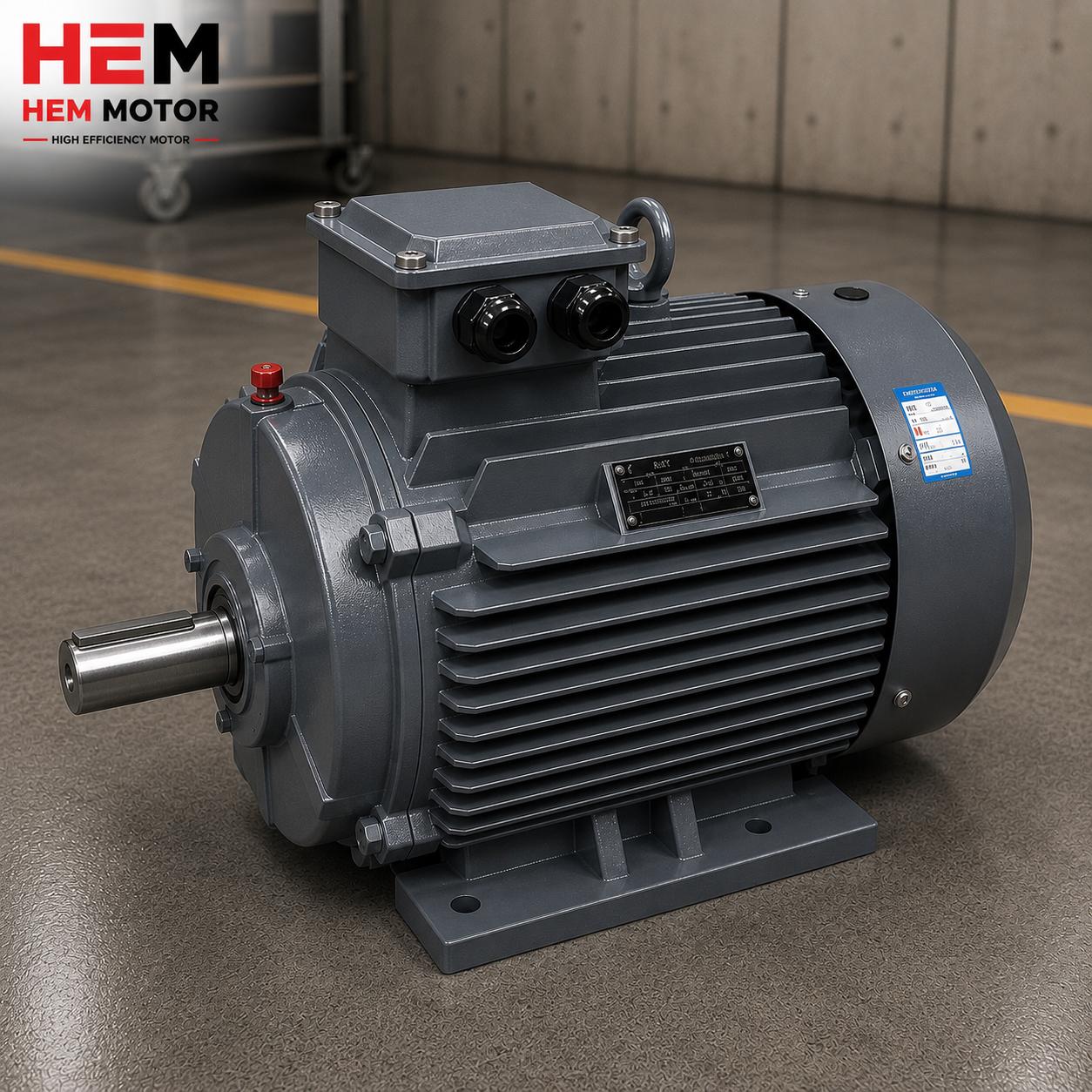
The most critical mechanical phenomenon in a 2-pole motor at 3000 rpm is centrifugal force. The centrifugal force on a rotating part is proportional to the square of the angular speed. So when the speed doubles, the centrifugal force quadruples. Therefore a rotor turning at 3000 rpm is subjected to four times greater centrifugal force than the same rotor turning at 1500 rpm.
This force turns even the smallest imbalance of the rotor into a large source of vibration. Even a mass imbalance of a thousandth of a millimetre on the rotor produces noticeable vibration at high speed. This vibration both wears the motor's bearings and damages the connected equipment. For this reason, vibration control is much more critical in high-speed motors than in low-speed ones.
The Chain Effect of Vibration
Vibration at high speed is not just an annoying noise; it starts a chain of mechanical wear. Vibration first wears the bearing, the bearing clearance increases, which amplifies the vibration and finally leads to early failure. In addition, vibration affects the shaft-coupling connection, the foundation bolts and the connected pump or fan. For this reason, controlling vibration at its source extends the life of the whole system.
The Cast Iron Body Damps Vibration
The cast iron body offers one of the most important mechanical advantages in high-speed motors. The high mass and high rigidity of cast iron effectively damp vibration. Heavier than aluminium-bodied motors, the cast iron body absorbs the vibration energy produced by the rotating parts and transmits less vibration to the outside.
Another important feature of the cast iron body is that it moves resonance away from the operating speed. Every mechanical structure has a natural frequency; if this frequency coincides with the operating speed, vibration grows dangerously (resonance). The high-rigidity cast iron body keeps the natural frequency high and away from the 3000 rpm operating speed. So the motor runs safely at high speed without the risk of resonance. For more information about body type and mounting selection, you can look at our asynchronous motor pole selection content.
Cast Iron versus Aluminium Comparison
The aluminium body is preferred in many applications for its lightness and good heat conduction. But in high-speed and mechanically demanding applications, the rigidity and vibration-damping capacity of the cast iron body come to the fore. Especially in continuously running, high-speed and vibration-sensitive applications, the cast iron body provides a longer life and lower maintenance cost. The correct body selection should be made according to the speed and vibration character of the application.
Two-Plane Dynamic Balancing Is Essential
In a high-speed motor, the balance of the rotor is the basis of mechanical health. Imbalance is the deviation of the rotor's mass centre from the axis of rotation and turns into a large centrifugal force at high speed. For this reason, rotors turning at 3000 rpm are put through two-plane dynamic balancing. While single-plane balancing is sufficient for short rotors, two-plane balancing is required for high-speed and long rotors.
Dynamic balancing is done by measuring and correcting the imbalance remaining in two separate planes of the rotor. At the end of this process, the rotor is brought into conformity with the specified vibration grade (for example ISO 21940 / old G grade). A tight balance grade means low vibration at high speed and long bearing life.
ISO 20816 Vibration Grade
The motor's vibration during operation is evaluated according to the ISO 20816 standard. This standard classifies the motor's vibration velocity (mm/s) and defines acceptable limits. Choosing a tight vibration grade in high-speed motors extends the life of both the motor and the connected equipment. Vibration measurement is done during commissioning and in periodic maintenance to track the motor's mechanical health.
C3 Clearance Bearing Selection
In high-speed and continuously running motors, the bearing is one of the most stressed parts. At high speed the bearing heats up and thermally expands. If the bearing clearance is insufficient, this expansion leads to bearing seizure and early failure. For this reason, C3-clearance bearings are usually preferred in high-speed motors. C3 has a wider internal clearance than the standard clearance (CN) and tolerates thermal expansion.
A C3-clearance bearing extends bearing life by preventing seizure due to heating at high speed. In addition, correct lubrication is also critical in high-speed motors; insufficient or excess grease raises the bearing temperature. Correct bearing selection and correct lubrication together ensure the long-lived operation of the high-speed motor. In some high-speed and heavy-duty applications, re-greasable bearing types are preferred to extend bearing life, allowing the bearing life to be extended with periodic maintenance.
- A C3-clearance bearing tolerates thermal expansion and prevents seizure.
- The correct grease type and amount keep the bearing temperature under control.
- The bearing temperature should be monitored periodically at high speed.
- Vibration and noise are early indicators of bearing health.
Shaft and Coupling Alignment
In the mechanical health of a high-speed motor, the installation is as decisive as the motor itself. The alignment between the motor's shaft and the shaft of the driven machine is critically important at high speed. The smallest misalignment turns into large vibration and bearing load at high speed. For this reason, in high-speed applications, the coupling connection should be precisely adjusted with a laser alignment device.
Misalignment is of two types: parallel and angular. Both create extra load on the bearing and coupling at high speed. Although flexible couplings tolerate some misalignment, the tolerance narrows greatly at high speed. Correct alignment both reduces vibration and extends the bearing and coupling life. So precise alignment during commissioning is a step that should not be skipped in high-speed motors.
Foundation and Mounting Rigidity
The foundation or base frame to which the motor is fixed is also part of the mechanical durability. A flexible or weak foundation amplifies the motor's vibration and increases the risk of resonance. High-speed motors must be fixed to a rigid, vibration-damping foundation. The foundation bolts must be tightened to the correct torque and checked periodically; a loose bolt quickly becomes a vibration source at high speed. A solid installation ensures that the motor's balance and bearing quality truly pay off in the field.
Cooling and Thermal Management
High-speed motors have high power density and require effective cooling. Most 2-pole motors are self-cooled by a fan at the end of the shaft (IC411). At high speed this fan produces a strong airflow, but this also increases fan noise. For cooling to be effective, the motor's air inlets and outlets must be kept open and clean; a blocked air path leads to motor overheating.
Thermal management directly affects the life of the high-speed motor. Overheating adversely affects both the winding insulation and the bearing grease. For this reason, in high-speed motors the cooling paths must be kept clean, the ambient temperature must be considered and, if necessary, additional cooling measures must be taken. Correct cooling, together with balance and bearing selection, completes the safe operation of the motor at high speed.
High-Speed Application Examples
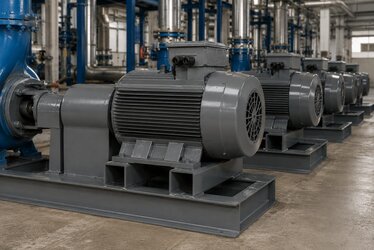
Typical applications using 2-pole high-speed motors are areas where the speed-flow relationship is important. Centrifugal pumps need high speed for high head; for this reason many pumps are driven with a 2900 rpm motor. High-speed fans and extractors prefer 2-pole motors for high air flow. High-speed motors are also common in compressors and some special machines.
The common feature of these applications is that the motor runs continuously at high speed and usually for long hours. This makes mechanical durability, balance and bearing selection even more critical. In a high-speed application, correct motor selection requires evaluating not only power and speed but all mechanical features such as body type, balance grade, bearing clearance and cooling capacity together.
The Speed-Power Relationship
At the same power, a 2-pole motor is smaller and more economical per unit of power than its 4-pole equivalent, because lower torque is enough for the same power at high speed. But if this advantage is not supported by correct mechanical design, it can turn into vibration and bearing problems at high speed. To examine the speed-power relationship in more detail, our article on understanding HP-kW motor power is a useful resource.
Supplying the Right Motor from Stock
In high-speed and mechanically demanding applications, it is critical that the motor is correctly designed and correctly manufactured. In the power range from 0.25 to 355 kW, when 2-pole motors are supplied from stock with manufacturer assurance and fast delivery, both correct mechanical design and fast, safe supply are provided together. This minimises production loss in case of a failure or new investment in a high-speed application and secures the continuity of the operation.
Choosing the right motor means not only determining the power and speed but also evaluating the body type, balance grade and bearing selection according to the application. During stock consultation, the speed, load and vibration character of the application is questioned, so the motor is selected to fully match the application both electrically and mechanically. This prevents problems such as vibration, heating and early bearing failure that are common at high speed. You can review the whole product family and technical content via the homepage.
Frequently Asked Questions
Why is a cast iron body preferred at high speed?
The cast iron body effectively damps vibration with its high mass and rigidity and moves resonance away from the operating speed. Since centrifugal forces and vibration become critical at high speeds such as 3000 rpm, the cast iron body provides a longer life and lower maintenance cost. For this reason, the cast iron body is often preferred in high-speed and continuously running applications.
What does a C3-clearance bearing do?
A C3-clearance bearing has a wider internal clearance than the standard clearance. When the bearing heats up at high speed, it thermally expands; if the clearance is insufficient, the bearing seizes and fails early. The C3 clearance tolerates this thermal expansion, prevents seizure and extends bearing life. For this reason, C3-clearance bearings are usually used in high-speed motors.
Why is vibration so important in a high-speed motor?
Because centrifugal force rises with the square of speed, even the smallest imbalance of the rotor turns into large vibration at high speed. This vibration wears the bearing, affects the shaft-coupling connection and the connected equipment, and leads to early failure. For this reason, two-plane dynamic balancing and a tight vibration grade are essential in high-speed motors. Controlling vibration at its source extends the life of the whole system and, with regular vibration measurement, allows a developing fault to be caught early.