 English
 Türkçe

As energy costs claim an ever larger share of total operating expenses in industrial facilities, choosing the right high-efficiency electric motor has moved to the heart of every investment decision. The purchase price of an electric motor is usually a small line item compared with the energy it consumes over its lifetime, which is why the choice between IE3 and IE4 motors is not merely a technical detail but a strategic decision that directly shapes profitability. On this page we examine in depth the differences between the IE3 premium and IE4 super premium efficiency classes, their energy-saving potential, payback periods, and the right approach to purchasing.
At HEM Motor our goal is not to leave you alone with a single motor code, but to help you determine the most suitable IE3 and IE4 high-efficiency electric motor based on your application, running hours, and energy tariff. With fast supply from manufacturer stock, a clear quotation process, and technical guidance, we put your buying decision on solid ground. In the sections below, we explain step by step how to build the price-performance balance numerically and which efficiency class makes more sense in which scenario.
Switching to a more efficient motor is one of the fastest-returning energy-efficiency investments available to most businesses. In continuously running applications such as pumps, fans, compressors, and conveyors, every efficiency point gained turns into tangible annual savings. That is precisely why selecting the correct class matters just as much as sourcing it from the right supplier at the right time.
The Difference Between IE3 Premium and IE4 Super Premium Efficiency Classes
The efficiency of electric motors is defined by IE (International Efficiency) classes under the international IEC 60034-30-1 standard. IE1 denotes standard efficiency, IE2 high efficiency, IE3 premium efficiency, and IE4 super premium efficiency. As a motor's IE class rises, the electrical energy it draws from the grid to produce the same mechanical power decreases; in other words, it does the same job with fewer losses. IE3 premium efficiency motors today represent a proven technology that has become the standard across a broad swath of industry.
IE4 super premium efficiency motors push the efficiency curve one step further. Typically, IE4 motors generate roughly 15 to 20 percent fewer losses than equivalent-power IE3 motors. Although this may look like a small percentage, in high-power, long-running applications it translates into a noticeable reduction in the annual energy bill. Because IE4 motors generally contain more copper, higher-grade electrical steel, and optimized design geometry, their purchase cost is higher than IE3, which makes price-performance analysis essential.
The Effect of Efficiency Class on Nominal Efficiency
For example, a 4-pole 11 kW motor may have a nominal IE3 efficiency of around 91.4 percent, while an IE4 motor of the same power can reach approximately 92.6 percent. Those few decimal points add up to significant cumulative kilowatt-hour savings once the motor runs for thousands of hours. Absolute savings grow as power increases, while at lower powers the efficiency gap can be proportionally more pronounced. For this reason, every application should be evaluated on its own terms, with numerical calculation taking precedence over general assumptions.
Motor Losses: Copper Losses and Iron Losses
The main factor determining the efficiency of an induction motor is the losses inside it. Reducing these losses through a more efficient design is the source of the fundamental difference between the IE3 and IE4 classes. Understanding the losses is the key to grasping why IE4 motors, although more expensive, can be more economical in the long run.
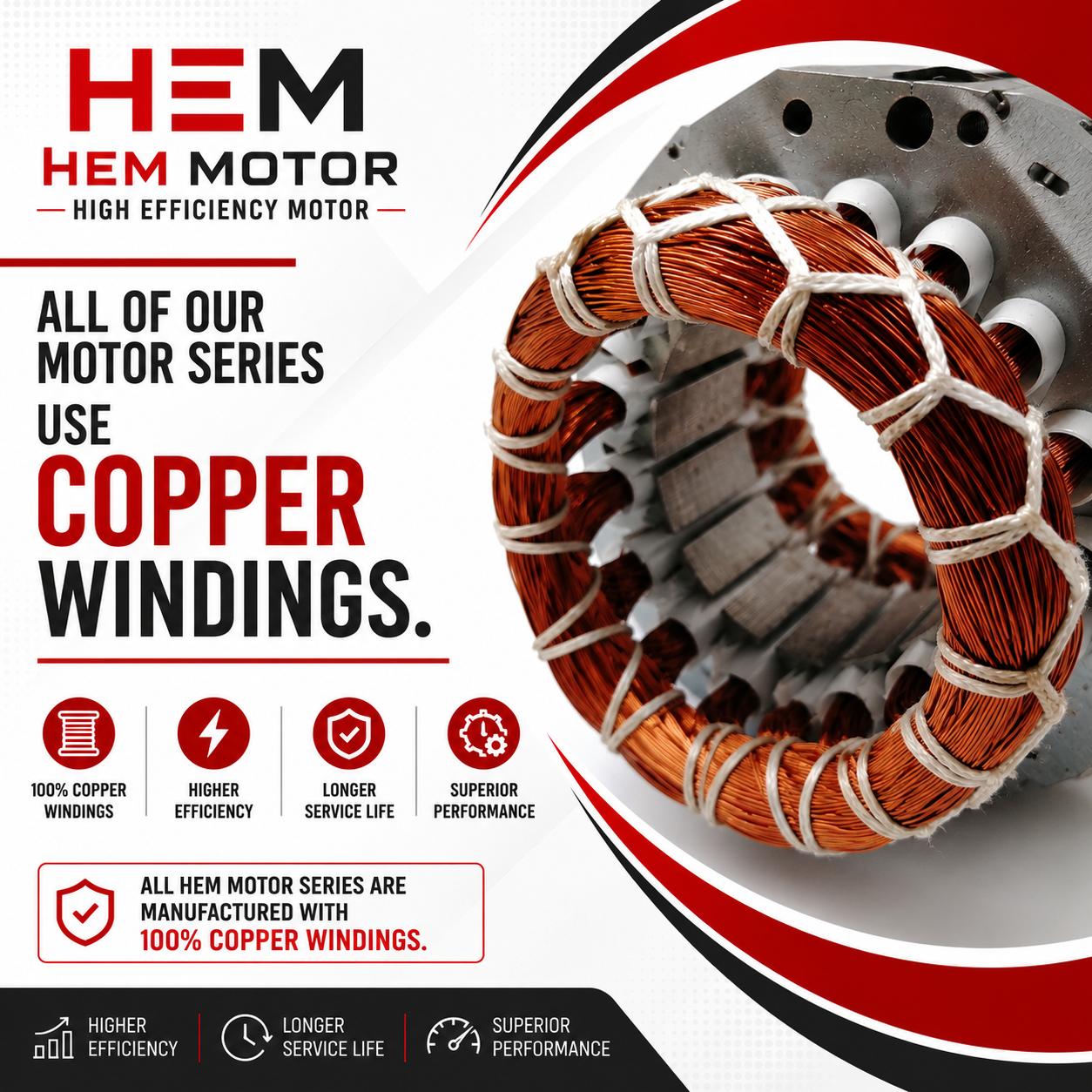
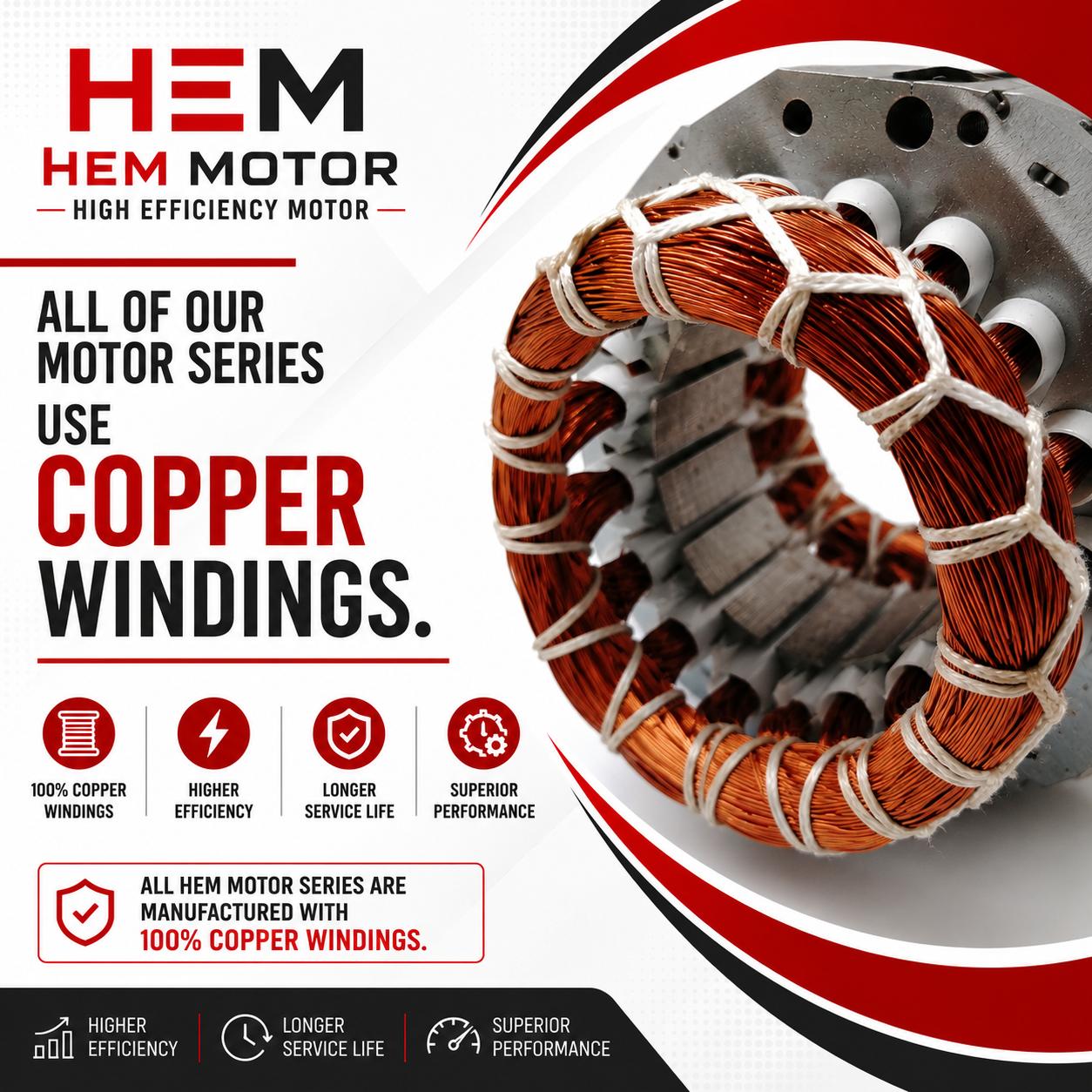
- Copper losses (winding losses): Energy converted to heat by the electrical resistance in the stator and rotor windings. Using thicker cross-sections and more copper reduces these losses; IE4 motors generally contain more copper.
- Iron losses (core losses): Hysteresis and eddy current losses caused by the changing magnetic field. Using thin, low-loss electrical steel reduces these losses.
- Mechanical losses: Friction in the bearings and windage created by the cooling fan. Optimized cooling design improves this category.
- Stray load losses: The hardest loss type to model, arising from a non-ideal flux distribution and reduced through design quality.
Deliberately lowering both copper and iron losses in IE4 motors also brings side benefits such as a lower operating temperature and longer insulation life. This means the motor gains value not only in how much energy it consumes but also in terms of service life and reliability. Proper high-efficiency electric motor supply requires considering this multidimensional benefit as a whole.
EU EcoDesign Regulation and Minimum Efficiency Requirements
The European Union's EcoDesign regulation legally defines the minimum efficiency classes of electric motors placed on the market. This regulation has tightened progressively over time in order to reduce energy consumption and lower the carbon footprint. In current practice, a minimum IE3 class has become mandatory for three-phase induction motors across a wide power range, and IE4 requirements have also begun to apply in certain power bands.
This legislation has effectively limited new sales of IE1 and, in many cases, IE2 class motors. Therefore, when making a new investment the question is no longer "should I buy an efficient motor?" but rather "is IE3 or IE4 the better choice?" While EcoDesign requirements accelerate the move toward energy-efficient equipment, they also make a sound price-performance analysis unavoidable for selecting the correct class. Sourcing compliant, certified, and correctly labeled motors from a reliable manufacturer is critical for both legal compliance and real savings.
Regulatory Compliance and Correct Documentation
Whether a motor is genuinely in its declared efficiency class is verified through the efficiency values on the motor nameplate and in the technical documentation. During purchasing, requesting that the efficiency class, the nominal efficiency percentage, and the relevant standard reference be clearly stated at the quotation stage provides you with assurance for future energy audits and savings calculations alike. An experienced supplier offering IE3 and IE4 motor stock should be able to provide these documents in full.
Price-Performance Comparison: IE3 or IE4?
The choice between IE3 and IE4 cannot be made by looking at the purchase price alone. The correct approach is to evaluate the Total Cost of Ownership (TCO) over the motor's lifetime. A motor's total cost consists of three main components: purchase cost, energy cost, and maintenance cost. In continuously running industrial motors, energy cost often accounts for more than 90 percent of the lifetime total cost. This striking ratio explains why the initial price difference remains secondary in most scenarios.
The higher purchase cost of an IE4 motor compared with IE3 is recovered over time through lower energy consumption. The speed of recovery depends on the motor's power, annual running hours, load profile, and unit energy price. When these variables are favorable, the additional investment in IE4 amortizes itself quickly, while for applications with few running hours or low power, IE3 may be a more balanced choice.
Calculating the Payback Period
Calculating the payback period follows simple but powerful logic. First, the annual energy savings arising from the efficiency difference between the two motors is found, then converted into a monetary value, and finally the additional purchase cost is divided by this annual saving. The steps can be summarized as follows:
- Running hours: Determine how many hours the motor runs over the year. In a three-shift, continuously operating facility this figure can exceed 8,000 hours.
- Efficiency delta: Take the difference between the nominal efficiency values of the IE4 and IE3 motors as a percentage.
- Annual energy savings: Combine motor power, running hours, and the efficiency delta to calculate the kilowatt-hours saved per year.
- Energy cost: Multiply the saved energy by your facility's unit electricity tariff to find the monetary saving.
- Payback: Divide the additional purchase cost of IE4 over IE3 by the annual monetary saving to obtain the payback period in years.
In high-power, continuously running applications the payback period for an IE4 investment is often under a few years, while the economic life of the motor usually exceeds ten years. This means that all the years after payback remain as net savings for the business. To clarify your calculation, we recommend reviewing the criteria on electric motor selection and sharing data specific to your application with your supplier.
When to Choose IE3 and When to Choose IE4
The right decision depends on the character of the application. The approach below provides a practical roadmap for most businesses. Still, because each facility's load profile and energy tariff differ, the final decision should always be supported by numerical calculation.
Scenarios Where IE3 Premium Makes Sense
In applications with low running hours, intermittent operation, or those positioned as backup units, IE3 premium motors generally offer the most balanced price-performance point. Seasonally operating equipment, systems that run only a few hours a day, and projects where budget constraints are prominent are typical cases where IE3 is advantageous. IE3 also stands out for fast stock availability across a wide power range, which is an important supply advantage in projects requiring short delivery times.
Scenarios Where IE4 Super Premium Excels
In applications that run continuously under high load, where energy cost is decisive in operating expenses, IE4 super premium motors come out on top. Pump stations, continuously running fans, compressors, and process lines are areas where IE4 quickly recovers its additional cost. Moreover, thanks to their lower operating temperature, IE4 motors also provide indirect advantages in environments where cooling load and thermal wear are critical. For the technical details of these classes, you can review our IE3 electric motor and IE4 electric motor pages.
The Total Cost of Ownership (TCO) Approach
Making a purchasing decision based solely on the sticker price often leads to a costly mistake. The total cost of ownership approach gathers all the expenses a motor will generate over its lifetime into a single picture and makes the real cost visible. This approach clearly reveals that an initial price difference of a few percent usually becomes insignificant next to the energy savings accumulated over the years.
Items to consider in a TCO analysis include the purchase price, installation and commissioning costs, lifetime energy consumption, planned maintenance, potential failure and downtime costs, and end-of-life value. The low operating temperature and robust construction of an efficient motor also provide indirect savings in maintenance and failure items. For this reason, evaluating the IE3 and IE4 motor purchase decision through the TCO lens is the safest way to protect yourself from the misleading pressure of short-term budgeting.
Fast Supply from Manufacturer Stock and the Right Quotation Process
Once you have determined the correct efficiency class, the next step is to source it from a reliable supplier on time and at the right price. Sourcing directly from a manufacturer offers significant advantages in both price-performance and delivery speed. A broad and current IE3 and IE4 motor stock prevents your projects from being crushed under schedule pressure; having standard power and speed combinations ready on the shelf means short delivery times.
A fast and clear quotation process is a precondition for a sound purchasing decision. Sharing the basic data of your application in your quotation request ensures the most suitable class is recommended to you. At HEM Motor, we help you define your need correctly, present IE3 and IE4 alternatives in a comparative price-performance manner, and shorten your delivery time with fast supply from stock. For current electric motor prices and supply conditions, simply send us your quotation request.
Information to Share in Your Quotation Request
- Motor power and speed: The kW power required by the application and the number of poles (such as 2, 4, or 6 poles).
- Operating profile: Annual running hours, load condition, and whether operation is continuous or intermittent.
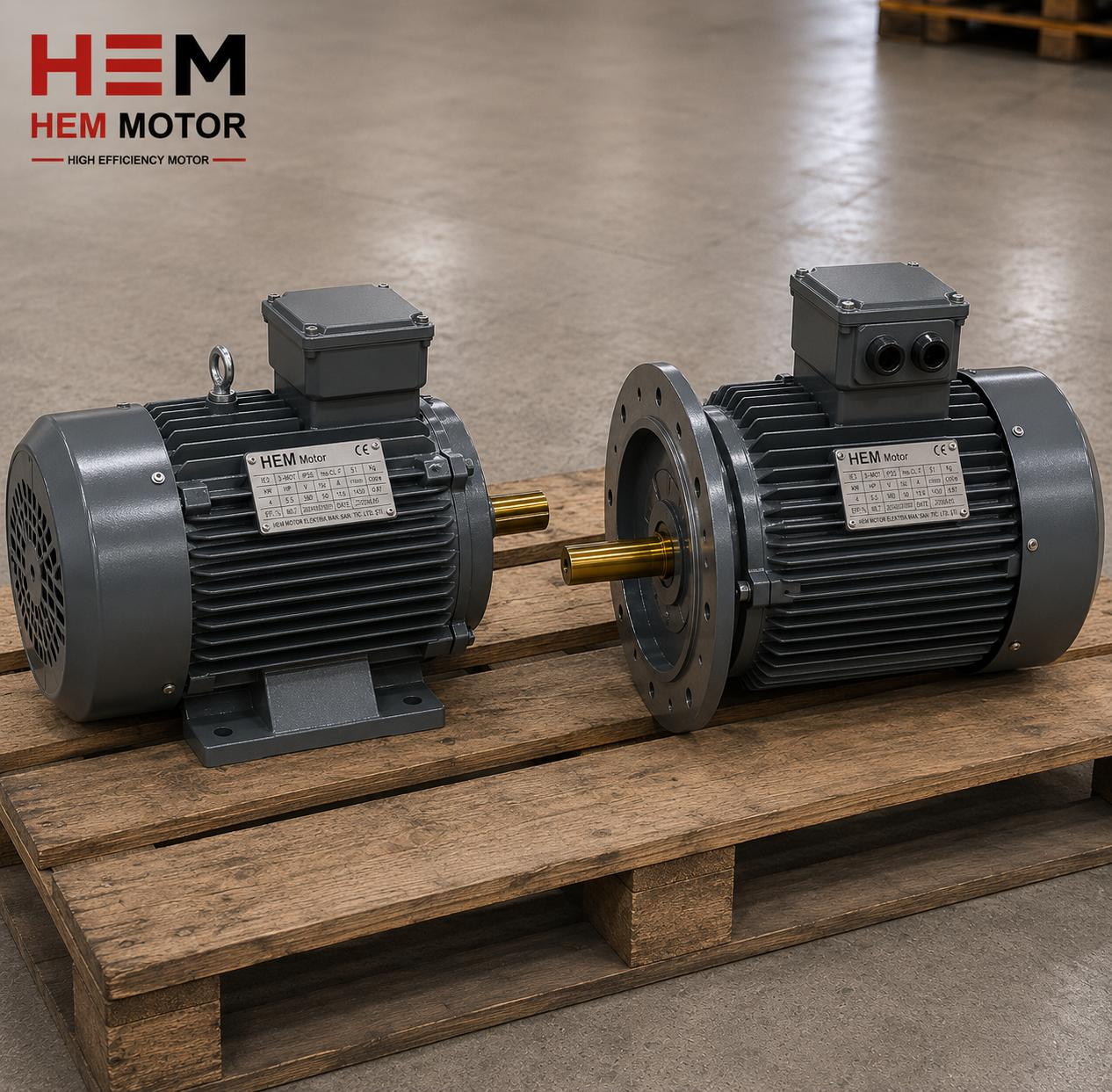
- Mounting and frame type: Foot-mounted, flange-mounted, or combined mounting, along with the expected protection class.
- Environmental conditions: Ambient temperature, dust/humidity conditions, and any special application requirements.
- Target efficiency class: Whether IE3 or IE4 is preferred, or the expectation of a comparative quotation.
A quotation prepared with this information ensures both the selection of the correct class and the avoidance of unnecessary over-investment. The goal is not to supply the most expensive motor, but the one best suited to your application with the lowest total cost.
Frequently Asked Questions
How much energy does an IE4 motor save compared with IE3?
IE4 super premium motors typically generate roughly 15 to 20 percent fewer losses than equivalent-power IE3 premium motors. In terms of nominal efficiency, this corresponds to an improvement of approximately one to two percentage points depending on the power. The absolute saving grows in direct proportion to the motor's power and annual running hours; in continuously running high-power applications the saving is clearly felt in the annual energy bill.
How long does it take to recover the additional cost of an IE4 motor?
The payback period depends on motor power, annual running hours, the efficiency delta, and the unit energy price. In high-power applications running three continuous shifts, the payback period is often under a few years. Because the economic life of the motor usually exceeds ten years, all the years after payback remain as net savings for the business. In applications with low running hours, however, IE3 may be more balanced.
What should I pay attention to in the quotation process for the right efficiency class?
In the quotation process it is important to clearly share the motor power, speed, annual running hours, load profile, mounting type, and environmental conditions. This data enables an accurate price-performance comparison of the IE3 and IE4 alternatives. Additionally, requesting that the efficiency class and nominal efficiency value be clearly stated in the quotation, that the motors be available for fast supply from current stock, and that certified documentation be provided gives you assurance for both legal compliance and real savings.