 English
 Türkçe

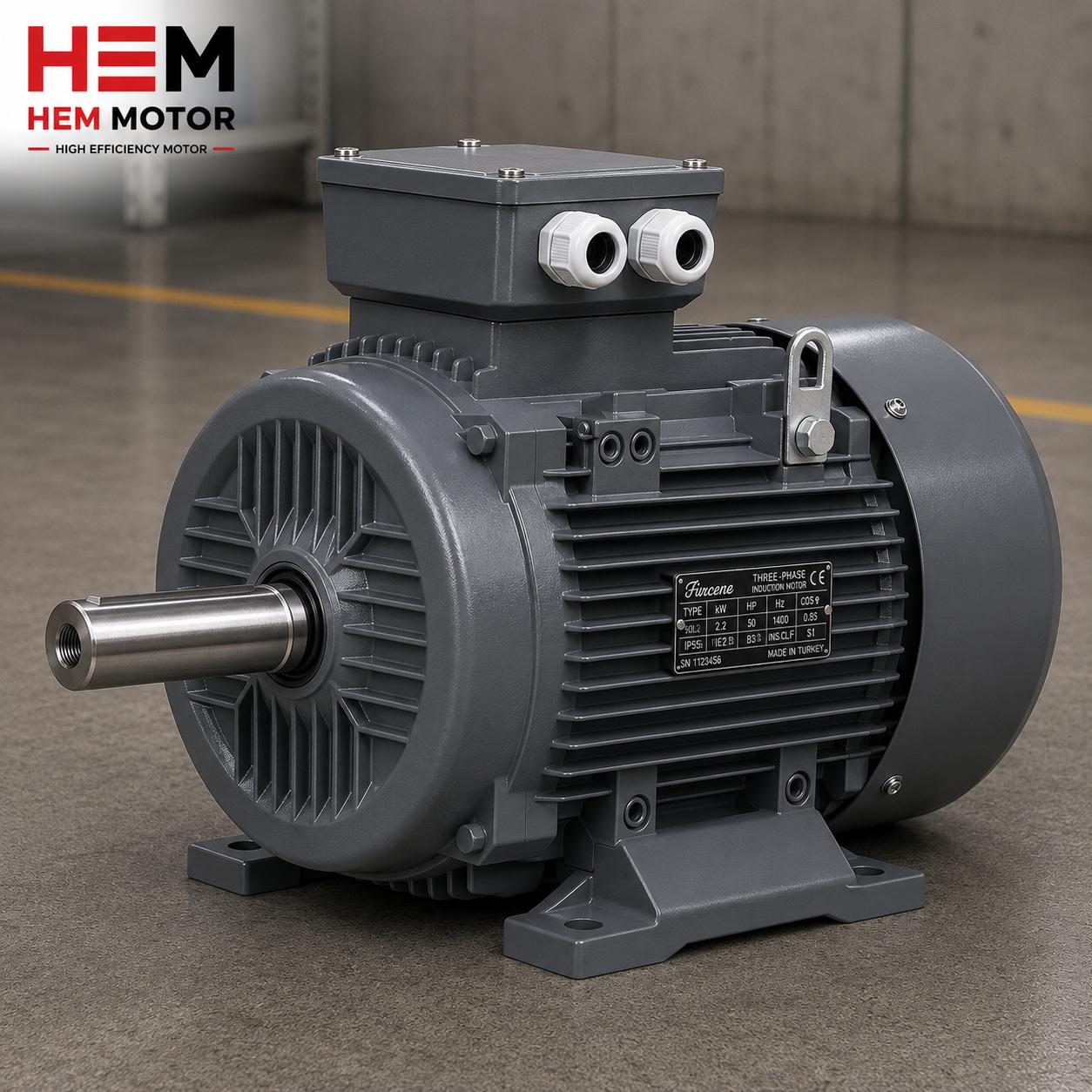
Denizli is one of the cities where the heart of Türkiye's textile production beats. Across an ecosystem that ranges from suitcase trade to giant integrated facilities producing for global brands, the invisible yet indispensable hero of production is the electric motor. From spinning machines to weaving looms, from dye-house pumps to stenter fan drives, a correctly selected, high-quality and quickly supplied motor directly determines a facility's efficiency and uninterrupted operation. In this article we cover electric motor sales, price advantage and supply processes for Denizli's textile industry, all backed by manufacturer assurance.
The Place of the Electric Motor in Denizli's Textile Industry
In Denizli, textiles are not merely a sector; they shape the livelihood of thousands of families, dozens of large facilities in the organized industrial zones, and the economic identity of the city. In this intense production tempo, machines run on a shift basis, often three uninterrupted shifts. At such a pace, it is not enough for the motor merely to turn; it must be high-efficiency, heat-resistant, low-vibration and long-lived.
The conditions an electric motor faces in textile facilities are quite harsh. Lint, dust and fiber particles fill the air; in dye and finishing sections, moisture and chemical vapor are high; on stenter and drying lines, ambient temperature rises above that of standard industry. For this reason, the correct motor choice for Denizli's textile producers is a holistic decision that covers not only price but also protection class, insulation and frame material.
Most Common Motor Applications in Textiles
- Spinning and twisting machines: High-speed, precise speed control, mostly 2- and 4-pole motors.
- Weaving and knitting looms: Low-vibration main drive motors running in continuous S1 duty.
- Dye-house pumps: Cast iron, at least IP55 protected motors exposed to moisture and chemicals.
- Stenter and drying fans: Heat-resistant fan drive motors with Class F insulation.
- Compressor and booster groups: Motors demanding high starting torque and continuous duty.
- Air handling units and exhausters: Efficient fan motors running continuously for facility ventilation.
How Is a Price Advantage Achieved in Denizli?
The textile sector is an area of thin profit margins where energy cost takes a serious share of total expenses. Therefore, for a Denizli business, the electric motor price decision cannot be made by looking only at the label at the moment of purchase. Total cost of ownership requires considering the motor's efficiency class, operating hours and electricity unit price together.
Direct supply from the manufacturer eliminates intermediate layers, providing both a price advantage and speed. You will find the most accurate information on electric motor prices in the quotation you obtain by clearly defining your need. Once stock availability, power range and mounting type are clarified, the right motor for your Denizli facility ships quickly.
The Effect of Efficiency Class on Price
For a motor running 16-24 hours a day in a textile facility, an IE3 Premium or IE4 Super Premium efficiency class recovers the small initial investment difference from the electricity bill within a few years. An old, low-efficiency motor continuously accumulates a loss that is invisible on the bill while drawing its labeled power. In a city with an intense work tempo like Denizli, this loss reaches serious figures on an annual scale.
Fast Supply and Stock Assurance
In textiles, a stopped machine often means not just that machine but the whole line stopping. When a weaving loom's main motor burns out, a spare arriving days later means a missed delivery deadline. This is exactly why, for facilities in Denizli, stock and fast shipment capacity can be more critical than price.
- Broad stock in commonly used powers (0.55–75 kW) provides a solution within hours in emergency failures.
- Holding B3 foot-mounted, B5 flange and B35 combined mounting types in stock means rapid adaptation to different machine types.
- The variety of 2-, 4- and 6-pole motors instantly answers different speed needs.
- A spare motor backed by manufacturer assurance is not a "temporary fix" but a permanent investment.
The Right Supplier Reflex in an Emergency
For a textile business, the worst scenario is the main drive motor failing on the night shift with no spare available. The way to manage this risk is to stock spares of critical motors in advance and work with a manufacturer that provides fast supply. The right supplier is not one that merely sells the motor, but a partner that confirms the correct power, speed and mounting type together with you.
Supply in Denizli OIZ and Surrounding Districts
The Denizli Organized Industrial Zone is one of Türkiye's most active textile production centers. Besides the integrated facilities here, intense weaving and knitting production also takes place in districts such as Babadağ, Buldan, Sarayköy and Çivril. Electric motor supply for this entire geography must be planned to meet the needs of both small workshops and large integrated facilities.
A 0.75 kW motor is as critical for a small twister as a 90 kW pump motor is for a large dye-house. The right supplier is a structure that can provide stock and quotations across this entire power range, serving quickly regardless of scale. Motor supply processes in other regions where textile production concentrates should be evaluated with the same diligence.
Points to Consider for Correct Motor Selection
- Power (kW): Should be selected by the machine's real shaft power demand; an unnecessarily large motor is both expensive and inefficient.
- Speed (pole count): 2-pole ~3000, 4-pole ~1500, 6-pole ~1000 rpm; determined by application.
- Protection class: At least IP55 is recommended for the dusty and humid textile environment.
- Insulation class: Class F insulation should be the standard choice for hot environments.
- Frame material: In heavy-duty applications, a cast iron body is advantageous for vibration and life.
- Mounting type: B3, B5, B14, B35 — the one suitable for the machine connection should be clarified from the start.
Frequently Asked Questions
How quickly can I receive a motor for my textile facility in Denizli?
For standard powers and mounting types held in stock, fast shipment is provided once the need is clarified. For motors in the commonly used 0.55–75 kW range, the supply time is usually very short; for project-based special powers, lead time is stated clearly from the outset.
Does it make sense to replace my old motor with a high-efficiency one?
For a textile motor running more than 16 hours a day, switching to IE3 or IE4 class repays the initial investment difference through electricity savings within a few years. A simple calculation with your operating hours and electricity unit price clearly shows when the switch turns into profit.
Which motor is suitable for humid environments like a dye-house?
In dye and finishing sections where moisture, chemical vapor and water splash are present, motors that are at least IP55 protected, Class F insulated and cast iron bodied are recommended. These features ensure the motor operates safely and for a long life in this harsh environment.
A motor supply that can keep pace with the rhythm of Denizli's textile industry is possible by combining the right product, the right price and fast delivery. When you define your need clearly, you can procure the most suitable motor for your facility with manufacturer assurance and competitive terms.