 English
 Türkçe


Do you need to set up a drive that will reduce the speed and increase the torque? For your geared electric motor and worm gear reducer needs, HEM Motor offers single-point supply. You buy the motor and the reducer as a fully compatible gearmotor (geared motor) without dealing with each separately. With our identity as manufacturer and seller, we offer a wide frame and ratio range from stock and with fast delivery, and we prepare a fast quote according to your need. On this page we explain how a geared motor works, the worm gear and helical bevel reducer options, the HEM30-130 frame range and the correct selection steps. From conveyor to mixer, from door drive to packaging machine, we determine the correct output speed and torque together in every application. Buying both the motor and the reducer from a single source saves time in assembly and gathers responsibility at a single point; for spare parts and service needs you also handle your business with a single point of contact.

How Does a Geared Motor Work? Speed Reduction and Torque Increase
An electric motor on its own rotates at high speed, but most machines do not need such fast rotation; on the contrary, they require a slower and more powerful drive. This is where the reducer comes into play. The reducer lowers the high speed of the motor by the gear ratio and increases the torque (the turning force) by the same proportion. The rotation taken from the output shaft is the slow but powerful movement that your machine requires. The gearmotor, which combines the motor and reducer in a single housing, gathers this work into a compact, sturdy and easy-to-maintain package.
The key to selecting the right geared motor is the output speed and the output torque. We first determine at what speed the machine should rotate and what torque it requires; then we match the motor power, reducer ratio and mounting form accordingly. As HEM Motor we make this calculation together with you and set up a perfectly fitting drive that is neither larger nor smaller than necessary.
The Difference Between a Worm Gear Reducer and a Helical Bevel Reducer
A worm gear reducer consists of a worm and gear wheel pair; it provides a high reduction ratio in a single stage, is compact and generally offers a right-angle (90°) output. With its quiet operation and self-locking (no back-driving) feature at certain ratios, it is preferred in applications such as doors, barriers, mixers and conveyors. The helical bevel reducer, on the other hand, stands out in heavy and continuous loads with its higher efficiency and higher torque-carrying capacity. The choice between the two types is made according to the application's ratio, efficiency expectation and load profile.
| Feature | Worm Gear Reducer | Helical Bevel Reducer |
|---|---|---|
| Output angle | Right angle (90°) | Right angle, high torque |
| Single-stage ratio | High reduction | Medium-high |
| Efficiency | Good, compact | Higher |
| Self-locking | Present at certain ratios | Generally absent |
| Typical use | Conveyor, door, mixer | Heavy continuous load, line drive |
HEM30-130 Frame Worm Gear Reducer Range
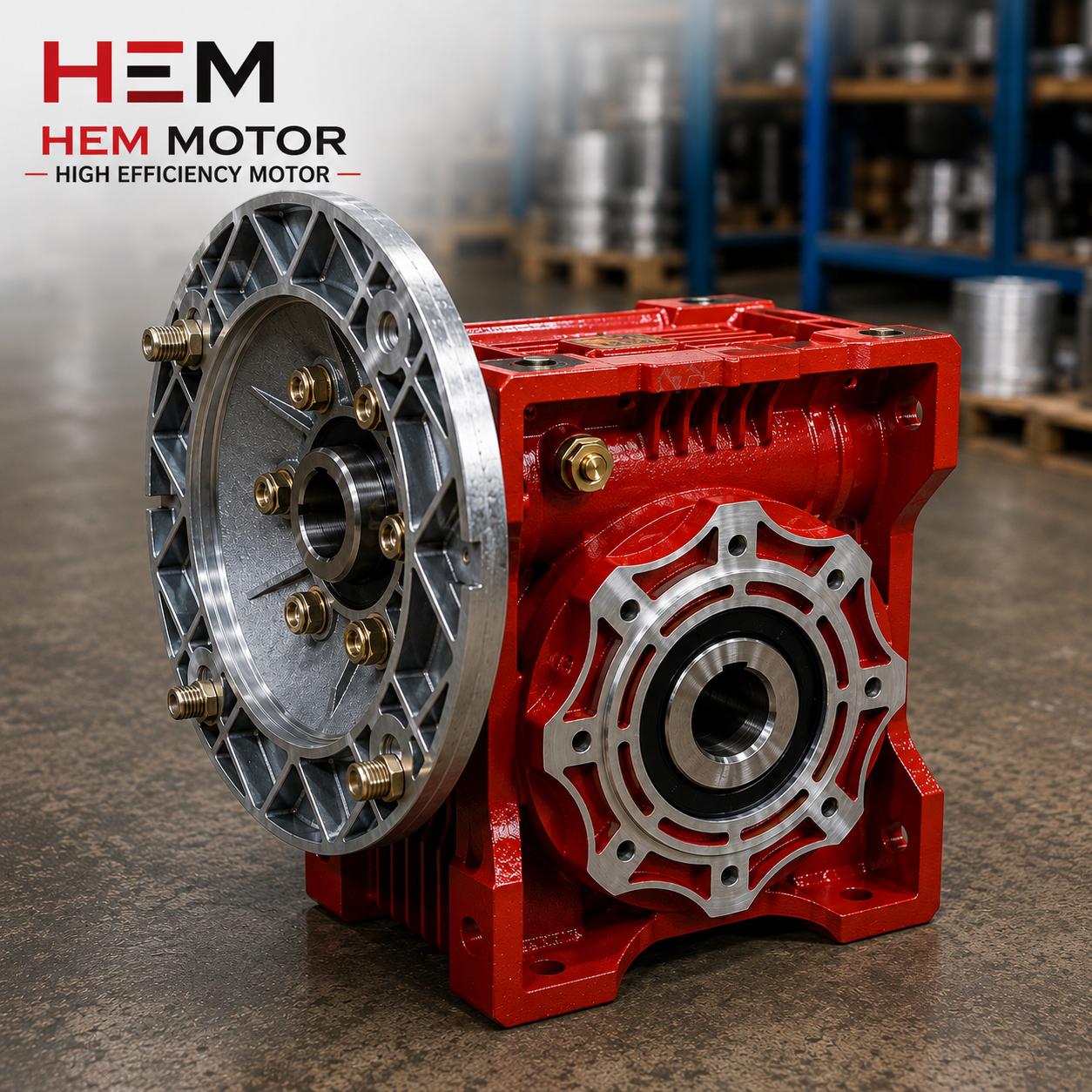
The HEM Motor worm gear reducer range covers a wide frame range from small machines to medium-scale drives. The HEM30, HEM40, HEM50, HEM63, HEM75, HEM90, HEM110 and HEM130 frames answer different torque and ratio needs. Small frames are used in compact and light machines, while large frames are used in conveyor and mixer applications requiring higher torque. All frames are offered with foot-mounted (B3) or flange-mounted options and with different output shaft configurations.
- HEM30-HEM50 — compact machines, small conveyors, dosing
- HEM63-HEM90 — medium-load conveyor, mixer, packaging line
- HEM110-HEM130 — heavy drives requiring high torque
- Foot-mounted (B3) and flange-mounted options
- Single output shaft, double output shaft and hollow shaft options
We can supply the reducer by combining it directly with the motor (geared motor) or by connecting it to the motor of your choice via a PAM flange interface. In this way you remain flexible between using your existing motor or buying a complete new gearmotor.
The Relationship Between Reducer Ratio and Output Speed
The heart of the reducer is the reduction ratio. The larger the ratio, the lower the output speed and the higher the output torque. For example, a high-ratio worm gear reducer turns the fast-spinning motor into a very slow but powerful output shaft; this is exactly the behaviour sought in mixers, rotary tables or door drives that need to move a heavy load at low speed. A lower-ratio reducer, on the other hand, leaves a higher speed at the output and suits applications where you need to keep the conveyor speed or feed rate high. When determining the right ratio, we take into account not only the speed but also the torque demand of the machine at the moment of start-up; because many machines require higher torque when starting than during continuous operation. For this reason we size the reducer and motor not only for the nominal operating point but also for the start-up and peak load conditions.
Setting up the output speed and torque balance correctly is critical in terms of both energy and mechanical life. A ratio higher than necessary may slow the machine down unnecessarily and reduce productivity; a ratio lower than necessary leaves the torque insufficient, strains the reducer and brings heating and early wear. As HEM Motor we set up this balance according to your application and capture the correct ratio-power-torque trio in one go.
Steps to Select the Right Geared Motor
To place the selection on a solid foundation, we clarify the following information in order: the required output speed of the machine, the required output torque, the operating duty type (continuous or frequent start-stop), the mounting position and the ambient conditions. If there is frequent start-stop or impact load, the service factor and thermal capacity are selected with a wider margin. The output shaft direction and the mounting flange must fit your machine. As HEM Motor we carry out these steps together with you and prevent the losses experienced due to a wrong ratio or insufficient torque.
Service Factor and Duty Type: Sizing the Reducer Correctly
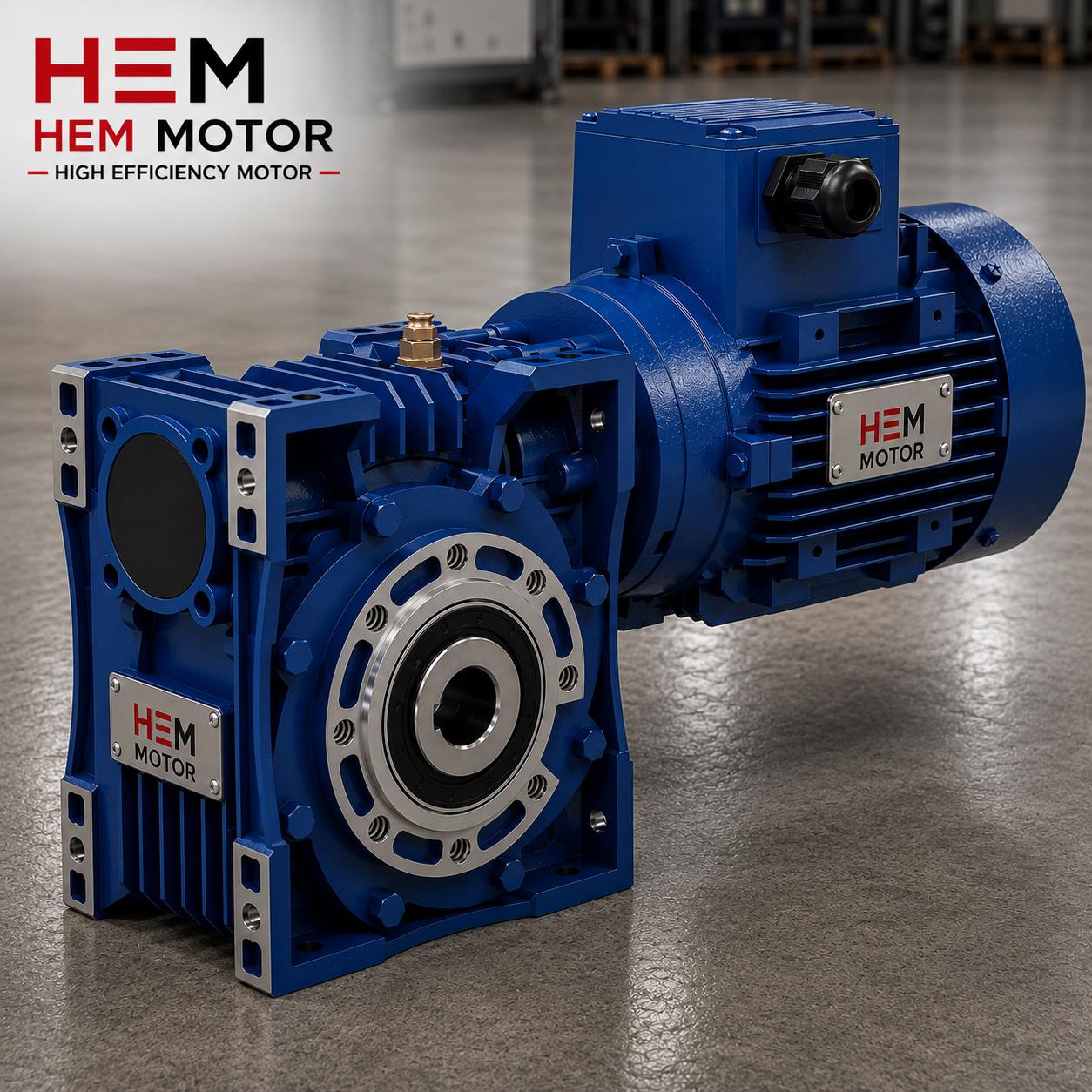
The field life of a geared motor is often determined by the selected service factor. The service factor shows how much margin you leave above the nominal capacity of the reducer; if there is frequent start-stop, impact load or high inertia, this margin is widened. While a standard service factor is sufficient in a continuous and smooth conveyor drive, in a door drive that engages hundreds of times during the day or in a mixer with sudden load increases, selecting a higher service factor prevents early wear and unplanned stoppage. Defining the duty type correctly (continuous, intermittent, frequent-start) is the key to sizing both the reducer and the motor neither too little nor too much.
As HEM Motor we evaluate the real operating regime of your application together and select the service factor and thermal capacity accordingly. In this way the reducer carries the expected load with a safe margin; the risk of heating, back-kick and early gear wear is minimized. A correctly sized gearmotor runs for years with low maintenance and a stable torque output.
Single-Point Supply: Motor + Reducer Together
Buying the motor from one place and the reducer from another means compatibility problems, prolonged lead time and scattered responsibility. With HEM Motor the motor and reducer come from a single point, fully compatible with each other. This provides both ease of assembly and the advantage of a single point of contact. With fast delivery from stock and a fast quote you complete your project on time. For current electric motor and reducer prices you can reach us from the HEM Motor homepage, tell us your requirement and get a quote.
- Fully compatible motor + reducer package
- Fast delivery from stock and a wide frame range
- Single point of contact, single invoice, single responsibility
- Competitive price-performance with the manufacturer advantage
Typical Applications Where Geared Motors Are Used
The geared electric motor appears in almost every corner of industry. Wherever low speed and high torque are required, a gearmotor is at work. The HEM Motor worm gear and helical bevel reducer range is frequently preferred in the following applications:
- Conveyors and transport belts — drives the belt at a stable speed and the required torque
- Mixers and agitators — mixes dense product at low speed with high torque
- Industrial door and barrier drives — safe stopping with self-locking
- Packaging and wrapping machines — synchronized and precise output speed
- Rotary tables and turning units — high torque, low vibration
- Feeding and dosing augers — controlled low speed
In each of these applications, the right frame, the right ratio and the right mounting form differ. With the machine and load information you share with us, we determine the perfectly fitting geared motor together. For continuously running heavy lines, the helical bevel reducer, and for compact and quiet drives, the worm gear reducer, is often the most correct solution.
Frequently Asked Questions
Can I connect a worm gear reducer to my existing motor?
Yes. Thanks to the PAM flange interface, we can connect the reducer to your existing electric motor. We clarify the motor frame size, shaft diameter and flange dimensions and recommend a suitable reducer.
In which case should I choose a worm gear and in which a helical bevel reducer?
If a high ratio, a compact structure and self-locking are desired, a worm gear is suitable; if there is higher efficiency and heavy continuous load, a helical bevel reducer is suitable. We evaluate your load profile together and recommend the right type.
Can I get a geared motor quickly from stock?
Common frames and ratios are delivered quickly from stock. Tell us your requirement; we quickly inform you of the stock availability and lead time according to the frame, ratio and mounting information.
How do you determine the output speed and torque?
We first determine at what speed your machine should rotate and what torque it should produce; then we match the motor power and reducer ratio accordingly. By also taking into account the peak torque demand at the moment of start-up, we set up a perfectly fitting drive that is neither too little nor too much.
Why is the service factor important in a geared motor?
The service factor is the safety margin you leave above the nominal capacity of the reducer. If there is frequent start-stop, impact load or high inertia, selecting a higher service factor prevents early wear and unplanned stoppage. We clarify your duty type together and determine the right margin.
The HEM Motor Geared Motor Advantage and Quote
In the supply of geared electric motors and worm gear reducers, manufacturer assurance, broad stock and fast delivery come together. Review our product range: in our categories Worm Gear Reducers and Helical Bevel Gear Reducers you can find all the frames, and for the motor to be matched with the reducer you can look at our Electric Motors for Reducers and Conveyor Belt Electric Motors pages. For the right selection read our articles monoblock geared motor purchasing and selection and, for an efficient combination, the gain in an IE4 motor + reducer combination. Reach us with your output speed, torque and mounting information; let us prepare a fast quote and supply from a single point.