 English
 Türkçe

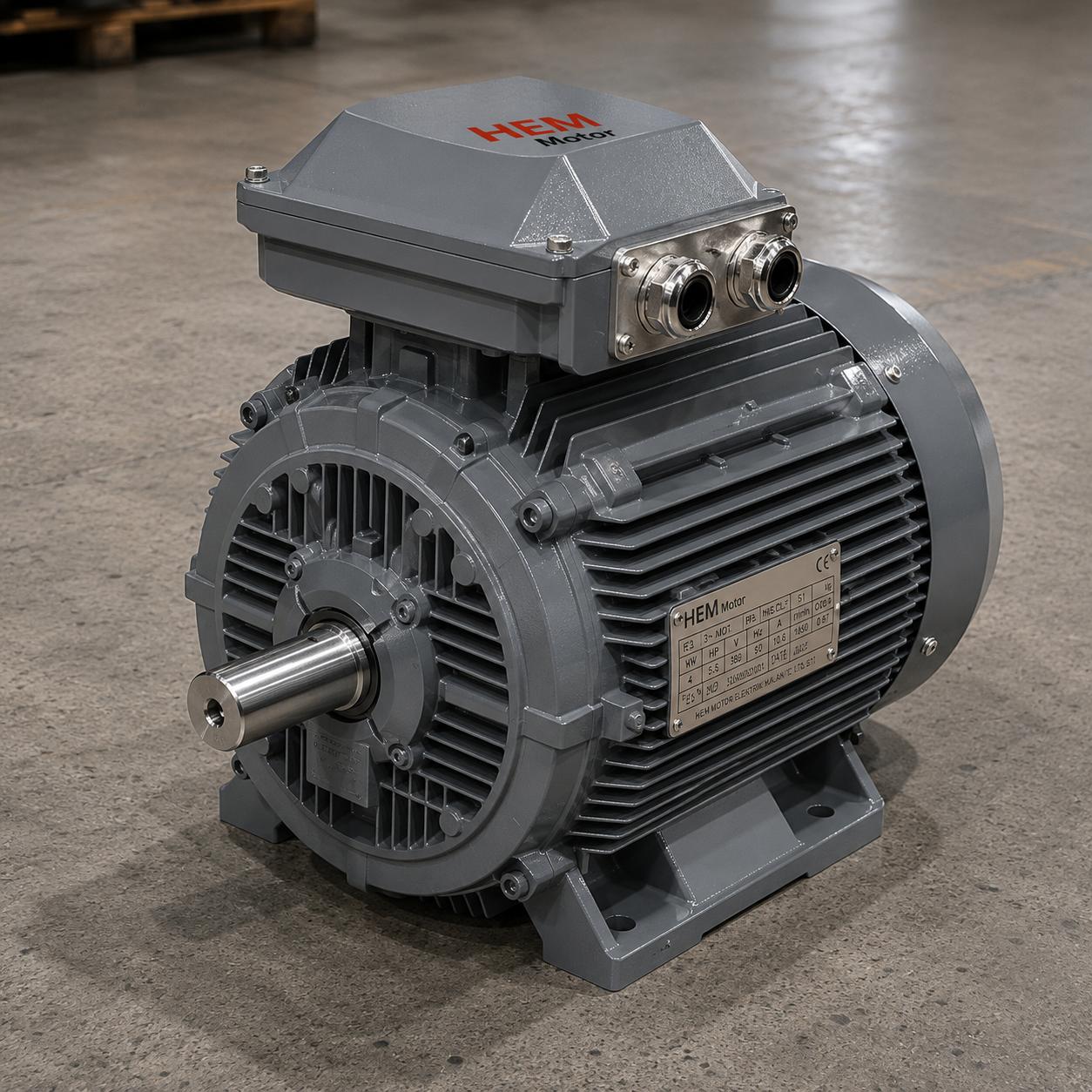
The efficiency of a production facility depends on the quietly turning electric motors having been chosen correctly. Behind every application, from pumps to compressors and from conveyors to fan systems, sits a motor calculated specifically for that task. For businesses looking to buy an electric motor, the most critical question is often not price, but whether the right motor can be supplied at the right time, without interruption. At HEM Motor, we answer that question clearly by combining the advantage of manufacturer stock supply with solid engineering support.
A poorly selected motor does not just mean wasted energy; it returns as overheating, premature failure, production downtime, and unexpected maintenance costs. For this reason, the purchasing process should be treated as a technical consultancy process. When the correct power, correct speed, correct mounting type, and correct protection class come together, the motor does not merely run; it serves efficiently and reliably for years.
In this guide, we explain in detail what to consider when buying an electric motor, the advantages of manufacturer stock supply, how to make the correct selection according to the application, and how to request a fast quotation. Our goal is to help you base your purchasing decision not on guesswork, but on sound engineering data.
Technical Information to Specify When Buying an Electric Motor
The first condition for receiving a fast and accurate quotation is defining your requirement correctly. The parameters that must be established before ordering a motor directly affect both the accuracy of the selection and the speed of the supply process. The more clearly the information below is specified, the shorter the quotation process becomes and the lower the risk of an incorrect shipment.
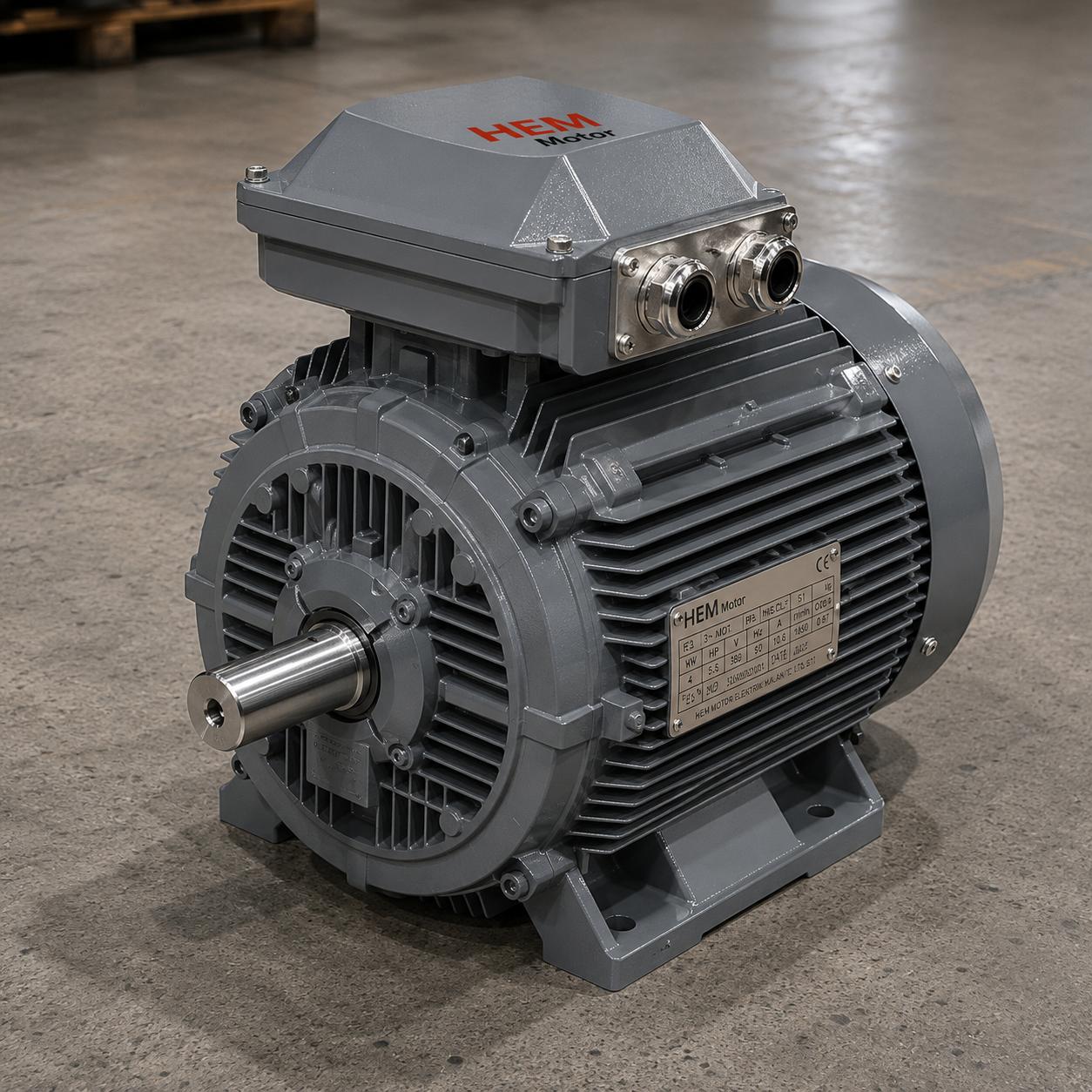
- Power (kW or HP): The rated power of the motor must be selected to meet the mechanical load required by the application. Insufficient power means the load will not lift, while excess power leads to unnecessary investment and low-efficiency operation.
- Pole count and speed (rpm): 2 poles give roughly 3000 rpm, 4 poles 1500 rpm, 6 poles 1000 rpm, and 8 poles around 750 rpm synchronous speed. Speed is vital in pump, fan, and conveyor selection.
- Voltage and frequency: Supply values such as 230/400 V or 400/690 V, at 50 Hz or 60 Hz, must be clearly specified. Determining whether a single-phase electric motor or a three-phase electric motor is required is the first step.
- Mounting type: Connection forms such as B3 (foot-mounted), B5 (flange-mounted), B14 (face-flange), and B35 (foot + flange) must be selected to suit your machine.
- Protection class (IP): IP55, IP56, or higher protection determines the motor's resistance to dust and water. It is a critical parameter for outdoor or humid environments.
- Insulation class and duty cycle: Class F insulation with Class B temperature rise is common. The duty cycle, such as S1 (continuous) or S3 (intermittent), also affects the selection.
- Special options: Use with a variable frequency drive, thermal protection (PTC/PT100), forced cooling fan, brake motor, special shaft diameter, and ATEX explosion-proof requirements should be stated in advance.
- Quantity and delivery time: The order quantity and required delivery date determine whether the motor ships from stock or is built to a planned production schedule.
If you do not know all of these parameters, do not worry. In most cases, sharing the type of application, the machine it will connect to, and the nameplate details of the existing motor is enough to make the correct selection. Our technical team completes any missing information with a few questions and identifies the most suitable model.
Advantages of Manufacturer Stock Supply
Buying an electric motor directly from a manufacturer that holds stock offers advantages that fundamentally change the purchasing process. Shortening the chain of intermediaries does not only mean cost savings; it is also decisive in terms of delivery speed, technical support, and after-sales assurance.
At a manufacturer that works with stock, motors in the most frequently requested power and speed ranges are kept ready. As a result, a facility facing an emergency shutdown can obtain a new motor in hours rather than days. While every minute a production line is stopped generates cost, fast shipment from ready stock is the strongest shield a business can have. Stock supply is the factor that makes the difference during unplanned failures.
Another advantage of buying from a manufacturer is direct access to engineering support. When you have a special requirement that falls outside the standard catalogue, you reach the technical team without dealing with intermediate layers and obtain the solution at its source. Professional guidance on correct electric motor selection reduces the risk of an incorrect order to nearly zero.
Fast Supply and Lead Time
Lead time is a dimension of the purchasing decision at least as important as price. For standard stock products, delivery is usually possible the same day or in a very short time, while for motors requiring special manufacturing, the timeline is shared clearly once the order is finalized. A transparent delivery schedule gives you confidence when planning your projects.
When a broad stock range covers different power ratings and mounting types, most needs can be met instantly. This is a critical advantage for facilities that carry out maintenance planning: you can quickly obtain your spare motor when needed, without tying up capital in a large stock investment. Fast electric motor supply capability directly protects production continuity.
Correct Motor Selection According to the Application
Every application has its own load characteristics, and the correct motor must be chosen to match those characteristics. Two motors of the same power can serve entirely different applications through their different speed and torque curves. Below are the most commonly encountered application areas and the logic behind their selection.
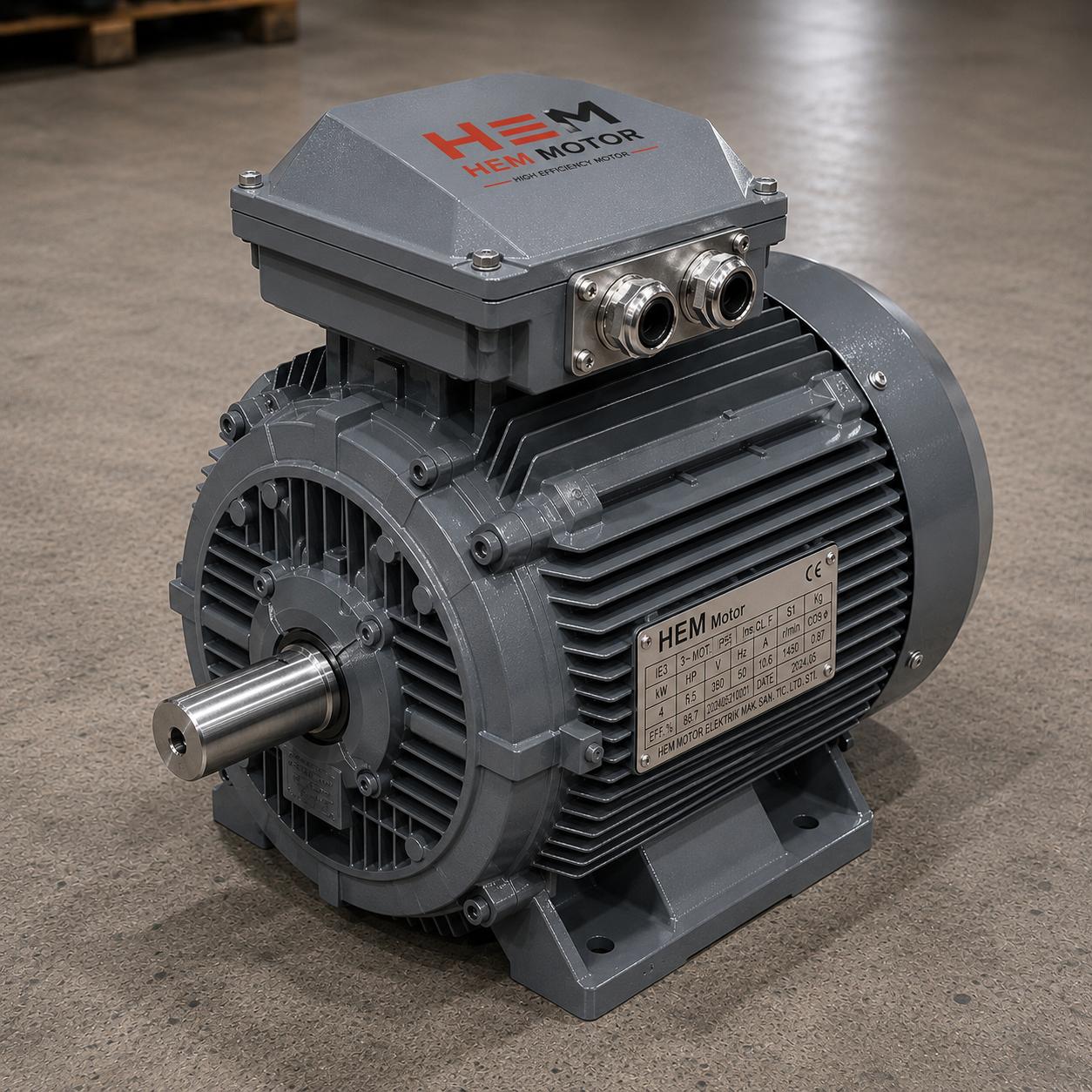
Pumps and Water Systems
In centrifugal pumps, 2- or 4-pole motors are generally preferred. Selecting the speed that suits the pump characteristic is the key to both flow rate and energy efficiency. In submersible and surface pumps, motors suited to a continuous duty cycle and with an appropriate protection class should be used. An incorrect speed choice can cause the pump to fail to perform or become overloaded.
Fans and Ventilation Systems
Fans have a load characteristic that increases rapidly with speed, so the motor's starting torque and cooling must be evaluated carefully. Low-speed, quiet-running fan motors are frequently preferred in ventilation systems. Speed control with a variable frequency drive provides a major advantage in both energy savings and process control.
Compressors
Compressor applications require high starting torque and durability. These systems use robust-bodied, high-protection-class motors, generally with 2 or 4 poles. In applications with frequent switching cycles, selecting the motor according to its duty cycle directly affects its service life.
Conveyors and Material Handling Systems
Conveyors generally use geared motor units; smooth starting under load and controlled speed are important. In these applications, options such as a brake motor, encoder, or variable frequency drive often come into play. The correct mounting type and shaft diameter are critical for compatibility with the gearbox.
Machine Tools and Machine Building
In machine tools and special machinery, compact size, precise speed control, and vibration-free operation come to the fore. In these applications, B5 or B14 flange-mounted motors are selected to be integrated directly into the machine. Servo- or inverter-compatible solutions are preferred in processes that require precise positioning.
IEC Standardization and Brand Flexibility
The vast majority of electric motors are manufactured to IEC standards. This standardization provides a very important flexibility in purchasing: motors with the same frame size, mounting type, and power values can be used interchangeably regardless of brand. Thanks to IEC 60072 dimensioning, when a motor fails it can be replaced with a suitable motor of the same IEC frame size without requiring mechanical modification.
This flexibility allows businesses to procure with the most favorable lead time and conditions without being tied to a single brand. When you share the IEC frame size and nameplate values of your existing motor, we can quickly identify a suitable replacement. Standardization is a powerful advantage that applies to both three-phase electric motor and single-phase electric motor groups.
Factors Affecting Cost in the Purchasing Process
The total cost of owning a motor is not limited to the purchase price alone. The energy efficiency class (IE2, IE3, IE4) often forms a larger item than the initial investment because of the electricity the motor will consume over the years. A high-efficiency motor, despite a slightly higher initial cost, pays for itself in a short time.
Ease of maintenance, spare part availability, and service access are also factors that affect total cost. When you choose a standard and widely available motor, it is both easy to stock as a spare and quick to procure in the future. A correctly selected motor saves you both energy and maintenance throughout its life.
To get information about current electric motor prices and to request a quotation tailored to your needs, you can contact our technical team. A quotation prepared with the right information helps you save both time and budget.
How to Request a Fast and Accurate Quotation
The most effective way to speed up the quotation process is to communicate your requirement details clearly from the start. When you prepare and send the information below, we can offer you an accurate quotation in the shortest possible time.
- Required power (kW/HP) and speed (rpm) or pole count
- Voltage, frequency, and phase information (single-phase/three-phase)
- Mounting type (B3, B5, B14, B35) and shaft diameter if required
- Protection class (IP) and efficiency class request (such as IE3/IE4)
- Application type (pump, fan, compressor, conveyor, machine tool, etc.)
- Special options (inverter compatibility, brake, thermal protection, explosion-proof)
- Order quantity and required delivery time
If you are replacing an existing motor with a new one, sharing a photo of the old motor's nameplate greatly speeds up the process. The power, speed, voltage, and frame information on the nameplate allows us to identify the correct equivalent within seconds. A fast quotation begins with the right information.
Frequently Asked Questions
What information should I prepare when buying an electric motor?
The most important information is power (kW), speed or pole count, voltage/frequency, phase type, mounting form (B3/B5/B14/B35), protection class (IP), and application type. If you are replacing an existing motor with a new one, sharing the nameplate details of the current motor is usually sufficient for a correct selection. Our team completes any missing technical details with a few questions and recommends the suitable model for you.
What is the advantage of manufacturer stock supply?
Buying from a manufacturer that works with stock provides a major speed advantage, especially for urgent needs. Because motors in the most frequently requested power and speed ranges are kept ready, facilities facing production downtime can procure quickly. In addition, direct access to the manufacturer's engineering team allows special requests to be resolved without intermediate layers and reduces the risk of incorrect orders.
Can motors from different brands be used interchangeably?
Yes. Because the vast majority of electric motors are manufactured to IEC standards, motors with the same frame size, mounting type, and power values can be used interchangeably regardless of brand. This standardization makes it possible, when you share the IEC frame size of your existing motor, to supply a suitable equivalent without requiring mechanical modification.
Choosing the right motor is a strategic decision that protects both your production continuity and your energy budget. When manufacturer stock supply, engineering support, and the flexibility provided by IEC standardization come together, the purchasing process becomes fast, secure, and economical. The more clearly you define your requirement, the more accurate the solution we offer will be. Contact us to procure the right motor at the right time.